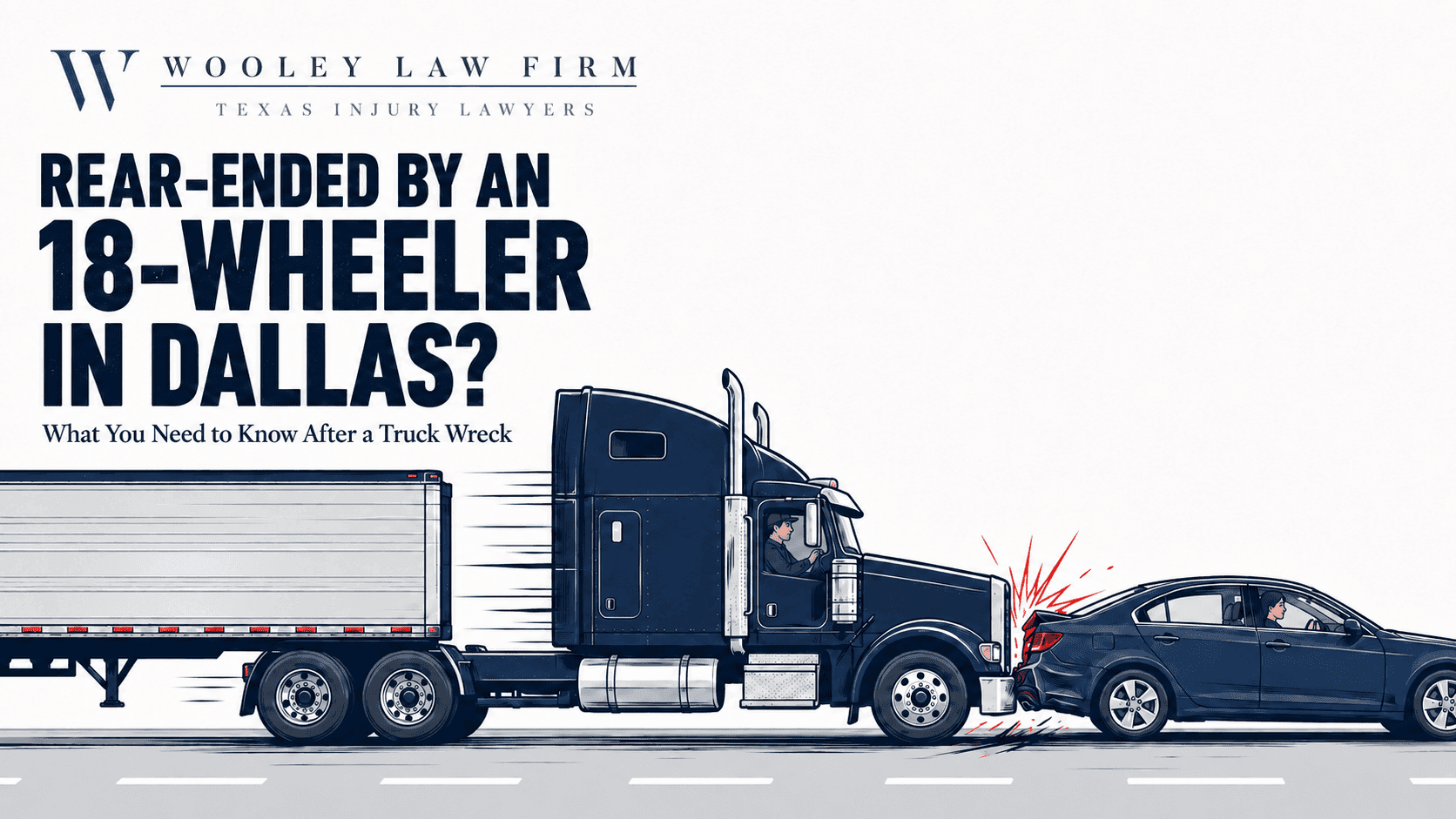
Being rear-ended by an 18-wheeler is not an ordinary fender-bender. A tractor-trailer can strike with enough force to crush the rear of a passenger vehicle, push it into another car or concrete barrier, cause it to roll over, or trap the occupants inside.
Many victims are hit while stopped at a red light, slowing for traffic, waiting in a construction zone, or traveling through congestion on highways such as I-35E, I-30, I-20, I-45, I-635, U.S. 75, or Loop 12.
After the crash, the trucking company may claim that traffic stopped suddenly, the passenger vehicle changed lanes, or the collision happened too slowly to cause serious injuries. Those claims should not be accepted without a complete investigation.
If you were rear-ended by an 18-wheeler in Dallas or anywhere in the Dallas-Fort Worth area, important evidence may include the truck’s black box data, onboard cameras, braking records, automatic emergency braking data, driver logs, cellphone activity, maintenance files, and dispatch communications.
The Wooley Law Firm represents people injured in serious tractor-trailer and commercial vehicle crashes. Learn more about how we investigate these cases on our Dallas truck accident lawyer practice page.
Why Rear-End 18-Wheeler Accidents Are So Dangerous
The rear of a passenger vehicle provides some protection through its trunk, rear structure, seatbacks, and head restraints. That protection may be overwhelmed when the striking vehicle is an 18-wheeler.
A rear-end tractor-trailer crash may:
Crush the trunk or rear seating area;
Push the vehicle into surrounding traffic;
Force the car beneath another truck;
Cause a secondary head-on or side-impact collision;
Propel the vehicle into a concrete barrier;
Cause the vehicle to roll over;
Trap occupants inside;
Injure rear-seat passengers; or
Cause catastrophic or fatal injuries.
A rear impact can also start a much larger collision. An 18-wheeler may strike one stopped vehicle and push it into several others. When that happens, determining responsibility requires looking at the entire sequence of impacts—not merely the vehicle that ultimately struck the injured person. Our article on who may be responsible when an 18-wheeler causes a chain-reaction crash in Dallas explains how these multi-vehicle truck wrecks should be investigated.
The danger is not limited to high-speed interstate crashes. A tractor-trailer’s size and weight can cause serious injuries even when the impact occurs in slower traffic. Our article about low-speed 18-wheeler wrecks in Dallas-Fort Worth explains why a crash should not be dismissed merely because the truck was traveling below highway speed.
Where Rear-End Truck Accidents Commonly Happen in Dallas
Rear-end 18-wheeler accidents frequently occur where traffic slows, merges, stops, or changes unexpectedly.
Common locations include:
Congested interstate highways;
Red lights and stop signs;
Highway entrance and exit ramps;
Construction zones;
Toll plazas;
Railroad crossings;
School zones;
Warehouse and distribution districts;
Commercial driveways;
Traffic backups;
Disabled-vehicle scenes; and
Crash scenes involving police or emergency vehicles.
Dallas-area highways carry significant commercial traffic. Congestion, construction, short entrance ramps, changing lane patterns, and sudden slowdowns can increase the need for truck drivers to maintain a safe following distance and remain alert.
Common Causes of Rear-End 18-Wheeler Accidents
A rear-end truck crash is often preventable. A proper investigation should determine why the driver failed to slow or stop before impact.
Following Too Closely
An 18-wheeler requires more distance to slow than a passenger car. The necessary distance can increase when the truck is heavily loaded, traveling downhill, operating on wet pavement, or experiencing brake or tire problems.
A driver following too closely may have no safe response when traffic slows.
Tailgating may be encouraged by:
Unrealistic delivery schedules;
Driver impatience;
Congested traffic;
Aggressive driving;
Inadequate training;
Failure to account for cargo weight; or
A company culture that rewards speed over safety.
Black box data, dashcam footage, and witness testimony may help establish the distance between the vehicles before impact.
Distracted Driving
A commercial driver who looks away from the roadway for only a few seconds may fail to notice stopped traffic.
Potential distractions include:
Text messages;
Phone calls;
GPS systems;
Dispatch screens;
Electronic logging devices;
Paperwork;
Food and drinks;
In-cab controls; and
Objects inside the tractor.
Cellphone records, application data, dispatch communications, driver-facing video, and forward-facing camera footage may show what the driver was doing before the wreck.
Driver Fatigue
Fatigue can reduce attention, slow reaction time, impair judgment, and cause a driver to overlook obvious traffic conditions.
A tired truck driver may:
Fail to notice brake lights;
Drift between lanes;
React too slowly to congestion;
Misjudge stopping distance;
Brake too late; or
Fall asleep behind the wheel.
Federal motor-carrier rules regulate commercial vehicle operation, driver management, dispatching, and safety responsibilities. The regulations also prohibit operation by an ill or fatigued driver when the condition makes driving unsafe.
Relevant fatigue evidence may include:
Electronic logging device records;
Driver logs;
Fuel receipts;
Toll records;
GPS data;
Delivery times;
Bills of lading;
Hotel receipts;
Dispatch messages; and
Payroll records.
Excessive Speed
A speeding 18-wheeler may be unable to stop safely when traffic slows.
The posted speed limit does not always determine whether a truck was traveling safely. A driver may need to reduce speed because of congestion, rain, construction, limited visibility, cargo weight, road grade, or other hazards.
Federal regulations require commercial drivers to exercise extreme caution and reduce speed when weather conditions such as rain, fog, ice, dust, or smoke affect visibility or traction.
Failing to Anticipate Traffic
Professional drivers should continually scan the roadway ahead rather than watching only the vehicle immediately in front of them.
A truck driver may cause a rear-end crash by failing to anticipate:
A line of stopped traffic;
A red light;
Construction congestion;
A lane closure;
A disabled vehicle;
An earlier collision;
A school bus stop;
A railroad crossing; or
Traffic slowing near an entrance ramp.
Forward-facing video may show whether the hazard was visible long before the driver began braking.
Brake Failure or Poor Brake Maintenance
A truck driver may claim the brakes failed. That explanation raises additional questions rather than ending the investigation.
Investigators should determine:
When the brakes were last inspected;
Whether repairs were recommended;
Whether defects were reported;
Whether the brakes were properly adjusted;
Whether the tractor and trailer brakes worked together;
Whether worn parts were replaced;
Whether the company deferred repairs; and
Whether a maintenance contractor performed defective work.
Federal regulations require motor carriers to systematically inspect, repair, and maintain vehicles under their control, and parts and accessories must remain in safe operating condition. Commercial vehicles are also subject to periodic inspection requirements.
Inspection reports, repair invoices, brake measurements, driver inspection reports, and the physical brake components may be critical evidence.
A claim of brake failure can also expand the number of potentially responsible parties. Depending on the evidence, responsibility may extend beyond the truck driver to the motor carrier, trailer owner, maintenance company, repair facility, or component manufacturer. Learn more about brake failure after a rear-end 18-wheeler accident in Dallas and who may be responsible.
Worn or Defective Tires
Unsafe tires can increase stopping distance and reduce traction.
Tire-related causes may include:
Insufficient tread;
Underinflation;
Overinflation;
Uneven wear;
Mismatched tires;
Overloaded axles;
Defective tires; or
Failure to replace damaged tires.
The tractor, trailer, and tires should be preserved when mechanical failure may have contributed to the wreck.
Unsafe Driving in Rain or Poor Weather
Rain is common in North Texas and can make highway traffic especially dangerous. Wet pavement reduces traction, increases stopping distance, and makes sudden braking more difficult.
Bad weather does not automatically excuse a truck driver. Federal regulations require reduced speed and extreme caution when weather affects visibility or traction. If conditions become sufficiently dangerous, operation must be discontinued until the vehicle can be operated safely.
Improperly Loaded or Overweight Cargo
Cargo affects how quickly an 18-wheeler can stop.
A truck may become more difficult to control when cargo is:
Overweight;
Improperly distributed;
Loaded too far forward;
Unsecured;
Shifting inside the trailer; or
Inconsistent with the truck’s operating limits.
The trucking company, shipper, warehouse, loading contractor, or another company may share responsibility if unsafe cargo practices contributed to the collision.
Inadequate Driver Training
A trucking company may be responsible for placing an inexperienced or unqualified driver behind the wheel.
Training should address:
Following distance;
Hazard recognition;
Defensive driving;
Emergency braking;
Distracted driving;
Fatigue;
Wet-weather operation;
Cargo effects;
Brake systems; and
Urban highway congestion.
The driver’s qualification file, road-test results, training records, prior violations, previous crashes, employment history, and disciplinary records may reveal whether the driver was properly prepared.
Drug or Alcohol Impairment
Alcohol, illegal drugs, certain prescription medications, and other impairing substances can affect reaction time and judgment.
Post-crash testing records, medical records, witness observations, video, and the driver’s employment history may become relevant when impairment is suspected.
Rear-Ended While Stopped in Dallas Traffic
Many serious Dallas rear-end truck wrecks happen when the passenger vehicle is completely stopped.
Examples include being stopped:
At a red light;
At a stop sign;
In highway congestion;
Behind a school bus;
At a railroad crossing;
In a construction zone;
For emergency vehicles;
Because of an earlier crash; or
Behind a disabled vehicle.
A person sitting at a red light or waiting in a highway backup may have little or no opportunity to escape when an 18-wheeler approaches from behind.
If you were stationary when the collision occurred, read our more detailed guide about what may matter when you are rear-ended by an 18-wheeler while stopped in Dallas traffic.
The trucking company may argue that traffic stopped suddenly. But that statement does not answer why the tractor-trailer failed to stop.
The investigation should determine:
How far behind traffic the truck was traveling;
How fast the truck was moving;
When stopped traffic first became visible;
When the driver released the accelerator;
When the driver first applied the brakes;
Whether the driver received a forward-collision warning;
Whether automatic emergency braking activated;
Whether the driver was distracted;
Whether the truck had mechanical problems; and
Whether the driver was traveling too fast for existing traffic conditions.
When a truck driver says the vehicle ahead “stopped suddenly,” electronic data and video may tell a very different story. Our article addressing who may be at fault when a truck driver claims you stopped suddenly explains the evidence that can be used to test that defense.
Evidence showing how long traffic had been stopped may include:
Dashcam footage;
Traffic cameras;
Surveillance video;
Brake-light activation;
Witness statements;
911 calls;
GPS data;
Photographs; and
Data from other vehicles.
Injured in an Accident?
Free consultation. Tell us what happened and learn what options may be available.
Rear-Ended After Changing Lanes
The trucking company may claim that the passenger vehicle suddenly changed lanes in front of the truck.
Sometimes that claim is supported by evidence. In other cases, it is an attempt to shift blame before the truck’s data and video have been reviewed.
The investigation should examine:
How long the passenger vehicle was in the lane;
Whether the lane change was complete;
Whether a turn signal was used;
The truck’s following distance;
The truck’s speed;
When the driver began braking;
Whether the truck accelerated;
Whether the driver was distracted; and
What the onboard cameras recorded.
Forward-facing camera footage and electronic truck data can be especially important when the parties disagree about how long the passenger vehicle occupied the lane.
Rear-End Crashes Involving Stopped 18-Wheelers
Not every rear-end truck crash involves an 18-wheeler striking a passenger vehicle. A motorist may crash into the back of a tractor-trailer that is stopped or partially blocking the roadway.
A truck may create a dangerous hazard when it is stopped:
In a travel lane;
On a narrow shoulder;
Around a curve;
Near the crest of a hill;
Without hazard lights;
Without reflective triangles;
At night without adequate lighting; or
With part of the trailer extending into traffic.
Federal regulations generally require stopped commercial vehicles to activate warning flashers and place warning devices within specified time and distance requirements when stopped on a traveled roadway or shoulder for reasons other than necessary traffic stops.
Read more about truck safety and similar issues in our truck accident articles.
Common Injuries After Being Rear-Ended by an 18-Wheeler
Rear-end truck wrecks can cause injuries throughout the body.
Common injuries include:
Traumatic brain injuries;
Concussions;
Head injuries;
Facial injuries;
Whiplash;
Cervical disc injuries;
Neck strains and sprains;
Herniated discs;
Back injuries;
Spinal cord injuries;
Shoulder injuries;
Collarbone fractures;
Broken ribs;
Chest injuries;
Arm and wrist fractures;
Hip injuries;
Knee injuries;
Leg and ankle fractures;
Internal bleeding;
Organ damage;
Crush injuries;
Burns;
Amputations;
Post-traumatic stress;
Anxiety while driving; and
Wrongful death.
A person does not have to strike their head or lose consciousness to suffer a concussion or traumatic brain injury.
Symptoms that should be reported to a medical provider include:
Headaches;
Dizziness;
Confusion;
Memory problems;
Nausea;
Light sensitivity;
Neck pain;
Back pain;
Numbness;
Tingling;
Weakness;
Chest pain;
Abdominal pain; and
Difficulty sleeping.
Symptoms may appear or worsen after the crash. Prompt medical care protects the victim’s health and creates documentation of the injuries.
The Insurance Company May Call It a “Minor” Accident
Truck insurers sometimes focus on the appearance of the passenger vehicle rather than the forces involved or the victim’s medical condition.
They may argue that:
The impact occurred at low speed;
The vehicle has limited visible damage;
The airbags did not deploy;
The victim did not leave by ambulance;
Medical treatment did not begin immediately;
The injuries were preexisting; or
The symptoms should have resolved quickly.
Vehicle damage does not determine whether a person was injured. The issue should be evaluated through medical evidence, vehicle dynamics, occupant movement, crash data, photographs, and the person’s condition before and after the wreck.
Our post about low-speed 18-wheeler wrecks explains why an apparently modest collision can still produce serious injuries.
Who May Be Responsible for a Rear-End Truck Accident?
A rear-end truck wreck may involve several responsible parties.
The Truck Driver
The driver may be liable for:
Following too closely;
Speeding;
Distracted driving;
Fatigued driving;
Failing to watch traffic;
Braking too late;
Driving too fast for weather conditions;
Failing to inspect the truck; or
Operating with known defects.
The Trucking Company
The motor carrier may be responsible for the driver’s conduct and for its own negligent practices, including:
Negligent hiring;
Inadequate training;
Negligent supervision;
Retaining an unsafe driver;
Pressuring drivers to meet unsafe schedules;
Failing to monitor driver hours;
Ignoring prior violations;
Failing to maintain the truck; or
Allowing unsafe equipment to remain in service.
Federal commercial-vehicle rules apply not only to drivers but also to motor carriers and personnel responsible for management, maintenance, hiring, supervision, training, assignment, and dispatch.
The Trailer Owner
The tractor and trailer may be owned by different companies. The trailer owner may be responsible for defective brakes, lights, tires, or other equipment.
A Maintenance or Repair Company
A third-party contractor may be responsible when negligent inspection or repair work contributed to the collision.
A Cargo-Loading Company or Shipper
A company that overloaded or improperly distributed the cargo may share responsibility if the load increased stopping distance or interfered with safe braking.
A Freight Broker or Logistics Company
Depending on its conduct and control, a broker or logistics company may become relevant if it selected an unsafe carrier or participated in unsafe scheduling or transportation decisions.
A Truck or Component Manufacturer
A manufacturer may be responsible when defective brakes, tires, steering components, warning systems, or other equipment contributed to the wreck.
Evidence That Matters After a Rear-End 18-Wheeler Accident
A rear-end truck case should not be investigated like an ordinary car accident.
Important evidence may include:
Electronic control module data;
Event data recorder information;
Truck speed data;
Brake-application data;
Automatic emergency braking data;
Forward-collision warning information;
Throttle-position data;
Engine data;
Forward-facing camera footage;
Driver-facing camera footage;
Electronic logging device records;
GPS and telematics information;
Cellphone records;
Text messages;
Dispatch communications;
Driver qualification files;
Training records;
Hours-of-service records;
Maintenance and repair files;
Brake inspection records;
Tire records;
Pre-trip and post-trip inspection reports;
Cargo records;
Weight tickets;
Bills of lading;
Drug and alcohol testing records;
Crash-scene photographs;
Dashcam footage;
Traffic-camera footage;
Business surveillance video;
911 calls;
Police body-camera footage;
Witness statements;
Skid marks;
Debris;
Vehicle damage; and
The tractor and trailer.
Read our guide to 18-wheeler black box data after a Dallas-Fort Worth truck wreck for more information about the electronic evidence that may help establish speed, braking, and vehicle operation.
Our article about the evidence that matters most in Texas 18-wheeler cases also explains the importance of driver logs, qualification files, company policies, maintenance records, and scene evidence.
Why the Truck’s Black Box Matters
The term “black box” may refer to one or more electronic systems capable of recording information about the truck’s operation.
Depending on the vehicle and system, the available data may include:
Speed;
Engine RPM;
Throttle use;
Brake application;
Cruise-control status;
Fault codes;
Sudden deceleration; and
Other operational information.
In a rear-end crash, that evidence may help answer:
How fast was the truck traveling?
When did the driver begin braking?
Did the driver brake at all?
Was cruise control active?
Did the truck slow before impact?
Were there mechanical fault codes?
Was the driver accelerating before the crash?
Electronic data may be overwritten through continued operation. That is one reason the tractor should be identified and preservation demands should be sent promptly.
Automatic Emergency Braking Data May Show What Happened Before Impact
Some commercial trucks contain advanced collision-avoidance technology that can provide another layer of electronic evidence.
Depending on the truck and installed system, forward-collision warning or automatic emergency braking technology may record or generate information about:
Detection of a vehicle or obstacle ahead;
Forward-collision warnings;
The timing of a warning;
Driver brake application;
Automatic brake activation;
Truck speed;
System status; and
Potential fault codes.
This information can become particularly important when the truck driver claims traffic appeared without warning or stopped too quickly for the driver to respond.
For example, if the truck’s collision-avoidance system recognized stopped traffic before impact, investigators may be able to compare that information with the driver’s reaction, braking, camera footage, and other electronic records.
Learn more about how automatic emergency braking data may help prove what happened in a truck wreck.
AEB data should not be evaluated in isolation. It may need to be synchronized with black box information, GPS records, forward-facing video, driver-facing video, physical evidence, and witness accounts to reconstruct the seconds before the collision.
Why Onboard Camera Footage Matters
Many commercial trucks have forward-facing or driver-facing cameras.
Forward-facing video may show:
Traffic congestion;
Brake lights;
Construction warnings;
The passenger vehicle’s lane position;
How long traffic was stopped;
Following distance;
Weather conditions; and
The driver’s opportunity to react.
Driver-facing video may show:
Cellphone use;
Drowsiness;
Eating;
Looking away from the roadway;
Reaching for objects; or
Failure to monitor traffic.
Camera systems may overwrite footage after a limited period. The trucking company and camera provider should be notified to preserve it.
What Should You Do After Being Rear-Ended by an 18-Wheeler?
Your health and safety should come first.
When possible:
Call 911.
Request emergency medical assistance.
Photograph the vehicles and crash scene.
Photograph the rear of your vehicle and the front of the truck.
Record the tractor number, trailer number, license plate, company name, and USDOT number.
Identify witnesses.
Preserve dashcam footage.
Seek medical treatment.
Report every symptom to your medical providers.
Follow treatment recommendations.
Keep records of bills, lost wages, mileage, and other expenses.
Avoid giving a recorded statement to the trucking company’s insurer before obtaining legal advice.
Contact a Dallas rear-end truck accident lawyer before important truck evidence is lost or overwritten.
Do not assume that the company name printed on the tractor identifies every responsible business. The tractor, trailer, cargo, driver, maintenance, and dispatch operations may involve different companies.
What Compensation May Be Available?
A person injured because of another party’s negligence may be entitled to pursue compensation for:
Ambulance expenses;
Emergency room care;
Hospital bills;
Surgery;
Rehabilitation;
Physical therapy;
Prescription medications;
Past medical expenses;
Future medical expenses;
Lost wages;
Reduced earning capacity;
Property damage;
Rental car expenses;
Physical pain;
Mental anguish;
Physical impairment;
Disfigurement; and
Other crash-related losses.
When a rear-end truck crash causes a death, eligible family members may have wrongful-death claims. The estate may also have a survival claim.
The value of a claim depends on the injuries, available insurance, treatment, future limitations, lost income, liability evidence, and the impact of the wreck on the victim’s life.
How a Dallas Rear-End Truck Accident Lawyer Can Help
A serious tractor-trailer case requires more than obtaining the police report and sending medical bills to an adjuster.
A Dallas truck wreck lawyer can:
Investigate the scene;
Identify the motor carrier and related companies;
Send preservation notices;
Obtain black box data;
Investigate automatic emergency braking and collision-warning data;
Preserve onboard video;
Review driver logs;
Analyze cellphone and dispatch records;
Investigate the driver’s qualifications;
Review maintenance and brake records;
Inspect the tractor and trailer;
Locate witnesses;
Obtain surveillance footage;
Work with accident-reconstruction experts;
Identify insurance coverage;
Document past and future damages;
File suit when necessary; and
Prepare the case for trial.
Trucking companies and their insurance carriers may begin investigating immediately. Our article explaining why evidence disappears quickly after a truck accident discusses the importance of early preservation efforts.
Contact a Dallas Rear-End 18-Wheeler Accident Lawyer
Being rear-ended by an 18-wheeler can leave you facing pain, surgery, lost income, vehicle damage, and uncertainty about the future.
The trucking company may already have insurance adjusters, investigators, and defense attorneys working to protect its interests. An injured person should have the opportunity to investigate the evidence from their side as well.
The Wooley Law Firm represents people injured in rear-end tractor-trailer crashes, semi-truck accidents, delivery truck wrecks, and other commercial vehicle collisions throughout Dallas and North Texas.
Visit our Dallas truck accident lawyer page or our main 18-wheeler wreck practice page to learn more.
Call or text The Wooley Law Firm at 214-699-6524 or contact us through our website for a free consultation.
You do not pay attorney’s fees unless we recover compensation for you.
Frequently Asked Questions About Rear-End 18-Wheeler Accidents
Is the truck driver automatically responsible for a rear-end collision?
Not automatically. Liability depends on the circumstances of the collision, including following distance, speed, braking, lane position, mechanical condition, video, electronic data, and the conduct of all involved drivers.
What if the trucking company says I stopped suddenly?
A claim that you “stopped suddenly” should be investigated rather than simply accepted.
Evidence may show when traffic became visible, how long vehicles were stopped, how closely the truck was following, the truck’s speed, when the driver began braking, and whether a collision-warning or automatic braking system detected the danger.
Read more about the “you stopped suddenly” defense after a Dallas truck wreck.
What if I was completely stopped when the 18-wheeler hit me?
Being stopped for a red light, congestion, road construction, an earlier accident, or another legitimate traffic condition can be important evidence.
The investigation should determine why the approaching commercial driver failed to recognize and react to the stopped traffic. Dashcam video, onboard truck cameras, electronic braking information, black box data, and witnesses may help establish what happened.
What if the 18-wheeler pushed my vehicle into another car?
A second collision does not necessarily mean you caused it. If the force from an 18-wheeler pushed your stopped vehicle into another vehicle, investigators should reconstruct the entire crash sequence and determine what caused the first impact.
Multiple drivers, trucking companies, and insurance carriers can become involved in these cases.
What if I changed lanes before the truck hit me?
A lane change does not automatically make you responsible. The investigation should determine when the lane change occurred, how long you were established in the lane, the truck’s speed and following distance, and when the driver began braking.
Can a low-speed rear-end truck crash cause serious injuries?
Yes. The size and weight of a commercial truck can create substantial forces even at lower speeds. The severity of an injury should be evaluated medically rather than based only on visible vehicle damage.
What if the truck’s brakes failed?
Brake failure does not necessarily eliminate responsibility. Instead, it may raise questions about inspections, maintenance, prior defects, repairs, brake adjustment, and whether the tractor or trailer should have been operating.
Depending on the evidence, potential responsible parties could include the motor carrier, maintenance company, trailer owner, repair facility, or component manufacturer.
Can automatic emergency braking data help prove my truck wreck claim?
Potentially. Depending on the truck and installed technology, electronic information may help show whether the truck detected traffic ahead, issued a forward-collision warning, automatically applied its brakes, or recorded system faults.
That evidence should generally be compared with black box information, cameras, GPS records, physical evidence, and other crash data.
Should I give the trucking insurer a recorded statement?
Use caution. The adjuster represents the insurance company, not you. A statement may later be used to dispute liability, minimize your symptoms, or argue that you contributed to the wreck.
How quickly should I contact a lawyer?
As soon as reasonably possible after a serious truck collision. Video may be overwritten, electronic data may be lost, the truck may be repaired or returned to service, and witnesses may become harder to locate.
How long do I have to file a Texas truck accident lawsuit?
Texas generally has a two-year limitations period for many personal-injury claims, but exceptions and different deadlines can apply depending on the circumstances. Evidence can disappear well before any lawsuit deadline, so an injured person should not rely on the limitations period as a reason to delay investigating the wreck.
This article is for general informational purposes only and is not legal advice. Reading it does not create an attorney-client relationship. Every case is different.
Topics
Share This Article

Andrew J. Wooley
Personal Injury Attorney
Andrew J. Wooley is a dedicated personal injury attorney based in Dallas, Texas. He focuses on helping accident victims recover fair compensation for their injuries. With a commitment to personalized service, Andrew works directly with each client to understand their unique situation and fight for their rights.