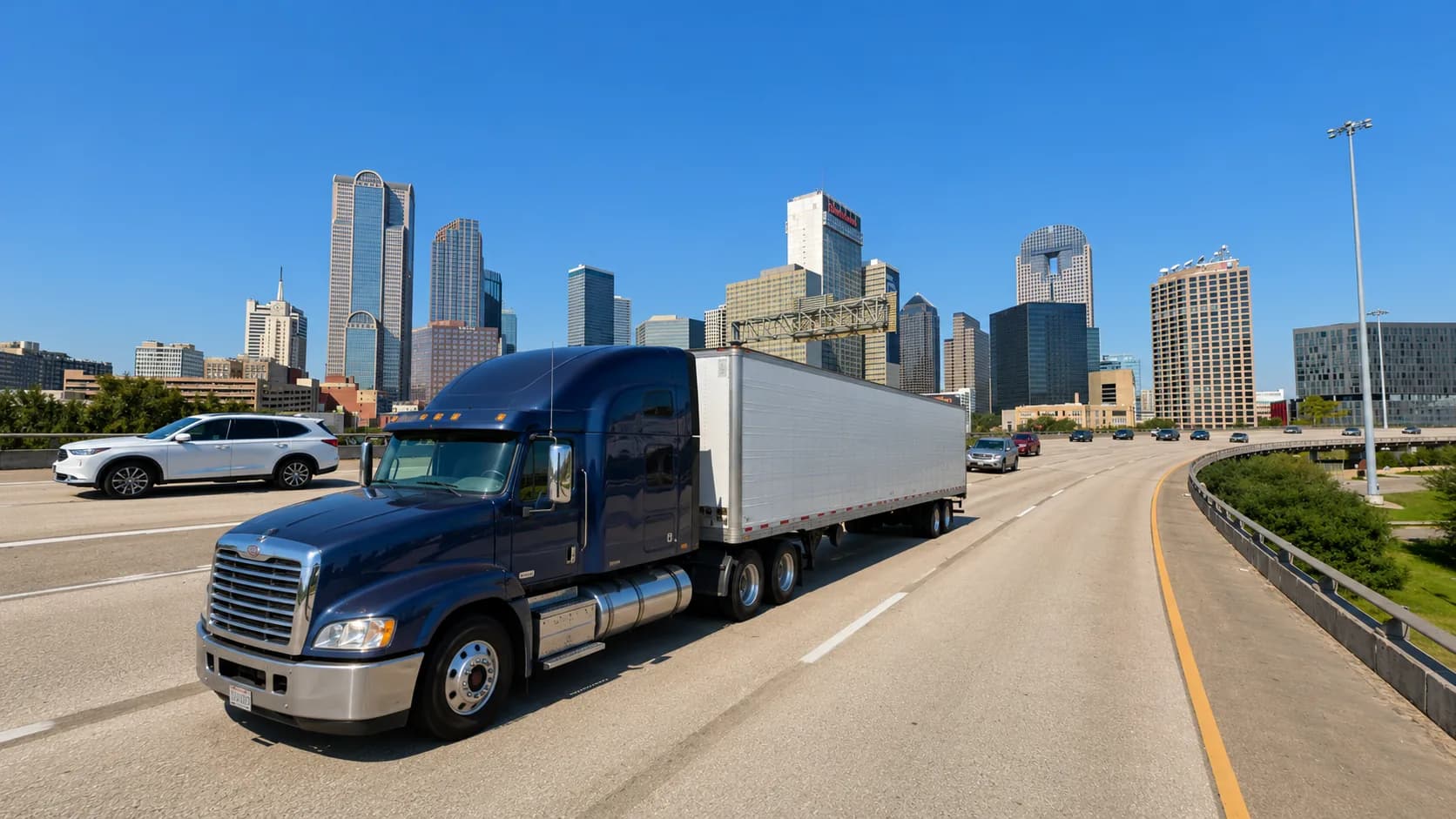
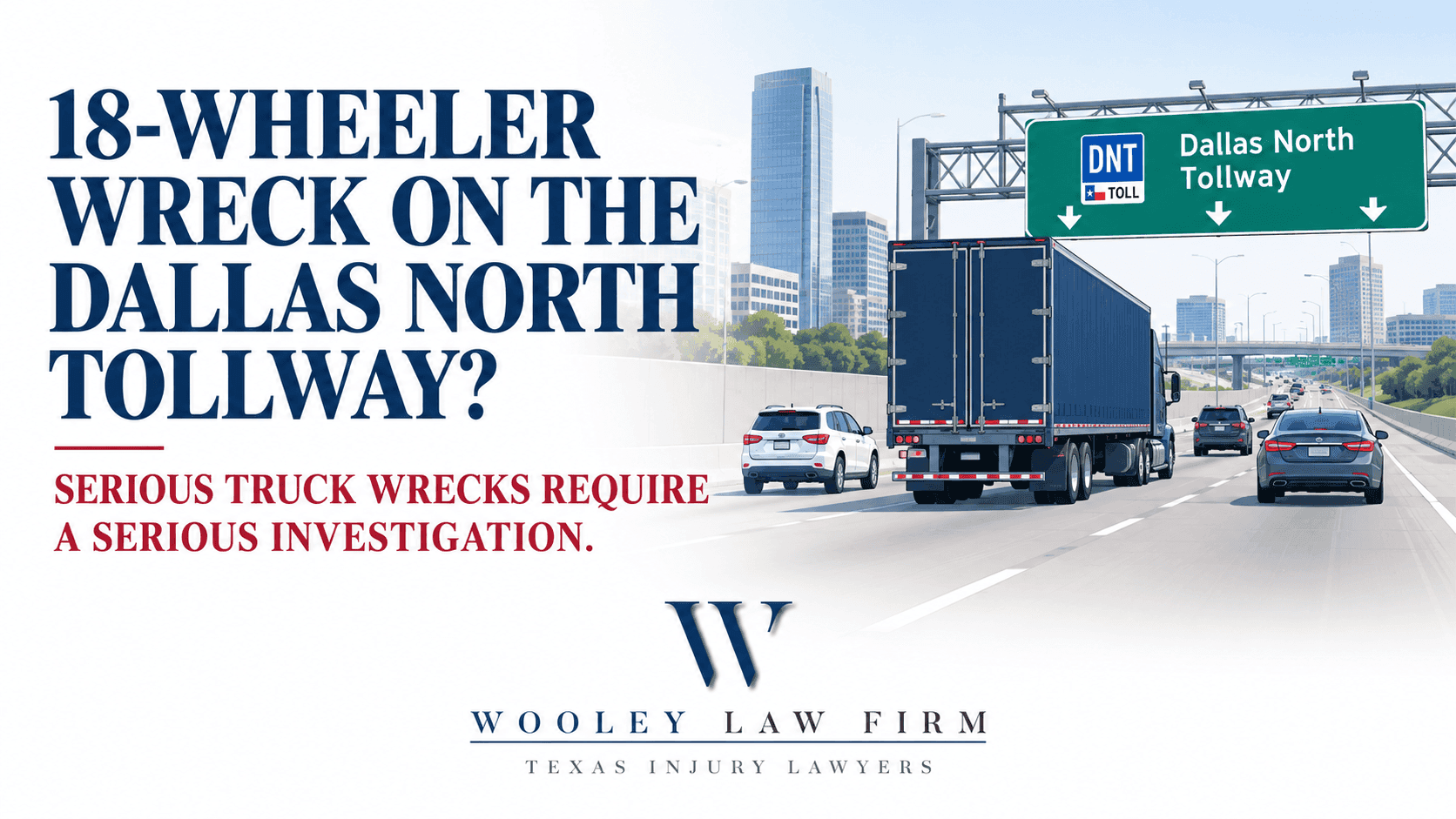
A crash with an 18-wheeler, tractor-trailer, delivery truck, dump truck, or other commercial motor vehicle can change your life in seconds. Large commercial trucks are much bigger and heavier than passenger vehicles. Many of these vehicles weigh up to 80,000 lbs. Victims often suffer serious injuries, expensive medical bills, missed work, and long-term uncertainty about their future.
If you were hurt in a truck accident in Dallas, Texas, you may already be receiving calls from the trucking company's insurance carrier. The adjuster may ask for a recorded statement, offer a quick settlement, or try to blame you before the full investigation is complete. Before you speak with the insurance company, talk to a Dallas 18-wheeler accident lawyer who understands how serious truck wreck claims are handled.
At The Wooley Law Firm, Andrew J. Wooley represents injured Texans after serious commercial truck accidents. His background includes experience in personal injury law and work within the insurance industry for large corporations. That insight helps him understand how insurance companies evaluate injury claims, defend trucking companies, and look for ways to reduce what victims are paid.
Call (214) 699-6524 for a free consultation. You don't pay unless we win.
Dallas Truck Accidents Are a Serious Local Risk
Dallas is a major commercial traffic center in North Texas, located near some of the busiest highway, freight, business, medical, construction, and distribution corridors in the state. Because of its size and central role in the Dallas-Fort Worth region, local drivers regularly share the road with 18-wheelers, delivery trucks, construction vehicles, dump trucks, box trucks, service vehicles, and other commercial motor vehicles.
Truck traffic is especially common on and around:
Interstate 35E
Interstate 30
Interstate 45
Interstate 20
Interstate 635
U.S. Highway 75 / Central Expressway
U.S. Highway 67
Loop 12
State Highway 114
State Highway 183
Dallas North Tollway
Woodall Rodgers Freeway
Stemmons Freeway
Lyndon B. Johnson Freeway
Harry Hines Boulevard
Buckner Boulevard
Northwest Highway
Garland Road
Jefferson Boulevard
Commerce Street
Industrial Boulevard
Dallas's location makes it a regular route for freight, delivery, construction, warehouse, medical, retail, restaurant, hotel, office, and service vehicles moving throughout Dallas County and the broader DFW area. Trucks traveling through Dallas may be headed to distribution centers, loading docks, construction sites, hospitals, office towers, restaurants, retail centers, apartment developments, industrial properties, or other commercial destinations throughout North Texas.
When truck drivers, trucking companies, cargo loaders, maintenance providers, or other commercial operators cut corners, innocent people can suffer the consequences. A careless decision involving an 18-wheeler or commercial vehicle can lead to a serious crash, catastrophic injuries, and long-term financial hardship for victims and their families.
2025 Dallas Commercial Motor Vehicle Crash Data
Commercial motor vehicle crashes are not rare in Dallas. According to TxDOT C.R.I.S. Query data, there were 2,484 crashes involving commercial motor vehicles in Dallas, Texas in 2025, resulting in 1,073 injuries including 22 fatalities.
The data showed that Dallas truck wrecks occurred on major routes including:
Interstate 35 East332
Interstate 30299
Interstate 20298
Interstate 635178
Interstate Loop 12117
Interstate 4598
State Highway Spur 366 / Woodall Rodgers Freeway68
Dallas North Tollway66
US Highway 75 / Central Expressway58
Interstate 34544
US Highway 17533
Bonnie View Road24
Elm Street17
Illinois Avenue17
Harry Hines Boulevard16
Inwood Road16
State Highway 183 / Airport Freeway15
State Highway 31014
Mockingbird Lane14
Hampton Road14
Royal Lane13
US Highway 67 / Marvin D. Love Freeway13
Haskell Avenue13
State Highway 289 / Preston Road12
Singleton Boulevard11
Westmoreland Road11
Commerce Street10
Ferguson Road10
Forest Lane10
Lemmon Avenue10
State Highway Spur 408 / Patriot Parkway10
Other major Dallas roadways with multiple commercial motor vehicle crashes included Walnut Hill Lane, Skillman Street, Botham Jean Boulevard, Martin Luther King Jr. Boulevard, Elsie Faye Heggins Street, Cedar Springs Road, and Jefferson Boulevard. The data further showed that 127 Dallas commercial motor vehicle crashes occurred in construction zone areas, with workers present in 66 of those crashes. Four Dallas commercial motor vehicle crashes occurred in active school zones. These numbers matter because many commercial trucks and trailers can weigh up to 80,000 pounds. When a vehicle that large hits a passenger car, pickup, motorcycle, or SUV, the injuries can be devastating.
Common Causes of 18-Wheeler Accidents in Dallas
Truck accident cases are often more complex than ordinary car wreck claims. A serious crash may involve a careless driver, an unsafe trucking company, improper cargo loading, poor maintenance, or multiple responsible parties. Common causes of Dallas 18-wheeler and commercial vehicle accidents include:
Unsafe Lane Changes
Unsafe lane change was the most common contributing factor in Dallas truck crashes in 2025. Truck drivers must check blind spots, signal properly, and make sure lanes are clear before moving over. An unsafe lane change by a tractor-trailer is especially dangerous in Dallas because large commercial trucks have significant blind spots, wide turning paths, and long trailers that can move into nearby lanes before a truck driver realizes another vehicle is there. On busy Dallas roadways such as I-35E, I-30, I-45, I-20, I-635, U.S. 75, Loop 12, Dallas North Tollway, Harry Hines Boulevard, Northwest Highway, Buckner Boulevard, and Industrial Boulevard, traffic conditions can change quickly.
When a truck driver changes lanes without checking blind spots, signaling properly, allowing enough space, or accounting for surrounding traffic, the result can be a sideswipe collision, underride crash, rollover, jackknife, or multi-vehicle wreck. Unsafe lane changes may also force smaller vehicles off the road, into barriers, or into the path of other traffic. In a Dallas commercial motor vehicle accident case, an unsafe lane change may point to driver distraction, speeding, fatigue, poor training, aggressive driving, or a failure by the trucking company to enforce safe driving practices.
Failure to Control Speed or Unsafe Speed
Failure to control speed or unsafe speed was the second most common contributing factor in Dallas truck crashes. Large trucks need much more distance to stop than ordinary passenger vehicles. When a truck driver is traveling too fast for traffic, weather, road construction, or congestion, the driver may be unable to stop in time.
Driver Inattention
Driver inattention was listed as the third most common contributing factor in the Dallas truck crash data from TxDOT C.R.I.S. This type of driving behavior may occur when a truck driver fails to keep a proper lookout, watch traffic ahead, monitor surrounding vehicles, or react safely to changing road conditions. Inattention can include texting, looking at a GPS or dispatch device, adjusting controls, eating, talking on the phone, checking mirrors too late, or simply failing to focus on the roadway.
Other Contributing Factors
Other common issues in truck accident cases may include:
Faulty evasive action
Failure to yield the right of way
Improper or wide turns
Turned improperly – wrong lane
Turned when unsafe
Fatigued or asleep
Failed to pass safely
Load not secured
Oversized load
Disregarding stop-and-go traffic
Driving under the influence of alcohol
Driving under the influence of drugs
A thorough investigation is often necessary to determine exactly what happened and who may be legally responsible.
Major Roadway Issues Affecting Dallas Drivers
A major traffic concern for Dallas motorists is the constant mix of passenger vehicles and commercial traffic moving through some of the busiest roadway corridors in Texas. As the largest city in North Texas and the center of the Dallas-Fort Worth region, Dallas has heavy commuter traffic, freight movement, construction activity, delivery routes, public transportation, airport-related traffic, and commercial vehicles operating throughout the day.
Commercial traffic is especially common along Interstate 35E, Interstate 30, Interstate 45, Interstate 20, Interstate 635, U.S. Highway 75 / Central Expressway, U.S. Highway 67, State Highway 114, State Highway 183, Loop 12, Woodall Rodgers Freeway, Dallas North Tollway, Stemmons Freeway, Lyndon B. Johnson Freeway, and major streets such as Harry Hines Boulevard, Buckner Boulevard, Northwest Highway, Garland Road, Jefferson Boulevard, Commerce Street, and Industrial Boulevard. These routes can become congested quickly, especially during rush hour, near downtown Dallas, around construction zones, near highway interchanges, and in areas with warehouses, hospitals, office towers, restaurants, apartments, hotels, retail centers, and industrial properties.
Dallas's role as a major business, medical, construction, distribution, and transportation hub increases the risk of serious commercial motor vehicle collisions. Trucks and delivery vehicles regularly travel through Dallas to reach job sites, warehouses, loading docks, hospitals, office buildings, restaurants, retail centers, apartment developments, and commercial destinations throughout Dallas County, broader DFW area, the State of Texas, and the entire country.
For people driving in Dallas, these conditions can create sudden slowdowns, frequent merging, lane changes, stop-and-go traffic, limited shoulder space, and tight conditions between large trucks and smaller vehicles. When a truck driver is distracted, speeding, following too closely, failing to stay in a single lane, making an unsafe lane change, failing to control speed, or failing to adjust to traffic conditions, an ordinary drive can quickly become a serious commercial motor vehicle accident.
Why Truck Accident Claims Are Different From Car Accident Claims
An 18-wheeler accident claim is not just a bigger car accident case. Trucking cases often involve federal and state safety rules, corporate defendants, commercial insurance policies, and evidence that may disappear if it is not preserved quickly. Depending on the facts, responsible parties may include the truck driver, trucking company, trailer owner, cargo loader, maintenance contractor, freight broker, parts manufacturer, or another negligent motorist.
The insurance company may begin investigating immediately after the crash. Its goal is usually to protect the trucking company and limit financial exposure. Your lawyer's job is to protect your claim, preserve evidence, and build the strongest case possible. Some trucking evidence may be lost, overwritten, repaired, or destroyed if action is not taken quickly. An attorney can send preservation letters, identify potential defendants, request key records, inspect the vehicles when appropriate, and work to prevent important evidence from disappearing.
Injuries Caused by Dallas 18-Wheeler Accidents
Because of the size and weight of commercial trucks, victims may suffer life-changing injuries. Common injuries in Dallas truck accident cases include:
Traumatic brain injuries
Spinal cord injuries
Neck and back injuries
Broken bones
Internal injuries
Burns
Crush injuries
Amputations
Shoulder, knee, and hip injuries
Severe lacerations
Permanent scarring or disfigurement
Chronic pain
Wrongful death
Even injuries that seem manageable at first can become serious over time. You should get medical care as soon as possible after a truck accident and follow your doctor's instructions.
Compensation After a Dallas Truck Accident
Every case is different, but an injured person may be able to pursue compensation for losses such as:
Medical bills
Emergency treatment
Hospitalization
Surgery
Physical therapy
Future medical care
Lost wages
Loss of earning capacity
Pain and suffering
Physical impairment
Disfigurement
Vehicle damage
Other losses recognized under Texas law
If a truck accident causes a death, surviving family members may have a wrongful death claim. These cases require careful legal attention because the eligible claimants, available damages, and evidence can differ from a standard injury case.
Talk to a Dallas 18-Wheeler Accident Lawyer Today
If you were injured in an 18-wheeler accident, delivery truck crash, dump truck wreck, or other commercial motor vehicle collision in Dallas, do not assume the trucking company or insurance carrier will treat you fairly. Their goal is to protect their financial interests. Your goal should be to protect your health, your claim, and your future. The Wooley Law Firm, PLLC can review your case, explain your options, and help you pursue compensation based on the evidence.
Call (214) 699-6524 for a free consultation. You don't pay unless we win.
Free Consultation
Call (214) 699-6524 for a free consultation. You don't pay unless we win.
If you were injured in Dallas, The Wooley Law Firm can review your case, explain your options, and help you pursue compensation based on the evidence. Call (214) 699-6524 for a free consultation.