A “Minor” 18-Wheeler Crash Is Not Always Minor
Insurance companies often try to downplay low-speed crashes. They may look at the photographs, point to limited property damage, and argue that no one could have been seriously hurt.
That argument is especially dangerous when the crash involves an 18-wheeler.
A fully loaded tractor-trailer may legally weigh up to 80,000 pounds under Texas weight limits. Texas Transportation Code § 621.101 provides that the overall gross weight on a group of axles may not exceed 80,000 pounds, subject to specific rules and permits.
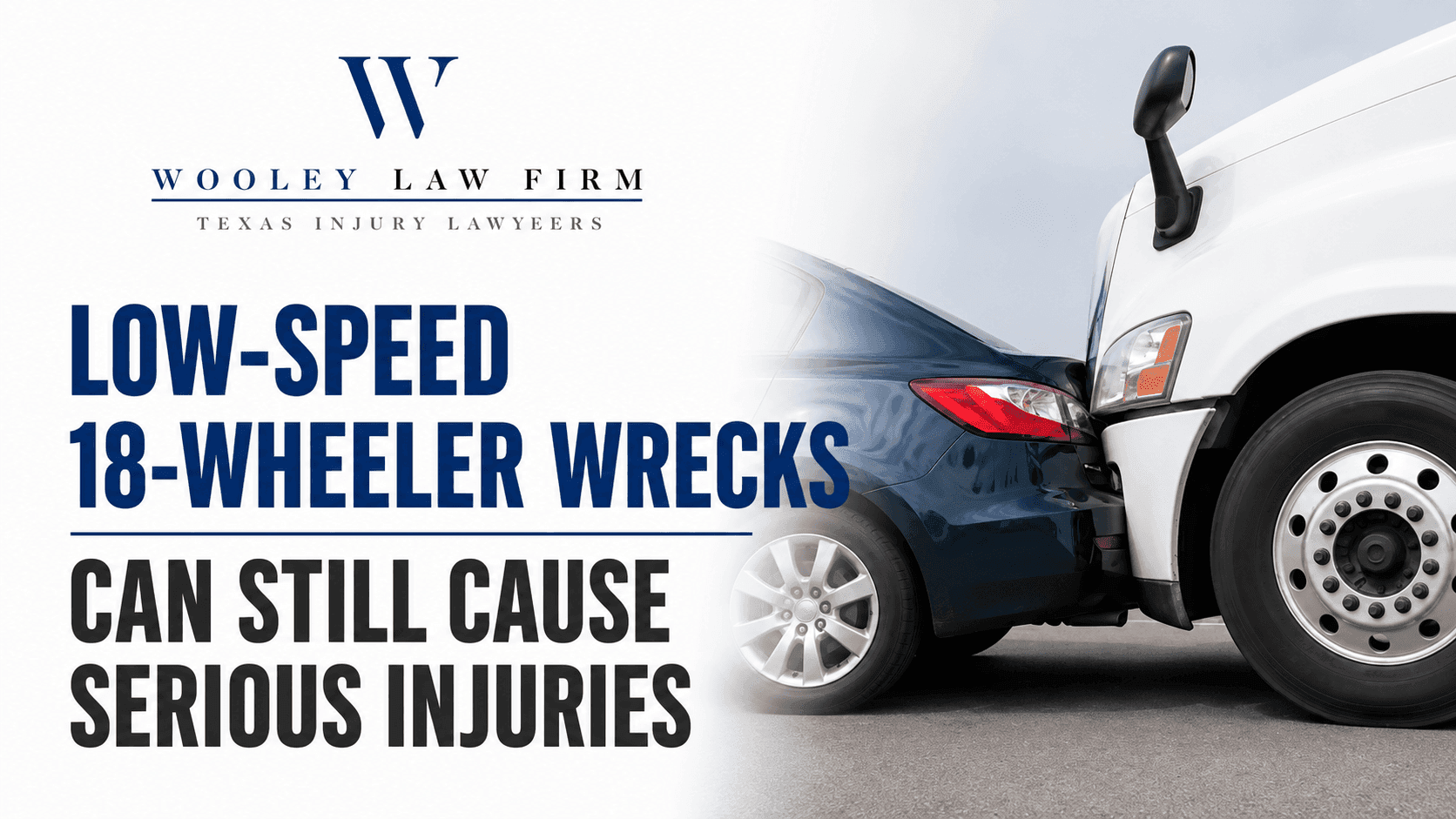
That means an 18-wheeler can weigh 20 times more than a typical passenger vehicle. Even at low speeds, the force from that kind of weight can crush vehicle panels, twist frames, shove cars into other objects, and violently move the people inside the smaller vehicle.
For drivers and passengers in Dallas, Fort Worth, Arlington, Irving, Grand Prairie, Mesquite, Denton, McKinney, Frisco, and across North Texas, a low-speed 18-wheeler wreck can still cause life-changing injuries.
Why Low-Speed 18-Wheeler Crashes Can Still Be Dangerous
A wreck does not have to happen at highway speed to cause serious harm. The danger comes from a combination of weight, momentum, vehicle mismatch, and the way the crash occurs.
A passenger vehicle and an 18-wheeler are not evenly matched. When a massive tractor-trailer bumps, sideswipes, turns into, backs into, or rear-ends a smaller vehicle, the smaller vehicle absorbs much of the impact. Even when the truck driver says he was “barely moving,” the force can still be significant because the truck is so heavy.
This is basic physics. Force is related to mass and acceleration. Momentum is related to mass and speed. A slower-moving 18-wheeler can still carry tremendous momentum because of its mass. When that momentum transfers into a much smaller car, SUV, motorcycle, bicycle, or pedestrian, the result can be catastrophic.
Common Low-Speed 18-Wheeler Crash Scenarios in DFW
Low-speed truck wrecks often happen in places where traffic is congested, vehicles are close together, and drivers have little room to escape. In Dallas-Fort Worth, these crashes may occur:
At intersections when an 18-wheeler makes a wide right turn or left turn
In stop-and-go traffic on I-35E, I-20, I-30, I-635, US-75, Loop 12, SH-183, or SH-114
On frontage roads where trucks merge, turn, or stop suddenly
In parking lots, loading areas, warehouses, and construction zones
When a truck backs up without a proper lookout
When a trailer swings into another lane
When a truck rolls forward into a stopped vehicle
When a truck rear-ends a car at low speed
When a truck pins a smaller vehicle against a curb, barrier, or another vehicle
These are the kinds of crashes insurance adjusters may try to label as “minor.” But for the person inside the smaller vehicle, the injuries can be anything but minor.
Texas News Stories Show Heavy Vehicles Can Cause Severe Harm at Low Speeds
Recent Texas news reports show how devastating heavy-vehicle impacts can be, even when the vehicle is not traveling at highway speeds.
In Houston, a construction worker was killed after being struck by a reversing work truck on the Gulf Freeway near Dixie Farm Road. According to the report, the truck was backing up during a lane-closure operation when it struck the worker, and the Houston Fire Department pronounced the worker dead at the scene.
That incident did not involve a typical passenger-car highway-speed crash. It involved a heavy commercial vehicle backing up. It is a reminder that heavy vehicles can cause fatal injuries even during slow-speed movements.
In Dallas, NBC 5 reported on a crash involving a semi-truck that left a Mesquite man with an amputated arm. The injured man said he was struck by an 18-wheeler on his way to work, while the truck owner later disputed fault and shared video.
In another Dallas report, a pedestrian was killed after being struck by a semi-truck on South R.L. Thornton Freeway near East Laureland Road. Police reported that all northbound lanes were closed for approximately three hours while investigators processed the scene.
Every crash is different, and news reports do not always provide complete details about speed, fault, visibility, braking, or the truck driver’s conduct. But these Texas incidents show the same basic truth: when a large commercial vehicle contacts a person or a smaller vehicle, the consequences can be severe.
The Weight Difference Matters
A loaded 18-wheeler can weigh up to 80,000 pounds. A passenger car may weigh around 3,000 to 4,000 pounds. That weight difference matters in every phase of a wreck.
It affects:
How much momentum the truck carries
How far the truck needs to stop
How much force transfers into the smaller vehicle
How badly the smaller vehicle is pushed, twisted, or crushed
Whether the occupants experience sudden acceleration, deceleration, or rotation
Whether the crash becomes a secondary impact with another vehicle, curb, wall, guardrail, or median barrier
FMCSA warns that large trucks need additional space for safe braking and unexpected actions. FMCSA also notes that when driving below 40 mph, a typical tractor-trailer should leave at least four seconds of following distance, and for speeds over 40 mph, an additional second is recommended.
That guidance matters because low-speed truck crashes often happen in traffic, at intersections, and in areas where the truck driver does not leave enough space.
Low Speed Does Not Mean Low Injury
Low-speed 18-wheeler wrecks can cause serious injuries because the human body is not designed to absorb sudden force from a commercial truck. The vehicle may be pushed sideways, rotated, lifted, compressed, or shoved into another object.
Common injuries after a low-speed 18-wheeler wreck include:
Neck injuries
Back injuries
Herniated discs
Shoulder injuries
Knee injuries
Hip injuries
Nerve damage
Concussions and traumatic brain injuries
Headaches and dizziness
Wrist and hand injuries
Chest and rib injuries
Aggravation of prior conditions
Anxiety, sleep disruption, and trauma symptoms
In some crashes, the damage looks worse inside the body than it does on the vehicle. A bumper photo does not show a herniated disc. A dented door does not show nerve pain. A repair estimate does not show loss of range of motion, headaches, numbness, or the inability to work.
Injured in an Accident?
Free consultation. Tell us what happened and learn what options may be available.
Underride and Override Risks Can Make Truck Impacts More Dangerous
One of the most dangerous features of large truck crashes is the height and structure mismatch between an 18-wheeler and a passenger vehicle.
The Insurance Institute for Highway Safety explains that rear underride crashes occur when a passenger vehicle moves underneath the back of a large truck. These crashes can cause severe damage to the smaller vehicle’s occupant compartment and are often deadly.
Underride concerns are often discussed in the context of rear crashes, but the same general principle applies to many truck wrecks: passenger vehicles are not built to match the size, height, and mass of tractor-trailers. When the trailer structure, bumper, tires, or frame contacts the smaller vehicle in the wrong place, the injuries can be devastating.
Studies and Safety Reviews Confirm Truck Crashes Require Serious Investigation
The federal government has studied large truck crashes because they present unique safety risks. The Large Truck Crash Causation Study was a major data collection project conducted by NHTSA and FMCSA to examine large truck crashes and contributing factors.
Research on truck-involved crashes has also found that crash severity can be affected by roadway type, lighting, weather, crash configuration, truck type, and other factors. Studies analyzing truck-involved crash injury severity have emphasized that different conditions can produce different severity patterns, which is why truck wrecks should not be dismissed based only on speed or photographs.
In other words, a serious truck wreck investigation should look at the full picture, including vehicle weights, speeds, angles, braking, perception-reaction time, visibility, roadway conditions, driver conduct, maintenance, and company safety practices.
Texas and Federal Safety Rules May Apply After a Low-Speed Truck Wreck
A low-speed crash may still involve violations of Texas law, federal trucking regulations, or basic commercial driving safety rules.
Texas Following Distance Law
Texas Transportation Code § 545.062 requires a driver following another vehicle to maintain an assured clear distance so the driver can safely stop without colliding with the vehicle ahead or veering into another vehicle, object, or person.
This law can matter when an 18-wheeler rolls into traffic, follows too closely, rear-ends a stopped vehicle, or fails to leave enough room in congestion.
Federal Hazardous Conditions Rule
Under 49 CFR § 392.14, commercial drivers must use extreme caution when hazardous conditions such as rain, fog, mist, dust, smoke, ice, or reduced traction affect visibility or control. The rule also requires speed to be reduced when such conditions exist.
In DFW, rain, construction dust, night driving, work zones, glare, and congested highways can all make a low-speed truck movement more dangerous.
Federal Brake Performance Rules
Federal regulations also contain brake performance requirements for commercial motor vehicles. Under 49 CFR § 393.52, certain vehicles must meet stopping performance standards, including stopping from 20 mph within required distances.
Brake condition matters even in low-speed crashes. If the truck was creeping forward, rolling downhill, backing up, or attempting to stop in traffic, investigators should determine whether the brakes were properly maintained and functioning.
Federal Maintenance Rules
49 CFR § 396.3 requires motor carriers to systematically inspect, repair, and maintain commercial motor vehicles under their control, and parts and accessories must be in safe and proper operating condition.
After a low-speed 18-wheeler crash, maintenance records may be important if the wreck involved brakes, tires, mirrors, lighting, backup alarms, steering, trailer components, underride guards, or other safety equipment.
Why Insurance Companies Downplay Low-Speed 18-Wheeler Claims
After a low-speed 18-wheeler wreck, the trucking company or insurance carrier may argue:
“The crash was too minor to cause injury.”
“There was not enough vehicle damage.”
“The truck was barely moving.”
“You already had back or neck problems.”
“You did not go to the hospital right away.”
“Your pain is unrelated to the crash.”
These arguments are common. They are also incomplete.
A low-speed crash can still cause serious injury depending on the force, angle of impact, position of the occupant, size of the vehicles, prior medical history, seat position, head movement, and whether the smaller vehicle was pushed into another object.
That is why the evidence matters.
Evidence That Should Be Preserved After a Low-Speed 18-Wheeler Wreck
Low-speed truck wreck cases can become evidence fights. The trucking company may try to frame the crash as a harmless bump. The injured person must be ready to show what actually happened.
Important evidence may include:
Police crash report
Scene photographs
Vehicle damage photographs
Repair estimates
Tow records
Dashcam video
Nearby business surveillance video
Truck dash camera or inward/outward camera footage
Electronic control module data
Event recorder data
Telematics and GPS data
Driver logs
Dispatch records
Bills of lading
Maintenance records
Brake inspection records
Driver qualification file
Post-crash inspection records
Witness statements
Medical records
Imaging studies
Work restrictions
Lost wage documentation
This evidence can help prove that a low-speed 18-wheeler crash was not minor.
Common Low-Speed 18-Wheeler Injury Cases in Dallas-Fort Worth
The Wooley Law Firm investigates low-speed truck wreck cases involving:
18-wheeler rear-end crashes
Tractor-trailer sideswipe crashes
Wide-turn truck wrecks
Truck backing crashes
Parking lot truck collisions
Construction zone truck crashes
Stop-and-go traffic truck wrecks
Delivery truck and box truck collisions
Trailer swing accidents
Truck crashes involving pedestrians, cyclists, and motorcyclists
Whether the crash happened on a major freeway, a frontage road, a warehouse lot, or a city street, the same issue remains: commercial trucks can cause serious harm even when they are moving slowly.
Do Not Let the Insurance Company Define Your Injuries by the Vehicle Damage
Property damage is one part of the evidence. It is not the whole case.
A person can suffer a serious injury even when the vehicle is not totaled. This is especially true when the crash involves a much larger commercial vehicle. The body may absorb force in ways that do not show up clearly in exterior photographs.
If you are hurt after a low-speed 18-wheeler wreck, it is important to:
Get medical care.
Report all symptoms accurately.
Take photographs of the vehicles and scene.
Save repair estimates and towing records.
Avoid giving a recorded statement without legal advice.
Contact a Dallas-Fort Worth 18-wheeler wreck lawyer before evidence disappears.
Talk to a Dallas-Fort Worth 18-Wheeler Wreck Lawyer
A low-speed 18-wheeler wreck can still cause serious injuries. The trucking company and insurance carrier may try to minimize the crash, but the weight, force, and size of a tractor-trailer can make even a slow impact dangerous.
The Wooley Law Firm helps injured Texans investigate truck wrecks, preserve evidence, and pursue compensation for medical bills, lost wages, pain and suffering, mental anguish, physical impairment, and other damages.
If you were injured in a low-speed 18-wheeler wreck in Dallas, Fort Worth, Arlington, Irving, Grand Prairie, Denton, Frisco, McKinney, Garland, Mesquite, or anywhere in North Texas, contact The Wooley Law Firm for a free consultation.
You do not pay unless we win.
Frequently Asked Questions About Low-Speed 18-Wheeler Wrecks
Can a low-speed 18-wheeler crash cause serious injuries?
Yes. A low-speed 18-wheeler crash can cause serious injuries because a tractor-trailer may weigh up to 80,000 pounds. Even at low speed, that weight can create enough force to injure people in smaller vehicles.
What injuries are common after a low-speed truck wreck?
Common injuries include neck injuries, back injuries, herniated discs, shoulder injuries, knee injuries, concussions, headaches, nerve pain, and aggravation of prior medical conditions.
Can I have a truck accident case if my car does not look badly damaged?
Yes. Vehicle damage does not always show the full force transferred to the occupants. Medical records, imaging, symptoms, crash mechanics, and expert analysis may be needed to prove the injury.
Why do insurance companies call these crashes “minor”?
Insurance companies often use the term “minor impact” to reduce the value of a claim. In 18-wheeler cases, that argument ignores the size and weight difference between the truck and the passenger vehicle.
What evidence is important after a low-speed 18-wheeler wreck?
Important evidence may include crash reports, photographs, dashcam video, surveillance video, event recorder data, telematics, driver logs, maintenance records, repair estimates, and medical records.
Should I give a recorded statement after a low-speed truck crash?
You should be careful before giving a recorded statement to the trucking company’s insurance carrier. The adjuster may ask questions designed to minimize your injuries or blame you for the crash.
How can a Dallas-Fort Worth truck wreck lawyer help?
A truck wreck lawyer can preserve evidence, investigate the driver and trucking company, obtain records, analyze the crash, deal with the insurance company, and pursue compensation for your injuries.
Disclaimer
This blog post is for general informational purposes only and is not legal advice. Reading this post does not create an attorney-client relationship. Every truck wreck case is different, and you should speak with an attorney about the specific facts of your case.
Topics
Share This Article

Andrew J. Wooley
Personal Injury Attorney
Andrew J. Wooley is a dedicated personal injury attorney based in Dallas, Texas. He focuses on helping accident victims recover fair compensation for their injuries. With a commitment to personalized service, Andrew works directly with each client to understand their unique situation and fight for their rights.