18-Wheeler Black Box Data Can Reveal What Really Happened Before a Truck Wreck
After a serious 18-wheeler wreck in Dallas-Fort Worth, the trucking company may quickly start building its defense.
The driver may say traffic stopped suddenly.
The company may say the truck was traveling at a safe speed.
The insurance carrier may claim the crash could not have been avoided.
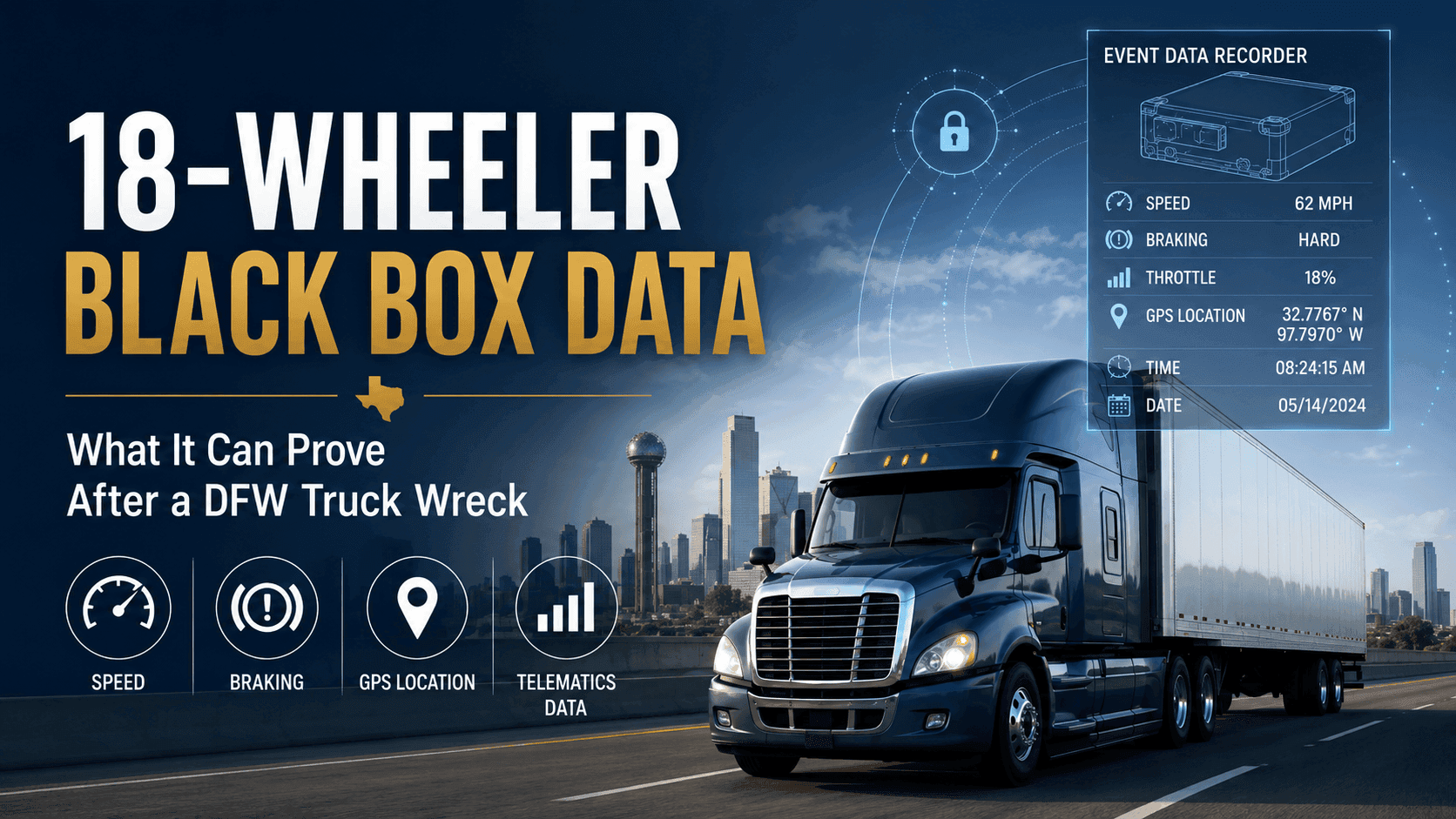
But a tractor-trailer often carries electronic evidence that can prove what actually happened in the seconds, minutes, and hours before impact. This evidence is commonly called the truck’s “black box” data, but in a commercial truck case, that phrase can refer to several different systems, including the Electronic Control Module (ECM), Event Data Recorder (EDR), Electronic Logging Device (ELD), GPS tracking, telematics systems, dash cameras, and driver-facing cameras.
For injury victims, this data can be critical. It may prove that the truck driver was speeding, failed to brake, drove too many hours, ignored traffic, followed too closely, or violated trucking safety rules.
The Wooley Law Firm investigates serious 18-wheeler wrecks in Dallas, Fort Worth, Arlington, Irving, Garland, Mesquite, Denton, Frisco, McKinney, Grand Prairie, Lewisville, and across North Texas. The Wooley Law Firm has obtained millions of dollars for people injured by 18-wheelers and commercial vehicles. When trucking companies and insurance carriers try to avoid responsibility, our firm investigates the evidence, preserves critical black box data, and fights to hold negligent truck drivers and companies accountable.
What Is an 18-Wheeler “Black Box”?
In a truck wreck case, “black box” is a general term. Unlike an airplane black box, a tractor-trailer may have several separate electronic systems that record different types of information.
The most important sources often include:
1. Electronic Control Module / Engine Control Module
The ECM, sometimes called the Engine Control Module, is part of the truck’s engine and vehicle control system. Depending on the truck, engine, manufacturer, and settings, it may record:
Speed
Engine RPM
Throttle use
Brake application
Cruise control status
Hard braking events
Sudden deceleration events
Fault codes
Engine hours
Vehicle miles
Other operational data
This matters because an 18-wheeler driver may claim they were driving safely, but ECM data may show they were speeding, failed to brake, or did not react until it was too late.
2. Event Data Recorder
An Event Data Recorder, or EDR, is designed to capture crash-related data. Federal regulations at 49 CFR Part 563 set uniform national requirements for vehicles equipped with EDRs, including the collection, storage, retrievability, data elements, data capture, crash-test survivability, and commercially available retrieval tools.
However, this is important: federal law does not currently require every 18-wheeler or heavy tractor-trailer to have a dedicated EDR. Part 563 is generally an “if equipped” standard for covered vehicles. In other words, if a covered vehicle has an EDR, the EDR must meet certain federal standards.
That does not mean there is no electronic evidence. Many modern tractor-trailers still contain ECM data, ELD data, GPS data, telematics data, dashcam video, and fleet management data that can be just as important.
3. Electronic Logging Device
An ELD is different from an EDR or ECM. An ELD is primarily used to track a commercial driver’s hours of service.
The FMCSA’s ELD rule applies to most motor carriers and drivers required to keep records of duty status under 49 CFR Part 395. The ELD regulations are found in 49 CFR Part 395, Subpart B, which governs electronic logging devices and related supporting documents. You can also review the FMCSA’s General Information About the ELD Rule.
ELD data can help prove whether a truck driver was fatigued, over hours, falsifying logs, driving when they should have been off duty, or operating under pressure from a company schedule.
What Can Black Box Data Prove After a DFW 18-Wheeler Crash?
Black box and electronic truck data can help prove facts that are often disputed after a serious crash.
Speed Before Impact
The ECM, EDR, GPS system, or telematics system may show how fast the tractor-trailer was traveling in the seconds before impact.
This can be critical in crashes involving stopped traffic on highways such as:
I-35E
I-35W
I-20
I-30
I-45
I-635
US-75
SH-360
SH-121
Loop 12
President George Bush Turnpike
Speed data can show whether the truck driver was driving too fast for traffic, weather, construction zones, curves, exits, or congestion.
Whether the Truck Driver Braked
One of the most important questions after a truck wreck is whether the driver ever hit the brakes.
Black box data may show:
No brake application before impact
Late brake application
Hard braking seconds before the crash
Whether the truck was still under throttle
Whether cruise control was engaged
Whether the driver made any evasive maneuver
In a rear-end 18-wheeler collision, no braking can be powerful evidence that the driver was distracted, fatigued, inattentive, or failed to keep a proper lookout.
Throttle and Acceleration
Throttle data can show whether the driver was accelerating, maintaining speed, or backing off the accelerator before impact.
This matters when a truck driver claims that traffic suddenly stopped or that the crash was unavoidable. If the data shows the driver stayed on the accelerator or cruise control until impact, that can directly contradict the driver’s story.
Cruise Control Use
Cruise control data may show whether the driver had the truck set at highway speed despite traffic, rain, construction, or slowed vehicles ahead.
A commercial driver must adjust to roadway conditions. Cruise control is not a defense when a truck driver fails to react to traffic.
Engine RPM and Gear Information
Engine RPM and gear data can help reconstruction experts determine how the truck was being operated before the crash.
This can be useful in:
Rear-end crashes
Underride crashes
Rollover wrecks
Jackknife crashes
Wide-turn crashes
Heavy braking events
Sudden steering events
Hard Braking and Sudden Deceleration Events
Some ECMs record hard brake or sudden deceleration events. These records may include data before and after the triggering event.
This can help reconstruct the truck’s movement before impact and determine whether the crash involved panic braking, delayed reaction, or no reaction at all.
Hours-of-Service Violations
ELD data can show whether the driver was legally allowed to be behind the wheel.
It can reveal:
Driving time
On-duty time
Off-duty time
Sleeper berth time
Log edits
Unassigned driving time
Location history
Engine power-up and shutdown
Possible falsification or manipulation
Hours-of-service evidence is important because fatigued truck drivers are dangerous. A tired 18-wheeler driver may have slowed reaction time, poor judgment, lane drift, tunnel vision, or even fall asleep behind the wheel.
Location and Route History
GPS, ELD, and telematics data can show where the truck was before the crash.
This can help prove whether:
The driver was on the correct route
The company knew where the truck was
The driver was speeding between locations
The truck entered a restricted roadway
The truck was operating on a “No Trucks” road
The truck driver took an unsafe shortcut
The truck entered an area not designed for tractor-trailer traffic
In DFW truck wreck cases, route data may matter when an 18-wheeler is operating on a residential street, local roadway, construction zone, or restricted truck route.
Driver Distraction
Black box data alone may not always prove cell phone use, but it can support a distracted-driving theory when combined with other evidence.
For example, if the data shows no braking, no steering input, steady speed, and a straight-line impact into stopped traffic, that can support an argument that the driver was not paying attention.
Additional evidence may include:
Cell phone records
Text messages
Dispatch messages
Qualcomm data
Omnitracs data
Samsara data
Motive data
Lytx DriveCam footage
Dashcam video
Driver-facing camera footage
Fleet safety system data
Mechanical Problems or Maintenance Issues
Electronic data may show engine fault codes, ABS issues, brake system warnings, stability control events, or other vehicle problems.
This can be important if the trucking company claims the wreck was caused by a sudden mechanical failure. If the data shows the problem existed before the crash, the case may involve negligent maintenance, negligent inspection, or failure to remove an unsafe truck from service.
Injured in an Accident?
Free consultation. Tell us what happened and learn what options may be available.
Federal Regulations and Event Recorder Rules
There are several important regulatory points to understand.
49 CFR Part 563: Event Data Recorders
49 CFR Part 563 sets standards for vehicles equipped with EDRs, including collection, storage, retrieval, crash survivability, and access tools. The regulation’s stated purpose is to help ensure that EDRs record data in a usable way for crash investigations and safety analysis.
However, Part 563 does not require every heavy commercial truck to have an EDR. It is generally an “if equipped” standard for covered vehicles. In other words, if a covered vehicle has an EDR, the EDR must meet certain federal standards.
2025 NHTSA Final Rule Extending EDR Recording Time
NHTSA issued a final rule, effective January 17, 2025, extending the required recording period for covered EDR data from 5 seconds of pre-crash data at 2 Hz to 20 seconds of pre-crash data at 10 Hz, with compliance dates beginning September 1, 2027 for most covered vehicles. You can review the rule here: NHTSA Event Data Recorder Final Rule.
NHTSA explained that longer and higher-frequency recording can help investigators better understand pre-crash actions, including braking, throttle, steering, ABS activity, stability control, and other crash-avoidance actions.
Again, this does not mean every 18-wheeler has a federally mandated EDR. But it shows the importance of event data in crash reconstruction.
49 CFR Part 395: Electronic Logging Devices
The ELD rule is different. FMCSA states that the ELD rule applies to most drivers required to maintain records of duty status under Part 395. You can review the FMCSA’s ELD rule information here: FMCSA General Information About the ELD Rule.
ELD data can be critical in a truck wreck case because it may show fatigue, hours-of-service violations, falsified logs, unassigned drive time, or company pressure to keep driving.
News and Investigations Showing Why Black Box Data Matters
Electronic truck data has played an important role in major crash investigations. It can confirm or contradict what a truck driver, trucking company, or insurance carrier says happened.
NTSB Investigation: Deadly Multi-Vehicle Truck Crash on I-35 in Austin, Texas
A Texas NTSB investigation shows why electronic truck data can be critical after a catastrophic 18-wheeler wreck.
On March 13, 2025, the National Transportation Safety Board opened an investigation into a deadly multi-vehicle crash on southbound I-35 near mile marker 245.4 in Austin, Travis County, Texas. According to the official NTSB investigation page for HWY25MH005, a 2016 Volvo VNL truck-tractor operated by ZBN Transport LLC, pulling a 2022 CIMC Intermodal Equipment semitrailer, was traveling south in the center lane of I-35 when it encountered a traffic queue in a work zone.
The NTSB stated that the combination vehicle was traveling in a long-term work zone and encountered a traffic queue caused by lane closures about 0.4 miles ahead. The truck did not stop as it approached slowing traffic and collided with vehicles at the end of the queue before continuing south into the queue and involving 13 other vehicles. The NTSB reported that five people were fatally injured and others reported injuries ranging from minor to serious. You can also review the NTSB docket for HWY25MH005 and the NTSB preliminary report PDF.
Newer local reporting on the investigation stated that the NTSB reviewed driver performance factors, including phone records, rest opportunity, and whether phone use, impairment, or a medical emergency contributed to the crash. KVUE reported that the NTSB examined cell phone records and sleep opportunity, and CBS Austin reported that investigators found no evidence of alcohol, drugs, a medical emergency, or active phone use at the exact time of collision, while prosecutors alleged unsafe speed, failure to take evasive action, and failure to apply the brakes.
This Texas crash is a strong example of why a DFW truck wreck lawyer must act quickly to preserve more than the police report. ELD records, telematics data, dashcam footage, GPS data, driver monitoring systems, phone records, and fatigue evidence can help show whether a truck driver failed to slow down, failed to stop, was distracted, was fatigued, or was operating unsafely before a deadly crash.
NTSB Investigation: Triton Logistics Party Bus Crash
The NTSB investigation into the fatal Williamsburg, Virginia crash involving a Triton Logistics tractor-trailer and a party bus is another example of how electronic truck data can expose the truth.
According to the official NTSB investigation page for HWY23MH004, the crash happened on December 16, 2022, on I-64 near Williamsburg, Virginia. The NTSB found that in the five seconds before the crash, the bus was traveling about 20 to 25 mph while the combination vehicle was traveling between 65 and 70 mph with cruise control activated. The NTSB also found that the truck driver did not brake or take evasive action as he approached the slower-moving bus. You can also review the NTSB final report PDF and the NTSB docket for HWY23MH004.
The NTSB determined that the probable cause of the crash was the truck driver’s fatigue due to excessive driving time and limited sleep opportunity. The NTSB also found that the motor carrier created fictitious driver accounts in its ELD system, allowing drivers to operate beyond federal regulations.
That is exactly why black box, ECM, and ELD data matter. A driver or company may argue that a crash happened suddenly. But electronic evidence may show the truck driver never slowed down, never braked, and should not have been driving in the first place.
NTSB Investigation: I-70 Multi-Vehicle Crash in Ohio
The NTSB also investigated a deadly multi-vehicle crash involving a commercial truck, a motorcoach, and passenger vehicles on I-70 in Etna, Ohio.
According to the official NTSB investigation page for HWY24MH001, the crash involved multiple vehicles, including a commercial truck and a motorcoach, in traffic that was slowing or stopped because of an earlier crash scene. You can also review the NTSB final report PDF and the NTSB docket for HWY24MH001.
Speed and pre-impact data can be crucial in a case like this because the trucking company may focus on the traffic queue, but the electronic evidence can focus the case on the truck driver’s failure to see, slow, brake, and react.
NTSB Investigation: FedEx Freight Truck and Motorcoach Crash in Orland, California
The NTSB investigation into the FedEx Freight truck and motorcoach crash in Orland, California also shows why objective evidence matters in catastrophic commercial vehicle crashes.
According to the official NTSB investigation page for HWY14MH009, the crash happened on April 10, 2014, on I-5 near Orland, California. A FedEx Freight truck-tractor pulling double trailers crossed the median, entered the northbound lanes, struck a passenger car, and then collided with a motorcoach. You can also review the NTSB final report PDF and the NTSB docket for HWY14MH009.
The NTSB later issued recommendations that included event data recorders for commercial trucks and motorcoaches. That recommendation matters because, in serious truck wreck cases, electronic data can help investigators determine whether the driver braked, steered, accelerated, slowed, or failed to react before impact.
This is another example of why objective electronic and physical evidence matters. Witness statements and company explanations may be incomplete, mistaken, or self-serving. Data can help determine whether the driver braked, whether the truck was under control, and whether the defense story matches the evidence.
Why Black Box Data Must Be Preserved Immediately
Truck data can disappear.
Depending on the system, data may be overwritten, deleted, lost when the truck is repaired, lost when the tractor is put back into service, or inaccessible without the correct download tools.
Some systems require specialized software and trained experts. Others store data in cloud-based fleet platforms controlled by the trucking company or its vendor.
That is why a DFW truck wreck lawyer should send a preservation letter immediately demanding that the trucking company preserve:
The tractor and trailer
ECM data
EDR data
ELD records
GPS data
Telematics data
Dashcam footage
Driver-facing camera footage
Qualcomm, Omnitracs, Samsara, Motive, Lytx, or other fleet system data
Driver logs
Driver qualification file
Dispatch records
Bills of lading
Load documents
Maintenance records
Inspection reports
Post-crash drug and alcohol testing records
Cell phone records
Company safety policies
Prior crashes and violations
A trucking company should not be allowed to control the evidence, download it without oversight, repair the truck, put it back on the road, and then claim the data is gone.
How Black Box Data Can Contradict a Truck Driver’s Story
After a serious Dallas-Fort Worth truck wreck, a driver may say:
“Traffic stopped suddenly.”
“I was not speeding.”
“I hit the brakes.”
“The car cut me off.”
“There was nothing I could do.”
“I was not tired.”
“I was not distracted.”
“The truck had a mechanical failure.”
“The crash was unavoidable.”
Black box data may prove otherwise.
It may show the truck was traveling too fast.
It may show the driver never braked.
It may show cruise control was still engaged.
It may show the truck drifted out of its lane.
It may show the driver was over hours.
It may show the driver had been on duty too long.
It may show the truck had prior fault codes.
It may show the company knew the truck was being operated unsafely.
In other words, black box data can turn a trucking company’s defense into evidence of negligence.
Why This Evidence Matters in Dallas-Fort Worth Truck Wreck Cases
Dallas-Fort Worth has some of the busiest highways in Texas. Heavy truck traffic moves through DFW every day on highways including:
I-20
I-30
I-35E
I-35W
I-45
I-635
US-75
SH-360
SH-121
SH-183
Loop 12
President George Bush Turnpike
When an 80,000-pound tractor-trailer crashes into a passenger vehicle, the injuries can be devastating. Victims may suffer:
Brain injuries
Spinal injuries
Neck and back injuries
Fractures
Burns
Amputations
Internal injuries
Permanent pain
Disability
Wrongful death
The trucking company and insurance carrier may start investigating immediately. They may send rapid response teams, accident reconstruction experts, adjusters, and defense lawyers to the scene. Their goal is to protect the company.
The injured person needs someone protecting the evidence for them.
What The Wooley Law Firm Does After a Serious Truck Wreck
In a serious 18-wheeler crash case, The Wooley Law Firm can take immediate action to investigate and preserve key evidence, including:
Sending preservation letters
Demanding black box, ECM, EDR, ELD, GPS, and telematics data
Inspecting the tractor and trailer
Hiring accident reconstruction experts
Seeking dashcam and surveillance footage
Obtaining the truck driver’s qualification file
Reviewing hours-of-service records
Investigating maintenance and inspection history
Reviewing company safety policies
Investigating prior crashes, violations, and out-of-service orders
Determining whether the trucking company violated federal safety rules
The sooner this investigation begins, the better the chance of preserving the electronic data before it disappears.
Common 18-Wheeler Cases Where Black Box Data Is Important
Black box data may be critical in cases involving:
Rear-end 18-wheeler crashes
Stopped traffic crashes
Construction zone truck wrecks
Jackknife crashes
Rollover crashes
Wide-turn collisions
Unsafe lane change crashes
Underride crashes
No-zone and blind spot collisions
Fatigued truck driver crashes
Distracted truck driver crashes
Speeding truck crashes
No-truck-route violations
Brake failure claims
Mechanical failure defenses
Fatal truck wrecks
FAQs About 18-Wheeler Black Box Data
Do all 18-wheelers have black boxes?
Not necessarily. Federal law does not currently require every heavy tractor-trailer to have a dedicated event data recorder. However, many modern commercial trucks have ECMs, ELDs, GPS systems, telematics platforms, dash cameras, and other electronic systems that may contain valuable crash evidence.
Is an ELD the same thing as a black box?
No. An ELD primarily tracks hours-of-service and duty status information. A black box, ECM, or EDR may record vehicle operation and crash-related data such as speed, braking, throttle, and engine performance. In a serious truck wreck case, both types of data may be important.
What can a truck’s black box show?
Depending on the system, it may show speed, braking, throttle, cruise control, engine RPM, hard braking, sudden deceleration, fault codes, GPS location, hours of service, driver status, engine hours, vehicle miles, and other data.
Can black box data prove the truck driver was speeding?
Yes. ECM, EDR, GPS, and telematics data may help prove the truck’s speed before impact. This can be especially important when the driver claims they were driving safely or that the crash was unavoidable.
Can black box data prove the driver did not brake?
Yes. In many cases, electronic data may show whether the service brakes were applied before impact. No braking before a crash can support claims involving distraction, fatigue, inattention, or failure to keep a proper lookout.
Can trucking companies delete black box data?
Data can be lost, overwritten, altered, or destroyed if it is not preserved quickly. That is why immediate legal action is important after a serious truck wreck.
How quickly should a lawyer request black box data?
Immediately. In a serious 18-wheeler crash, a preservation letter should be sent as soon as possible demanding that the trucking company preserve the tractor, trailer, ECM data, EDR data, ELD records, GPS data, dashcam footage, and related electronic evidence.
Can black box data help prove fatigue?
Yes. ELD records, GPS data, engine hours, duty status records, and dispatch records can help determine whether the driver was over hours, falsified logs, or had been driving too long.
What if the trucking company says the data is gone?
If the company had notice of the crash and failed to preserve evidence, that may raise spoliation issues. Courts may consider whether evidence was destroyed after the company knew or should have known it was relevant to a claim.
Do I need a DFW truck wreck lawyer after an 18-wheeler crash?
Yes, especially if the crash involved serious injuries or death. Truck wreck cases involve federal safety regulations, electronic evidence, commercial insurance, corporate defendants, and fast-moving defense investigations. A lawyer can help preserve critical evidence before it disappears.
Injured in an 18-Wheeler Wreck in Dallas-Fort Worth?
If you or a loved one was injured in a truck wreck in Dallas-Fort Worth, do not rely only on the police report or the trucking company’s version of events. The truck may contain electronic data that proves what really happened.
The Wooley Law Firm has obtained millions of dollars for people injured by 18-wheelers and commercial vehicles. Our firm investigates serious truck wreck cases across North Texas and works to preserve black box data, ELD records, GPS data, dashcam footage, maintenance records, and other key evidence before it disappears.
Call The Wooley Law Firm today for a free consultation with a DFW truck wreck lawyer. You don’t pay unless we win.
Topics
Share This Article

Andrew J. Wooley
Personal Injury Attorney
Andrew J. Wooley is a dedicated personal injury attorney based in Dallas, Texas. He focuses on helping accident victims recover fair compensation for their injuries. With a commitment to personalized service, Andrew works directly with each client to understand their unique situation and fight for their rights.