A truck crash is not “just another accident.” When an 18-wheeler, semi-truck, tractor-trailer, box truck, delivery van, dump truck, tanker, construction vehicle, or other commercial vehicle causes a wreck, the injured person is usually not dealing with only one driver.
You may be dealing with a trucking company, delivery company, vehicle owner, commercial insurance carrier, third-party claims administrator, defense attorney, accident investigator, and corporate risk-management team. In serious cases, some of those parties may begin investigating the crash before the injured victim has even left the hospital.
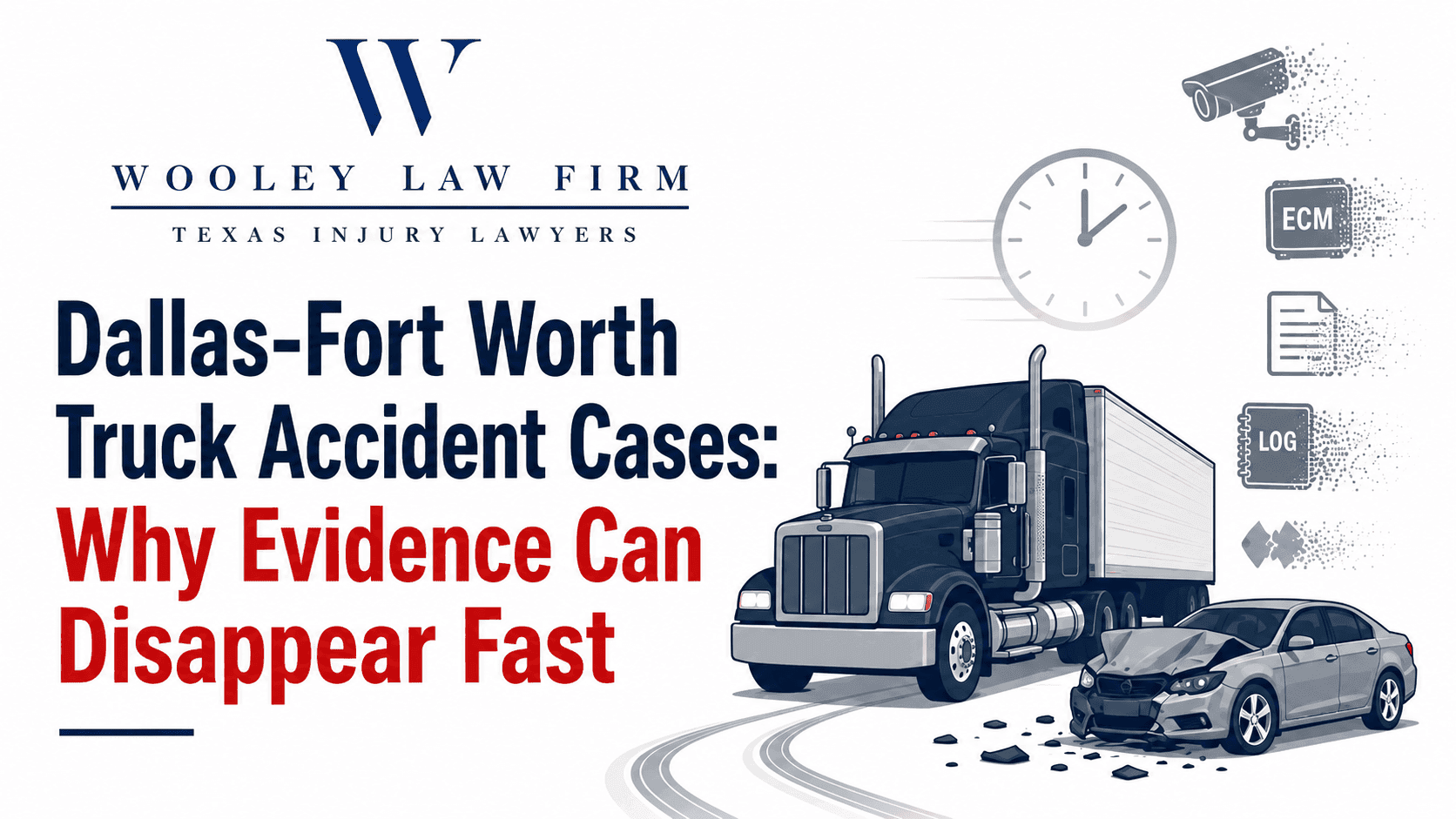
These cases move quickly for an important reason: critical truck accident evidence can be lost, overwritten, repaired, destroyed, or made more difficult to obtain within days.
At The Wooley Law Firm, we represent people injured in serious commercial vehicle wrecks throughout Dallas, Fort Worth, Arlington, Irving, Garland, Mesquite, Grand Prairie, Plano, Frisco, McKinney, Denton, Lewisville, and communities across North Texas. We have handled many Texas truck wreck cases and have obtained millions of dollars for injured clients.
Trucking companies and their insurers understand which evidence matters and how quickly it can disappear. That is why injured victims need a law firm prepared to investigate immediately.
Call The Wooley Law Firm at (214) 699-6524 for a free consultation with a Dallas truck accident lawyer. You do not pay unless we win.
Why Dallas-Fort Worth Truck Accidents Are Different From Car Accidents
An accident involving two passenger vehicles may primarily involve the drivers and their personal auto insurance policies. An 18-wheeler or commercial vehicle claim can be substantially more complicated.
Commercial truck accident cases may involve:
Multiple insurance policies;
Large commercial liability limits;
Corporate safety rules and training requirements;
Federal and state trucking regulations;
Electronic logging devices;
GPS and fleet-tracking systems;
Dash cameras and surveillance video;
Driver qualification and employment files;
Dispatch instructions and delivery schedules;
Vehicle inspection and maintenance records;
Cargo-loading companies;
Truck owners and leasing companies;
Brokers, shippers, contractors, and subcontractors;
Multiple companies pointing the finger at one another.
The trucking company’s insurance carrier is not responsible for making sure you receive fair compensation. Its job is to reduce the company’s exposure and pay as little as reasonably possible.
That defense can begin immediately after a Dallas-Fort Worth truck wreck.
Commercial Vehicles Involved in DFW Accidents
Not every commercial vehicle accident involves a traditional tractor-trailer. The same preservation and insurance issues can arise after collisions involving:
18-wheelers;
Semi-trucks;
Tractor-trailers;
Box trucks;
Delivery vans;
Amazon-type delivery vehicles;
UPS- or FedEx-type delivery trucks;
Dump trucks;
Garbage trucks;
Tow trucks;
Tanker trucks;
Concrete trucks;
Construction vehicles;
Utility vehicles;
Work trucks;
Buses and shuttle vehicles;
Moving trucks;
Rental trucks used for business;
Cargo vans;
Food-service and beverage-delivery trucks.
The type of vehicle can affect which company owns it, who employed the driver, which insurance policies apply, and which records must be preserved.
Where Serious Truck Wrecks Happen in Dallas-Fort Worth
Dallas-Fort Worth has a large network of interstate highways, commercial corridors, warehouses, distribution centers, construction sites, and delivery routes. Serious commercial vehicle collisions frequently occur on or near:
Interstate 35E;
Interstate 35W;
Interstate 20;
Interstate 30;
Interstate 45;
Interstate 635 and LBJ Freeway;
U.S. Highway 75;
U.S. Highway 67;
U.S. Highway 287;
State Highway 121;
State Highway 183;
State Highway 360;
State Highway 114;
State Highway 161;
President George Bush Turnpike;
Dallas North Tollway;
Loop 12;
Spur 408;
Major warehouse and industrial routes throughout North Texas.
Truck wrecks also happen on city streets when drivers make unsafe turns, enter restricted roads, back into traffic, cross multiple lanes, or attempt to maneuver large trailers through areas that were not designed for them.
A victim does not have to be traveling on an interstate to have a serious commercial truck claim.
Evidence That Can Disappear After an 18-Wheeler Wreck
The outcome of a truck accident case often depends on evidence that is controlled by the trucking company, delivery company, vehicle owner, or another corporate entity.
That evidence may not remain available indefinitely.
Driver Logs and Hours-of-Service Data
Commercial drivers may be required to track their driving time, rest periods, and duty status through paper records or an electronic logging device.
Driver logs and electronic logging device data may help determine:
How long the driver had been working;
Whether the driver had adequate rest;
Whether the driver exceeded driving limits;
Whether the records were edited;
Whether the driver was under pressure to meet a deadline;
Whether the company scheduled an unrealistic route;
Whether fatigue contributed to the collision.
A driver may appear fully awake after a crash but still have been dangerously fatigued before impact. Log data, dispatch records, fuel receipts, toll records, GPS history, and delivery documentation may provide a more accurate picture.
GPS, Telematics, and Route-Tracking Data
Many commercial fleets use telematics systems to monitor their vehicles. Depending on the system, that information may show:
Vehicle speed;
Location history;
Sudden braking;
Rapid acceleration;
Harsh turns;
Lane movements;
Route deviations;
Stops and rest periods;
Arrival and departure times;
Driver alerts;
Safety warnings;
Communications with dispatch.
This evidence can be particularly important when the driver and injured victim give different accounts of how the accident happened.
Dash Camera and In-Cab Video
Commercial trucks and delivery vehicles may have forward-facing cameras, driver-facing cameras, side cameras, backup cameras, or multiple camera systems.
Video may show:
The traffic signal;
Lane position;
The movement of surrounding vehicles;
Whether the driver was distracted;
Whether the driver was using a phone;
Whether the driver checked mirrors;
Whether the driver reacted before impact;
The condition of the roadway;
The force of the collision;
Statements made immediately afterward.
Some fleet camera systems retain video only when a triggering event is detected. Others overwrite recordings on a rolling basis. A prompt preservation demand can help identify and protect available footage.
Black Box and Electronic Control Module Data
The term “black box” may refer to data stored in an engine control module, electronic control module, event data recorder, or another onboard system.
Depending on the truck and system, electronic data may reveal:
Speed before impact;
Engine RPM;
Throttle position;
Brake application;
Cruise-control use;
Sudden deceleration;
Fault codes;
Seat-belt status;
Vehicle movement before the wreck;
Mechanical or system warnings.
You can learn more in our guide to 18-wheeler black box data after a Dallas-Fort Worth truck wreck.
This information should be downloaded by someone who understands the applicable system and can preserve the data without altering it.
Cellphone and Electronic Device Evidence
A distracted truck driver can cause a catastrophic wreck in seconds. Evidence may exist on:
Personal cellphones;
Company-issued phones;
Tablets;
Dispatch devices;
Navigation systems;
Delivery scanners;
Messaging applications;
Fleet-management platforms.
Relevant records may show calls, texts, application use, dispatch communications, route changes, or other activity near the time of the collision.
Maintenance and Inspection Records
Commercial trucks travel long distances, carry heavy loads, and place significant stress on brakes, tires, steering components, lighting systems, and other equipment.
Maintenance and inspection records may reveal:
Worn or defective brakes;
Tire problems;
Steering issues;
Lighting failures;
Repeated mechanical complaints;
Overdue repairs;
Failed inspections;
Inadequate preventive maintenance;
Repairs performed shortly before or after the accident;
Defects that should have removed the truck from service.
The trucking company may blame the driver, while the driver blames the equipment. Maintenance records can help determine whether the truck was safe to operate.
Driver Qualification and Employment Files
A trucking company should not place an unsafe or unqualified driver behind the wheel of a commercial vehicle.
A driver qualification or employment file may contain:
The driver’s application;
Commercial driver’s license information;
Driving history;
Prior accidents;
Prior safety violations;
Training records;
Road-test results;
Medical certification;
Drug and alcohol testing records;
Disciplinary records;
Performance reviews;
Previous employment inquiries;
Company safety warnings.
These records may support claims involving negligent hiring, training, supervision, retention, or entrustment.
Company Safety Policies and Internal Records
A company’s written safety policies can be important, but the investigation should also determine whether the company actually followed those policies.
Relevant records may include:
Driver handbooks;
Safety manuals;
Training materials;
Disciplinary procedures;
Cellphone policies;
Fatigue-management policies;
Vehicle-inspection procedures;
Accident-prevention programs;
Prior safety complaints;
Internal audits;
Safety-score reports;
Post-crash investigations.
A company may have strong written rules while rewarding drivers for meeting schedules that cannot be completed safely.
Dispatch Records and Delivery Schedules
Dispatch information may show whether the company pressured the driver to hurry, skip breaks, take an unsafe route, or continue operating despite fatigue or mechanical concerns.
Relevant evidence may include:
Dispatch messages;
Delivery deadlines;
Route assignments;
Pickup and drop-off times;
Customer communications;
Warehouse records;
Driver complaints;
Schedule changes;
Instructions from supervisors.
Delivery pressure can become an important issue in accidents involving parcel carriers, food distributors, moving companies, construction suppliers, and other commercial fleets.
Cargo and Loading Records
Improperly loaded or unsecured cargo can shift inside a trailer and affect the driver’s ability to brake, steer, or maintain control.
Cargo evidence may include:
Bills of lading;
Weight tickets;
Loading diagrams;
Cargo securement records;
Warehouse video;
Shipping documentation;
Inspection records;
Communications with the loading company;
Photographs of the cargo;
Trailer seal information.
Responsibility may extend beyond the driver and trucking company when another business loaded or secured the cargo negligently.
Physical Evidence From the Truck
The truck itself may be one of the most important pieces of evidence. A physical inspection may reveal:
Impact points;
Brake condition;
Tire condition;
Steering defects;
Lighting problems;
Mirror position;
Underride-guard damage;
Trailer damage;
Vehicle measurements;
Visibility limitations;
Evidence of recent repairs or alterations.
Once the truck is repaired, sold, returned to service, or destroyed, some physical evidence may be impossible to recover.
Crash-Scene Evidence
Evidence can also disappear from the roadway.
Important scene evidence may include:
Skid marks;
Gouge marks;
Fluid trails;
Debris patterns;
Tire marks;
Roadway defects;
Sight obstructions;
Traffic signals;
Construction signs;
Lane markings;
Surveillance cameras;
Nearby business video;
Weather and lighting conditions.
Photographs, measurements, drone images, video, and reconstruction analysis may be necessary in a disputed or catastrophic truck accident.
How a Preservation Letter Helps Protect Truck Accident Evidence
A preservation letter, sometimes called a spoliation notice, formally instructs a company to retain evidence relevant to an anticipated claim or lawsuit.
Depending on the circumstances, a preservation demand may be sent to:
The truck driver;
The motor carrier;
The driver’s employer;
The vehicle owner;
The trailer owner;
A leasing company;
A delivery company;
A broker;
A shipper;
A cargo-loading company;
A maintenance provider;
A contractor;
An insurance carrier;
A fleet-management company;
A camera or telematics provider.
The letter should identify the categories of information that must be retained. A generic request may not adequately identify all the available electronic, physical, and documentary evidence.
Sending a letter does not automatically mean every piece of evidence will be produced immediately. It does, however, place the recipient on notice that relevant evidence should not be destroyed or allowed to disappear.
Injured in an Accident?
Free consultation. Tell us what happened and learn what options may be available.
Why Trucking Insurance Companies Move Quickly
Commercial insurance carriers and trucking companies may deploy adjusters, investigators, lawyers, and experts immediately after a serious wreck.
They may act quickly to:
Interview the driver;
Photograph and inspect the vehicles;
Obtain witness statements;
Download electronic data;
Review driver logs;
Examine the crash scene;
Contact the injured victim;
Request a recorded statement;
Obtain medical authorizations;
Search for prior injuries;
Develop a comparative-fault defense;
Prepare the truck for repair or return to service.
While they gather evidence for their defense, the injured person may be undergoing surgery, dealing with pain, arranging transportation, and trying to understand how to pay medical bills.
That imbalance is one reason early legal representation can matter.
Common Insurance Company Tactics After a Commercial Truck Accident
Requesting a Recorded Statement
An adjuster may describe a recorded statement as routine. The questions, however, may be designed to obtain admissions about fault, speed, distraction, symptoms, prior health conditions, or medical treatment.
You should not give the trucking company’s insurance carrier a recorded statement without first speaking with an attorney.
Offering a Quick Settlement
A fast offer may seem helpful when medical bills and lost wages are accumulating. But an early offer may come before you know:
The full extent of your injuries;
Whether surgery will be required;
Whether you can return to work;
Whether you will have permanent limitations;
How much future care will cost;
How the injuries will affect your family;
Which insurance policies are available.
Accepting a settlement normally requires signing a release that ends the claim.
Calling the Collision “Minor”
An insurance company may focus on visible vehicle damage or characterize the collision as low speed. But the appearance of the vehicles does not determine whether a person was injured.
Even a low-speed 18-wheeler wreck can cause serious injuries.
Medical records, diagnostic imaging, specialist evaluations, treatment history, and testimony about your limitations can be more important than an adjuster’s description of the wreck.
Blaming the Injured Driver
The trucking company may claim that the injured person:
Changed lanes improperly;
Drove in the truck’s blind spot;
Followed too closely;
Stopped suddenly;
Was speeding;
Failed to take evasive action;
Was distracted;
Contributed to the accident.
Objective evidence such as video, electronic data, vehicle damage, witness testimony, and scene measurements can help resolve disputed accounts.
For example, our article about being sideswiped by an 18-wheeler in Dallas-Fort Worth explains why truck drivers and carriers may improperly rely on a “blind spot” defense.
Blaming Pre-Existing Conditions
A carrier may review years of medical history and argue that pain or physical limitations existed before the truck accident.
A prior condition does not automatically eliminate a claim. A collision can aggravate, worsen, or make a previously manageable condition symptomatic.
The medical evidence should distinguish your prior condition from the symptoms, treatment, and limitations caused or worsened by the truck wreck.
Using a Gap in Treatment Against You
Insurance companies may argue that delayed treatment or missed appointments show that the injuries were not serious.
That is why accident victims should seek appropriate medical care promptly, follow medical recommendations, attend scheduled appointments, and communicate with providers when problems arise.
Common Causes of Dallas-Fort Worth 18-Wheeler Accidents
A thorough investigation may reveal one or several contributing causes.
Driver Fatigue
Long hours, overnight routes, demanding schedules, irregular sleep, and pressure to meet delivery deadlines can impair judgment and reaction time.
Distracted Driving
Commercial drivers may be distracted by cellphones, dispatch systems, navigation devices, food, paperwork, delivery scanners, or activity inside the cab.
Speeding or Driving Too Fast for Conditions
A fully loaded truck requires significantly more distance to slow or stop than a passenger vehicle. Rain, construction, traffic, curves, and heavy loads can make excessive speed especially dangerous.
Unsafe Lane Changes and Sideswipes
Large trucks have significant visibility limitations. Drivers must use mirrors, signals, and proper observation before moving across lanes.
Wide and Improper Turns
A tractor-trailer’s rear wheels do not follow the same path as the cab. An improperly executed turn can trap or crush a vehicle beside the trailer.
Learn more about wide-turn 18-wheeler accidents in Dallas-Fort Worth.
Following Too Closely
An 18-wheeler that follows too closely may be unable to stop when traffic slows. Rear-end truck wrecks can cause severe neck, back, head, and orthopedic injuries.
Impaired Driving
Alcohol, illegal drugs, certain prescription medications, and other substances can affect a commercial driver’s judgment and reaction time.
Our guide to drug and alcohol testing rules for 18-wheeler drivers discusses the records that may be relevant when impairment is suspected.
Poor Maintenance or Mechanical Failure
Brake failure, tire blowouts, steering problems, defective lights, and other equipment failures may result from inadequate inspection or maintenance.
Improper Cargo Loading
Overloaded, unbalanced, or unsecured cargo can contribute to rollovers, jackknifes, lost loads, and loss-of-control crashes.
Inadequate Hiring or Training
A company may be responsible when it hires an unsafe driver, fails to check the driver’s background, provides inadequate training, ignores violations, or keeps a dangerous driver on the road.
Unsafe Roadside Stops
A stopped tractor-trailer can become a deadly hazard when it blocks a lane, lacks adequate lighting, or is not surrounded by required warning devices.
Read more about 18-wheelers stopped on the shoulder and the safety rules that apply.
Common Types of 18-Wheeler and Commercial Truck Wrecks
The type of collision can help identify what went wrong and what evidence should be requested.
Common truck crashes include:
Rear-end collisions;
Sideswipe accidents;
Wide-turn accidents;
Jackknife accidents;
Truck rollovers;
Underride collisions;
Override accidents;
Blind-spot collisions;
Head-on crashes;
Lost-load accidents;
Tire-blowout accidents;
Brake-failure crashes;
Intersection collisions;
Wrong-way accidents;
Highway merge accidents;
Multi-vehicle pileups;
Accidents involving stopped trucks;
Delivery vehicle backing accidents;
Box truck and cargo van collisions;
Hit-and-run commercial vehicle crashes.
Each type of crash requires a case-specific investigation. A jackknife wreck may raise questions about braking, speed, cargo, and road conditions, while a sideswipe may focus on mirrors, cameras, lane position, and driver awareness.
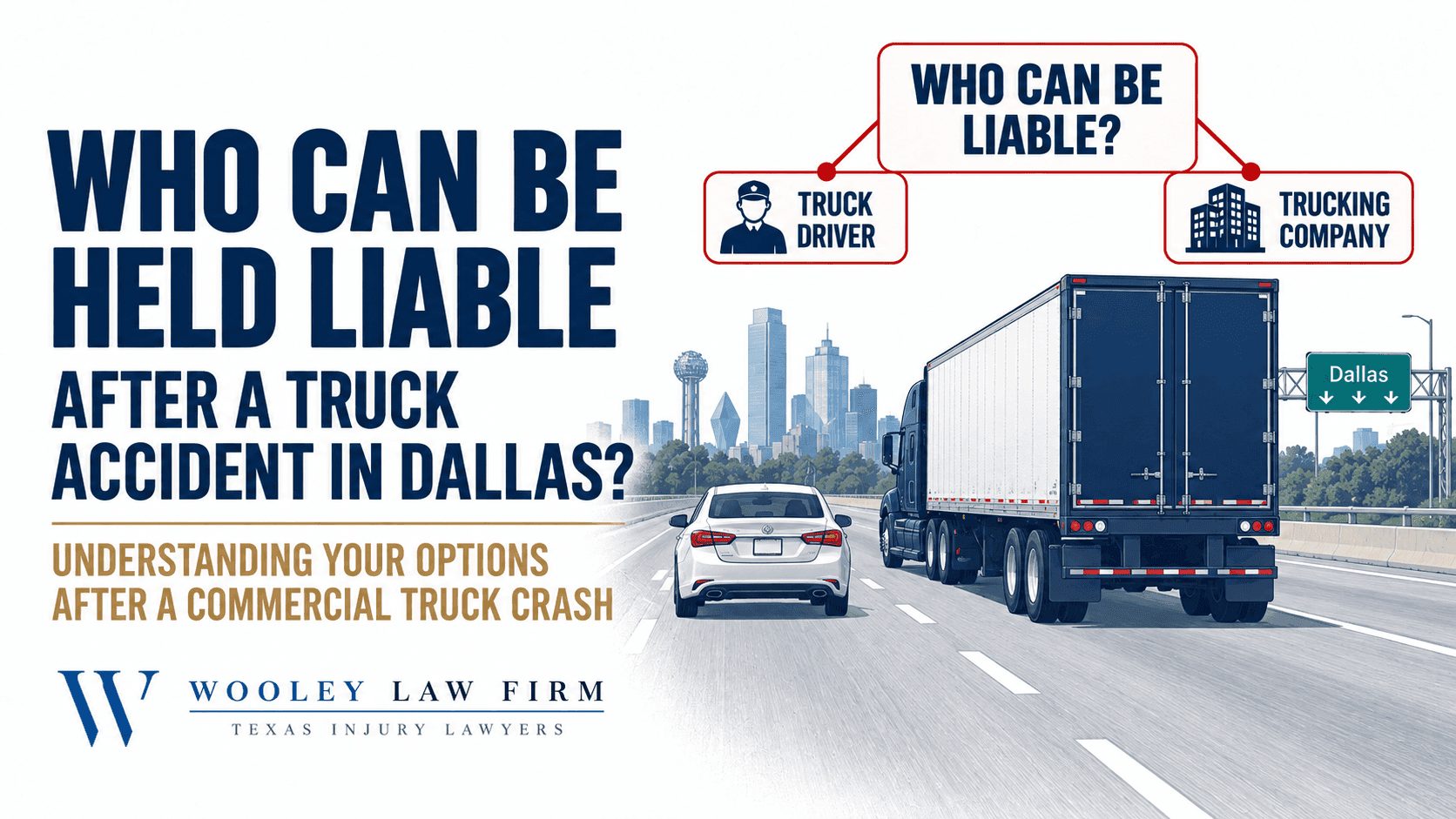
Who Can Be Held Responsible for a Dallas-Fort Worth Truck Wreck?
A commercial vehicle case should not stop with the name on the driver’s license.
Potentially responsible parties may include:
The Truck Driver
A driver may be negligent by speeding, following too closely, driving while distracted, making an unsafe turn, changing lanes improperly, driving while fatigued, or violating another safety rule.
The Motor Carrier or Trucking Company
The trucking company may be responsible for the driver’s conduct and for its own negligent acts, including unsafe hiring, training, supervision, retention, dispatching, inspection, or maintenance practices.
The Driver’s Employer
The company that employs the driver may not always be the same business identified on the truck. Employment and contracting records may be necessary to determine who controlled the driver’s work.
The Truck or Trailer Owner
A separate business may own or lease the tractor, trailer, delivery van, or other commercial vehicle.
A Delivery Company or Fleet Operator
Delivery companies may use employees, contractors, franchisees, logistics partners, or third-party fleet operators. The relationships between the businesses should be investigated rather than assumed.
A Broker or Shipper
A broker, shipper, or logistics company may be relevant depending on its role in selecting the carrier, controlling the transportation, setting the schedule, or loading the cargo.
A Cargo-Loading Company
A warehouse, loading contractor, or shipper may be responsible when improperly loaded or unsecured cargo contributes to the crash.
A Maintenance or Repair Company
A repair shop, maintenance contractor, or inspection provider may share responsibility when defective work or a missed safety problem causes the accident.
A Vehicle or Parts Manufacturer
A defective tire, brake component, steering system, coupling device, or other product may support a product-liability claim.
Identifying all responsible parties is important because each party may have separate insurance coverage, records, defenses, and legal responsibilities.
Delivery Truck and Contractor Cases Can Be Especially Complicated
Delivery vehicles may display the branding of a well-known company even though the driver technically works for another business.
These cases may involve:
Independent contractors;
Delivery-service partners;
Franchise operators;
Staffing companies;
Temporary drivers;
Vehicle leasing companies;
Logistics companies;
Multiple layers of insurance;
Contractual indemnity agreements.
The company whose name appears on the vehicle may argue that it did not employ the driver. Another company may argue that the driver was an independent contractor. The insurer may claim that a different policy should apply.
A proper investigation examines who hired the driver, who trained the driver, who controlled the route, who owned the vehicle, who set the delivery schedule, and who had the power to enforce safety rules.
How a Trial-Ready Truck Accident Law Firm Builds the Case
Sending Immediate Preservation Notices
Preservation demands should be tailored to the truck, companies, technology, and facts involved in the collision.
Inspecting the Vehicles and Scene
When appropriate, the truck, trailer, passenger vehicle, and crash location should be documented and inspected before conditions change.
Obtaining Electronic and Documentary Evidence
Relevant records may include logs, black box data, camera footage, GPS history, dispatch communications, maintenance records, personnel files, cargo documents, and company safety materials.
Identifying Every Company Involved
Corporate registrations, insurance filings, vehicle records, contracts, employment documents, and shipping records may help identify the responsible businesses.
Interviewing Witnesses
Witness memories can fade, phone numbers can change, and nearby surveillance footage can be overwritten. Witnesses should be identified and contacted promptly.
Investigating the Driver and Company
The investigation may include the driver’s history, prior safety violations, qualifications, training, employment status, previous accidents, and the company’s safety practices.
Working With Qualified Experts
Depending on the case, experts may be needed in:
Accident reconstruction;
Commercial vehicle operation;
Trucking safety;
Electronic data downloads;
Mechanical inspection;
Cargo securement;
Human factors;
Economics;
Life-care planning;
Medical causation.
Documenting the Injuries and Damages
A strong truck accident case must prove not only how the wreck happened but also how it changed the injured person’s life.
Evidence may include:
Emergency room records;
Diagnostic imaging;
Surgical records;
Specialist evaluations;
Physical therapy;
Prescription medication;
Future medical recommendations;
Lost wage documentation;
Employment records;
Tax records;
Photographs;
Testimony from family members;
Evidence of physical limitations;
Evidence of lost activities and diminished quality of life.
Injuries Caused by 18-Wheeler and Commercial Vehicle Wrecks
Because commercial vehicles are larger and heavier than passenger cars, truck accidents can cause catastrophic or fatal injuries.
Common injuries include:
Traumatic brain injuries;
Concussions;
Skull fractures;
Neck injuries;
Herniated or bulging discs;
Spinal cord injuries;
Paralysis;
Back injuries;
Shoulder injuries;
Clavicle fractures;
Arm fractures;
Wrist and hand injuries;
Rib fractures;
Internal bleeding;
Organ damage;
Pelvic fractures;
Hip injuries;
Knee injuries;
Leg fractures;
Foot and ankle injuries;
Burns;
Scarring and disfigurement;
Amputations;
Psychological trauma;
Wrongful death.
Symptoms may not be fully apparent at the scene. Adrenaline, shock, and the chaos following a collision can temporarily mask pain and neurological symptoms.
Seek medical attention promptly if you experience pain, dizziness, confusion, headaches, weakness, numbness, tingling, limited movement, breathing problems, abdominal pain, or other concerning symptoms after a truck wreck.
What Compensation May Be Available After a Texas Truck Accident?
The damages available depend on the facts, injuries, insurance coverage, and applicable law.
An injured victim may be entitled to pursue compensation for:
Past medical expenses;
Future medical care;
Lost wages;
Loss of earning capacity;
Physical pain;
Mental anguish;
Physical impairment;
Disfigurement;
Property damage;
Out-of-pocket expenses;
Other losses caused by the collision.
Families affected by a fatal 18-wheeler accident may also have claims involving wrongful death and survival damages.
Learn more in our complete guide to truck accident damages and what a Dallas 18-wheeler case may be worth.
No lawyer can responsibly determine the value of a case from the type of accident alone. The value depends on the evidence, available coverage, severity of the injuries, future medical needs, lost earning capacity, degree of impairment, liability disputes, and other case-specific considerations.
What to Do After an 18-Wheeler or Delivery Truck Accident
Call 911
Report the collision and request emergency medical assistance when needed. A police investigation can help document the vehicles, drivers, witnesses, roadway, and initial accounts.
Get Medical Care Immediately
Do not ignore symptoms or assume they will resolve without treatment. Prompt medical care protects your health and creates documentation connecting your symptoms to the collision.
Photograph the Scene
When it is safe, photograph or record:
All vehicles;
Damage to each vehicle;
License plates;
Company names and logos;
USDOT numbers;
Truck and trailer numbers;
Skid marks;
Debris;
Traffic signals;
Lane markings;
Road signs;
Cargo;
Visible injuries;
The surrounding crash scene.
Do not place yourself in danger to obtain photographs.
Identify Witnesses
Get the names and contact information of anyone who saw the collision or the truck’s behavior before impact.
Preserve Your Own Evidence
Save photographs, videos, damaged personal property, medical paperwork, receipts, towing records, rental records, missed-work documentation, and communications with insurance companies.
Do Not Give a Recorded Statement to the Trucking Insurer
The commercial carrier may contact you quickly. You are not required to help the trucking company build its defense.
Do Not Sign Broad Medical Authorizations
A broad authorization may allow the insurance carrier to search through years of unrelated medical history.
Avoid Posting About the Accident Online
Insurance companies and defense attorneys may review public social media posts. A photograph or comment can be taken out of context and used to challenge your injuries.
Follow Medical Recommendations
Attend appointments, complete prescribed therapy, obtain recommended testing, and tell your providers about ongoing or changing symptoms.
Contact a Dallas-Fort Worth Truck Accident Lawyer Early
The sooner an investigation begins, the greater the opportunity to identify the responsible parties and preserve electronic, physical, and documentary evidence.
How Long Do You Have to File a Truck Accident Claim in Texas?
Texas law generally imposes deadlines on personal injury and wrongful death lawsuits. However, the applicable deadline can vary based on the parties and facts involved.
Claims involving a governmental vehicle may require formal notice much earlier than the general lawsuit deadline. Claims involving minors, death, out-of-state defendants, or other unusual circumstances may also raise additional issues.
Waiting until the deadline approaches is especially dangerous in a truck case because important evidence may disappear long before the legal filing period expires.
Speak with an attorney promptly to determine which deadlines apply to your situation.
Why Choose The Wooley Law Firm After a DFW Truck Wreck?
The Wooley Law Firm represents injured Texans in serious truck and commercial vehicle cases.
We understand that these cases require more than submitting medical bills to an adjuster. A strong case may require preserving electronic data, investigating corporate relationships, reviewing safety records, identifying multiple insurance policies, consulting experts, taking depositions, and preparing the case for trial.
Our firm helps truck accident victims by:
Investigating the collision;
Sending preservation notices;
Identifying responsible parties;
Locating available insurance coverage;
Obtaining company and driver records;
Reviewing electronic data;
Documenting medical injuries and future needs;
Communicating with insurers;
Filing suit when necessary;
Preparing the case for trial.
You can learn more about our truck accident representation on our Dallas-Fort Worth 18-wheeler wrecks page.
Frequently Asked Questions About Dallas-Fort Worth Truck Accidents
Do I need a lawyer after an 18-wheeler accident?
You are not legally required to hire an attorney. However, serious truck accident cases can involve multiple companies, commercial insurance policies, federal records, electronic evidence, and aggressive defense teams. Early representation can help protect evidence and prevent avoidable mistakes.
What evidence is most important after a truck wreck?
Important evidence may include dash camera video, black box data, driver logs, GPS information, cellphone records, maintenance documents, driver qualification files, dispatch communications, cargo records, witness statements, vehicle inspections, and crash-scene evidence.
The most important evidence depends on how the collision happened.
How quickly can truck accident evidence disappear?
Some evidence may be lost or overwritten within days or weeks. Video systems and electronic platforms may retain information for limited periods. Trucks may also be repaired and returned to service quickly. Preservation efforts should begin as soon as reasonably possible.
Can I sue the trucking company instead of only the driver?
Possibly. The trucking company may be responsible for the driver’s negligence and may also be directly responsible for negligent hiring, training, supervision, retention, maintenance, dispatching, or safety practices.
What if the truck driver was an independent contractor?
Labeling a driver an independent contractor does not automatically resolve responsibility. The investigation should examine the actual relationships between the driver, carrier, delivery company, vehicle owner, and other businesses.
What if I was hit by an Amazon, FedEx, UPS, or other delivery vehicle?
Delivery claims may involve a driver, contractor, delivery fleet, logistics company, vehicle owner, and multiple insurers. The companies and insurance policies involved must be identified based on the facts rather than the logo displayed on the vehicle.
What if the trucking company says I was in the driver’s blind spot?
A blind spot does not automatically excuse an unsafe lane change or turn. Commercial drivers must make sure a movement can be completed safely. Camera footage, mirror positioning, lane markings, witnesses, vehicle damage, and electronic data may help determine what occurred.
Should I accept the trucking company’s first settlement offer?
You should understand your injuries, future treatment, lost earnings, available coverage, and long-term limitations before resolving your claim. Accepting an offer generally requires releasing the responsible parties from further liability.
What if I did not feel hurt immediately?
Some neck, back, head, and orthopedic injuries become more noticeable after the initial adrenaline wears off. Seek appropriate medical care when symptoms develop and explain when and how they began.
Can a low-speed commercial truck accident cause a serious injury?
Yes. The size and weight of an 18-wheeler, box truck, or commercial vehicle can cause significant injuries even when the collision occurs at a relatively low speed.
How much does it cost to hire The Wooley Law Firm?
Truck accident cases are handled on a contingency-fee basis. You do not pay attorney fees unless we obtain a recovery for you.
Speak With a Dallas-Fort Worth 18-Wheeler Accident Lawyer
A trucking company may already be collecting evidence and building its defense. You should have someone working to protect your interests too.
The Wooley Law Firm represents people injured in 18-wheeler, semi-truck, tractor-trailer, box truck, delivery van, dump truck, and other commercial vehicle accidents throughout Dallas-Fort Worth and across Texas.
We move quickly to preserve driver logs, electronic logging information, telematics, black box data, dash camera footage, maintenance records, dispatch communications, safety files, and other evidence before it disappears.
Call (214) 699-6524 for a free consultation or visit our Dallas truck accident lawyer page.
You do not pay unless we win.
Disclaimer
This article is provided for general informational purposes and does not constitute legal advice. Every case is different. Prior results do not guarantee a similar outcome. Contact a qualified attorney regarding the specific facts and deadlines applicable to your claim.
Topics
Share This Article

Andrew J. Wooley
Personal Injury Attorney
Andrew J. Wooley is a dedicated personal injury attorney based in Dallas, Texas. He focuses on helping accident victims recover fair compensation for their injuries. With a commitment to personalized service, Andrew works directly with each client to understand their unique situation and fight for their rights.