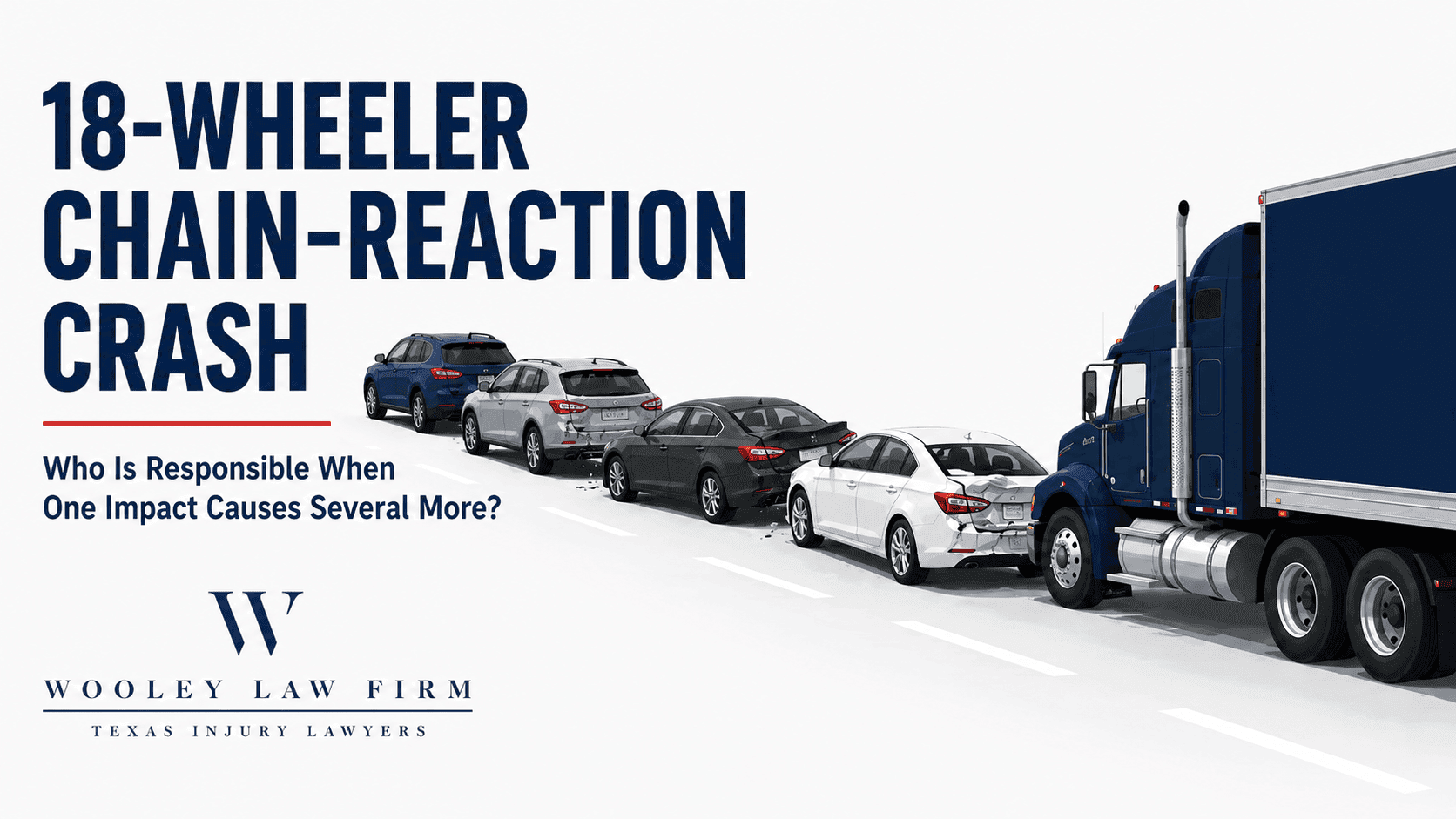
A chain-reaction crash involving an 18-wheeler can happen in seconds.
Traffic may be stopped on I-35E, I-30, I-20, US-75, or I-635 when a tractor-trailer approaches from behind and fails to stop. The truck crashes into one car, that car is pushed into another, and within moments several vehicles may be involved.
If you were injured in an 18-wheeler chain-reaction accident in Dallas, the insurance company may focus on the vehicle that physically struck you.
But that may not be the vehicle that actually caused the wreck.
The critical question is often:
What started the chain reaction?
When an 18-wheeler creates the initial impact and forces several vehicles into one another, the truck driver, trucking company, and potentially other companies may bear responsibility for injuries caused throughout the crash sequence.
The Wooley Law Firm represents people seriously injured in Dallas and throughout North Texas in collisions involving commercial trucks. Learn more about how we investigate these cases on our Dallas 18-wheeler accident lawyer page.
How Does an 18-Wheeler Cause a Chain-Reaction Accident?
One common scenario happens when traffic ahead of an 18-wheeler has slowed or completely stopped.
For example:
Vehicle A is stopped in Dallas traffic.
Vehicle B is stopped behind Vehicle A.
Vehicle C is stopped behind Vehicle B.
An 18-wheeler approaches from behind without slowing enough.
The truck crashes into Vehicle C.
Vehicle C is pushed into Vehicle B.
Vehicle B is then pushed into Vehicle A.
Someone sitting in Vehicle A may technically have been hit by Vehicle B.
But Vehicle B may never have struck Vehicle A if the 18-wheeler had not slammed into the vehicles from behind.
That distinction matters.
A chain-reaction truck wreck should be investigated from the first impact through the final impact, rather than simply looking at which vehicle contacted which bumper.
This type of collision is closely related to the serious rear-end wrecks discussed in our guide for people who have been rear-ended by an 18-wheeler in Dallas.
The Last Vehicle That Hit You May Not Be the Vehicle That Caused Your Accident
One of the biggest mistakes in investigating a multi-vehicle wreck is focusing only on the final impact.
Imagine you are stopped at a red light.
The car behind you is also stopped.
An 18-wheeler crashes into that car at highway speed and drives it forward into the back of your vehicle.
The damage to your vehicle shows that the passenger car hit you from behind.
But that does not necessarily mean the passenger-car driver caused the collision.
That driver may have been sitting completely still and had no opportunity to prevent the impact.
The real cause may have been the truck driver's failure to:
Maintain a safe following distance;
Control the truck's speed;
Pay attention to traffic ahead;
Recognize stopped traffic;
Brake in time;
Account for the truck's stopping distance; or
Properly respond to congestion or changing road conditions.
That is why photographs of only two vehicles rarely tell the entire story in a major chain-reaction truck accident.
Investigators need to understand where every vehicle was before the first impact and how each vehicle moved afterward.
Who Can Be Responsible for a Dallas 18-Wheeler Chain-Reaction Crash?
There may be several potentially responsible parties.
The 18-Wheeler Driver
The truck driver may be responsible if negligent driving started the collision sequence.
Possible causes include:
Following too closely;
Speeding;
Failing to control speed;
Distracted driving;
Cellphone use;
Driver fatigue;
Falling asleep;
Failing to watch traffic ahead;
Improper braking;
Driving too fast for traffic or weather conditions; or
Making an unsafe lane change immediately before the wreck.
A truck driver's claim that traffic "stopped suddenly" does not end the investigation. Commercial drivers must operate their vehicles in a manner that allows them to respond safely to traffic conditions ahead.
The Trucking Company
The trucking company may also be legally responsible depending on the facts.
Relevant issues may include:
Hiring an unsafe or unqualified driver;
Inadequate driver training;
Poor supervision;
Allowing excessive driving hours;
Pressuring drivers to meet unrealistic delivery schedules;
Failing to discipline unsafe drivers;
Negligent maintenance;
Ignoring known brake or tire problems; or
Other company practices that contributed to the crash.
A serious truck accident should therefore involve more than simply obtaining the driver's insurance information.
The relationships between the driver, motor carrier, tractor owner, trailer owner, maintenance contractors, and other businesses should be investigated.
A Maintenance or Repair Company
Sometimes the driver claims:
"I tried to stop, but the brakes didn't work."
That explanation can expand the investigation.
If brake failure contributed to the chain reaction, maintenance records may reveal whether:
The brakes had been inspected;
Brake defects had previously been reported;
Repairs had been recommended but delayed;
Brake components were improperly adjusted;
Worn parts were not replaced; or
A repair company performed inadequate work.
A truck's mechanical condition can be especially important when the wreck begins with a tractor-trailer failing to stop for traffic.
Another Driver
Not every chain-reaction collision has only one responsible party.
For example, another driver may have made an unsafe lane change immediately in front of the truck, or another vehicle may have contributed to a separate impact within the larger collision.
Texas law allows responsibility in many negligence cases to be allocated among multiple parties based on their respective contributions to the harm.
The important point is that liability should be determined from the evidence—not simply from the order in which the vehicles ended up after the crash.
Chain-Reaction Truck Wrecks Can Involve Multiple Insurance Claims
Multi-vehicle collisions can quickly become complicated because several insurance companies may become involved.
There could be coverage associated with:
The tractor;
The trailer;
The trucking company;
Another commercial entity;
Individual passenger vehicles;
Your own auto insurance policy; or
Other responsible parties depending on the circumstances.
Each insurer may conduct its own investigation.
And each insurance company has an incentive to minimize what its insured is accused of causing.
For example, the trucking company's insurer may argue that the truck only caused the first collision and that later impacts were caused by other motorists.
Another driver's insurer may argue its insured had no control over the vehicle because it had already been pushed forward by the truck.
Meanwhile, an injured person may receive calls from several adjusters asking for statements about a wreck that happened in only a few seconds.
You should be cautious about assuming that the first insurance company's explanation of the accident is correct.
Injured in an Accident?
Free consultation. Tell us what happened and learn what options may be available.
One Insurance Company May Try to Blame Another
Chain-reaction wrecks create opportunities for insurers to point fingers at each other.
You may hear arguments such as:
"Our driver only hit the vehicle immediately in front of him."
"Another vehicle caused your impact."
"There were multiple separate collisions."
"Your vehicle had already been hit before our insured became involved."
"The driver behind you caused your injuries."
"The truck couldn't have caused all of the damage."
"We only accept responsibility for the first impact."
Those claims need to be tested against the physical and electronic evidence.
A collision reconstruction may show that the 18-wheeler supplied the force that propelled multiple stopped cars forward.
The vehicle directly behind you may have been nothing more than the object through which that force was transferred.
Evidence Can Show How the Chain Reaction Actually Happened
A serious Dallas multi-vehicle truck wreck should be reconstructed carefully.
Important evidence may include:
Police crash reports;
Photographs of every involved vehicle;
Dash-camera footage;
Nearby surveillance video;
Traffic-camera footage;
Witness statements;
911 calls;
Police body-camera footage;
Measurements from the roadway;
Skid or tire marks;
Debris locations;
Vehicle crush patterns;
Event data recorder information; and
Accident reconstruction analysis.
Commercial trucks may contain even more valuable information.
Truck Black-Box and Electronic Data
Electronic truck information may help determine:
Truck speed before impact;
Whether the driver applied the brakes;
When braking began;
Changes in speed;
Throttle position;
Engine information;
GPS location; and
Other vehicle-operation information depending on the system involved.
Read more about 18-wheeler black-box data after a Dallas-Fort Worth truck wreck.
The firm's broader guide to evidence that can help prove an 18-wheeler wreck claim also explains why electronic records and company documents should be identified early.
Onboard and Dash Cameras
Many commercial trucks use forward-facing or driver-facing camera systems.
Video may show:
Traffic was stopped well before impact;
When the driver should have seen the stopped vehicles;
Whether brake lights were visible;
Whether the truck driver was distracted;
Whether another vehicle cut in front of the truck; and
The exact sequence of impacts.
Video can be particularly powerful when several drivers remember the wreck differently.
Electronic Logs and Driver Records
Investigators may also examine:
Electronic logging-device records;
Hours-of-service information;
Dispatch messages;
GPS and telematics records;
Driver qualification files;
Training documents;
Prior safety violations; and
Relevant company policies.
Evidence preservation can become important quickly because electronic information and video may not be retained indefinitely.
Damage to Each Vehicle Can Help Reconstruct the Crash
Vehicle damage frequently tells part of the story.
Suppose four cars were stopped in a line.
After an 18-wheeler crashes into the fourth car:
The fourth car has severe rear and front damage;
The third car has rear and front damage;
The second car has rear and front damage; and
The first car has rear damage.
That pattern may be consistent with force traveling forward through a line of vehicles.
Investigators may compare:
Crush depth;
Damage height;
Impact locations;
Paint transfer;
Broken components;
Airbag deployment;
Seat-belt information; and
Electronic vehicle data.
No single piece of damage necessarily proves the entire case. The evidence should be considered together.
Why Witnesses Matter in Multi-Vehicle Truck Wrecks
Witnesses positioned farther away from the collision sometimes have the clearest view of how it started.
A driver several vehicles ahead may have heard one major impact followed almost immediately by several additional impacts.
A driver in the next lane may have watched the truck approach stopped traffic without slowing.
Someone behind the truck may have seen whether the truck's brake lights came on.
These witnesses may help establish whether there was one continuous chain reaction or several unrelated impacts.
Their contact information should be obtained as early as reasonably possible.
Chain-Reaction Wrecks Can Cause Serious Injuries
A person caught in a multi-impact collision may experience forces from more than one direction.
A vehicle may be struck from behind and then pushed into another car moments later.
Potential injuries can include:
Traumatic brain injuries;
Concussions;
Neck injuries;
Back injuries;
Herniated or bulging discs;
Spinal cord injuries;
Shoulder injuries;
Knee injuries;
Broken bones;
Internal injuries;
Nerve damage;
Crush injuries; and
Permanent impairment.
Some truck collisions cause injuries that affect a person for years or permanently. Our article on life-changing injuries after a Dallas-Fort Worth truck wreck discusses these serious conditions in more detail.
What If I Was the First Car in the Chain Reaction?
Being several vehicles away from the truck does not automatically prevent you from pursuing a claim against the party that started the collision.
Suppose you were stopped three cars ahead of the 18-wheeler.
You never physically touched the truck.
But the evidence shows:
Truck → Car 1 → Car 2 → Your Vehicle
The truck's initial impact may still have caused the collision that injured you.
The investigation needs to establish the complete sequence.
What If the Police Report Blames the Car That Hit Me?
A police crash report can be useful evidence, but it should not automatically be treated as the final word about responsibility.
Officers usually arrive after the collision.
In a multi-vehicle pileup, the scene can be confusing. Vehicles may have moved, drivers may have different accounts, and witnesses may leave before being interviewed.
The report may not include commercial-truck electronic data, onboard video, cellphone records, maintenance documents, or later reconstruction evidence.
That is why a truck-wreck investigation may continue well beyond the initial crash report.
What Should I Do After an 18-Wheeler Chain-Reaction Crash in Dallas?
After obtaining necessary emergency care and ensuring the crash has been reported, it may be helpful to preserve as much information as possible.
When reasonably possible:
Photograph every involved vehicle;
Photograph the truck and trailer;
Photograph license plates and company markings;
Save your dash-camera video;
Identify witnesses;
Keep copies of the crash report and related paperwork;
Preserve photographs and videos from your phone;
Keep information from every insurer that contacts you;
Avoid signing releases you do not fully understand; and
Consider speaking with a Dallas truck accident attorney before important evidence disappears.
Commercial truck cases can involve evidence that ordinary passenger-car wrecks do not.
The sooner the entire sequence can be reconstructed, the harder it may be for an insurer to reduce a five-vehicle chain reaction to one misleading photograph of the final impact.
How a Dallas Truck Wreck Lawyer Can Investigate a Chain-Reaction Crash
When several vehicles and insurers are involved, one of the lawyer's most important jobs is determining what actually happened before arguing about who should pay.
A truck accident investigation may include:
Identifying every driver, vehicle, owner, trucking company, and insurer;
Determining the order of impacts;
Locating witnesses and available video;
Preserving the tractor and trailer;
Requesting truck electronic and black-box data;
Obtaining driver logs and dispatch information;
Investigating the driver's training and driving history;
Reviewing inspection and maintenance records;
Analyzing vehicle damage;
Consulting qualified reconstruction experts when necessary; and
Determining whether more than one person or company contributed to the crash.
The goal should be to identify the event that started the chain reaction, not simply the vehicle that happened to hit you last.
Frequently Asked Questions About Dallas 18-Wheeler Chain-Reaction Accidents
Is the driver who rear-ended me automatically responsible?
No. If that driver's vehicle was stopped and was pushed into you by an 18-wheeler, the driver may have had no realistic opportunity to avoid the collision. The entire sequence must be investigated.
Can the trucking company be responsible even if the truck never touched my car?
Potentially. Physical contact between your vehicle and the 18-wheeler is not necessarily required if the evidence establishes that negligent operation of the truck caused the sequence of events that resulted in your injuries.
What if several drivers contributed to the wreck?
Texas proportionate-responsibility law may apply when more than one person or entity contributed to the harm. Responsibility depends on the particular evidence and circumstances of the case.
Why does truck black-box data matter in a chain-reaction crash?
Electronic information may help establish the truck's speed and braking behavior before the first collision. That can be particularly important when the trucking company argues traffic stopped too suddenly for its driver to respond.
Can there be more than one insurance claim?
Yes. A multi-vehicle crash may involve several drivers, companies, and insurance policies. Determining which policies may apply requires identifying who contributed to causing the wreck and the relationships among the commercial entities involved.
Should I give every insurance company a recorded statement?
Use caution. Each insurance adjuster represents the interests of the insurer handling that particular claim. Before giving multiple recorded statements or signing releases, consider obtaining advice about how those statements could affect your claims.
Injured in an 18-Wheeler Chain-Reaction Accident in Dallas?
If an 18-wheeler crashed into stopped or slowing traffic and caused a chain-reaction accident, do not assume the vehicle that physically struck you was the vehicle responsible for the wreck.
The first impact may be the most important impact.
The Wooley Law Firm represents people injured in serious truck accidents throughout Dallas-Fort Worth and Texas. We can investigate the collision sequence, identify the trucking companies and insurers involved, and work to preserve evidence that may establish how the wreck actually began.
Call (214) 699-6524 for a free consultation or contact The Wooley Law Firm online.
You don't pay unless we win.
Disclaimer
This article is for general informational purposes only and is not legal advice. Reading it does not create an attorney-client relationship. Every case is different, and past results do not guarantee a similar outcome.
Topics
Share This Article

Andrew J. Wooley
Personal Injury Attorney
Andrew J. Wooley is a dedicated personal injury attorney based in Dallas, Texas. He focuses on helping accident victims recover fair compensation for their injuries. With a commitment to personalized service, Andrew works directly with each client to understand their unique situation and fight for their rights.