If an 18-wheeler rear-ends a stopped or slowing vehicle, one of the most important questions is simple:
Why didn't the truck stop?
On newer commercial trucks, the answer may be buried in the truck's electronic systems.
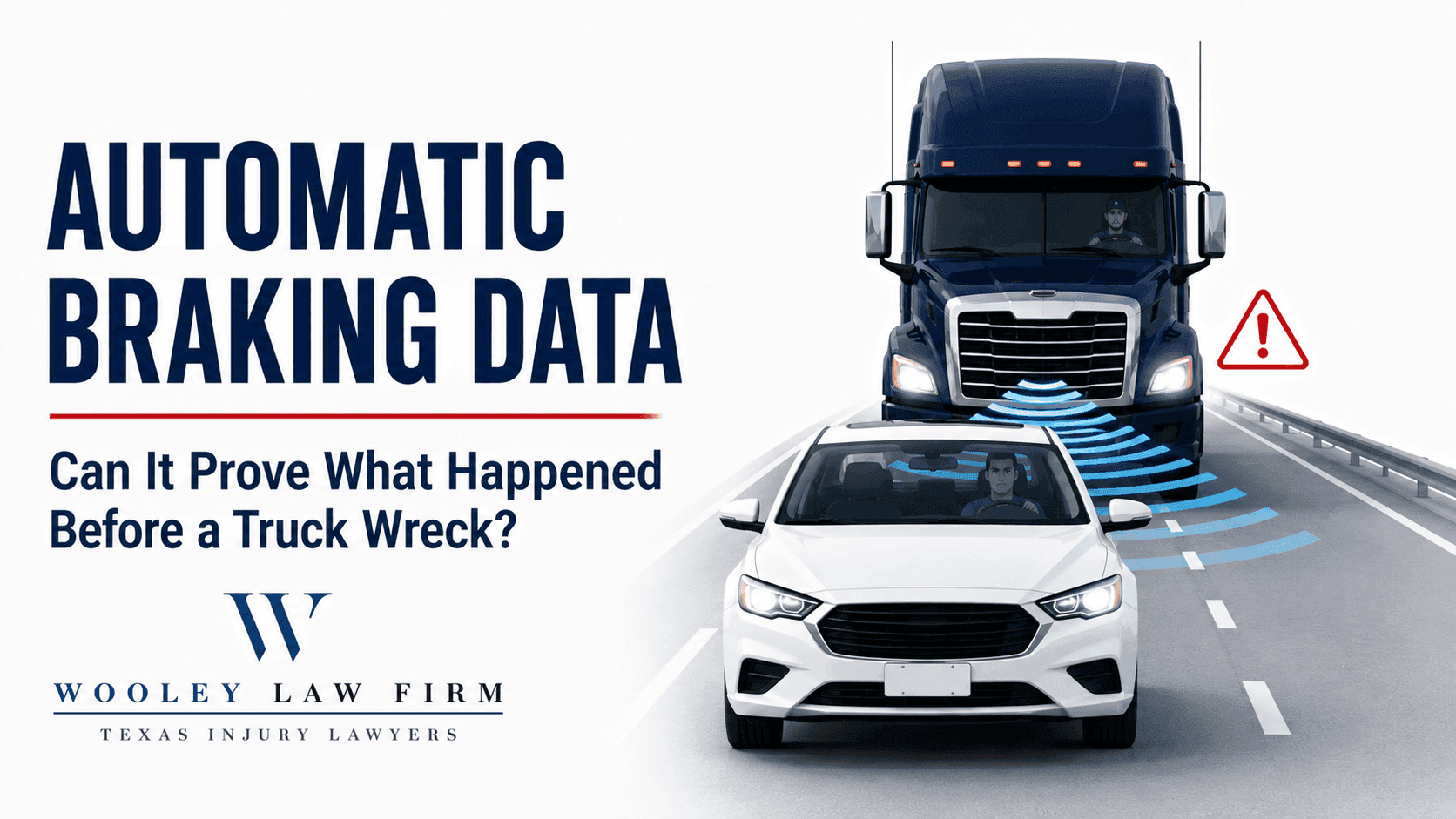
Many tractor-trailers are equipped with advanced driver-assistance technology such as forward-collision warning and automatic emergency braking (AEB). These systems may detect traffic ahead, warn the driver that a collision is becoming likely, and—in some situations—automatically apply the brakes.
After a serious truck accident, truck automatic braking accident evidence may help answer critical questions:
Did the truck detect the vehicle ahead?
Did the system issue a collision warning?
How long before impact did the warning occur?
Did the truck driver respond to the warning?
Did the driver apply the brakes?
Did automatic emergency braking activate?
How much did the truck slow before impact?
Was the system operating properly?
Were there fault codes, disabled features, or prior warnings?
This type of evidence can be especially important in a Dallas rear-end truck wreck where the driver claims that traffic "stopped suddenly" or that there was nothing the driver could have done to avoid the collision.
If you have been seriously injured in a commercial truck collision, learn more about how a Dallas 18-wheeler accident lawyer can investigate the truck's electronic evidence.
What Is Forward-Collision Warning on an 18-Wheeler?
A forward-collision warning system, sometimes called FCW, monitors the roadway in front of the truck.
Depending on the system, it may use:
Radar
Forward-facing cameras
Other electronic sensors
Vehicle-speed information
Distance measurements
Closing-speed calculations
The system evaluates whether the truck is approaching another vehicle too quickly.
According to the National Highway Traffic Safety Administration, forward-collision warning technology detects a potential collision with a vehicle ahead and warns the driver.
The important distinction is that a collision warning generally alerts the driver—it does not necessarily stop the truck for the driver.
That distinction can matter after a serious wreck.
If the system warned the truck driver several seconds before impact but the driver did nothing, investigators may need to determine why.
Was the driver:
Looking at a cellphone?
Looking at a dispatch device?
Falling asleep?
Looking away from traffic?
Following too closely?
Traveling too fast?
Distracted by something inside the cab?
The warning itself may become an important piece of the collision timeline.
What Is Automatic Emergency Braking?
Automatic emergency braking goes a step further.
NHTSA explains that AEB can automatically apply a vehicle's brakes when a forward collision is imminent.
In a commercial truck, the system may detect an impending rear-end crash and either:
Apply the brakes when the driver has not responded; or
Add braking force when the driver's braking is insufficient.
NHTSA and FMCSA have specifically studied AEB for heavy trucks because of its potential to reduce the frequency and severity of rear-end commercial-vehicle collisions. The agencies explained in their heavy-vehicle rulemaking proposal that AEB systems can use multiple sensors to recognize a crash-imminent situation and automatically brake when necessary.
But AEB is a driver-assistance system, not permission for a commercial driver to stop paying attention.
A professional truck driver is still responsible for maintaining a proper lookout, controlling speed, maintaining adequate following distance, and responding to changing traffic conditions.
What Automatic Braking Data Could Show After a Truck Accident
There is not one universal "AEB report" stored identically on every tractor-trailer.
The available information depends on the manufacturer, model, components, software, motor carrier's telematics setup, and other systems installed on the truck.
But an investigation may uncover electronic information relating to:
Forward-Collision Warnings
The system may contain information showing that it identified a potential collision or issued an alert.
That can help establish when the truck's own technology recognized the hazard ahead.
Automatic Brake Activation
Investigators may be able to determine whether automatic emergency braking activated before the crash.
If so, the evidence may help determine:
When braking started
How aggressively the truck braked
Whether the truck slowed
Whether driver braking occurred before or after automated braking
Truck Speed
The truck's electronic systems may contain speed information immediately before impact.
This evidence can be compared against:
The speed limit
Traffic conditions
Dash-camera footage
Physical evidence
Witness statements
Other vehicle data
Driver Brake Application
Electronic control module or event information may show whether the driver applied the service brakes.
Our guide to 18-wheeler black-box data after a Dallas-Fort Worth truck wreck explains how electronic truck data may provide evidence about speed, braking, throttle use, cruise control, and other vehicle operations.
Injured in an Accident?
Free consultation. Tell us what happened and learn what options may be available.
Fault Codes and System Status
The investigation should also determine whether the collision-warning or automatic-braking system was functioning properly.
Potential questions include:
Was the system turned on?
Had the system been disabled?
Were sensors blocked or damaged?
Were there active fault codes?
Had the system generated prior warnings?
Had drivers complained about the system?
Was maintenance recommended but not performed?
The answers may lead to additional maintenance, inspection, training, or company records that should be obtained.
Did the Truck Warn the Driver Before Impact?
This may be one of the most important questions in a rear-end 18-wheeler case.
Imagine a truck driver says:
"Traffic stopped so suddenly that I had no time to react."
But the truck's collision-avoidance system recorded a warning before the collision.
That evidence may raise additional questions:
How early did the truck detect the danger?
What was the driver doing when the warning occurred?
Did the driver brake immediately?
Did the driver ignore the warning?
Was the driver even looking at the roadway?
The electronic warning should be analyzed alongside the truck's speed, braking data, dash-camera video, cellphone records, GPS information, driver-facing video, and physical crash evidence.
A single piece of data rarely tells the whole story.
AEB Data Can Be Especially Important in Rear-End 18-Wheeler Wrecks
Automatic-braking evidence can be particularly useful when an 18-wheeler crashes into vehicles stopped for:
A red light
Dallas highway congestion
Construction
An earlier wreck
A traffic backup
A school bus
Railroad traffic
Emergency vehicles
Stop-and-go freeway conditions
Dallas highways such as I-35E, I-30, I-20, I-635, I-45, and U.S. 75 can quickly go from highway speeds to stopped traffic.
When a commercial driver approaches stopped traffic, the investigation should not simply accept the explanation that "everyone stopped suddenly."
Our guide for people rear-ended by an 18-wheeler in Dallas discusses the electronic, video, braking, and other evidence that should be examined after these collisions.
Automatic Braking Data Should Be Compared With Dash-Camera Video
Electronic data becomes even more powerful when it can be synchronized with video.
A forward-facing truck camera may show:
When stopped traffic became visible
Brake lights ahead
The distance between the truck and traffic
Construction warning signs
Weather conditions
Lane position
Whether another vehicle actually cut in front of the truck
Driver-facing video may show whether the truck driver was:
Looking down
Using a cellphone
Appearing tired
Eating
Reaching for something
Looking toward another part of the cab
Otherwise distracted
The injured person's dash camera may provide another independent view.
Read more about how dash-camera evidence can help after a Dallas car or truck wreck.
The Trucking Company Should Preserve the Entire Collision-Avoidance System
After a serious wreck, a preservation request should not be limited to asking for the truck's "black box."
Modern commercial vehicles can contain data across multiple systems.
Depending on the truck and crash, evidence that should be investigated may include:
Automatic emergency braking data
Forward-collision warning records
Collision-mitigation system data
Electronic control module data
Event data
Fault-code histories
Radar or sensor information
Forward-facing video
Driver-facing video
GPS and telematics records
Electronic logging device information
Vehicle speed
Brake application
Throttle position
Cruise-control information
Maintenance records
Diagnostic records
Software or calibration information
Inspection reports
Driver training materials
Electronic information can potentially be overwritten, lost, or changed as the truck continues operating.
That makes early preservation important.
What If the Automatic Braking System Did Not Work?
The fact that a truck had automatic emergency braking does not mean it would necessarily prevent every crash.
The investigation may need to determine whether:
The system detected the vehicle
The system activated
The system operated as designed
Sensors were properly maintained
The driver overrode or disabled a feature
A mechanical problem affected braking
A repair or maintenance issue contributed
The collision was outside the system's operating capabilities
Depending on what the investigation shows, potential responsibility may extend beyond the truck driver.
It could involve the motor carrier, maintenance provider, truck owner, component manufacturer, or another company—but liability always depends on the specific facts.
The Truck Driver's Story Should Be Tested Against the Electronic Evidence
Truck wreck claims often involve conflicting versions of what happened.
A driver may say:
"The car stopped suddenly."
"The car cut me off."
"I immediately hit the brakes."
"I was going the speed limit."
"I couldn't have avoided it."
"The brakes didn't work."
Those statements can be tested.
Automatic-braking data, black-box information, cameras, physical evidence, GPS records, and witness testimony may provide a second-by-second picture of what actually occurred.
After a serious Dallas truck wreck, the trucking company's version should not be accepted before the available electronic evidence is preserved and analyzed.
How a Dallas Truck Wreck Lawyer Can Help Preserve AEB Evidence
A serious commercial-truck collision requires more than obtaining a police report.
A Dallas truck wreck attorney can work to:
Identify the tractor and motor carrier
Send preservation demands
Prevent relevant electronic evidence from being overwritten
Preserve the tractor for inspection when appropriate
Request collision-warning and AEB information
Obtain ECM and event data
Preserve dash-camera footage
Obtain GPS and telematics information
Review driver logs
Investigate cellphone and dispatch records
Obtain maintenance and diagnostic records
Review driver training
Work with qualified truck and crash-reconstruction experts
Compare electronic data with the physical collision evidence
The Wooley Law Firm represents people seriously injured in 18-wheeler and commercial truck wrecks in Dallas, throughout the Dallas-Fort Worth area, and across Texas.
Learn more about our Dallas truck accident practice.
Frequently Asked Questions About Automatic Braking Evidence
Can automatic emergency braking data prove a truck driver was distracted?
Not necessarily by itself. But if the system issued a warning and the driver failed to respond, that evidence can be examined alongside driver-facing video, cellphone records, dash-camera footage, braking information, and other evidence to determine whether distraction contributed to the wreck.
Can AEB data prove the truck driver did not brake?
Depending on the truck and available systems, electronic information may help establish when the brakes were applied and whether automated or driver braking occurred. ECM, event, telematics, and collision-mitigation data should be evaluated together.
Does every 18-wheeler have automatic emergency braking?
No. Equipment varies based on the truck's age, manufacturer, configuration, and installed safety systems. NHTSA and FMCSA proposed federal heavy-vehicle AEB requirements in 2023, but the existence and capabilities of AEB should be determined for the specific truck involved in the collision.
Can automatic emergency braking completely prevent a truck wreck?
Not always. AEB may avoid some crashes or reduce impact speed in others. System capabilities depend on factors including speed, detection, road conditions, equipment, and the specific collision scenario.
How quickly should AEB and truck electronic data be preserved?
As quickly as reasonably possible. Electronic data and video may be overwritten as equipment continues operating. The tractor may also be repaired or returned to service.
Injured in an 18-Wheeler Wreck in Dallas?
If you or a family member suffered serious injuries in a Dallas 18-wheeler accident, the truck may contain evidence that tells a very different story from the driver's explanation.
The investigation should determine not only whether the driver hit the brakes, but also whether the truck recognized the danger, warned the driver, automatically applied braking, and slowed before impact.
The Wooley Law Firm investigates serious truck wrecks throughout Dallas-Fort Worth and Texas.
Call (214) 699-6524 for a free consultation. You don't pay unless we win.
Disclaimer
This article is for general informational purposes only and is not legal advice. Reading it does not create an attorney-client relationship. Every case is different, and past results do not guarantee a similar outcome.
Topics
Share This Article

Andrew J. Wooley
Personal Injury Attorney
Andrew J. Wooley is a dedicated personal injury attorney based in Dallas, Texas. He focuses on helping accident victims recover fair compensation for their injuries. With a commitment to personalized service, Andrew works directly with each client to understand their unique situation and fight for their rights.