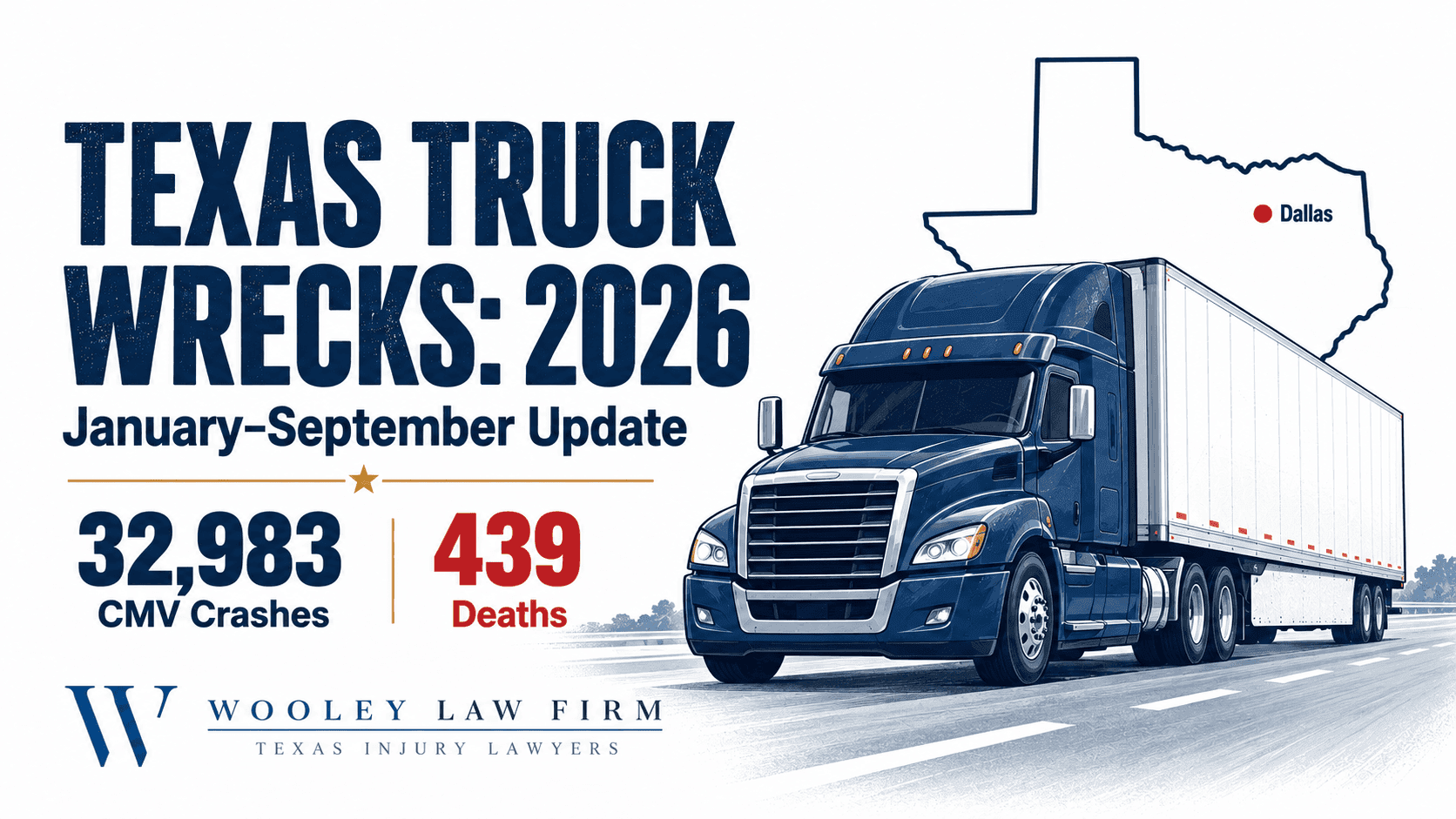
Texas recorded 32,983 crashes involving commercial motor vehicles from January 1 through September 30, 2026, resulting in 439 deaths and 11,545 injuries. Compared with the same nine months in 2025, reported commercial vehicle crashes increased approximately 0.5%, while deaths increased 8.1%.
Dallas recorded fewer commercial vehicle crashes, but several surrounding communities experienced substantial increases. Northlake, Forest Hill, Waxahachie and Mesquite all reported more CMV wrecks than during the same period in 2025.
This report follows our first-half analysis of Texas truck wrecks and cities with the biggest increases. It extends the comparison through September and examines how the third quarter compared with the first and second quarters of 2026.
The Wooley Law Firm represents clients involved in some of the truck and commercial vehicle wrecks reported across Texas. For our clients, these collisions involve medical treatment, missed work and uncertainty about recovery. Our work includes investigating what happened, preserving evidence, identifying responsible parties and pursuing compensation for the harm caused.
If you were injured in North Texas, learn more about your options on our Dallas truck accident lawyer page.
Texas Commercial Vehicle Crashes Increased Slightly, but Deaths Rose 8.1%
The January–September comparison shows:
Crashes: Increased from 32,807 in 2025 to 32,983 in 2026—176 additional crashes, or approximately 0.5%.
Deaths: Increased from 406 to 439—33 additional deaths, or approximately 8.1%.
Injuries: Decreased from 11,584 to 11,545—39 fewer injuries, or approximately 0.3%.
Suspected serious injuries: Decreased from 1,209 to 1,194—15 fewer, or approximately 1.2%.
Suspected serious injuries are included in the total injury count and should not be added to it. Deaths are reported separately.
The increase in deaths was substantially larger than the increase in crash counts. However, those totals do not establish why fatalities increased or identify the cause of any individual wreck.
These figures come from two Texas Department of Transportation Crash Records Information System query exports, both reflecting reports received and processed as of October 16, 2026. Both use the commercial motor vehicle flag and matching January 1–September 30 date ranges.
More information about these records is available through TxDOT’s crash-data analysis and statistics resources.
How Did Third-Quarter 2026 Truck Wrecks Compare With Q1 and Q2?
The updated dataset reports:
First quarter, January–March: 10,847 CMV crashes, 131 deaths and 3,681 injuries, including 385 suspected serious injuries.
Second quarter, April–June: 11,087 CMV crashes, 172 deaths and 3,929 injuries, including 403 suspected serious injuries.
Third quarter, July–September: 11,049 CMV crashes, 136 deaths and 3,935 injuries, including 406 suspected serious injuries.
Q3 Compared With Q1
Third-quarter crashes increased by 202, or approximately 1.9%, compared with the first quarter.
Deaths increased by five, or 3.8%. Injuries increased by 254, or 6.9%, while suspected serious injuries increased by 21, or 5.5%.
Q3 Compared With Q2
Third-quarter crashes decreased by 38, or approximately 0.3%, compared with the second quarter.
Deaths decreased from 172 to 136, a 20.9% decline. Injuries increased by six, or approximately 0.2%, while suspected serious injuries increased by three, or 0.7%.
The second quarter had the highest death toll. The third quarter had the highest reported injury total, although it was only slightly higher than Q2.
Quarter Length Matters When Comparing Crash Totals
The quarters contained different numbers of days. CMV crashes averaged approximately:
Q1: 120.5 per day across 90 days.
Q2: 121.8 per day across 91 days.
Q3: 120.1 per day across 92 days.
Although Q3 had more total crashes than Q1, its daily average was slightly lower. Daily averages account for quarter length, but they do not account for traffic volume or miles traveled.
Dallas Truck Wrecks Declined, but Several DFW Cities Saw Increases
Dallas recorded 1,743 CMV crashes, compared with 1,843 during January–September 2025. That was a decline of 100 crashes, or approximately 5.4%.
Dallas nevertheless had the third-highest city total in Texas, behind Houston and San Antonio.
Fort Worth recorded 1,148 CMV crashes, up from 1,136—an increase of 12, or approximately 1.1%.
Several surrounding North Texas communities experienced larger increases.
Northlake: 130.4% Increase
Northlake’s reported CMV crashes increased from 23 to 53, adding 30 crashes.
Northlake had the largest percentage increase among Texas cities with at least 10 CMV crashes during the 2025 comparison period. That threshold helps avoid rankings dominated by changes from only one or two crashes.
Forest Hill: 66.0% Increase
Forest Hill in Tarrant County increased from 53 to 88 CMV crashes, adding 35.
Waxahachie: 52.5% Increase
Waxahachie increased from 59 to 90 CMV crashes, adding 31.
Mesquite: 24.6% Increase
Mesquite increased from 126 to 157 CMV crashes, also adding 31.
These figures describe where crashes were reported. They do not establish that warehouse activity, population growth, construction or any other particular factor caused the increases.
For people injured in Dallas–Fort Worth, responsibility depends on the evidence from the specific wreck—not whether crashes increased or decreased in that city.
Which Texas Cities Had the Most Commercial Vehicle Wrecks?
The leading city totals for January–September 2026 were:
Houston: 2,663.
San Antonio: 2,043.
Dallas: 1,743.
Fort Worth: 1,148.
El Paso: 729.
Laredo: 715.
Austin: 294.
Beaumont: 255.
Amarillo: 234.
Pasadena: 230.
A separate 10,556 crashes occurred outside city limits, compared with 10,072 during the same period in 2025.
That was an increase of 484, or approximately 4.8%. Outside-city-limits crashes accounted for approximately 32% of the statewide total.
Among incorporated cities, Waco and La Porte tied for the largest numerical increase, each adding 54 crashes:
Waco: Increased from 122 to 176, approximately 44.3%.
La Porte: Increased from 118 to 172, approximately 45.8%.
Pasadena also recorded a substantial increase, rising from 183 to 230 crashes, an increase of 47, or approximately 25.7%.
Injured in an Accident?
Free consultation. Tell us what happened and learn what options may be available.
Which Texas Highways Had the Most CMV Wrecks?
Using the dataset’s recorded “Street Name” field, the leading roadway designations were:
I-10: 2,082 crashes.
I-35: 1,735.
I-20: 1,594.
I-45: 936.
I-30: 929.
I-35E: 664.
U.S. 59: 484.
I-35W: 426.
U.S. 287: 345.
I-69: 330.
These are statewide totals for each recorded roadway designation. I-35, I-35E and I-35W are counted separately. Road names recorded differently in the source have not been combined into a broader corridor total.
I-20 and I-35W Recorded Increases
Among highways serving Dallas–Fort Worth:
I-20: Increased from 1,479 to 1,594 crashes, up 7.8%.
I-35W: Increased from 386 to 426, up 10.4%.
I-35E: Increased from 659 to 664, up 0.8%.
I-30: Decreased from 932 to 929, down 0.3%.
I-635: Decreased from 272 to 244, down 10.3%.
The increases on I-20 and I-35W show that statewide commercial vehicle crash trends differed substantially among highways.
I-35E Had the Most CMV Crashes Within Dallas
Within Dallas city limits, the leading roadways were:
I-35E: 236 CMV crashes.
I-30: 223.
I-20: 190.
I-635: 109.
Loop 12: 67.
I-45: 66.
These are counts of reported crashes, not measurements of risk per mile driven. Higher totals alone do not establish that one highway is more dangerous than another. A comparison of crash rates would also need appropriate traffic-exposure measures, such as vehicle miles traveled.
Reported Texas 18-Wheeler Wrecks During January–September 2026
The following reports illustrate different collision circumstances during the period. Their preliminary accounts do not replace a complete investigation or establish every party’s legal responsibility.
Mesquite: Fatal I-30 Ramp Crash and Alleged Backing Maneuver
A September 4 collision at the ramp from westbound I-30 to northbound I-635 killed Lisa Maldonado, 33, of Garland.
According to FOX 4’s reporting on a Mesquite Police Department arrest affidavit, investigators alleged that recovered dashcam footage showed the tractor-trailer reversing down the ramp before Maldonado’s SUV struck its rear.
The truck driver was charged with manslaughter. A criminal charge is an allegation, not a conviction.
This report illustrates why preserving onboard video can matter. Investigators reportedly obtained footage that differed from the driver’s initial account.
In a serious Dallas-area truck wreck, witness accounts, truck-camera footage and electronic records may help investigators reconstruct events that a preliminary description does not fully explain.
Grimes County: Three Killed After an 18-Wheeler Crossed the Median
On January 22, a collision on State Highway 6 near the Grimes–Waller County line killed Charles Ortega, Travis Morehead and Ryan Morehead, all of Hempstead.
According to KBTX’s report citing Texas DPS, a northbound Freightliner crossed the center median and struck a southbound Hyundai Santa Cruz.
DPS continued investigating. The preliminary account identified the vehicles’ movements but did not establish why the truck crossed the median.
A median-crossing investigation may require examination of driver activity, vehicle condition, electronic data, physical evidence and other circumstances specific to the collision.
Victoria: Three Family Members Killed in a Multi-Vehicle Truck Collision
On January 17, three members of a Robstown family died in a collision on U.S. 59 North in Victoria.
According to KRIS 6’s report describing a Victoria Police Department update, a tractor-trailer struck a Toyota Sequoia. The vehicles then collided with three additional vehicles.
The three people in the Sequoia died. Police reported that the investigation remained ongoing.
A chain-reaction collision requires investigators to reconstruct the sequence of impacts and distinguish the initial collision from later impacts. Vehicle inspections, scene photographs, video and witness statements may help establish that sequence.
Houston: Two Killed in an I-10 Katy Freeway Collision
On July 1, a crash on the Katy Freeway in west Houston killed two people.
The Houston Police Department’s release states that an eastbound 18-wheeler struck a Mitsubishi Galant and then collided with a highway barrier. Both drivers died at the scene.
Our coverage of the fatal I-10 Katy Freeway truck wreck discusses the collision. The official release stated that the investigation remained ongoing.
The crash occurred on the highway designation with the most reported CMV crashes in the January–September dataset. That connection provides context, but it does not establish the cause of this individual wreck.
Dallas North Tollway: Six-Vehicle Collision and Fuel Spill
On September 25, an 18-wheeler collided with five other vehicles and overturned near Northwest Highway.
Three people were hospitalized, and approximately 170 gallons of diesel spilled, according to FOX 4’s reporting on the Dallas North Tollway collision.
The cause had not been identified in that report. The truck’s involvement should not be treated as a final fault determination.
Why a Dallas Truck Wreck Requires More Than a Crash-Statistics Review
Statistics provide context. An injury claim requires evidence explaining what happened in the particular collision.
Depending on the facts, a Dallas truck wreck lawyer may need to investigate:
Truck-camera footage, nearby surveillance and witness accounts.
Electronic vehicle data, GPS information and driver logs.
Driver qualifications, training and dispatch communications.
Maintenance, inspection and repair records.
Cargo weight, loading and securement.
The relationships among the driver, motor carrier, tractor owner and trailer owner.
Available insurance coverage.
The injured person’s medical treatment, work restrictions and financial losses.
A trucking case may involve more than the driver. The evidence may identify conduct by an employer, motor carrier, vehicle owner, maintenance provider or another party that contributed to the collision.
However, a business’s connection to the truck does not automatically establish liability. Each claim requires a factual and legal basis.
Preserving Trucking Evidence Can Matter
Some electronic information can be overwritten, and video may be deleted under routine retention policies.
Prompt preservation efforts may help protect relevant evidence before it becomes unavailable. Our guide to evidence in Texas 18-wheeler cases explains why driver logs, electronic data, company records and other materials may matter.
Understanding the Full Effect of the Injuries
A serious truck wreck can leave someone facing ongoing treatment, rehabilitation, lost earnings and changes in daily activities.
Potential compensation depends on the evidence and applicable law. It may include:
Past and future medical expenses.
Lost income and diminished earning capacity.
Physical pain and mental anguish.
Physical impairment.
Disfigurement.
Property damage.
Fatal collisions may also involve wrongful-death and survival claims.
A claim should account for the person’s actual injuries and supported future needs. Statewide statistics cannot determine what an individual case is worth.
Frequently Asked Questions About Texas Truck Wrecks in 2026
How many Texas truck wrecks occurred through September 2026?
The supplied TxDOT dataset records 32,983 crashes involving commercial motor vehicles from January 1 through September 30, 2026.
The CMV category includes qualifying vehicles beyond 18-wheelers, such as certain delivery trucks, dump trucks, buses and other commercial vehicles.
Did Texas commercial vehicle crash deaths increase?
Yes. Deaths increased from 406 during January–September 2025 to 439 during the same period in 2026, approximately 8.1%.
Did Dallas truck wrecks increase?
Dallas CMV crashes declined approximately 5.4%, from 1,843 to 1,743.
Several surrounding communities, including Northlake, Forest Hill, Waxahachie and Mesquite, recorded increases.
Were third-quarter crashes higher than earlier in 2026?
Q3 had 11,049 CMV crashes—approximately 1.9% more than Q1 and 0.3% fewer than Q2.
Because Q3 contained more days, its daily crash average was slightly lower than both earlier quarters.
Which highway had the most commercial vehicle wrecks?
I-10 had the highest total at 2,082, followed by I-35 at 1,735 and I-20 at 1,594.
Those are statewide totals using the roadway designations recorded in the dataset.
Does CMV involvement mean the truck driver caused the crash?
No. The CMV flag identifies commercial vehicle involvement.
Fault requires evidence about the conduct of the drivers and other potentially responsible parties. Commercial vehicle involvement alone does not establish negligence.
Talk to a Dallas Truck Wreck Lawyer
If you were injured or lost a family member in an 18-wheeler or commercial vehicle wreck, The Wooley Law Firm can review the circumstances and explain your options.
We represent clients throughout Dallas–Fort Worth and across Texas. Our work includes investigating the collision, preserving evidence, identifying potentially responsible parties and evaluating available insurance coverage.
Learn more about our Texas truck and 18-wheeler accident representation.
Call (214) 699-6524 for a free consultation or contact The Wooley Law Firm online. You don’t pay unless we win.
Sources and Data Note
This analysis uses TxDOT CRIS exports for January 1–September 30, 2025, and January 1–September 30, 2026. Both reflect reports processed as of October 16, 2026.
Each crash ID was counted once. Death and injury totals use the corresponding crash-level count fields. Percentage changes were calculated from unrounded counts.
The updated file reports 21,934 CMV crashes during January–June 2026, compared with 21,787 in our earlier article. This follow-up uses the updated export consistently. We have not determined which individual record additions or corrections account for the difference.
CMV data can include qualifying buses and other commercial vehicles, as well as tractor-trailers. Injuries and deaths can involve anyone in the collision, not only commercial vehicle occupants.
News examples are separate illustrations and are not additional casualties to add to the dataset. This analysis is The Wooley Law Firm’s interpretation of the supplied data, not a conclusion issued by TxDOT. The firm’s statement about representing clients in reported Texas wrecks does not identify any named incident as a client matter.
This article is for general informational purposes only and is not legal advice. Reading it does not create an attorney-client relationship. Every case is different, and past results do not guarantee a similar outcome. Crash totals and preliminary news accounts may change as additional information becomes available.
Topics
Share This Article

Andrew J. Wooley
Personal Injury Attorney
Andrew J. Wooley is a dedicated personal injury attorney based in Dallas, Texas. He focuses on helping accident victims recover fair compensation for their injuries. With a commitment to personalized service, Andrew works directly with each client to understand their unique situation and fight for their rights.