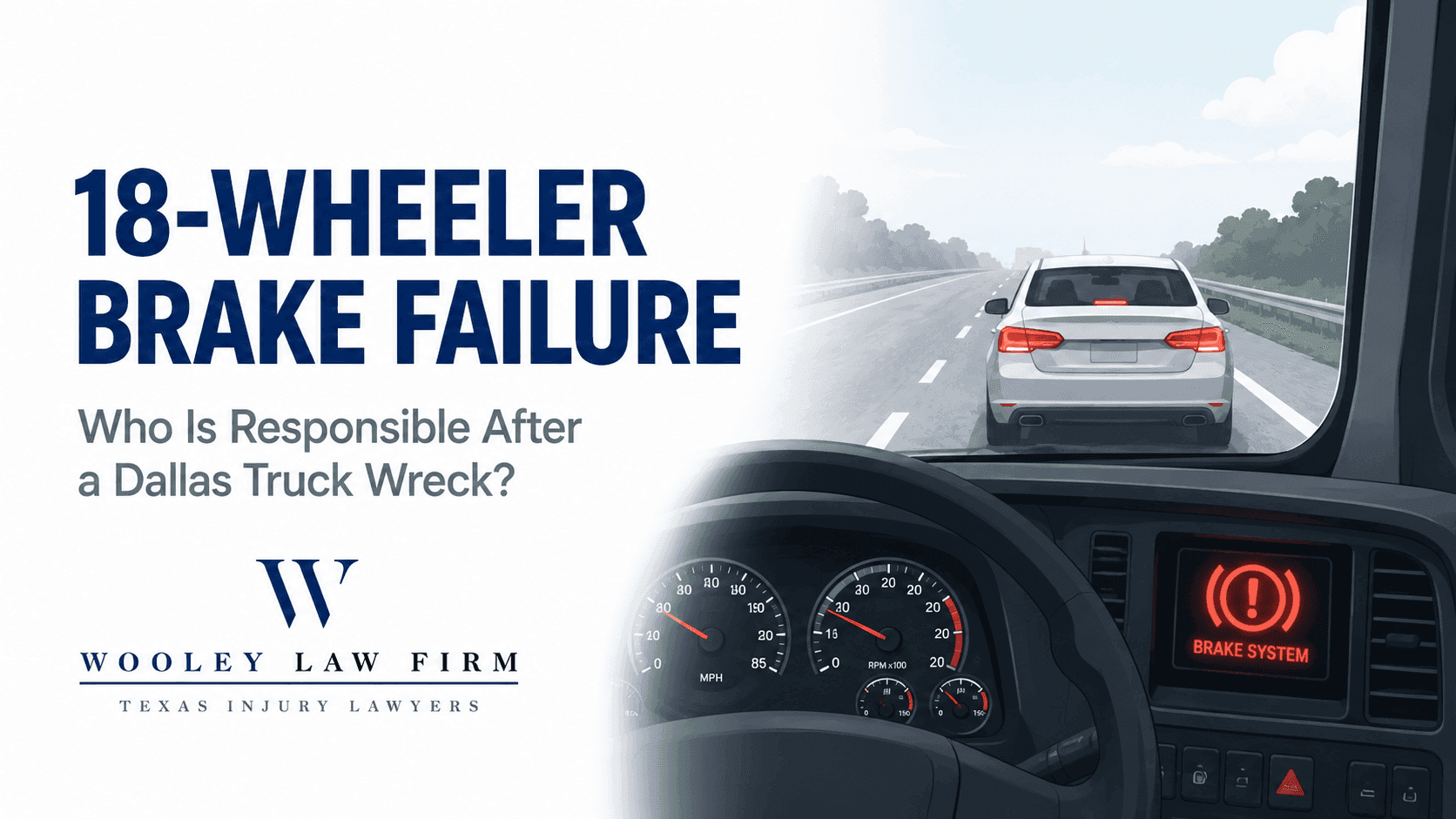
When an 18-wheeler rear-ends a car in Dallas, the truck driver or trucking company may claim that the brakes failed. But brake failure does not necessarily mean the collision was unavoidable.
In many cases, a claimed brake failure creates even more questions:
When were the tractor and trailer brakes last inspected?
Were the brakes properly adjusted?
Were there air leaks or worn brake components?
Had the truck previously received brake-related violations?
Did the driver report a brake problem before the wreck?
Did the trucking company delay recommended repairs?
Did an outside maintenance company improperly inspect or repair the brakes?
Federal motor-carrier regulations require commercial vehicles to be systematically inspected, repaired, and maintained. When brakes fail, an investigation should determine why they failed and who was responsible for keeping them safe.
If you were rear-ended by a tractor-trailer and believe defective or poorly maintained brakes contributed to the crash, a Dallas truck accident lawyer can investigate the truck, its inspection history, maintenance records, repair invoices, roadside violations, electronic data, and the companies responsible for maintaining it.
“The Brakes Failed” Is Not the End of the Investigation
An 18-wheeler driver may tell the police:
“I hit the brakes, but the truck wouldn't stop.”
That explanation should not automatically excuse the driver or trucking company.
Commercial trucks have complex braking systems that require inspection, maintenance, and repair. A brake problem may develop over days, weeks, or months before a rear-end collision.
The important question is often not simply whether the brakes failed, but why they failed.
The trucking company's records may reveal:
Repeated brake repairs
Unresolved defects
Brake-adjustment problems
Air leaks
Worn components
Overdue inspections
Driver complaints
Repair recommendations that were ignored
If you were hit from behind by a tractor-trailer, our guide on what to do after being rear-ended by an 18-wheeler in Dallas explains other evidence and liability issues that may need to be investigated.
Federal Rules Require Trucking Companies to Maintain Their Trucks
Federal Motor Carrier Safety Administration regulations require motor carriers to systematically inspect, repair, and maintain commercial vehicles under their control.
Under 49 C.F.R. § 396.3, parts and accessories must be maintained in safe and proper operating condition.
For someone injured in a Dallas truck wreck, this is important. A trucking company generally cannot simply operate an 18-wheeler until something breaks and then claim the mechanical failure was unexpected.
A proper investigation may examine:
The company's preventive-maintenance program
How frequently the truck was inspected
Whether drivers reported defects
Whether repairs were actually completed
Who performed the work
Whether the truck was returned to service despite a known problem
Maintenance records can become some of the most important evidence in an 18-wheeler brake failure accident case.
Were the Tractor and Trailer Properly Inspected?
Federal regulations also require periodic inspections of commercial motor vehicles.
Under 49 C.F.R. § 396.17, covered commercial vehicles generally must pass the required periodic inspection at least once during the preceding 12 months.
An 18-wheeler is not just one piece of equipment.
The tractor and trailer both matter.
A tractor may have properly functioning brakes while the trailer has defective or poorly adjusted brakes. The reverse can also be true.
The tractor and trailer may even be owned, leased, inspected, and maintained by different companies.
That is why an investigation should obtain inspection and maintenance records for every piece of commercial equipment involved in the wreck, rather than looking only at the company name printed on the truck.
Air-Brake Defects Can Cause Rear-End 18-Wheeler Accidents
Most large tractor-trailers use air-brake systems.
A properly functioning air-brake system allows the driver to apply braking force throughout the tractor and trailer. Problems anywhere in that system can potentially reduce the truck's ability to slow or stop.
Possible defects include:
Air leaks
Damaged hoses or tubing
Defective brake chambers
Compressor problems
Low air pressure
Defective valves
Worn brake linings or pads
Damaged brake drums or rotors
Slack-adjuster problems
Improper brake adjustment
Completely inoperative brakes
Federal safety regulations contain specific requirements for commercial-vehicle braking systems. The FMCSA also conducts and oversees roadside inspections that can identify serious brake defects.
After a major rear-end collision, a qualified commercial-vehicle or brake expert may need to inspect the tractor and trailer before anyone repairs or changes the braking system.
Improper Brake Adjustment Can Affect How an 18-Wheeler Stops
Brake adjustment can be particularly important after a rear-end truck wreck.
If portions of the braking system are improperly adjusted, the truck may not brake evenly or effectively when the driver attempts to stop.
That can become especially dangerous in Dallas traffic on roads such as:
I-35E
I-30
I-20
I-45
I-635
U.S. 75
Drivers on these highways regularly encounter congestion, construction zones, lane closures, red lights, sudden backups, and stop-and-go traffic.
A commercial driver and trucking company should anticipate these ordinary traffic conditions and operate equipment capable of safely responding to them.
If investigators discover an adjustment problem after the wreck, they should determine:
How long the condition likely existed;
Whether a reasonable inspection should have discovered it;
Whether anyone previously reported the problem; and
Who last inspected, adjusted, or repaired the brakes.
Injured in an Accident?
Free consultation. Tell us what happened and learn what options may be available.
What Are Brake-Related Out-of-Service Violations?
Commercial trucks are subject to roadside safety inspections.
Some mechanical defects are serious enough that a truck may be placed out of service until the problem is corrected.
Brake-related violations may involve issues such as:
Brakes out of adjustment
Inoperative brakes
Air leaks
Damaged brake hoses or tubing
Defective brake components
Automatic brake-adjuster problems
Multiple defective brakes
The FMCSA's commercial vehicle safety program provides information about federal motor-carrier safety requirements and enforcement.
After a brake-failure collision, a Dallas truck wreck lawyer may investigate whether the tractor, trailer, or motor carrier had previously received brake-related violations.
Important records can include:
Roadside inspection reports
Prior brake violations
Out-of-service orders
Repair certifications
Follow-up inspection records
Records showing whether previously identified defects were corrected
A previous violation does not automatically prove what caused a later collision. But repeated brake problems may be important evidence if they show that a trucking company knew or should have known its equipment had ongoing maintenance problems.
Maintenance Records Can Reveal What Happened Before the Crash
A trucking company's maintenance records can tell a very different story from what the driver says at the scene.
Important records may include:
Preventive-maintenance schedules
Annual inspection reports
Brake inspection records
Brake measurements
Repair orders
Work orders
Parts invoices
Mechanic notes
Driver inspection reports
Driver-reported defects
Roadside inspection reports
Electronic fleet-maintenance records
Warranty claims
Records of recurring brake problems
These records should be compared with the actual physical condition of the braking system.
For example, a maintenance record might state that the brakes were inspected shortly before the wreck. If a post-crash examination reveals severely worn components or improper adjustment, investigators may need to determine whether that inspection was performed correctly.
Maintenance records are only one category of evidence. Our guide to evidence that can help prove an 18-wheeler accident claim explains additional evidence that may exist after a commercial truck collision.
Can the Truck Repair or Maintenance Company Be Responsible?
Not every trucking company performs its own maintenance.
A carrier may hire a:
Truck repair shop
Mobile mechanic
Brake contractor
Dealership
Fleet-maintenance company
Trailer maintenance company
An outside company may need to be investigated if it recently:
Inspected the brakes
Adjusted the brakes
Replaced brake components
Repaired an air leak
Serviced the tractor
Serviced the trailer
Certified an annual inspection
Recommended or performed brake repairs
Depending on the facts, a maintenance or repair company could potentially share responsibility if negligent work contributed to the brake failure and collision.
Important evidence from a repair company may include:
Technician notes
Repair invoices
Inspection forms
Photographs
Diagnostic reports
Parts records
Employee qualifications
Training records
Communications with the trucking company
Records showing what work was requested and completed
The repair company's records should be preserved just like the trucking company's records.
Who May Be Responsible for an 18-Wheeler Brake Failure Accident?
One major difference between an ordinary rear-end car accident and an 18-wheeler collision is the number of companies that may potentially be involved.
The Truck Driver
The driver may be responsible for conduct such as:
Operating a truck despite a known brake problem
Failing to conduct required inspections
Failing to report a defect
Following too closely
Driving too fast for traffic conditions
Failing to leave adequate stopping distance
Failing to react appropriately to slowing traffic
The Trucking Company
The motor carrier may be responsible for inadequate inspection, maintenance, repair, supervision, training, or policies concerning unsafe equipment.
The Tractor or Trailer Owner
The motor carrier operating the truck does not necessarily own all the equipment.
The tractor may belong to one company while the trailer belongs to another. Leasing agreements and maintenance responsibilities should be investigated.
A Maintenance or Repair Company
An outside contractor could potentially be responsible if negligent inspection, adjustment, installation, or repair work contributed to the crash.
A Brake or Truck Component Manufacturer
Some cases may involve a defective component rather than poor maintenance.
Depending on the evidence, a manufacturer, distributor, or supplier could potentially become part of the investigation.
Black Box Data May Show Whether the Driver Actually Tried to Brake
Electronic truck data can be extremely important when a driver claims mechanical brake failure.
Depending on the truck and systems installed, electronic evidence may provide information about:
Vehicle speed
Engine RPM
Throttle position
Brake application
Cruise-control operation
Changes in speed
Hard-braking events
Engine fault information
Other vehicle-operation data
Suppose the driver says:
“I was standing on the brakes, but the truck wouldn't stop.”
Electronic data showing little or no brake application before impact could raise questions about that explanation.
On the other hand, evidence of significant braking combined with a mechanical inspection identifying serious defects could point investigators toward a maintenance or mechanical-failure issue.
Our detailed article explains more about 18-wheeler black box data after a Dallas-Fort Worth truck wreck.
The Tractor and Trailer Should Be Preserved Before Repairs Are Made
When brake failure is suspected, preserving the physical truck can be critical.
Once the brakes are repaired, adjusted, disassembled, or replaced, valuable evidence may be changed or lost.
A preservation letter may demand that the appropriate companies preserve:
The tractor
The trailer
Brake chambers
Slack adjusters
Brake linings and pads
Brake drums and rotors
Air hoses and connections
Valves
Air-system components
Electronic control modules
Diagnostic information
Maintenance records
Inspection records
Repair invoices
Roadside inspection records
Photographs
Videos
Electronic fleet records
This evidence may help determine whether brake failure actually occurred and, if so, what caused it.
Serious Injuries After a Rear-End 18-Wheeler Collision
A brake failure can lead to a violent rear-end crash if the truck reaches stopped or slowing traffic without reducing enough speed.
Potential injuries include:
Traumatic brain injuries
Concussions
Neck injuries
Herniated or bulging discs
Spinal cord injuries
Back injuries
Shoulder injuries
Broken bones
Knee injuries
Internal injuries
Crush injuries
Permanent impairment
Wrongful death
You can read more about serious back and neck injuries after a Dallas-Fort Worth truck wreck and other life-changing injuries caused by 18-wheeler accidents.
What Should I Do If an 18-Wheeler Rear-Ended Me and the Driver Says the Brakes Failed?
If you are able:
Get appropriate medical attention.
Report the crash and obtain the police or crash-report information.
Photograph the tractor, trailer, roadway, vehicle damage, skid marks, and debris.
Preserve dash-camera footage from your vehicle.
Obtain witness contact information.
Do not dispose of your damaged vehicle or electronic evidence without considering whether it may be important to your claim.
Be cautious about signing releases presented by the trucking company's insurance carrier.
Speak with an attorney about preserving the tractor, trailer, brake components, and maintenance records.
The trucking company and its insurer may begin investigating immediately after a serious accident. Important physical and electronic evidence should be identified and preserved as early as possible.
Dallas 18-Wheeler Brake Failure Accident Lawyer
An 18-wheeler brake failure claim can involve much more than determining who struck whom.
The investigation may require examining:
The trucking company's maintenance program
Tractor and trailer inspection records
Brake measurements and adjustment history
Driver inspection reports
Repair records
Prior roadside violations
Out-of-service history
Electronic truck data
Tractor and trailer ownership
Leasing agreements
Work performed by outside maintenance companies
The Wooley Law Firm represents people seriously injured in 18-wheeler and commercial truck accidents in Dallas and throughout the Dallas-Fort Worth area.
If you were rear-ended by a commercial truck and the driver or trucking company claims the brakes failed, contact The Wooley Law Firm's Dallas truck accident lawyers to discuss the circumstances of the crash.
Frequently Asked Questions About 18-Wheeler Brake Failure Accidents
Does brake failure mean the truck driver is not responsible?
No. Brake failure does not automatically excuse the driver or trucking company. The investigation may examine whether the driver knew about a defect, whether proper inspections were conducted, whether the truck should have been operated, and whether the driver's speed, following distance, or reaction contributed to the wreck.
What records can prove poor brake maintenance?
Potential evidence includes inspection reports, maintenance records, repair invoices, brake-service records, mechanic notes, driver defect reports, roadside inspections, out-of-service violations, fleet-management records, and the physical brake components.
Can a truck repair shop be liable for an 18-wheeler accident?
Potentially. If a maintenance company negligently inspected, adjusted, installed, or repaired brake components and that work contributed to the collision, its conduct may become part of the case.
What if the truck had a prior brake violation?
A prior violation does not automatically establish responsibility for a later accident. However, it may be important evidence if it involved the same equipment, the same type of defect, or showed recurring brake-maintenance problems.
Why should both the tractor and trailer be inspected?
Both contain braking components that may affect stopping performance. They can also be owned, leased, maintained, or inspected by different companies.
Disclaimer
This article is for general informational purposes only and is not legal advice. Reading it does not create an attorney-client relationship. Every case is different, and past results do not guarantee a similar outcome.
Topics
Share This Article

Andrew J. Wooley
Personal Injury Attorney
Andrew J. Wooley is a dedicated personal injury attorney based in Dallas, Texas. He focuses on helping accident victims recover fair compensation for their injuries. With a commitment to personalized service, Andrew works directly with each client to understand their unique situation and fight for their rights.