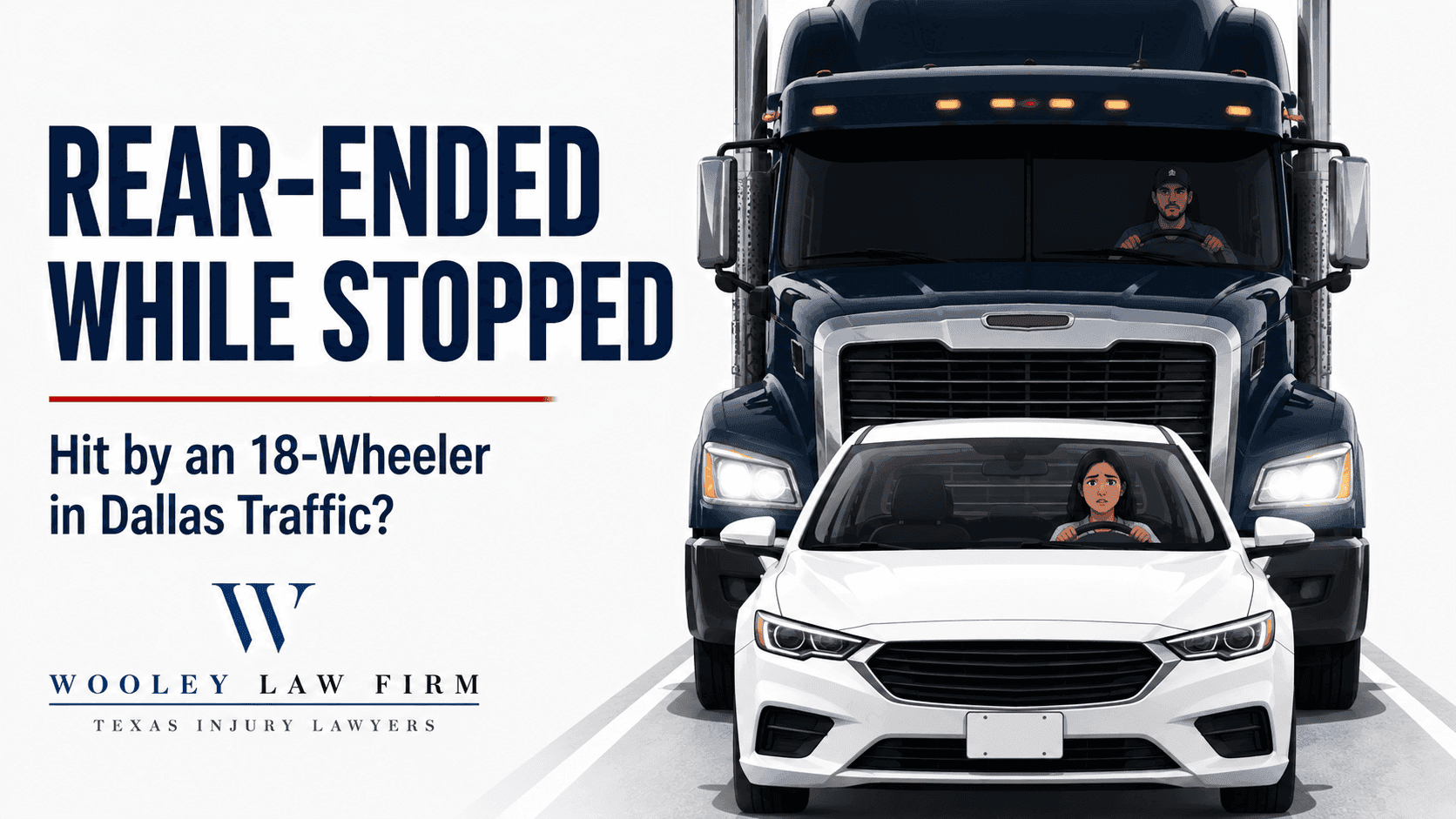
If you were completely stopped in Dallas traffic when an 18-wheeler rear-ended you, one of the first questions you may have is: How did a professional truck driver fail to see that traffic had stopped?
These wrecks happen at red lights, in construction zones, at the end of highway backups, and during stop-and-go traffic throughout Dallas. They are especially dangerous on heavily traveled roads such as I-35E, I-30, I-20, US-75, and I-635, where tractor-trailers may approach congestion at highway speeds.
When an 18-wheeler crashes into the back of a vehicle that was already stopped, the investigation should focus on why the truck driver did not slow down or stop in time.
Was the driver following too closely? Looking at a phone or dispatch screen? Driving too fast for traffic? Tired? Did the truck have a brake problem? Did the driver simply fail to notice a line of stopped vehicles?
Those questions can be answered with evidence—but some of that evidence may disappear unless it is preserved quickly.
If you were seriously injured in this type of wreck, our Dallas truck accident lawyer page explains more about how The Wooley Law Firm investigates commercial truck crashes throughout Dallas and North Texas.
“I Was Stopped and an 18-Wheeler Rear-Ended Me. Who Is at Fault?”
Being hit from behind does not automatically decide legal responsibility in every Texas accident. The specific circumstances still matter.
But if your vehicle was already stopped for traffic, a red light, road construction, or congestion, that fact can be extremely important.
Texas law requires a driver following another vehicle to maintain enough distance to safely stop considering the vehicles' speed, traffic, and highway conditions. Texas Transportation Code § 545.062 addresses following distance.
Texas law also requires drivers to operate at a speed that is reasonable and prudent under existing circumstances and to control their speed as necessary to avoid a collision. See Texas Transportation Code § 545.351.
Those rules become particularly important when a commercial truck is approaching traffic that is slowing or completely stopped.
The key question is often not simply:
“Did traffic stop?”
It is:
“Why didn't the truck driver recognize that traffic was stopped and respond in time?”
Rear-Ended by an 18-Wheeler at a Dallas Red Light
A driver stopped at a red light should be able to expect approaching vehicles to stop behind them.
Yet serious truck wrecks can happen when a tractor-trailer approaches an intersection and the driver:
is distracted;
follows too closely;
approaches the light too fast;
misjudges the stopping distance of the loaded truck;
is fatigued;
fails to notice the light has changed;
has defective or poorly maintained brakes; or
does not begin braking until it is too late.
A passenger vehicle sitting still at a traffic signal has very little ability to avoid an 18-wheeler approaching from behind.
In some crashes, the truck pushes the stopped vehicle into the car ahead of it, causing a chain-reaction collision.
That does not necessarily mean the driver of the middle vehicle caused the second impact. Investigators should determine whether the initial impact from the tractor-trailer forced the vehicle forward.
Rear-Ended in Stop-and-Go Traffic on I-35E
Traffic on I-35E through Dallas can move quickly one moment and come to a complete stop the next.
Truck drivers operating in congestion must account for those conditions.
A driver traveling through heavy traffic should be watching farther ahead than simply the bumper immediately in front of the truck. Brake lights several vehicles ahead, slowing traffic, merging lanes, traffic signs, and congestion can provide advance warning that the truck needs to reduce speed.
FMCSA specifically warns commercial drivers about the dangers of following too closely and explains that large trucks need additional space for safe braking.
If an 18-wheeler rear-ends a stopped vehicle on I-35E, electronic evidence may help determine how quickly traffic slowed and whether the truck driver reacted appropriately.
18-Wheeler Rear-End Wrecks During I-30 Traffic Backups
I-30 carries significant passenger and commercial traffic through Dallas and into surrounding North Texas communities.
An accident, disabled vehicle, lane closure, construction project, or normal rush-hour congestion can produce a line of stopped cars.
A truck driver approaching the end of that line should be paying attention to what is happening ahead.
When a truck does not slow down, investigators should determine:
How fast was the truck traveling?
How long was traffic already stopped?
Were brake lights visible?
When did the driver first apply the brakes?
Did the driver ever brake before impact?
Was the truck still accelerating?
Was cruise control being used?
Was the driver distracted?
Was the driver fatigued?
Were there mechanical or brake problems?
These questions can be much more important than what the trucking company's insurance adjuster says immediately after the crash.
Rear-Ended by an 18-Wheeler in an I-20 Backup
Highway backups can be particularly dangerous when traffic ahead is stopped but approaching traffic is still traveling at highway speeds.
That situation can occur on I-20 through southern Dallas County because of congestion, construction, lane closures, earlier wrecks, disabled vehicles, or emergency activity.
A tractor-trailer requires substantially more room to stop than an ordinary passenger vehicle.
That is exactly why maintaining a safe following distance and watching the traffic ahead matters.
The truck's size does not excuse its driver from stopping for traffic. The truck's size is a reason its driver must leave enough space to stop safely.
Rear-Ended in US-75 Stop-and-Go Traffic
US-75/Central Expressway regularly experiences heavy commuter traffic, merging vehicles, entrance and exit congestion, and abrupt slowdowns.
A truck driver operating in those conditions should anticipate that traffic may stop.
A trucking company may argue after a wreck:
“Traffic suddenly stopped.”
But Dallas highway traffic stopping is not necessarily an unforeseeable event.
A proper investigation should determine whether the driver left enough following distance, adjusted speed for congestion, and was watching the road.
Our broader guide on being rear-ended by an 18-wheeler in Dallas discusses additional causes of rear-end truck accidents and the parties that may potentially be responsible.
Injured in an Accident?
Free consultation. Tell us what happened and learn what options may be available.
Rear-Ended by a Truck in I-635 Traffic
I-635—particularly the heavily traveled LBJ Freeway corridor—can involve rapidly changing traffic conditions.
Cars may slow because of:
congestion;
construction;
lane closures;
entrance ramps;
merging traffic;
earlier collisions;
emergency vehicles; or
disabled vehicles.
A commercial driver needs to continuously monitor those conditions.
A driver who is staring at a GPS, phone, electronic logging device, dispatch screen, or another in-cab device may not realize traffic has stopped until there is no longer enough distance to avoid a wreck.
18-Wheeler Rear-End Wrecks in Dallas Construction Zones
Construction zones present another serious risk.
Traffic patterns may temporarily change. Lanes can narrow. Speeds can decrease. Traffic may merge. Workers or construction vehicles may enter the roadway. Congestion may unexpectedly build behind a lane closure.
Truck drivers need to recognize those conditions before reaching the stopped vehicles.
A driver who approaches a construction backup at normal highway speed may have nowhere near enough distance to stop a loaded tractor-trailer.
Depending on the crash, useful evidence may include:
construction-zone warning signs;
lane-closure notices;
traffic-control plans;
highway cameras;
contractor surveillance cameras;
dash-camera footage;
witness videos; and
photographs showing where the traffic backup began.
The Trucking Company May Say You “Stopped Suddenly”
This is one of the defenses that may arise after a rear-end crash.
The truck driver may claim:
“The car slammed on its brakes.”
“Traffic stopped suddenly.”
“I didn't have enough time.”
“The vehicle cut in front of me.”
“There was nothing I could do.”
Those statements should be compared against the actual evidence.
If your vehicle had already been stopped for several seconds—or longer—the truck's forward-facing camera may show that.
So may traffic cameras, dash cameras, witnesses, brake-light footage, GPS information, and electronic truck data.
If the truck driver claims you stopped too quickly, investigators should also determine how closely the truck was following before you stopped.
A commercial driver cannot safely follow a passenger vehicle so closely that normal traffic braking makes a collision unavoidable.
The Truck's Black Box May Show When the Driver Braked
Electronic truck data can be particularly important in a stopped-traffic collision.
Depending on the tractor and its systems, electronic data may provide information concerning:
vehicle speed;
brake application;
throttle position;
engine RPM;
cruise-control operation;
sudden deceleration;
fault codes; and
other vehicle operations.
For example, the evidence might show that the truck was traveling 50 or 60 mph while approaching stopped traffic and that the driver did not brake until shortly before impact.
Or it may show that there was no meaningful brake application at all.
Our article about 18-wheeler black box data after a Dallas-Fort Worth truck wreck explains this evidence in greater detail.
Electronic information can sometimes be overwritten or lost, making early preservation important.
The Truck's Camera May Show How Long You Were Stopped
Many commercial trucks now have forward-facing cameras. Some also have driver-facing cameras.
In a rear-end collision, forward-facing footage may show:
your vehicle's brake lights;
the traffic backup;
how far away stopped traffic was;
construction warning signs;
the truck's following distance;
how long your vehicle was stopped;
whether the truck changed lanes before impact; and
what the roadway looked like in the seconds before the collision.
A driver-facing camera may provide evidence concerning distraction or fatigue.
That can become extremely important when the driver's account conflicts with the physical evidence.
Was the Truck Driver Distracted?
A distracted truck driver may travel hundreds of feet while failing to recognize a developing traffic backup.
Potential distractions include:
texting;
phone calls;
GPS;
dispatch communications;
electronic logging devices;
paperwork;
eating or drinking;
adjusting in-cab equipment; and
reaching for objects.
Cellphone records, dispatch messages, camera footage, telematics information, and other electronic data may help determine what the driver was doing immediately before the collision.
Was the Truck Driver Too Tired to React?
Fatigue can slow reaction time and cause drivers to overlook obvious hazards—including an entire line of stopped vehicles.
Federal motor-carrier rules prohibit operating a commercial motor vehicle when a driver's ability or alertness is impaired by fatigue to the point that driving is unsafe.
Our article concerning truck driver Hours-of-Service violations and fatigue explains what records may help determine whether an exhausted driver was kept on the road too long.
Relevant evidence can include:
electronic logging-device data;
hours-of-service logs;
GPS history;
fuel receipts;
toll records;
delivery records;
dispatch communications; and
the driver's work schedule.
What If the Truck Driver Says the Brakes Failed?
“Brake failure” does not necessarily end the investigation.
It may expand it.
Investigators may need to determine:
when the tractor and trailer brakes were last inspected;
whether the driver identified brake problems before the trip;
whether repairs had previously been recommended;
whether maintenance was delayed;
whether the brakes were properly adjusted;
whether the tractor and trailer braking systems operated correctly together; and
whether a maintenance contractor performed defective work.
Possible responsibility may extend beyond the driver depending on what caused the brake problem.
Injuries After Being Rear-Ended by an 18-Wheeler While Stopped
A stopped passenger vehicle can absorb enormous forces when struck from behind by a commercial truck.
Possible injuries include:
neck injuries;
back injuries;
herniated or bulging discs;
spinal cord injuries;
traumatic brain injuries and concussions;
shoulder injuries;
knee injuries;
fractures;
nerve injuries;
facial injuries;
internal injuries; and
psychological trauma.
A truck can also push the vehicle into another car, concrete barrier, median, or other object, creating additional impacts.
Our article on serious back and neck injuries after a Dallas-Fort Worth truck wreck discusses some of the injuries frequently seen after violent commercial vehicle collisions.
Even where the trucking insurer argues the impact occurred at a relatively low speed, injuries should be evaluated based on the medical evidence—not simply the adjuster's characterization of the wreck. Read more about why a low-speed 18-wheeler wreck can still cause serious injuries.
Evidence to Preserve After an 18-Wheeler Hits Your Stopped Vehicle
Truck accident cases can involve far more evidence than an ordinary car crash.
Depending on the facts, evidence may include:
forward-facing camera footage;
driver-facing camera footage;
engine control module data;
GPS and telematics records;
electronic logging-device records;
driver logs;
cellphone records;
dispatch messages;
driver qualification records;
training materials;
maintenance records;
brake inspections;
post-crash inspection records;
bills of lading;
traffic-camera footage;
nearby surveillance video;
dash-camera footage;
witness statements;
911 recordings;
photographs;
police body-camera footage; and
the tractor and trailer themselves.
A preservation letter can be important because electronic information may be overwritten and vehicles may be repaired or returned to service.
What Should I Do After an 18-Wheeler Rear-Ends Me While I Am Stopped?
Your health should come first.
When possible:
Call 911 and report the collision.
Request medical help if you are injured.
Photograph the rear of your vehicle and front of the truck.
Photograph the surrounding traffic and roadway.
Record the tractor number, trailer number, license plates, USDOT number, and company name.
Get names and contact information for witnesses.
Save any dash-camera video immediately.
Tell medical providers about all symptoms you are experiencing.
Be cautious about giving recorded statements to the trucking company's insurer.
Consider speaking with a lawyer familiar with commercial truck evidence before important evidence disappears.
Talk to a Dallas Truck Wreck Lawyer After Being Rear-Ended While Stopped
If you were sitting at a red light, stopped in construction traffic, or waiting in a highway backup when an 18-wheeler crashed into the back of your vehicle, you deserve to know why the truck failed to stop.
The answer may be contained in evidence the trucking company already possesses.
The Wooley Law Firm represents people seriously injured in 18-wheeler and commercial truck wrecks throughout Dallas and North Texas. We investigate the driver, trucking company, electronic truck data, cameras, maintenance history, driver logs, and other evidence that may help explain what happened.
If an 18-wheeler rear-ended you while you were stopped in Dallas traffic, contact The Wooley Law Firm to discuss your situation.
Call (214) 699-6524 for a free consultation. You don't pay unless we win.
Frequently Asked Questions
Is an 18-wheeler automatically at fault if it rear-ends my stopped car?
Not automatically. Liability depends on the facts and evidence. However, proof that your vehicle was already stopped can be important when determining whether the truck driver followed too closely, drove too fast for traffic, was distracted, or failed to react appropriately.
What if traffic stopped suddenly?
Traffic backups and sudden slowdowns routinely occur on Dallas highways. An investigation should determine whether the truck driver maintained adequate following distance, watched traffic ahead, and controlled the truck's speed for the conditions.
What if I had been stopped for several seconds before the impact?
That fact can be significant. Forward-facing camera footage, witnesses, dash cameras, traffic cameras, electronic data, and other evidence may help establish how long your vehicle was stationary before the truck hit you.
What if I was stopped at a red light?
A driver approaching a red light must respond to the traffic ahead. Investigators should determine the truck's speed, following distance, braking, distraction, mechanical condition, and what the driver could see before impact.
Can the trucking company be responsible too?
Potentially. Depending on the evidence, issues may include negligent hiring, training or supervision; unsafe scheduling; driver fatigue; maintenance failures; or other company conduct.
Can a rear-end 18-wheeler collision cause serious injuries even if my car is not destroyed?
Yes. Vehicle damage alone does not determine whether someone was injured. Medical records, diagnostic imaging, symptoms, physical limitations, and medical opinions are more relevant to evaluating the injury.
How quickly should truck evidence be preserved?
Promptly. Some camera footage and electronic information may be overwritten or lost, while the tractor or trailer may be repaired and returned to service.
Disclaimer
This article is for general informational purposes only and is not legal advice. Reading it does not create an attorney-client relationship. Every case is different, and past results do not guarantee a similar outcome.
Topics
Share This Article

Andrew J. Wooley
Personal Injury Attorney
Andrew J. Wooley is a dedicated personal injury attorney based in Dallas, Texas. He focuses on helping accident victims recover fair compensation for their injuries. With a commitment to personalized service, Andrew works directly with each client to understand their unique situation and fight for their rights.