Driving beside an 18-wheeler can be uncomfortable even on an open highway.
Inside a Dallas construction zone, the margin for error can become much smaller.
The lane may suddenly narrow.
A concrete barrier may replace the shoulder.
Temporary striping may move traffic several feet left or right.
One lane may disappear.
Traffic ahead may stop without warning.
Construction vehicles may be entering the highway.
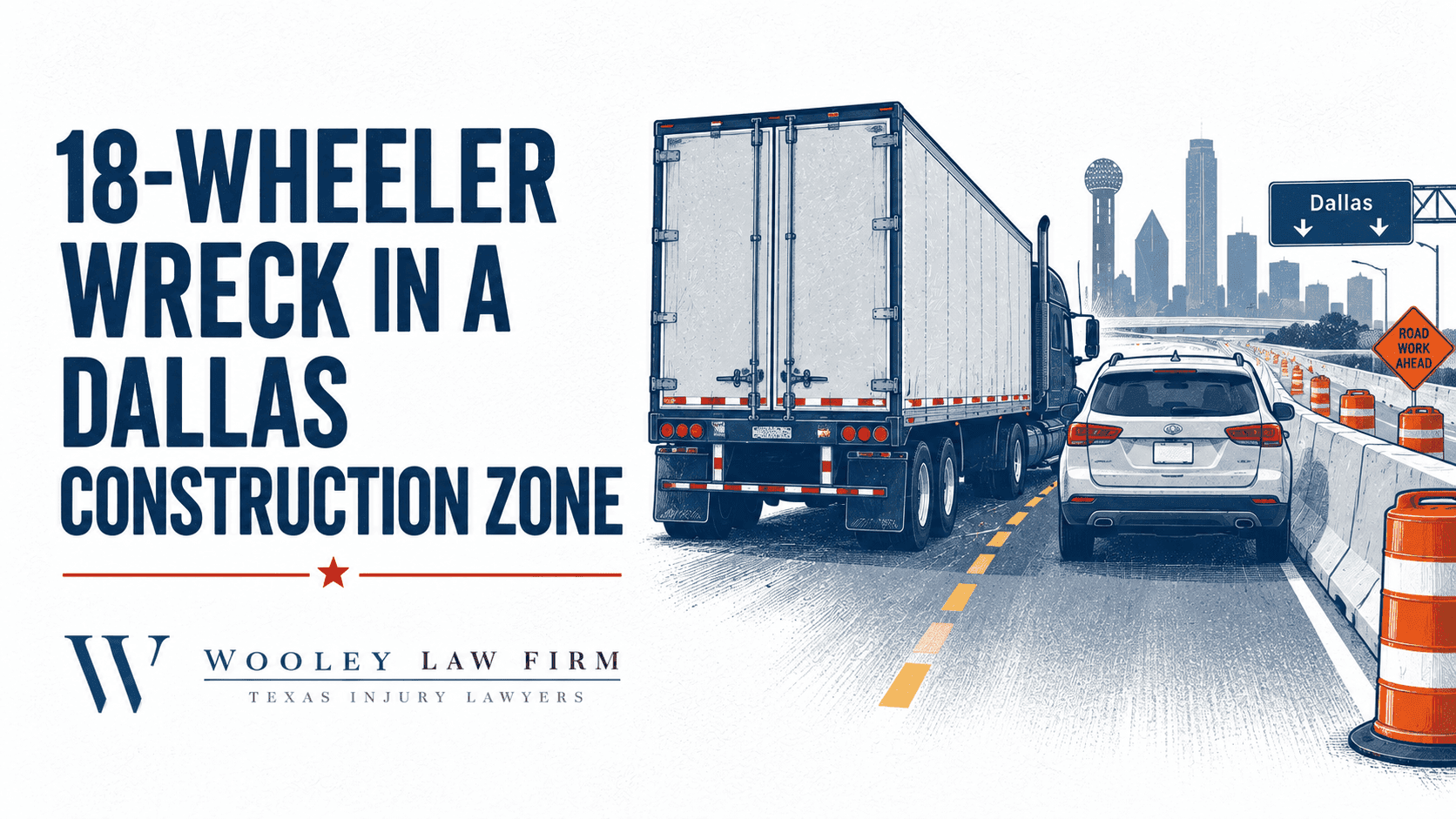
And a passenger vehicle may find itself traveling directly beside a tractor-trailer with almost nowhere to escape.
If the 18-wheeler drifts across the lane marker or begins changing lanes without making sure there is enough room, the passenger driver may be trapped between the trailer and a concrete barrier.
A construction zone does not excuse an unsafe truck lane change.
In many situations, the restricted roadway actually gives the commercial driver more reason to slow down, pay attention, monitor the mirrors, follow temporary lane markings, and avoid unnecessary lane changes.
If you were seriously injured in this type of collision, our Dallas truck accident lawyer page explains how The Wooley Law Firm investigates serious commercial-truck crashes in Dallas and throughout North Texas.
Why Dallas Construction Zones Can Be Especially Dangerous Around 18-Wheelers
Work zones change the roadway conditions that drivers normally expect.
A familiar stretch of I-35E or I-635 may look completely different during construction.
Drivers may encounter:
narrowed travel lanes;
temporary yellow or white lane markings;
old pavement markings that remain faintly visible;
concrete barriers immediately beside traffic;
closed shoulders;
sudden lane shifts;
merging lanes;
disappearing lanes;
construction trucks entering or leaving;
uneven pavement;
reduced speed limits;
workers close to traffic;
temporary signs;
flaggers;
congestion; and
sudden stops.
All of those conditions can become more significant when the vehicle navigating them is a long tractor-trailer.
An 18-wheeler has limited maneuverability, significant blind spots, a long trailer, and greater stopping-distance concerns than an ordinary passenger vehicle.
A professional driver should anticipate those limitations before entering the work zone.
Work Zones Require More Attention From a Truck Driver—not Less
Commercial drivers should be looking far enough ahead to recognize an approaching construction zone before the truck reaches a narrowed lane or lane closure.
The driver should be asking:
Are lanes about to narrow?
Is my current lane ending?
Is traffic being shifted left or right?
Is the shoulder disappearing?
Is a concrete barrier beginning?
Are vehicles merging ahead?
Has traffic slowed?
Do I need to change lanes before the work zone?
Is another vehicle currently beside my trailer?
Can I remain safely within the temporary lane?
A truck driver who waits until the last moment to respond may create a dangerous situation for surrounding motorists.
For example, if signs warn for a mile that the right lane is closing, a truck driver should not necessarily wait until the barricades begin and then force a tractor-trailer into an occupied lane.
Planning ahead matters.
Move Into the Open Lane Before the Last Second
Lane closures are common in highway construction.
A sign may warn:
RIGHT LANE CLOSED AHEAD
or
LEFT LANE ENDS
A commercial driver should be monitoring those warnings and surrounding traffic early.
Waiting until the truck reaches the final barrels or barricades can turn an ordinary merge into an emergency.
The driver may suddenly discover:
another vehicle is beside the tractor;
another car is beside the trailer;
traffic in the open lane is moving faster;
the destination lane has no large opening;
the truck cannot safely stop before the lane ends; or
a concrete barrier prevents any evasive movement.
A professional driver should not respond by simply activating a turn signal and forcing the tractor-trailer into the next lane.
The lane still has to be clear.
Our article explaining what truck drivers should do before changing lanes in Dallas discusses mirror checks, blind spots, signaling, trailer clearance, and the repeated observations that should occur before and during a commercial-truck lane change.
Texas Law Still Requires the Lane Movement to Be Safe
Texas Transportation Code § 545.060 generally requires a driver on a roadway divided into marked lanes to remain within a single lane and not move from that lane unless the movement can be made safely.
A construction zone does not eliminate that requirement.
If anything, the conditions may make the safety analysis more important.
Before moving over, the truck driver may need to account for:
narrower lanes;
reduced lateral clearance;
concrete barriers;
changing traffic patterns;
temporary markings;
cars already beside the truck;
vehicles merging ahead;
reduced speeds; and
limited room to correct a mistake.
Simply turning on a signal does not make an unsafe lane change safe.
There Are Several Different Types of Construction-Zone Lane-Change Wrecks
Not every work-zone truck collision happens the same way.
Understanding the exact movement can be critical to determining what evidence matters.
The Truck Intentionally Changes Lanes Into a Car
This is the traditional lane-change wreck.
The truck driver decides to move from one temporary travel lane into another but fails to recognize that a passenger vehicle is already beside the tractor or trailer.
The truck may:
sideswipe the vehicle;
push the car against a barrier;
force the driver onto the shoulder;
push the vehicle into another lane; or
cause a chain-reaction collision.
The Road Shifts but the Truck Continues Straight
This is different.
The driver may not intend to change lanes at all.
Instead, the construction pattern requires the lane itself to bend or shift.
For example, temporary lane markings may direct traffic several feet to the left.
A passenger driver follows the temporary stripe.
The truck driver continues traveling generally straight.
As the roadway shifts, the truck begins crossing into the passenger vehicle's lane.
From the truck driver's perspective, the tractor may appear to be continuing straight.
But relative to the actual temporary lane configuration, the truck may be leaving its lane.
A Lane Ends and the Truck Merges Too Late
The truck driver sees the lane closure but waits.
When the lane ends, the driver begins forcing the tractor-trailer into the remaining lane.
A passenger car already traveling there may suddenly be squeezed between the truck and a concrete barrier.
The Trailer Drifts Across a Narrow Lane
The tractor may remain mostly centered while the trailer comes dangerously close to—or crosses—the adjacent lane marker.
When lanes are narrowed, even a relatively small deviation can result in contact.
The Truck Changes Lanes to Avoid Slowing Traffic
Construction zones often create sudden backups.
A truck driver approaching stopped traffic may attempt to move quickly into another lane instead of slowing in the current lane.
That sudden movement can create both a lane-change collision and a secondary rear-end or multi-vehicle crash.
A Temporary Lane Shift Is Not the Same as an Ordinary Lane Change
This distinction deserves special attention.
Suppose a highway normally runs straight.
Construction requires traffic to shift 10 or 15 feet to the left.
Temporary pavement markings guide motorists through the shift.
A passenger vehicle follows those temporary markings.
The tractor-trailer continues along the path of the old roadway.
The truck eventually enters the car's lane.
The truck driver may later say:
“I never changed lanes.”
But the investigation should not end there.
The question may be whether the driver properly followed the temporary traffic lane.
Important evidence can include:
temporary pavement markings;
old pavement markings;
construction barrels;
warning signs;
directional arrows;
concrete barriers;
lane widths;
highway plans;
crash photographs;
dash-camera footage; and
video showing the driver's approach to the lane shift.
A work-zone collision may therefore require reconstructing the roadway itself—not just the movements of the vehicles.
Confusing Old and New Lane Markings Can Become Important
Construction areas sometimes contain both temporary markings and traces of the roadway's previous configuration.
Old stripes may have been removed or covered but can remain visible.
New temporary stripes may direct traffic differently.
At night, during rain, or under glare, the roadway may appear even more confusing.
If an 18-wheeler crosses into another vehicle's lane, the investigation may need to determine:
what markings existed on the crash date;
which markings were active;
whether old markings were still visible;
whether temporary markings were worn;
what signs warned drivers of the shift;
whether the truck driver's dash camera captured the markings; and
whether other motorists were successfully following the same lane configuration.
Roadway conditions can be relevant without automatically excusing the truck driver.
Narrow Construction Lanes Make Trailer Clearance Critical
The truck driver sits near the front of a long combination vehicle.
The trailer extends far behind.
Inside a narrowed construction lane, the driver must account for where the entire trailer is located.
A passenger car may be traveling:
beside the tractor;
beside the middle of the trailer;
near the rear trailer wheels; or
slightly behind the trailer.
Even if the tractor clears a passenger car, the trailer may not.
If the driver begins moving toward another lane too early, the trailer can strike the side of the vehicle.
That becomes particularly dangerous when a concrete barrier leaves the passenger driver nowhere to move.
Our article on being sideswiped by an 18-wheeler in Dallas-Fort Worth explains how trailer sideswipes can push a smaller vehicle out of its lane and create secondary collisions.
The Passenger Driver May Have Nowhere to Escape
On an ordinary highway, a motorist may have a shoulder.
Inside a construction zone, that shoulder may be gone.
Instead, the driver may have:
18-wheeler on one side.
Concrete wall on the other.
If the trailer begins moving toward the car, the passenger driver may have only bad options.
The driver may:
brake hard;
sound the horn;
move as close as possible to the barrier;
strike the barrier;
accelerate to escape the trailer;
become trapped against the wall; or
collide with another vehicle.
The trucking company may later question why the passenger driver did not simply move away.
The construction layout may show that there was nowhere to go.
Injured in an Accident?
Free consultation. Tell us what happened and learn what options may be available.
“You Were in the Truck's Blind Spot” Is Not the End of a Work-Zone Investigation
Blind spots can become even more dangerous in narrowed lanes.
A passenger vehicle may be unable to quickly move away from the truck because barriers, barrels, traffic, or lane restrictions prevent it.
If the truck driver claims:
“I couldn't see the car.”
the investigation should ask:
When did the driver last see it?
How long had the car been beside the truck?
Was the car visible before the construction zone?
Did the driver check both flat and convex mirrors?
Did the driver recheck before moving?
Was the truck equipped with additional cameras?
Were the mirrors properly adjusted?
Did the driver know the lane was narrowing?
Was the driver attempting to merge?
Did the driver have enough information to determine that the movement was safe?
Our guide to 18-wheeler blind-spot accidents in Dallas explains why a blind spot should be treated as a known truck-safety issue rather than automatically blamed on the passenger vehicle.
Digital Mirrors and Side Cameras May Be Important in a Work-Zone Wreck
Some newer commercial trucks use camera-monitor systems commonly called digital mirrors.
These systems may provide side and rearward views around the tractor-trailer.
Depending on the system, recorded footage may show:
a passenger vehicle beside the truck;
the concrete barrier;
the temporary lane marker;
how much lateral room remained;
whether the trailer crossed the line;
whether another vehicle was trapped beside the trailer; and
when the driver began changing lanes.
That could be powerful evidence in a narrowed-lane case.
Our article about digital mirrors on 18-wheelers after a Dallas truck wreck explains why the exact camera system installed on the truck should be identified and investigated.
Dash-Camera Video May Preserve the Construction Zone Before It Changes
Dash-camera evidence may be even more valuable in a construction-zone case than in an ordinary highway wreck.
Why?
Because the roadway itself may change.
Your dash camera may preserve:
the construction signs;
lane-closure warnings;
temporary striping;
old striping;
traffic patterns;
barrier locations;
construction barrels;
the lane shift;
the position of the truck;
your vehicle's position;
the truck crossing the line;
the collision; and
what happened afterward.
A few days later, the barriers may be moved.
A week later, the lanes may shift again.
A month later, the work zone may look completely different.
Your video can preserve the roadway as it actually existed when the collision occurred.
Our guide to dash-camera evidence after a Dallas car or truck wreck explains why the original recording should be saved immediately and preserved in its native format.
Photograph the Work Zone—not Just the Cars
After a wreck, people naturally photograph their damaged vehicle.
In a construction-zone case, the surrounding roadway can be just as important.
If your condition allows, photographs may document:
the temporary lane markings;
the width of the lane;
old lane markings;
concrete barriers;
cones and barrels;
construction signs;
lane-closure signs;
directional arrows;
the start of a lane shift;
skid marks;
debris;
scrape marks on a barrier;
where the vehicles came to rest; and
the direction traffic was moving.
Photographs taken from farther away may help show the entire construction configuration.
Close-up photographs alone may not reveal why the vehicles had so little room.
Work-Zone Evidence Can Disappear Overnight
This is one of the biggest reasons these collisions are different.
A vehicle can be preserved.
A roadway configuration may not be.
Construction crews may:
move barriers;
remove barrels;
repaint lanes;
erase old markings;
add new markings;
close another lane;
reopen a lane;
change the speed limit;
install new signs; or
begin a completely different phase of construction.
That means evidence showing the exact configuration on the crash date can become extremely valuable.
The investigation may need to determine not only where the crash happened, but also what phase of construction was underway at that exact time.
Construction Plans and Traffic-Control Records May Matter
Depending on the circumstances, additional records may help reconstruct the work zone.
Potential records can include:
traffic-control plans;
construction drawings;
lane-closure schedules;
approved detours;
temporary striping plans;
work-zone inspection reports;
contractor photographs;
change orders;
daily construction logs;
traffic-control-device records; and
records showing when barriers or signs were moved.
These materials can sometimes help determine what the roadway was supposed to look like.
They can then be compared with photographs and videos showing what motorists actually encountered.
Could a Roadway or Construction Contractor Also Be Involved?
Most construction-zone truck-wreck investigations will begin with the conduct of the truck driver and trucking company.
But not every case stops there.
Depending on the facts, questions may arise concerning a roadway contractor, traffic-control contractor, or another entity responsible for the construction layout.
For example:
Were temporary lanes properly marked?
Were barriers placed according to the approved plan?
Were warning signs missing?
Was a lane closure adequately identified?
Were conflicting pavement markings left visible?
Was required traffic-control equipment missing or displaced?
That does not mean a construction company is automatically responsible whenever a crash occurs in a work zone.
Liability depends on the evidence, contractual responsibilities, applicable law, and the specific conditions that contributed to the wreck.
Claims involving governmental entities can also involve additional legal requirements and defenses.
Speed Matters Even When the Truck Is Below the Posted Limit
The speed-limit sign is not always the end of the analysis.
A truck may technically be below the posted limit and still be moving too fast for what is happening immediately ahead.
Construction-zone conditions can include:
sharp lane shifts;
narrowed pavement;
sudden congestion;
uneven surfaces;
workers near traffic;
vehicles merging;
lane closures; and
abrupt stops.
A commercial driver needs enough time to recognize those conditions and respond safely.
Traveling too fast can reduce the driver's opportunity to:
identify a lane shift;
notice a car beside the trailer;
recheck the mirrors;
cancel a lane change;
slow for traffic;
follow temporary markings;
reposition the tractor-trailer; or
stop before impact.
The Truck's Black-Box and Electronic Data May Show What the Driver Was Doing
A serious construction-zone truck wreck may involve multiple forms of electronic evidence.
Depending on the truck and equipment installed, investigators may look for information concerning:
vehicle speed;
braking;
throttle;
cruise-control use;
sudden deceleration;
GPS location;
route history;
telematics;
electronic logs;
lane-departure alerts;
collision warnings; and
camera-triggered safety events.
That evidence can be compared to the road configuration.
For example:
A dash camera shows a lane shift.
Electronic data shows the truck maintained highway speed.
A side camera shows a car beside the trailer.
The truck then crosses the temporary lane line.
That combination may provide a more complete reconstruction than any single piece of evidence alone.
Our article about 18-wheeler black-box data after a Dallas-Fort Worth truck wreck explains the different electronic systems that may contain information about a commercial truck's operation.
Was the Truck Driver Distracted?
Construction zones demand attention.
A driver looking at something other than the roadway may fail to notice:
a temporary lane shift;
an approaching lane closure;
stopped traffic;
a reduced speed;
construction workers;
a merging vehicle; or
a passenger car traveling beside the trailer.
Potential distractions may include:
cellphone use;
texting;
navigation systems;
dispatch messages;
eating;
drinking;
paperwork;
adjusting controls; or
looking away from the roadway.
If the truck driver suddenly crosses a temporary lane marking, the investigation may need to determine whether inattention contributed to the movement.
Fatigue Can Also Make Work-Zone Driving More Dangerous
Fatigue can affect attention, reaction time, judgment, and lane control.
A fatigued driver may fail to recognize that the road is shifting until the tractor is already close to the temporary lane marker.
Electronic logging-device records may help establish the driver's hours and duty status before the wreck.
Other evidence may include:
dispatch records;
trip history;
fuel receipts;
GPS data;
electronic logs;
driver communications; and
company scheduling records.
These records should be considered together rather than assuming fatigue solely because a truck crossed a lane line.
What If the Truck Driver Blames the Construction Zone?
After the collision, the driver may say:
“The lanes were confusing.”
“I couldn't see the temporary lines.”
“The lane suddenly shifted.”
“There wasn't enough room.”
Those explanations may be relevant.
But they also raise more questions.
If the roadway was confusing:
Why wasn't the truck moving more cautiously?
If the lane narrowed:
Why didn't the driver reduce speed?
If the lane shifted:
Was the driver scanning far enough ahead to see it?
If the truck did not have enough room:
Why did the driver attempt the lane change?
The construction zone may be part of the explanation without necessarily eliminating questions about the truck driver's conduct.
What If the Trucking Company Blames You?
The trucking company or its insurer may instead say:
you were in the blind spot;
you should have slowed down;
you were too close to the truck;
you crossed the temporary stripe;
you should have let the truck merge;
you accelerated beside the trailer; or
construction made the collision unavoidable.
Those claims should be compared to objective evidence.
Important questions may include:
Which vehicle crossed the active lane line?
Which lane was ending?
Where was your vehicle before impact?
How long had you been beside the truck?
Was the truck's turn signal on?
When was it activated?
Did the truck begin moving immediately after signaling?
Was your vehicle trapped beside a barrier?
Was there somewhere you could safely move?
What does the dash camera show?
What do side cameras show?
What do photographs show?
What do witnesses say?
A construction-zone collision should be reconstructed based on the actual roadway conditions, not assumptions made after the fact.
Truck Driver Training May Be Part of the Case
Commercial drivers should be prepared to encounter construction zones.
The trucking company's training may become relevant if the driver failed to safely navigate a lane closure, temporary lane shift, or narrowed roadway.
Potential records may address:
lane-change training;
work-zone driving;
mirror use;
blind spots;
reduced-speed driving;
defensive driving;
following distance;
lane-closure procedures;
digital-mirror systems;
distracted driving; and
safety coaching.
The investigation may also ask whether the driver had previous lane-departure or unsafe-lane-change events and how the company responded.
Could the Trucking Company Be Responsible?
Depending on the evidence and legal theories available, the investigation may extend beyond the individual driver.
Issues involving the trucking company can include:
driver training;
supervision;
safety policies;
route planning;
scheduling;
driver fatigue;
prior safety events;
maintenance of mirrors or cameras;
failure to respond to safety alerts; and
preservation of evidence after the wreck.
The facts of each case determine which claims and parties may be appropriate.
Serious Injuries Can Result When a Car Is Trapped Between a Truck and a Barrier
A construction-zone sideswipe can be much more serious than the word “sideswipe” suggests.
A passenger car may have nowhere to dissipate the truck's movement.
The vehicle can become trapped between the trailer and a concrete wall.
It may be crushed.
It may be spun into traffic.
It may roll over.
It may strike another vehicle.
Potential injuries can include:
traumatic brain injuries;
spinal cord injuries;
serious neck injuries;
serious back injuries;
fractures;
shoulder injuries;
knee injuries;
crush injuries;
internal injuries;
burns;
scarring;
disfigurement;
permanent impairment; and
fatal injuries.
Our guide to life-changing injuries after a Dallas-Fort Worth truck wreck discusses how catastrophic truck injuries may affect medical needs, employment, independence, and daily life.
What Evidence Should Be Preserved After a Dallas Construction-Zone Truck Wreck?
A preservation investigation may need to address two categories of evidence:
Evidence From the Truck and Trucking Company
This may include:
tractor and trailer photographs;
physical damage;
forward-facing camera footage;
driver-facing camera footage;
digital-mirror video;
side-camera footage;
rear or trailer cameras;
GPS;
telematics;
electronic logs;
electronic control-module data;
lane-departure warnings;
safety-system alerts;
dispatch communications;
driver qualification records;
training materials;
safety policies; and
company crash-investigation records.
Evidence From the Construction Zone
This may include:
photographs;
video;
temporary lane markings;
lane measurements;
barriers;
cones;
construction signs;
warning signs;
traffic-control plans;
project drawings;
construction logs;
lane-closure schedules;
inspection records; and
information showing the construction phase on the crash date.
The sooner these materials are identified, the easier it may be to reconstruct conditions before they change.
What Should You Do After an 18-Wheeler Wreck in a Dallas Construction Zone?
If you are able to do so safely:
Call 911. Explain that the wreck occurred inside a construction zone.
Get medical attention. Your health comes first.
Photograph the truck and trailer. Include company markings, tractor and trailer numbers, license plates, USDOT information, and damage.
Photograph the work zone. Do not focus solely on the vehicles.
Preserve your dash-camera footage. Save the original recording immediately.
Identify witnesses. Another motorist may have seen whether the truck crossed the temporary lane marker.
Record the exact location. Highway, direction, nearest exit, mile marker, bridge, cross street, and construction signs may help identify the correct project.
Do not assume the roadway will look the same tomorrow. Work-zone configurations can change quickly.
Consider evidence preservation early. Truck-camera footage, electronic data, and construction records may become important.
How This Page Fits With Other Dallas Truck-Wreck Evidence
A construction-zone collision may involve several overlapping issues.
If the truck intentionally moved into your lane, see what truck drivers should do before changing lanes in Dallas.
If the driver says your vehicle could not be seen, read about 18-wheeler blind-spot accidents in Dallas.
If newer side-camera technology was installed, read about digital mirrors on 18-wheelers after a Dallas truck wreck.
If your vehicle captured the construction layout or collision, see our guide to dash-camera evidence after a Dallas car or truck wreck.
If the trailer actually struck the side of your vehicle, see our article on being sideswiped by an 18-wheeler in Dallas-Fort Worth.
And if the issue is speed, braking, GPS, logs, or electronic truck information, read our guide to 18-wheeler black-box evidence after a Dallas-Fort Worth truck wreck.
Together, these forms of evidence can help answer the central question:
Did the truck driver safely control the entire tractor-trailer through the construction zone?
Talk to a Dallas Truck Wreck Lawyer After a Construction-Zone 18-Wheeler Crash
Construction zones can be difficult for every driver.
But professional commercial drivers know that an 18-wheeler's size, length, limited maneuverability, blind spots, and stopping distance require careful driving through narrowed lanes and changing traffic patterns.
If an 18-wheeler changed lanes into you, drifted across temporary markings, failed to follow a lane shift, squeezed your vehicle against a concrete barrier, or caused another serious wreck in a Dallas construction zone, the investigation should determine:
which lane each vehicle occupied;
what the temporary markings showed;
whether the truck was intentionally changing lanes;
whether the roadway itself shifted;
whether the driver checked the mirrors;
whether the trailer cleared your vehicle;
whether the truck was traveling at a safe speed;
whether the driver was distracted or fatigued;
whether onboard cameras recorded the collision;
what GPS and electronic data show;
whether trucking-company training played a role; and
what the construction zone looked like at the exact time of the crash.
The Wooley Law Firm represents individuals and families after serious 18-wheeler and commercial-truck wrecks in Dallas and throughout North Texas.
Call (214) 699-6524 for a free consultation. You don't pay unless we win.
Frequently Asked Questions About Dallas Construction-Zone Truck Wrecks
Who is at fault when an 18-wheeler changes lanes in a construction zone?
Fault depends on the evidence. Important issues may include which vehicle crossed the active lane marker, whether the truck driver maintained a proper lookout, whether the truck was changing lanes or failing to follow a temporary lane shift, speed, video evidence, and the layout of the work zone.
What if the temporary lanes were confusing?
The condition of the construction zone may be relevant. The investigation may examine temporary and old markings, traffic-control plans, warning signs, barriers, and photographs. It may also examine whether the truck driver adjusted speed and attention for the conditions.
What if the 18-wheeler squeezed my car against a concrete barrier?
That can occur when a truck changes lanes or drifts while a passenger vehicle has no shoulder or escape path. Trailer position, vehicle damage, barrier marks, cameras, witnesses, and lane markings may help reconstruct the collision.
Can dash-camera footage prove the truck crossed the temporary lane line?
Potentially. Dash-camera footage may show the truck's movement, temporary markings, signs, traffic conditions, lane width, and the collision. It can also preserve the construction configuration before it changes.
Can the truck's cameras show my vehicle beside the trailer?
Possibly. Depending on the equipment installed, digital mirrors, side cameras, or rear-facing cameras may have captured the area beside the tractor-trailer.
What if the truck driver says I was in the blind spot?
That does not automatically determine fault. Investigators may examine when the driver last saw your vehicle, mirror use, camera systems, vehicle positions, traffic conditions, and whether the lane change could safely be made.
Can the construction company also be responsible?
Possibly, depending on the facts and applicable law. Issues such as temporary markings, barriers, signs, and traffic-control responsibilities may require investigation. The presence of a construction zone alone does not establish contractor liability.
Why should the construction zone be photographed quickly?
Because construction conditions change. Barriers, lane markings, signs, and lane closures may be moved or altered as the project progresses.
What electronic truck evidence could matter?
Depending on the vehicle, evidence may include speed, braking, throttle information, GPS, telematics, electronic logs, lane-departure events, camera footage, and safety-system alerts.
Topics
Share This Article

Andrew J. Wooley
Personal Injury Attorney
Andrew J. Wooley is a dedicated personal injury attorney based in Dallas, Texas. He focuses on helping accident victims recover fair compensation for their injuries. With a commitment to personalized service, Andrew works directly with each client to understand their unique situation and fight for their rights.