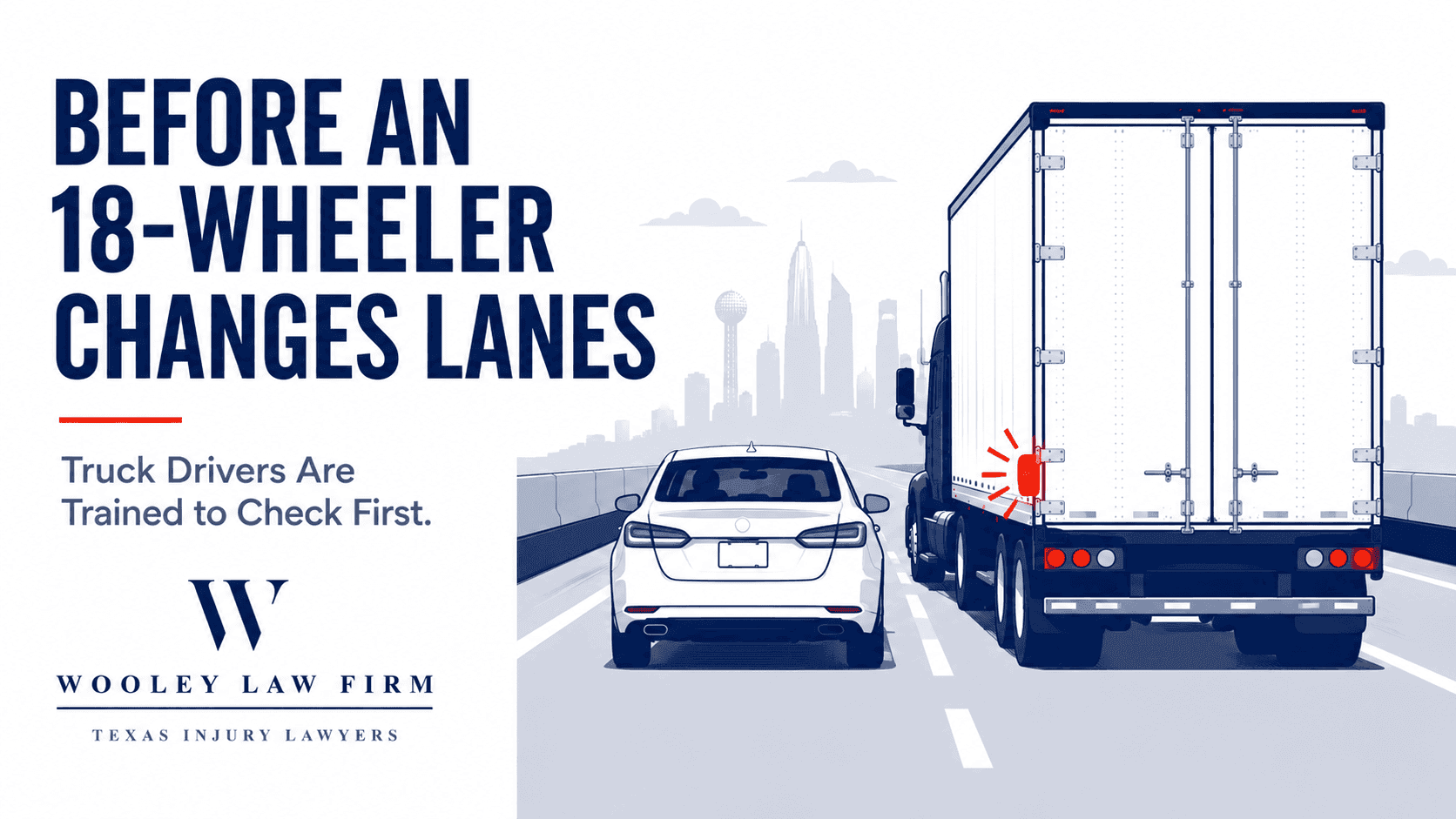
Changing lanes may seem routine, but it is one of the most dangerous maneuvers an 18-wheeler driver performs.
A fully loaded tractor-trailer may be approximately 70 to 80 feet long. It has large blind spots, requires more room to maneuver, and can cause catastrophic injuries if the driver moves into an occupied lane. Before changing lanes, a trained commercial driver should monitor the surrounding traffic, check the truck’s mirrors, account for blind spots, signal the intended movement, maintain a safe speed, and make sure the entire tractor-trailer can enter the new lane safely.
The driver should not begin moving simply because the turn signal is on or because the driver briefly glanced at one mirror.
If an 18-wheeler changed lanes into your car on I-35E, I-30, I-45, I-635, US-75, or another Dallas-area highway, the truck driver’s training, mirror checks, lane-change procedure, and company safety policies may become important evidence.
The Wooley Law Firm represents individuals who have been seriously injured when an 18-wheeler negligently changed lanes, sideswiped their vehicle, forced them off the road, or pushed them into another vehicle or highway barrier.
Truck Drivers Are Trained to Plan a Lane Change Before Making It
A safe lane change begins before the truck crosses the lane marker.
Professional truck drivers should be trained to recognize that a tractor-trailer cannot move as quickly or precisely as a passenger car. The trailer may track differently from the tractor, surrounding vehicles may disappear from view, and the driver may need substantial space to complete the maneuver.
A proper lane-change process generally includes:
Monitoring traffic well before the lane change
Checking the truck’s flat and convex mirrors
Identifying vehicles in or approaching the truck’s blind spots
Activating the turn signal early enough to warn other motorists
Rechecking the mirrors before moving
Confirming that the adjacent lane provides enough space for the tractor and trailer
Moving gradually while continuing to monitor traffic
Establishing the entire truck in the new lane before canceling the signal
A driver who is uncertain whether the adjacent lane is clear should remain in the current lane until the movement can be made safely.
Check Traffic Ahead, Beside, and Behind the Truck
A truck driver should not focus only on the space immediately beside the cab. The driver must evaluate the entire traffic environment.
Before changing lanes, the driver should consider:
Vehicles traveling beside the tractor or trailer
Cars approaching quickly from behind
Traffic slowing ahead
Vehicles entering from an on-ramp
Motorcycles that may be difficult to see
Construction barriers or narrowed lanes
Curves that limit visibility
Rain, darkness, glare, or other visibility problems
Whether another driver is already attempting to change lanes
Whether there is enough space for the trailer to clear the other vehicle
The Federal Motor Carrier Safety Administration’s safety guidance for commercial drivers advises drivers to scan ahead and check their mirrors every eight to ten seconds for vehicles entering blind spots.
Regular mirror monitoring matters because a driver who waits until the moment of the lane change may have already lost track of a car traveling beside the trailer.
Check Both Flat and Convex Mirrors
Commercial trucks commonly use multiple mirrors because one mirror cannot show every area around the tractor and trailer.
Flat mirrors generally provide a clearer view of traffic behind and beside the truck. Convex mirrors show a wider area but can make vehicles appear smaller or farther away than they actually are.
A trained truck driver should use the mirrors together. Before changing lanes, the driver should check the appropriate flat mirror, convex mirror, and any additional fender, hood, or blind-spot mirror installed on the truck.
A quick glance at one mirror may not be enough.
The driver should also understand how the vehicle’s length affects visibility. A car may appear in one mirror, disappear while traveling beside the trailer, and then become visible again. That temporary disappearance should not be treated as proof that the lane is empty.
Our article about 18-wheeler blind-spot accidents in Dallas explains why “the car was in my blind spot” does not automatically excuse an unsafe lane change.
Account for Every Blind Spot Before Moving
Tractor-trailers have large areas where visibility is limited. These areas may extend:
Directly in front of the tractor
Along the driver’s side
Across multiple lanes on the passenger side
Behind the trailer
The passenger side can be particularly dangerous because the blind area may extend across more than one traffic lane.
Truck drivers know, or should know, about these visibility limitations. That knowledge creates a reason to exercise greater care. It does not give the driver the right to move into a lane without confirming that it is clear.
If the driver recently saw a car beside the trailer but can no longer locate it in the mirrors, the safe response is not to assume that the vehicle disappeared. The driver should wait until the vehicle’s location can be confirmed.
Signal Before Beginning the Lane Change
A truck driver should activate the turn signal before the tractor begins crossing the lane marker. The signal is supposed to provide advance warning, not merely blink after the movement has already started.
Texas Transportation Code § 545.104 requires a driver to use a turn signal to indicate an intention to change lanes.
However, a turn signal does not create a right-of-way.
A truck driver cannot activate a signal and immediately move into an occupied lane. The signal communicates an intention to change lanes; the driver must still determine that the movement can be completed safely.
Injured in an Accident?
Free consultation. Tell us what happened and learn what options may be available.
Recheck the Mirrors Before Crossing the Lane Marker
Traffic conditions can change within seconds.
A lane that appeared clear when the truck driver first activated the signal may no longer be clear when the driver begins steering. Another vehicle may have entered the area beside the trailer, accelerated from behind, or merged onto the highway.
For that reason, the driver should recheck the mirrors before moving and continue monitoring them throughout the lane change.
This repeated checking helps the driver recognize:
A vehicle that entered the blind spot
A motorcycle approaching from behind
A car that did not slow down
Another driver changing lanes at the same time
The trailer moving too close to another vehicle
Traffic ahead suddenly slowing
If the lane is no longer clear, the driver should cancel or delay the maneuver.
Leave Enough Space for the Entire Tractor-Trailer
A truck driver must account for more than the tractor.
The driver may see enough room for the cab and begin moving even though the trailer has not cleared the passenger vehicle. This can cause the side of the trailer or its rear wheels to strike the car.
Before changing lanes, the driver should make sure there is sufficient room for the entire combination vehicle. The driver should also consider whether traffic ahead might force the truck to brake before the trailer is fully established in the new lane.
Unsafe lane changes frequently result in 18-wheeler sideswipe accidents in Dallas-Fort Worth. These wrecks can push a passenger vehicle toward a concrete median, into another lane, underneath the trailer, or off the roadway.
Change Lanes Gradually and Predictably
Once the lane is confirmed clear, the truck driver should move gradually and predictably.
Sudden steering can cause a trailer to swing, sway, or become unstable. Abrupt movements may be especially dangerous when a truck is carrying a heavy or improperly balanced load, traveling through a curve, or operating on wet pavement.
The driver should maintain control, monitor the truck’s position, and continue checking the mirrors until the tractor and trailer are completely inside the new lane.
What Texas Law Says About Unsafe Lane Changes
Texas Transportation Code § 545.060 generally requires a driver on a roadway divided into marked lanes to remain within a single lane and not move from that lane unless the movement can be made safely.
That rule applies to commercial truck drivers.
After a Dallas truck lane-change wreck, important questions may include:
Did the truck driver determine that the lane was clear?
Did the driver check all available mirrors?
Did the driver signal before moving?
Did the driver know a car was beside the trailer?
Was the driver distracted or fatigued?
Did the driver cross the lane marker suddenly?
Was the driver attempting to cross several lanes to reach an exit?
Did the driver continue moving after making contact?
Did the trucking company properly train the driver?
A citation for an unsafe lane change can be important, but it is not the only evidence that may establish negligence.
How Negligent Lane Changes Cause Serious Truck Wrecks
A lane-change collision involving two passenger vehicles may result in a sideswipe. When an 18-wheeler is involved, the consequences can be far more severe.
A tractor-trailer may:
Crush the side of a passenger vehicle
Push a vehicle into a concrete barrier
Force a vehicle into surrounding traffic
Cause a multi-vehicle collision
Trap a car underneath the trailer
Force a motorcyclist off the roadway
Cause the truck or another vehicle to roll over
Continue dragging or pushing a vehicle before stopping
Victims may suffer traumatic brain injuries, spinal cord damage, herniated discs, broken bones, internal-organ injuries, amputations, burns, paralysis, or wrongful death.
The size difference between a commercial truck and a passenger vehicle means that a momentary failure to look can permanently change another person’s life.
The Trucking Company’s Training May Be Part of the Case
The truck driver may not be the only responsible party.
A trucking company may be investigated for failing to properly train, supervise, or monitor its driver. Relevant issues may include:
Whether the company provided lane-change and mirror-use training
Whether the driver completed behind-the-wheel instruction
Whether the driver passed a road test
Whether the company evaluated the driver’s ability to operate that particular truck
Whether prior crashes or complaints showed unsafe lane-change habits
Whether the company disciplined drivers for safety violations
Whether the mirrors were properly installed, adjusted, and maintained
Whether the company pressured the driver to cross lanes quickly to avoid missing an exit
Whether available blind-spot warning technology was working
Company safety manuals, training materials, road-test records, personnel files, and prior incident records may show what the driver was taught and whether the company enforced its own rules.
Evidence That Can Prove an Unsafe Truck Lane Change
Truck drivers and insurance companies may claim that the passenger vehicle entered the blind spot or refused to let the truck merge. Objective evidence can help determine what actually happened.
Important evidence may include:
Dash-camera footage from the car or truck
Side-facing and driver-facing truck cameras
Video from nearby vehicles or businesses
Traffic-camera footage
Witness statements
Photographs of the vehicle damage
Scrape marks and paint transfer
The truck’s electronic or telematics data
Lane-departure and blind-spot warning data
GPS records
Turn-signal and lighting inspections
Cellphone and dispatch records
Driver qualification and training files
Company lane-change policies
Prior crashes, complaints, or safety violations
The location and direction of vehicle damage may help establish whether the passenger car was already occupying its lane when the truck moved over.
Electronic and video evidence may be overwritten or lost. Our guide to evidence after an 18-wheeler wreck explains why a prompt preservation demand can be important.
What Should You Do After an 18-Wheeler Changes Lanes Into You?
After a serious lane-change truck wreck:
Seek medical attention.
Call law enforcement and report the collision.
Photograph the tractor, trailer, company markings, license plates, and vehicle damage if you can safely do so.
Save the original dash-camera footage.
Obtain witness names and contact information.
Avoid arguing with the truck driver at the scene.
Do not sign a release before understanding your injuries and legal options.
Speak with a truck accident attorney about preserving the truck, cameras, electronic data, and company records.
Your safety and medical needs should come first. Do not place yourself in danger attempting to collect evidence on an active Dallas highway.
Talk to a Dallas Truck Wreck Lawyer About an Unsafe Lane Change
The Wooley Law Firm represents individuals who have been seriously injured when an 18-wheeler negligently changed lanes.
We investigate whether the truck driver checked the mirrors, accounted for blind spots, used a signal, maintained a proper lookout, and confirmed that the entire tractor-trailer had enough space to move safely. We also examine the trucking company’s training, supervision, safety policies, electronic data, camera footage, and other evidence.
If an 18-wheeler sideswiped your vehicle, forced you off the road, pushed you into another car, or caused a serious collision while changing lanes, learn more about working with a Dallas 18-wheeler accident lawyer.
Call The Wooley Law Firm at (214) 699-6524 for a free consultation. You don’t pay unless we win. You may also contact our Dallas truck wreck law firm online.
Frequently Asked Questions
What should an 18-wheeler driver do before changing lanes?
A trained driver should monitor traffic, check the truck’s flat and convex mirrors, account for blind spots, signal the intended movement, recheck the mirrors, and confirm that the entire tractor-trailer can safely enter the adjacent lane.
Does using a turn signal give a truck driver the right-of-way?
No. A signal warns other motorists that the driver intends to change lanes. The driver must still wait until the movement can be made safely.
Is a car automatically at fault for being in a truck’s blind spot?
No. A blind spot does not automatically establish fault. Investigators should examine how long the car occupied its lane, whether the truck driver was monitoring the mirrors, whether a signal was used, and what the video, physical, and electronic evidence shows.
Can a trucking company be responsible for an unsafe lane change?
Potentially. Depending on the facts, the trucking company’s driver training, supervision, hiring, retention, maintenance, or enforcement of safety policies may be relevant.
Why should truck evidence be preserved quickly?
Dash-camera footage, telematics information, driver-monitoring data, and other electronic records may be overwritten. The tractor or trailer may also be repaired and returned to service. A prompt preservation demand can help protect relevant evidence.
Disclaimer
This article is for general informational purposes only and is not legal advice. Reading it does not create an attorney-client relationship. Every case is different, and past results do not guarantee a similar outcome.
Topics
Share This Article

Andrew J. Wooley
Personal Injury Attorney
Andrew J. Wooley is a dedicated personal injury attorney based in Dallas, Texas. He focuses on helping accident victims recover fair compensation for their injuries. With a commitment to personalized service, Andrew works directly with each client to understand their unique situation and fight for their rights.