If an 18-wheeler changes lanes into your vehicle and the truck driver says, “I never saw you,” one of the first questions should be:
What kind of mirror or camera system was installed on the truck?
Many commercial trucks still use traditional flat and convex mirrors. But newer tractor-trailers may also be equipped with digital mirrors, sometimes called camera-monitor systems, electronic mirrors, e-mirrors, mirror cameras, or camera-based rearview systems.
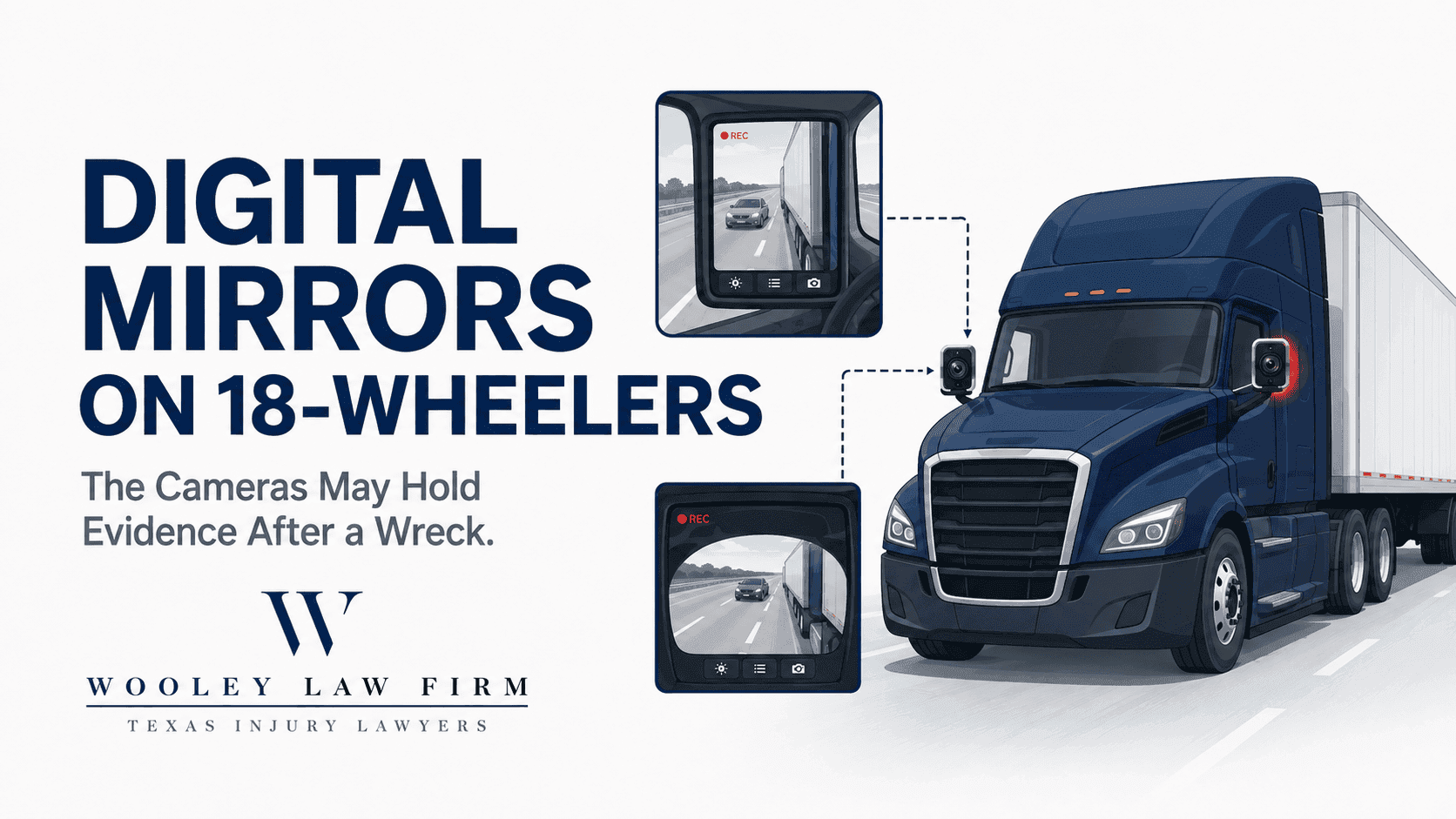
Instead of relying solely on a piece of glass mounted outside the cab, these systems use exterior cameras to send a live image to monitors mounted inside the truck.
Federal regulators have granted exemptions allowing several commercial camera-monitor systems to be used in place of conventional rearview mirrors. Current FMCSA exemptions include systems produced by companies such as Stoneridge, Rosco Vision, Vision Systems North America, and others.
This technology can improve a truck driver's view around an 18-wheeler.
But after a serious Dallas truck accident, it can create another important source of evidence.
Some digital-mirror systems can record and retrieve video. That video may show exactly what was beside the tractor-trailer before an unsafe lane change, sideswipe, turn, merge, or other collision.
If you were seriously injured in a commercial truck collision, learn more about how we investigate these cases on our Dallas truck accident lawyer page.
What Are Digital Mirrors on an 18-Wheeler?
A traditional truck mirror reflects whatever is behind and beside the tractor.
A digital mirror works differently.
Exterior cameras mounted to the truck capture the area surrounding the tractor-trailer and transmit those images to monitors inside the cab.
For example, Stoneridge's MirrorEye system offered for North American commercial trucks uses multiple exterior cameras and high-definition interior monitors. The system is designed to expand the driver's field of view, reduce traditional blind spots, provide better nighttime visibility, and help the driver see the trailer during turns and backing maneuvers.
Other commercial systems operate on similar principles. Rosco's D•CAMS system, for example, uses cameras intended to provide the views traditionally supplied by flat and convex mirrors.
These systems are becoming increasingly relevant in truck-wreck investigations as newer commercial vehicles enter Texas fleets.
What Can a Truck Driver See With Digital Mirrors?
The exact view depends on the truck and system installed.
Depending on the equipment, digital mirrors may provide views of:
Traffic beside the tractor;
Traffic beside portions of the trailer;
Vehicles approaching from behind;
Traditional blind-spot areas;
The passenger side of the tractor;
Trailer wheels;
The trailer during a turn;
Nearby vehicles during a lane change;
Areas around the truck during backing;
Roadway conditions behind and beside the truck; and
Wider views than conventional flat mirrors alone.
Some systems can automatically adjust the displayed image as the trailer turns so the driver continues to see areas near the trailer. Digital systems may also provide enhanced nighttime images or different viewing angles depending on driving conditions.
That can become extremely important when a truck driver claims a passenger vehicle was hidden in a blind spot.
Our article on 18-wheeler blind-spot accidents in Dallas explains why saying “the car was in my blind spot” should not end the investigation.
Do Digital Truck Mirrors Record Video?
Some do. Some do not.
That distinction is critical.
A lawyer should not assume that every truck equipped with digital mirrors automatically recorded the collision.
Some camera-monitor systems are designed primarily to provide a live image to the truck driver.
Other systems have optional or integrated recording capabilities.
For example, Stoneridge states that its North American MirrorEye system can provide video retrieval, including high-resolution video evidence available through cloud-based retrieval. The manufacturer specifically identifies liability investigation and driver training as uses for the recorded video.
Stoneridge has also described commercial deployments that include digital video recording and cloud-based retrieval capabilities.
That means one of the important questions following a serious truck wreck is not simply:
“Did the truck have digital mirrors?”
It should also be:
“Was the digital-mirror system configured to record, store, upload, or preserve video?”
What Information Could Digital-Mirror Evidence Show After a Truck Accident?
When recording is available, digital-mirror footage could potentially answer questions that are heavily disputed after an 18-wheeler wreck.
Was Your Vehicle Beside the Truck?
This may be one of the most important issues in a sideswipe or lane-change case.
A truck driver may claim:
“The car came out of nowhere.”
“I checked my mirrors.”
“Nobody was beside me.”
“The car was in my blind spot.”
“The other driver sped up while I was changing lanes.”
Recorded side-camera footage may provide objective evidence about where the passenger vehicle actually was.
It may show that a car had been traveling beside the tractor-trailer for several seconds before the driver began moving over.
Was the Lane Clear Before the Truck Changed Lanes?
A commercial driver should determine that a lane change can be made safely before moving an 18-wheeler into another lane.
Digital-mirror footage may help establish whether another vehicle was plainly visible in the area monitored by the truck's cameras.
This can be especially important in crashes on heavily traveled Dallas highways such as:
I-35E;
I-30;
I-45;
I-20;
I-635;
U.S. 75;
Loop 12;
State Highway 114; and
State Highway 183.
Injured in an Accident?
Free consultation. Tell us what happened and learn what options may be available.
Did the Trailer Move Into Another Vehicle?
Sometimes the tractor clears a vehicle, but the much longer trailer does not.
Camera footage that follows the side or rear of the trailer may help show how the trailer moved during a lane change or turn.
That evidence can be particularly useful after an 18-wheeler sideswipe accident in Dallas-Fort Worth.
How Long Was the Other Vehicle Visible?
Timing matters.
There is a significant difference between a passenger vehicle appearing for a fraction of a second and a vehicle being visible beside the tractor-trailer for an extended period before impact.
Digital video may allow attorneys and accident-reconstruction experts to analyze the sequence frame by frame.
What Were Traffic and Roadway Conditions?
Depending on camera placement, footage may also show:
Congested traffic;
Lane markings;
Construction zones;
Adjacent vehicles;
Merging traffic;
The position of the trailer;
Weather conditions;
Lighting conditions; and
Other circumstances surrounding the collision.
Digital Mirrors Can Be Especially Important in Lane-Change Truck Wrecks
One of the most valuable applications of digital-mirror evidence may be an unsafe lane-change accident.
Imagine that you are traveling legally in your lane on I-35E in Dallas.
An 18-wheeler is traveling in the lane beside you.
The truck suddenly begins moving into your lane and strikes the side of your vehicle.
After the collision, the truck driver says:
“I checked my mirrors and never saw the car.”
That statement should raise questions—not end them.
If the truck had a digital camera-monitor system, an investigation should determine:
What cameras were installed?
Where were the cameras pointed?
What areas did they display?
Were they functioning?
Was your vehicle visible?
Did the system record video?
Was the recording saved locally or in the cloud?
Was the video automatically uploaded after a collision event?
How long does the system retain recordings?
Did anyone access or download the video after the wreck?
Was any video deleted, overwritten, or lost?
Digital-mirror evidence may therefore become part of the larger investigation into whether the driver maintained a proper lookout before changing lanes.
Digital-Mirror Video Is Different From Dash-Camera Video
Commercial trucks may contain several different camera systems.
They should not automatically be treated as the same thing.
A truck could potentially have:
Forward-facing dash cameras
These generally show the roadway in front of the tractor.
Driver-facing cameras
These may show what the truck driver was doing inside the cab.
Digital side-mirror cameras
These generally monitor areas beside and behind the truck.
Rear or trailer cameras
These may provide views behind or around the trailer.
A serious truck-wreck investigation should identify every camera on the tractor and trailer, not simply request “dashcam footage.”
Our article on dash-camera evidence after a Dallas car or truck wreck explains other ways onboard and passenger-vehicle video can help prove what happened.
Digital-Mirror Video Should Be Compared With the Truck's Other Electronic Data
Video becomes even more powerful when it is analyzed alongside other evidence.
For example, digital-mirror footage may show the truck beginning to cross a lane line at a particular moment.
The truck's electronic data may then help determine what the driver was doing at that same time.
Depending on the equipment installed, relevant evidence may include:
Engine control module data;
Event data recorder information;
Vehicle speed;
Brake application;
Throttle position;
GPS location;
Telematics records;
Electronic logging-device records;
Lane-departure warnings;
Collision warnings;
Dispatch communications; and
Driver safety-system alerts.
Read our detailed guide to 18-wheeler black-box data after a Dallas-Fort Worth truck wreck for more information about this electronic evidence.
Why Digital-Mirror Evidence Needs to Be Preserved Quickly
One of the biggest mistakes after a serious truck wreck is assuming that electronic evidence will still be available months later.
Video systems may operate under different retention settings.
Files may be:
Automatically overwritten;
Stored for only a limited period;
Saved on removable media;
Uploaded to a cloud server;
Downloaded after a triggering event;
Maintained by the trucking company;
Maintained by a third-party technology provider; or
Deleted during normal data-management procedures.
The precise system must be identified.
An attorney investigating a truck collision may need to send a detailed preservation letter directing the trucking company and other potentially responsible parties to preserve camera footage, digital-mirror recordings, metadata, cloud-stored files, system logs, downloads, and the equipment itself.
A generic request to preserve “video” may not identify every source of electronic evidence.
Our broader guide to evidence that can help prove an 18-wheeler wreck case explains why electronic truck evidence should be identified quickly.
The Trucking Company's Technology May Contradict Its Driver
Trucking companies increasingly use sophisticated technology to monitor commercial vehicles.
That technology can improve safety.
But when a crash occurs, it may also create evidence.
If a trucking company tells an injured driver:
“Our driver never saw you,”
the investigation should not stop there.
If the truck was equipped with digital cameras, the next questions may be:
What could the cameras see?
What appeared on the driver's monitors?
Was the system recording?
Where is the recording now?
The trucking company should not be allowed to rely on modern safety technology when operating its fleet and then ignore potentially important electronic evidence after a serious collision.
How a Dallas Truck Wreck Lawyer Can Investigate Digital Mirrors
A lawyer handling a serious 18-wheeler accident may investigate the tractor's complete camera and electronic-safety system.
Depending on the facts, that investigation may include identifying:
The tractor's year, make, model, and VIN;
The digital-mirror manufacturer;
Camera locations;
Monitor locations;
Recording hardware;
Software versions;
Storage devices;
Cloud accounts;
Video-retention policies;
Download history;
System error or diagnostic records;
Camera maintenance records;
Driver training concerning the system;
Trucking-company policies regarding digital mirrors; and
Communications with the system manufacturer or service provider after the crash.
An attorney can then compare that information with photographs, physical vehicle damage, witness accounts, police evidence, dash-camera footage, GPS records, and electronic truck data.
The goal is to reconstruct what actually happened rather than accepting the truck driver's version of events without investigation.
Injured in a Dallas 18-Wheeler Wreck?
If an 18-wheeler changed lanes into you, sideswiped your vehicle, forced you off the road, or struck you during a merge or turn, determining what the truck driver could see may be a critical part of proving your case.
The truck may contain more evidence than you realize.
Digital mirrors, onboard cameras, black-box data, GPS records, telematics, driver logs, safety-system alerts, and trucking-company records may all help explain how the crash occurred.
The Wooley Law Firm represents people seriously injured in 18-wheeler and commercial truck wrecks in Dallas, Dallas County, and throughout the Dallas-Fort Worth area.
Learn more about our Dallas 18-wheeler and truck wreck practice.
Call (214) 699-6524 for a free consultation. You don't pay unless we win.
Frequently Asked Questions About Digital Mirrors and Truck Wrecks
Do all 18-wheelers have digital mirrors?
No. Many commercial trucks still use traditional mirrors. Digital camera-monitor systems are available on certain newer trucks and may also be installed as aftermarket equipment. The specific tractor involved in the wreck should be inspected and its equipment identified.
Do digital truck mirrors record accidents?
Not necessarily. Some digital-mirror systems primarily display live camera images. Other systems include or offer recording and video-retrieval capabilities. The truck's specific equipment and configuration must be investigated.
Can digital-mirror cameras show that my car was beside the truck?
Potentially. Depending on camera placement, viewing angle, system configuration, and whether footage was recorded, the cameras may show vehicles traveling alongside or behind the tractor-trailer.
Can digital-mirror footage help prove an unsafe lane change?
Yes. If footage exists, it may help establish where the vehicles were located before impact, whether another vehicle was visible beside the truck, and how the tractor or trailer moved during the lane change.
Can a trucking company delete digital-mirror footage?
Electronic video can sometimes be overwritten or lost according to a system's retention settings. That is why potentially relevant recordings should be identified and preserved promptly after a serious collision.
Is digital-mirror video the same as black-box data?
No. Video may show what the cameras observed. Black-box, ECM, GPS, and telematics evidence may provide information about the truck's speed, braking, throttle, location, warnings, and other vehicle operations. Both can be important and may be even more useful when analyzed together.
Disclaimer
This article is for general informational purposes only and is not legal advice. Reading it does not create an attorney-client relationship. Every truck wreck is different, and the electronic evidence available depends on the specific tractor, trailer, equipment, software, settings, and facts involved. Past results do not guarantee a similar outcome.
Topics
Share This Article

Andrew J. Wooley
Personal Injury Attorney
Andrew J. Wooley is a dedicated personal injury attorney based in Dallas, Texas. He focuses on helping accident victims recover fair compensation for their injuries. With a commitment to personalized service, Andrew works directly with each client to understand their unique situation and fight for their rights.