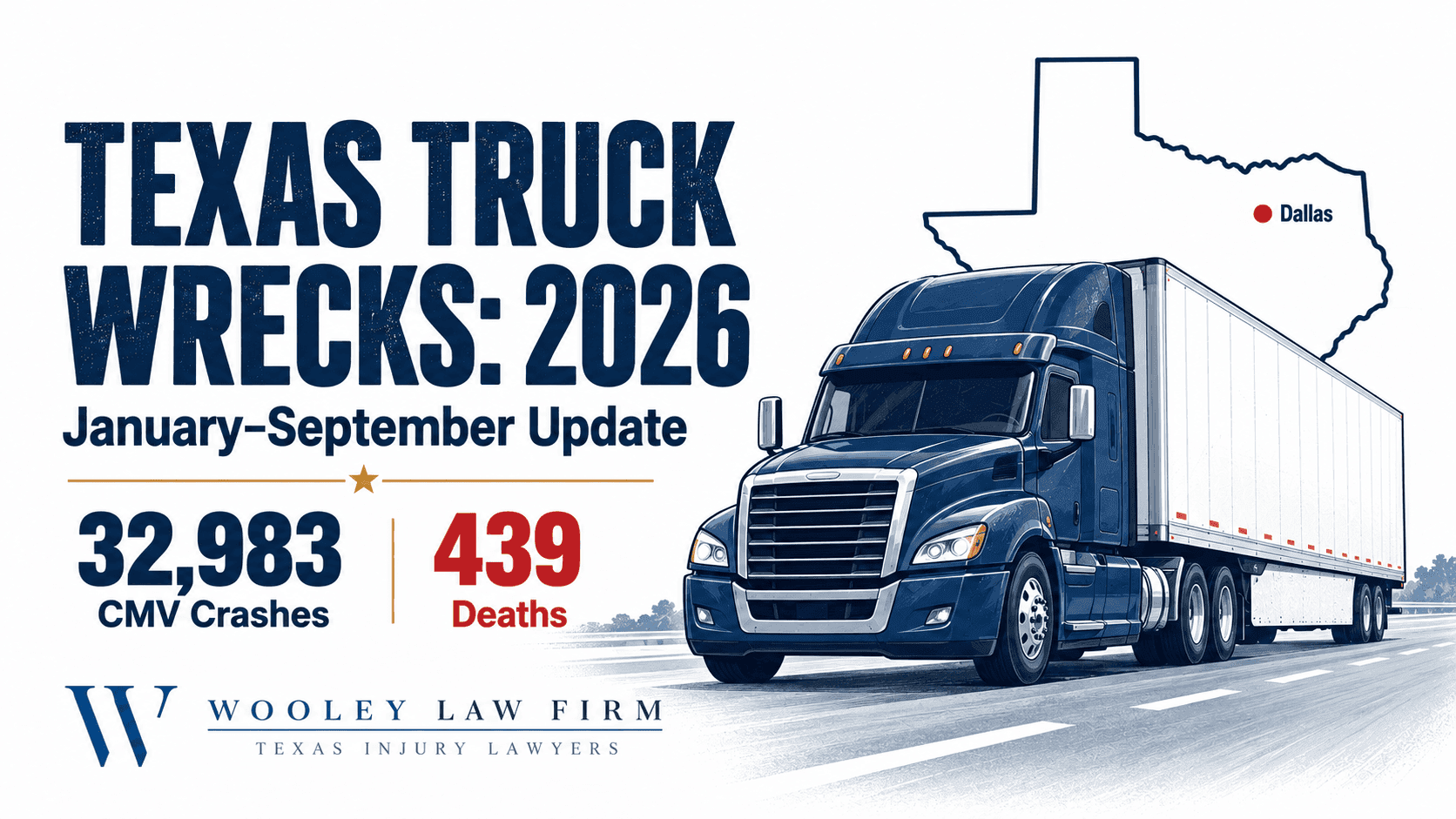
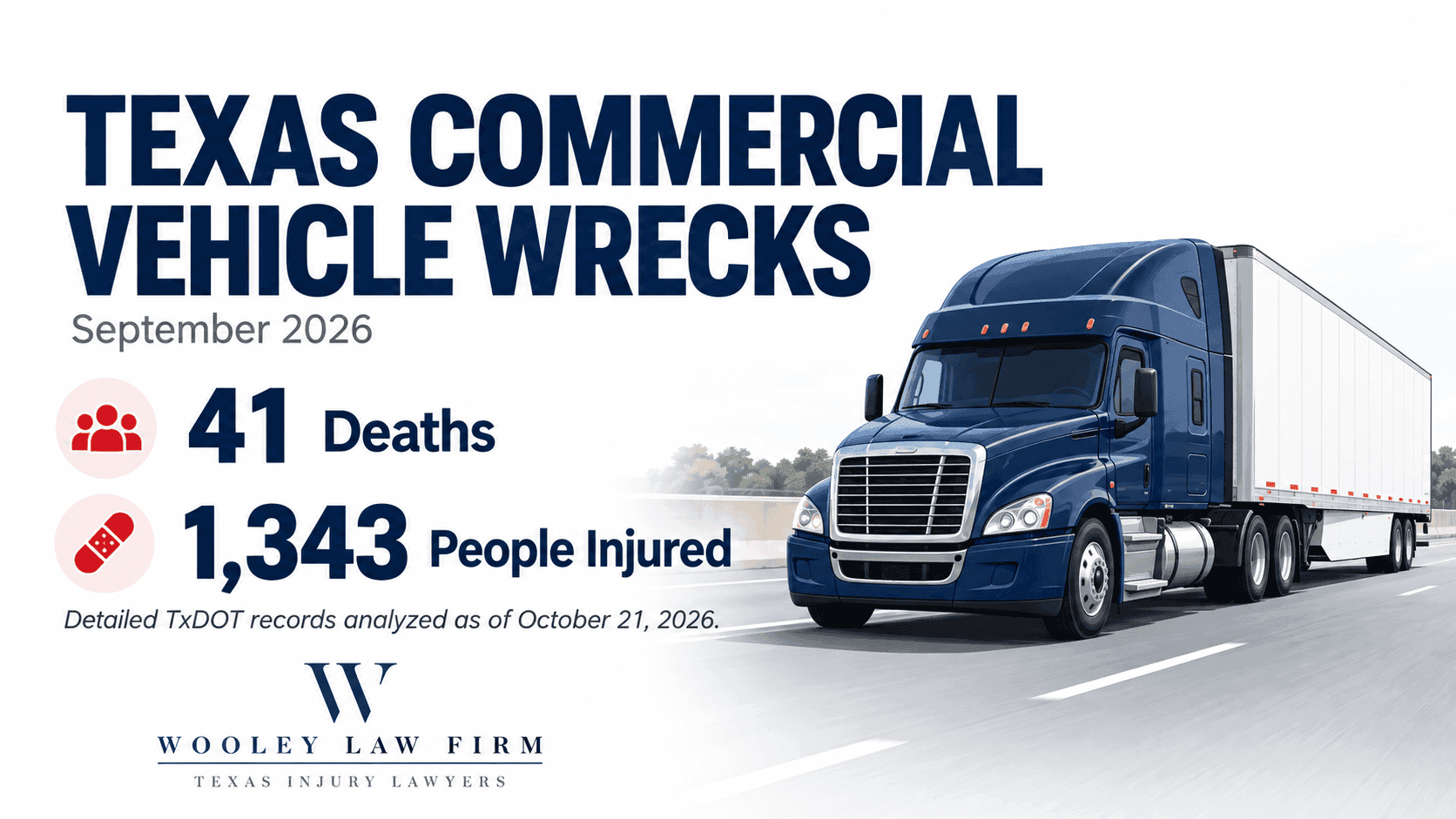
September 2026 crashes involving commercial motor vehicles left people across Texas facing serious injuries, medical bills and lost income. Detailed records in a Texas Department of Transportation crash-data export identify 3,749 CMV-involved crashes, 41 deaths and 1,343 injuries, including 146 suspected serious injuries.
Within Dallas city limits, the detailed records identify 197 commercial vehicle crashes. Across Dallas, Tarrant, Denton and Collin counties, they identify 723 crashes.
If you were injured in one of these collisions, statewide statistics cannot tell you who should pay your medical bills or whether the trucking company’s insurance offer is fair. Those questions require an investigation of your wreck, your injuries and the businesses responsible for operating the commercial vehicle.
The Wooley Law Firm’s Dallas truck wreck lawyer represents people injured in 18-wheeler and other commercial vehicle crashes throughout Dallas–Fort Worth and Texas.
We Represent People Injured in September CMV Wrecks
The Wooley Law Firm represents people injured in September 2026 crashes involving commercial motor vehicles across Texas. Some of these clients have already received compensation for their injuries.
For our clients, these wrecks involve more than statistics. They involve medical treatment, missed work, pain and uncertainty about recovery. Our work includes investigating the collision, identifying potentially responsible parties, preserving evidence and pursuing compensation based on each client’s injuries and losses.
Some claims can resolve sooner than others. Disputed responsibility, ongoing treatment, multiple injured people and questions about insurance coverage can affect the process. Every case requires its own evaluation, and past results do not guarantee a similar outcome.
September 2026 Texas Commercial Vehicle Crash Statistics
The detailed September records show:
3,749 unique crashes involving commercial motor vehicles.
38 fatal crashes resulting in 41 deaths.
922 crashes involving at least one reported injury.
1,343 people injured.
146 suspected serious injuries, included within the injury total.
364 crashes flagged as occurring in construction zones.
Deaths are reported separately from injuries. Suspected serious injuries are included in the total injury count and should not be added to it.
These figures come from a TxDOT Crash Records Information System export covering September 1–30, 2026, with reports received and processed as of October 21, 2026. TxDOT maintains crash records submitted by law enforcement and makes data available through its crash-data analysis and statistics resources.
Data limitation: The export’s summary reports 3,756 crashes, but its detailed rows contain 3,749 unique crash IDs. This article uses those 3,749 identifiable crashes for its detailed analysis. The file does not explain the seven-crash difference.
Does “CMV-Involved” Mean an 18-Wheeler Caused the Wreck?
No. The query uses the commercial motor vehicle flag and includes different commercial vehicle types. It is not limited to tractor-trailers.
Commercial vehicle involvement also does not establish responsibility. Another driver may have caused or contributed to a collision involving a commercial vehicle. Likewise, a contributing factor recorded for a crash may relate to a passenger vehicle rather than the commercial driver.
An individual investigation is necessary to determine what happened.
Dallas and DFW Commercial Vehicle Crashes in September
The detailed records identify the following county totals:
Dallas County: 344 crashes, three deaths and 151 injuries.
Tarrant County: 217 crashes, one death and 82 injuries.
Denton County: 103 crashes, one death and 25 injuries.
Collin County: 59 crashes, no reported deaths and 33 injuries.
Together, these four counties accounted for 723 crashes, five deaths and 291 injuries in the detailed export.
Within individual city limits:
Dallas: 197 crashes and 103 injuries.
Fort Worth: 140 crashes and 45 injuries.
Irving: 36 crashes and 11 injuries.
Arlington: 29 crashes and 25 injuries.
Denton: 26 crashes and nine injuries.
City and county totals overlap and should not be added together.
Among named cities statewide, Houston had 252 crashes, San Antonio had 211, Dallas had 197 and Fort Worth had 140. Another 1,250 crashes were coded as occurring outside city limits.
These are reported crash counts. They do not establish which community had the highest risk per mile driven or per commercial vehicle trip.
Which Highways Had the Most Texas CMV Wrecks?
Using the export’s primary Street Name field, the leading recorded routes were:
I-10: 214 crashes.
I-35: 174 crashes.
I-20: 170 crashes.
I-30: 114 crashes.
I-45: 88 crashes.
I-35E: 73 crashes.
U.S. 59: 47 crashes.
I-35W: 43 crashes.
U.S. 287: 37 crashes.
I-69: 34 crashes.
I-35, I-35E and I-35W are separate route codes in this analysis.
These figures do not combine every ramp, frontage road, intersecting road or alternate road-name entry into one highway corridor. They also do not adjust for highway length or traffic volume.
Dallas County Truck Wrecks on I-20, I-35E, I-30 and I-635
Within Dallas County, I-20 and I-35E each had 34 CMV-involved crashes. I-30 and I-635 each had 27.
For a person injured on one of these highways, the investigation should examine the conditions at the specific crash location. Relevant questions may include:
Was traffic slowing or stopped before impact?
Did the commercial vehicle change lanes?
Were temporary lane markings or construction barriers present?
Was the driver approaching an entrance ramp, exit or interchange?
Did cameras capture the vehicles before the collision?
Our guide to I-20 truck wrecks in Dallas–Fort Worth explains evidence that may help establish why a commercial vehicle failed to avoid a collision.
Injured in an Accident?
Free consultation. Tell us what happened and learn what options may be available.
What Were the Most Common Reported Contributing Factors?
Counting each factor once per crash, the leading specific entries were:
Failure to control speed: 623 crashes.
Unsafe lane changes: 596 crashes.
Driver inattention: 527 crashes.
Failure to drive in a single lane: 387 crashes.
Backing without safety: 188 crashes.
Unsafe turns: 144 crashes.
The broad “other” category also appeared in 589 crashes. Understanding that category requires reviewing the underlying report narrative.
A single crash may contain multiple contributing factors, so these categories overlap. They may relate to any involved vehicle and should not all be attributed to commercial drivers.
Looking specifically at factor entries on rows flagged as commercial vehicles:
Failure to control speed appeared in 290 distinct crashes.
Unsafe lane changes appeared in 266 distinct crashes.
Driver inattention appeared in 250 distinct crashes.
These are reported contributing factors, not final findings of civil liability.
Failure to Control Speed
“Failed to control speed” is a separate reporting category from exceeding the posted speed limit. An investigation may need to examine the driver’s response to slowing traffic, a stopped vehicle or another developing hazard.
Electronic speed and braking data, forward-facing video, witness accounts and vehicle inspections may help explain the collision.
If a commercial truck struck your vehicle from behind, read our guide to being rear-ended by an 18-wheeler in Dallas.
Unsafe Lane Changes and Lane Departures
When drivers disagree about who entered whose lane, the vehicles’ positions before impact become especially important.
Damage patterns, lane markings, camera footage and witness statements may help determine whether the commercial vehicle moved into an occupied lane or whether another vehicle’s movement contributed to the wreck.
Driver Inattention
An inattention entry may warrant further investigation into what diverted the driver’s attention. It does not, by itself, prove cellphone use.
Depending on the circumstances, relevant evidence may include onboard video, dispatch communications and lawfully obtained phone records.
Alcohol and Drug Results Reported for CMV Drivers
The September export contains two positive alcohol results among drivers of vehicles flagged as commercial motor vehicles:
September 5 in Arlington, Tarrant County: A CMV driver involved in a crash on I-30 had a recorded blood alcohol concentration of 0.199.
September 14 in Fort Bend County: A CMV driver had a recorded alcohol concentration of 0.249, with the specimen identified as breath.
Although the export labels the concentration field “Driver Blood Alcohol Content Test Result,” the Fort Bend entry identifies a breath specimen.
Among the 3,900 CMV-driver records examined, two contained positive alcohol results and 3,898 contained no alcohol-result data.
The drug-result fields show:
No recorded positive drug tests.
One negative result.
Five unknown results.
3,894 entries marked “not applicable.”
Separately, officers recorded “intoxicated—alcohol” as a contributing factor for three CMV drivers and “intoxicated—drug” for one CMV driver. Those entries are distinct from confirmed laboratory results.
Missing Results Do Not Establish That a Driver Was Sober
Missing, unknown and “not applicable” entries cannot be treated as negative tests. The export therefore does not establish how common impairment was among commercial drivers involved in September crashes.
When impairment is suspected, an investigation may need to examine the underlying crash report, toxicology records, officer observations, video and witness accounts. Specimen timing and the surrounding circumstances also matter when evaluating a positive result.
Construction Zones Appeared in 364 CMV-Involved Crashes
The detailed records flag 364 September crashes as occurring in construction zones.
That flag does not establish that construction caused the wreck, that workers were present or that a contractor was negligent. It identifies cases in which the work-zone layout may deserve closer examination.
For a collision involving temporary lane markings, narrowed lanes or a traffic backup, relevant evidence may include photographs, camera footage, traffic-control plans and records showing which lanes were open.
What Evidence Should a Dallas Truck Wreck Lawyer Investigate?
A commercial vehicle claim may require evidence beyond the crash report. Depending on the collision, relevant material may include:
Forward-facing and driver-facing camera footage.
Available electronic control module, event recorder and telematics data.
Driver logs and electronic logging device records.
Dispatch messages, route information and delivery documents.
Tractor and trailer inspection, maintenance and repair records.
Driver qualification and safety records.
Relevant alcohol or drug testing records.
The vehicles and components involved in the collision.
Different electronic systems serve different purposes. An electronic logging device principally records hours-of-service information; it is not a substitute for collision reconstruction data or camera footage.
The FMCSA’s ELD retention guidance states that carriers must retain covered records of duty status and supporting documents for six months. Other evidence may be overwritten sooner, and preservation duties can depend on the circumstances.
Who May Be Responsible for a September Truck Wreck?
Depending on the facts and applicable law, responsibility may involve the commercial driver, motor carrier, a maintenance or repair business, a cargo-loading business or another party whose conduct contributed to the collision.
The tractor owner, trailer owner and operating carrier may be different businesses. Ownership alone does not establish liability; the investigation must determine what each party controlled and whether its conduct contributed to the wreck.
Our article on who owns or leases the truck after a Dallas collision explains why identifying the businesses behind the vehicle can matter.
What Compensation May Be Available After a Commercial Vehicle Crash?
Depending on the injuries, proof and applicable law, an injured person may pursue compensation for:
Legally recoverable medical expenses.
Future medical care.
Lost income and reduced earning capacity.
Physical pain and mental anguish.
Physical impairment.
Disfigurement.
The number of crashes in a monthly report does not determine the value of an individual claim. A meaningful evaluation considers how the collision occurred, the injuries it caused, the treatment required and the effect on the injured person’s life.
Before accepting a settlement, it is important to understand which claims the release would resolve and whether the available information adequately addresses ongoing injuries and future care.
Frequently Asked Questions About September Texas Truck Wrecks
How many commercial vehicle crashes occurred in Texas in September 2026?
The supplied TxDOT export’s summary reports 3,756 crashes. Its detailed rows identify 3,749 unique crashes, which form the basis of this article’s detailed analysis.
How many people were injured or killed?
The detailed records identify 41 deaths and 1,343 injuries. The injury total includes 146 suspected serious injuries.
How many CMV crashes occurred in Dallas?
The detailed records identify 197 crashes within Dallas city limits and 344 across Dallas County. These totals overlap and should not be added together.
Were alcohol or drugs reported in any September CMV crashes?
Yes. Two CMV-driver records contain positive alcohol results. Separately, officers recorded alcohol intoxication as a contributing factor for three CMV drivers and drug intoxication for one. Most records lack meaningful test results, so the export cannot establish the overall prevalence of impairment.
Can I pursue a claim if the trucking company denies responsibility?
A denial does not resolve responsibility. Video, electronic records, witnesses and physical evidence may help establish how the collision occurred. A lawyer can evaluate that evidence and explain your options.
Has The Wooley Law Firm helped people injured in September CMV wrecks?
Yes. The Wooley Law Firm represents people injured in September 2026 commercial vehicle crashes, and some have already received compensation. Every claim is different, and prior results do not guarantee a particular recovery or resolution time.
Talk to a Dallas Truck Wreck Lawyer About Your September Crash
If you were injured in a September truck wreck in Dallas, Arlington, Fort Worth or elsewhere in Texas, The Wooley Law Firm can review your case, investigate potentially responsible parties and work to preserve relevant evidence.
Learn more about our representation after 18-wheeler and commercial truck wrecks, or request a free consultation.
Call (214) 699-6524. You don’t pay unless we win.
Data methodology: The Wooley Law Firm analyzed the supplied TxDOT CRIS export using one record per unique Crash ID for crash-level totals. Contributing factors were counted once per crash. CMV-specific factors used rows flagged as commercial vehicles; testing analysis additionally required the person type to be identified as a driver. Geographic and roadway figures use the recorded City, County and primary Street Name fields. Figures may change as reports are updated. This analysis and its conclusions are those of The Wooley Law Firm, not TxDOT.
This article provides general information and is not legal advice. Reading it does not create an attorney-client relationship. Every case is different, and past results do not guarantee a similar outcome.
Topics
Share This Article

Andrew J. Wooley
Personal Injury Attorney
Andrew J. Wooley is a dedicated personal injury attorney based in Dallas, Texas. He focuses on helping accident victims recover fair compensation for their injuries. With a commitment to personalized service, Andrew works directly with each client to understand their unique situation and fight for their rights.