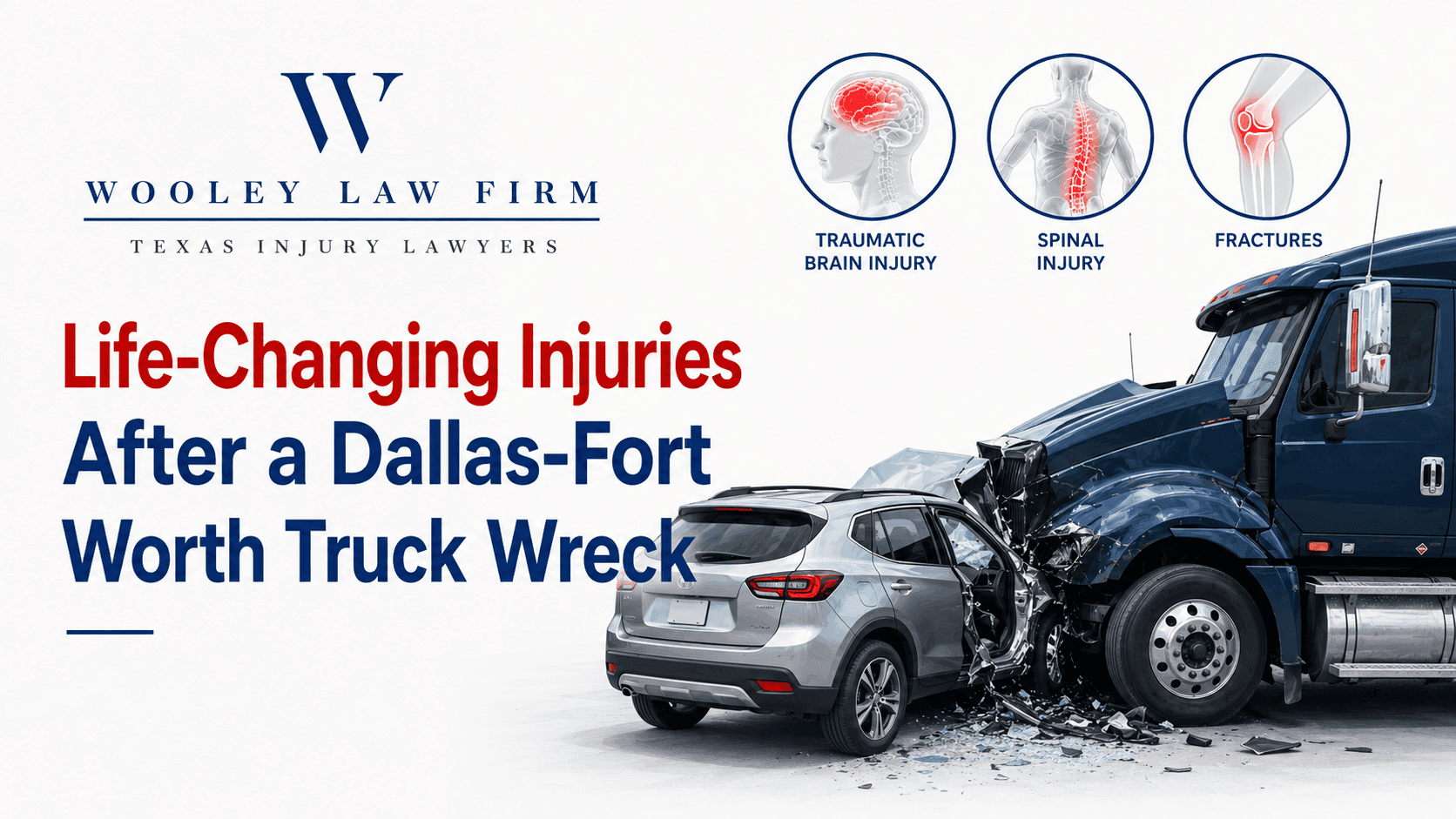
A serious collision with an 18-wheeler can change your life in seconds.
One moment, you may be driving to work, taking your children to school, or traveling home on I-35E, I-20, I-30, I-635, US-75, or another Dallas-Fort Worth highway. The next moment, you may be trapped inside a damaged vehicle, transported by ambulance, facing surgery, or learning that your injuries may never fully heal.
Truck wreck injuries are not always temporary. Some victims are left with permanent physical limitations, chronic pain, cognitive problems, emotional trauma, disfigurement, or an inability to return to the work and activities that once defined their lives.
If you or someone you love suffered life-changing injuries in a Dallas-Fort Worth truck wreck, you may be facing much more than an insurance claim. You may be facing years of treatment, financial uncertainty, and an entirely different future.
The Wooley Law Firm represents people seriously injured in wrecks involving:
18-wheelers and tractor-trailers
Semi-trucks
Delivery trucks and vans
Box trucks
Flatbed trucks
Dump trucks
Tanker trucks
Construction vehicles
Garbage and sanitation trucks
Buses and other commercial vehicles
Learn more about how we handle these cases on our Dallas 18-wheeler and truck accident lawyer page.
Call 214-699-6524 for a free consultation with a Dallas truck wreck lawyer. You pay no attorney’s fees unless we recover compensation for you.
What Is a Life-Changing Injury After a Truck Accident?
A life-changing injury is an injury that substantially affects how a person lives, works, thinks, communicates, moves, or interacts with others.
Some injuries are immediately recognized as catastrophic. Others become life-changing because symptoms continue long after the initial emergency-room visit.
An injury may be life-changing when it causes:
Permanent or long-term physical limitations
Chronic pain
Cognitive or memory problems
Loss of mobility
Loss of independence
An inability to return to work
Reduced earning capacity
Disfigurement or scarring
Emotional or personality changes
The need for repeated surgeries
The need for assistance with daily activities
The inability to participate in hobbies, exercise, parenting, or family activities
A permanent change in relationships and quality of life
Insurance companies may focus on medical bills or diagnostic codes. But those numbers do not always show the full impact of a catastrophic truck accident.
A serious injury claim must tell the story of how the wreck changed the victim’s life.
Why 18-Wheeler Wrecks Cause Catastrophic Injuries
A fully loaded tractor-trailer is much larger and heavier than a passenger vehicle. When that truck strikes a car, SUV, motorcycle, or pedestrian, the smaller vehicle’s occupants may be exposed to tremendous force.
Serious truck wreck injuries may occur because of:
The weight and momentum of the truck
High highway speeds
Multiple impacts
Vehicle intrusion into the passenger compartment
Rollover forces
Crushing injuries
Underride collisions
Unsecured cargo
Hazardous materials
Occupants being trapped inside the vehicle
Delayed emergency extraction
Secondary collisions with other vehicles or barriers
Even a truck wreck that appears to happen at a relatively low speed can cause severe injuries. Read more about why a low-speed 18-wheeler wreck can still cause serious injuries.
Common Life-Changing Injuries After a Dallas Truck Wreck
Every crash is different. However, several types of injuries commonly have lasting consequences after an 18-wheeler or commercial truck collision.
Traumatic Brain Injuries
A traumatic brain injury, or TBI, can affect memory, concentration, judgment, communication, mood, balance, vision, sleep, and personality.
Truck-wreck victims do not always have to hit their heads or lose consciousness to suffer a brain injury. Sudden acceleration, deceleration, and rotational movement may cause the brain to move inside the skull.
Symptoms may include:
Headaches
Dizziness
Memory problems
Difficulty concentrating
Confusion
Sensitivity to light or sound
Blurred vision
Irritability
Depression or anxiety
Sleep disturbances
Changes in behavior
Difficulty finding words
Problems managing work or household tasks
Some brain injuries are not immediately visible on a CT scan. Symptoms may also become more noticeable after the victim tries to return to work or resume normal responsibilities.
Our detailed guide explains traumatic brain injury symptoms after a Dallas car or truck wreck.
Spinal Cord Injuries and Paralysis
Damage to the spinal cord can cause partial or complete loss of movement and sensation.
Depending on where the spinal cord is injured, a victim may experience:
Paraplegia
Quadriplegia or tetraplegia
Loss of sensation
Muscle weakness
Loss of bowel or bladder control
Breathing complications
Chronic nerve pain
Loss of sexual function
Reduced independence
The need for mobility devices or home modifications
A spinal cord injury may require extensive rehabilitation, assistive technology, attendant care, and lifelong medical treatment.
The financial impact can include not only immediate hospital bills, but also future nursing care, medical equipment, accessible transportation, home renovations, and lost earning capacity.
Serious Back and Neck Injuries
Truck wrecks can cause significant damage to the vertebrae, discs, ligaments, muscles, and nerves of the back and neck.
These injuries may include:
Herniated or bulging discs
Vertebral fractures
Spinal instability
Nerve compression
Cervical radiculopathy
Lumbar radiculopathy
Chronic muscle spasms
Failed back syndrome
Permanent range-of-motion limitations
Some victims require injections, nerve procedures, spinal-fusion surgery, disc replacement, or long-term pain management.
An insurance company may describe a back injury as “soft tissue,” even when the victim continues to suffer severe pain and functional limitations. Proper medical documentation and expert evaluation can be critical.
Amputations and Loss of Limbs
Crushing forces, vehicle intrusion, severe fractures, vascular damage, burns, or infection can result in the surgical or traumatic loss of a limb.
An amputation may affect nearly every part of a person’s life, including:
Walking and mobility
Driving
Employment
Personal care
Parenting
Exercise
Social activities
Mental health
Body image
Independence
Amputation cases may involve prosthetic devices, replacement prosthetics, physical therapy, occupational therapy, home modifications, and future surgical care.
A fair claim should account for these future expenses—not only the bills incurred immediately after the wreck.
Crush Injuries
A driver or passenger may become pinned between the truck and another vehicle, trapped inside a crushed passenger compartment, or struck by shifting cargo.
Crush injuries can damage:
Muscles
Nerves
Blood vessels
Bones
Internal organs
Skin and soft tissue
Complications may include compartment syndrome, organ failure, infection, tissue death, and amputation.
These cases may require emergency surgery followed by months or years of rehabilitation.
Multiple Fractures and Orthopedic Injuries
Truck wreck victims frequently suffer multiple broken bones rather than a single isolated fracture.
Serious orthopedic injuries may involve:
Pelvic fractures
Hip fractures
Femur fractures
Tibia and fibula fractures
Knee injuries
Ankle and foot fractures
Shoulder fractures
Clavicle fractures
Arm, wrist, radius, or ulna fractures
Hand injuries
Rib fractures
Facial fractures
Complex fractures may require hardware, plates, screws, rods, external fixation, bone grafts, or joint replacement.
Even after the bone heals, the victim may be left with arthritis, weakness, reduced mobility, chronic pain, nerve damage, or an increased risk of future surgery.
Internal Organ Injuries
The force of an 18-wheeler collision may cause severe internal injuries, including damage to the:
Lungs
Liver
Spleen
Kidneys
Heart
Intestines
Bladder
Pancreas
Internal bleeding may become life-threatening before a victim or family member understands the severity of the injury.
Organ damage may require emergency surgery, extended hospitalization, blood transfusions, and ongoing monitoring. Some victims experience permanent organ dysfunction or other long-term complications.
Burn Injuries
Truck wrecks can cause fires, explosions, fuel spills, electrical injuries, and exposure to hazardous cargo.
Severe burns may result in:
Permanent scarring
Disfigurement
Nerve damage
Reduced range of motion
Infection
Skin-graft procedures
Reconstructive surgery
Chronic pain
Psychological trauma
Burn injuries often require repeated procedures and long-term treatment. The visible nature of scarring and disfigurement can also affect a victim’s confidence, relationships, and emotional well-being.
Facial Injuries, Scarring, and Disfigurement
Broken glass, airbags, steering wheels, dashboards, metal intrusion, and flying debris may cause serious injuries to the face.
These injuries may include:
Facial fractures
Jaw injuries
Dental damage
Eye injuries
Vision loss
Nerve damage
Facial lacerations
Permanent scars
Difficulty speaking or eating
Disfigurement can have consequences far beyond physical discomfort. A victim may become self-conscious, withdraw socially, or experience anxiety and depression.
Vision or Hearing Loss
Head trauma, facial injuries, airbag deployment, explosions, and nerve damage can cause partial or total loss of vision or hearing.
These injuries may interfere with:
Driving
Employment
Communication
Balance
Personal safety
Independent living
A victim may need hearing aids, assistive technology, occupational therapy, vocational retraining, or lifelong support.
Injured in an Accident?
Free consultation. Tell us what happened and learn what options may be available.
Post-Traumatic Stress and Emotional Trauma
Not every life-changing injury is visible.
Truck wreck victims may experience:
Post-traumatic stress disorder
Anxiety
Depression
Panic attacks
Fear of driving
Nightmares
Sleep disruption
Survivor’s guilt
Emotional withdrawal
Irritability
Loss of confidence
A victim may relive the crash whenever passing an 18-wheeler, entering an intersection, or driving on the highway where the wreck happened.
Mental anguish and psychological injuries should be taken seriously and documented through appropriate medical or mental-health treatment.
How a Catastrophic Truck Injury Can Affect Your Entire Family
A life-changing injury rarely affects only the person who was physically injured.
Spouses, children, parents, and other family members may become caregivers. They may have to manage appointments, transportation, medications, household tasks, finances, and personal care.
The family may also experience:
Lost household income
Reduced retirement savings
Increased childcare costs
Changes in family roles
Loss of companionship
Emotional stress
Housing modifications
Transportation challenges
The need to relocate
Uncertainty about future medical care
A catastrophic injury case should account for the real-world effect of the injury—not merely the amount listed on the hospital bill.
Who May Be Responsible for a Dallas-Fort Worth Truck Wreck?
One of the most important parts of a serious truck accident investigation is identifying every person or company that may be responsible.
Potentially responsible parties may include:
The Truck Driver
The driver may be liable for:
Speeding
Following too closely
Distracted driving
Unsafe lane changes
Fatigued driving
Impaired driving
Failing to maintain a proper lookout
Running a red light
Making an unsafe wide turn
Driving too fast for traffic or weather conditions
Failing to inspect the truck or cargo
Violating hours-of-service requirements
The Trucking Company
A trucking company may be responsible for its driver’s negligence and for its own unsafe conduct.
Examples may include:
Negligent hiring
Inadequate training
Negligent supervision
Retaining an unsafe driver
Encouraging drivers to violate safety rules
Unrealistic delivery schedules
Failure to maintain the vehicle
Failure to monitor driver qualifications
Failure to enforce drug and alcohol policies
Failure to properly inspect cargo or equipment
A Freight Broker, Shipper, or Cargo-Loading Company
Cargo-related crashes may involve companies other than the motor carrier.
A shipper, loader, broker, or contractor may bear responsibility when cargo is improperly loaded, balanced, inspected, or secured.
Flatbed trucks present particular dangers because steel, lumber, pipes, machinery, construction materials, and other exposed cargo can fall or shift into traffic.
Learn more about flatbed truck accidents, cargo securement, and liability.
A Maintenance or Repair Company
Some trucking companies outsource inspections, repairs, tires, brakes, or maintenance.
A maintenance provider may be responsible when careless work contributes to:
Brake failure
Tire blowouts
Steering failure
Lighting problems
Trailer separation
Mechanical breakdowns
The Truck or Parts Manufacturer
A defective tire, brake system, coupling device, steering component, underride guard, or other vehicle part may contribute to a serious crash.
These cases may involve product-liability claims in addition to negligence claims against the driver or motor carrier.
Evidence That Should Be Preserved After a Serious Truck Wreck
Trucking companies and their insurance carriers may begin investigating immediately.
They may send adjusters, attorneys, investigators, and reconstruction experts to the scene while the injured person is still in the hospital.
Important evidence may include:
Engine control module or “black box” data
Electronic logging device records
Dash-camera footage
Driver-facing camera footage
GPS and telematics data
Dispatch communications
Cellphone records
Driver qualification files
Training records
Employment records
Hours-of-service logs
Drug and alcohol testing records
Vehicle inspection reports
Maintenance and repair records
Cargo-loading documents
Weight tickets
Bills of lading
Photographs and videos
Nearby surveillance footage
Witness statements
Police body-camera footage
911 calls and emergency records
Post-crash company investigation materials
Some records may be overwritten, discarded, or lost unless steps are taken to preserve them.
Our firm has published additional information about 18-wheeler black-box data after a Dallas-Fort Worth truck wreck and the evidence that matters most in Texas truck accident cases.
Why Medical Documentation Matters After a Catastrophic Truck Injury
An insurance company may not accept your description of how badly you are hurt. It may demand medical records, imaging, physician opinions, functional assessments, and evidence of future treatment.
Important medical documentation may include:
Ambulance records
Emergency-room records
Hospital records
Operative reports
Diagnostic imaging
Specialist evaluations
Physical and occupational therapy records
Neuropsychological testing
Pain-management records
Rehabilitation assessments
Work restrictions
Impairment ratings
Life-care planning
Future medical opinions
Victims should tell their medical providers about all symptoms, including cognitive, emotional, sleep, balance, and functional problems.
Do not minimize symptoms because you are trying to remain positive. Your doctors can only document and treat the problems they know about.
What Compensation May Be Available After a Life-Changing Truck Injury?
The compensation available depends on the facts of the wreck, the severity of the injuries, the available insurance coverage, and the evidence connecting the losses to the collision.
Potential damages may include:
Past Medical Expenses
These may include emergency transportation, hospitalization, surgery, imaging, physician care, rehabilitation, therapy, medication, and medical equipment.
Future Medical Care
A life-changing injury may require care for years or for the rest of the victim’s life.
Future expenses may include:
Additional surgeries
Rehabilitation
Physical therapy
Occupational therapy
Counseling
Prescription medication
Pain management
Prosthetic devices
Wheelchairs and mobility equipment
Home healthcare
Attendant care
Medical monitoring
Accessible transportation
Home modifications
Lost Wages
A victim may recover income lost while unable to work because of the wreck, hospitalization, appointments, surgery, or recovery.
Loss of Earning Capacity
A serious injury may prevent a person from returning to the same occupation, working the same hours, performing physical tasks, advancing professionally, or remaining in the workforce for as long as expected.
Loss of earning capacity can be especially important when the victim is young or had a physically demanding career.
Physical Pain and Suffering
Compensation may be available for the physical pain, discomfort, and symptoms caused by the injuries.
Mental Anguish
Mental anguish may include emotional pain, anxiety, depression, fear, grief, humiliation, and psychological distress.
Physical Impairment
Physical impairment concerns the loss of the ability to participate in activities that were part of the victim’s normal life.
Examples include the inability to:
Exercise
Play with children
Drive
Travel
Perform household tasks
Attend family events
Participate in hobbies
Care for oneself independently
Disfigurement
Permanent scars, burns, amputations, surgical changes, and other visible injuries may support a claim for disfigurement.
Property Damage and Out-of-Pocket Expenses
A claim may also include vehicle damage, towing, storage, rental expenses, transportation costs, medical equipment, home modifications, and other expenses caused by the wreck.
For a more detailed explanation, read our guide to truck accident damages and what a Dallas 18-wheeler case may be worth.
How Insurance Companies Defend Catastrophic Truck Accident Claims
Large truck claims frequently involve experienced insurance adjusters and defense lawyers.
They may attempt to:
Blame the injured driver
Minimize the force of impact
Dispute whether the injuries came from the wreck
Point to preexisting medical conditions
Claim treatment was excessive
Argue that treatment was delayed
Challenge future medical recommendations
Downplay lost earning capacity
Request a broad medical authorization
Obtain a recorded statement
Monitor social-media activity
Offer a settlement before the long-term prognosis is known
A quick settlement may appear helpful when bills are accumulating. However, accepting a settlement usually ends the claim permanently.
A victim should understand the full extent of the injuries, future medical needs, employment consequences, and available insurance coverage before resolving a catastrophic injury case.
Common Types of Dallas-Fort Worth Truck Wrecks
Life-changing injuries may result from many different types of commercial-vehicle collisions, including:
Rear-end 18-wheeler wrecks
Sideswipe accidents
Wide-turn crashes
Jackknife accidents
Truck rollovers
Underride collisions
Cargo spills
Falling-load accidents
Tire blowouts
Brake-failure wrecks
Blind-spot collisions
Head-on crashes
Intersection accidents
Multi-vehicle pileups
Crashes involving stopped trucks
Wrecks on restricted or no-truck roads
Someone injured during a lane-change collision may find additional information in our guide for people sideswiped by an 18-wheeler in Dallas-Fort Worth.
Wrecks involving improperly stopped tractor-trailers may also require an investigation into emergency-warning rules. Read more about 18-wheelers stopped on Dallas-Fort Worth roadways and shoulders.
What Should You Do After Suffering Serious Injuries in a Truck Wreck?
Your medical needs come first. After obtaining emergency care, several steps may help protect your health and legal claim.
Continue With Recommended Medical Treatment
Attend appointments, follow medical instructions, and report new or worsening symptoms.
Unexplained gaps in treatment may be used by an insurance company to argue that the injuries resolved or were not serious.
Keep a Record of How the Injury Affects You
Consider documenting:
Pain levels
Medications
Medical appointments
Sleep problems
Cognitive symptoms
Missed work
Activities you cannot perform
Assistance required from family
Emotional changes
Transportation expenses
Out-of-pocket costs
Preserve Photographs and Documents
Keep photographs of the vehicles, crash scene, injuries, scars, medical devices, and recovery process.
Preserve receipts, bills, work records, insurance communications, and all correspondence involving the wreck.
Be Careful When Speaking With Insurance Adjusters
An adjuster may sound sympathetic while trying to obtain statements that reduce the company’s financial exposure.
You are not required to guess about your prognosis or minimize your symptoms. You should understand your rights before providing a recorded statement to the trucking company’s insurance carrier.
Avoid Posting About the Wreck or Your Recovery
Insurance companies may review public social-media posts and attempt to use photographs, videos, or comments out of context.
Contact a Dallas-Fort Worth Truck Wreck Lawyer Promptly
Early legal involvement can help preserve evidence, identify all responsible companies, locate insurance coverage, investigate the crash, and document the long-term consequences of the injuries.
How The Wooley Law Firm Handles Serious Truck Wreck Cases
Truck accident cases require more than collecting a police report and sending medical bills to an adjuster.
Depending on the case, The Wooley Law Firm may:
Investigate the crash scene
Obtain the police crash report
Send evidence-preservation letters
Secure black-box and electronic logging data
Identify the motor carrier and other responsible companies
Review driver qualification and safety records
Investigate maintenance and cargo issues
Interview witnesses
Obtain surveillance footage
Analyze medical records
Document future medical needs
Calculate lost wages and reduced earning capacity
Work with qualified experts
Handle communications with insurance companies
File suit when necessary
Prepare the case for trial
The goal is not simply to prove that a collision occurred. The goal is to show why it occurred, who was responsible, and how the injuries changed the victim’s life.
Dallas-Fort Worth Truck Accident Lawyer for Catastrophic Injuries
The Wooley Law Firm represents injured people and families throughout Dallas, Fort Worth, Arlington, Irving, Garland, Mesquite, Richardson, Plano, Frisco, McKinney, Allen, Denton, Lewisville, Carrollton, Grand Prairie, Grapevine, Keller, Southlake, Mansfield, and communities across North Texas.
We also handle truck and commercial-vehicle cases throughout Texas.
If an 18-wheeler, semi-truck, tractor-trailer, box truck, delivery vehicle, flatbed, dump truck, or other commercial vehicle caused life-changing injuries, call 214-699-6524.
Your consultation is free and confidential. You do not pay attorney’s fees unless we recover compensation for you.
Visit our Dallas truck accident lawyer page to learn more.
Frequently Asked Questions About Life-Changing Truck Wreck Injuries
What is considered a catastrophic injury after an 18-wheeler wreck?
A catastrophic injury generally causes permanent or long-term consequences, such as paralysis, traumatic brain injury, amputation, organ damage, severe burns, chronic pain, loss of mobility, disfigurement, or an inability to return to work.
An injury may also be life-changing even when it is not immediately classified as catastrophic. The important question is how the injury affects the person’s health, independence, employment, relationships, and daily life.
Who pays my medical bills after a Dallas truck accident?
The answer depends on the available insurance coverage and the facts of the case. Health insurance, personal injury protection, medical payments coverage, workers’ compensation, liability insurance, or other sources may be involved.
The trucking company’s insurer does not always pay medical bills as they arise. Those expenses may become part of the final injury claim.
Can I recover compensation for future medical treatment?
Future medical expenses may be recoverable when supported by evidence showing the treatment is reasonably necessary because of the wreck.
This may require opinions from treating physicians, medical experts, rehabilitation professionals, or life-care planners.
Can I recover compensation if I cannot return to my old job?
A victim may be able to pursue compensation for lost earning capacity when an injury reduces the ability to earn income in the future.
This may include situations in which the victim must accept a lower-paying job, reduce working hours, change careers, or leave the workforce entirely.
What if the trucking company blames me for the wreck?
Texas truck accident cases may involve disputed liability. A trucking company’s accusation does not automatically determine fault.
Evidence such as vehicle data, video, witness statements, electronic logs, physical damage, inspection records, and expert analysis may help establish how the crash occurred.
How long do I have to file a truck accident claim in Texas?
Texas law imposes deadlines on personal-injury claims. Different deadlines or notice requirements may apply when a government vehicle or public entity is involved.
Because evidence may disappear long before the legal deadline expires, it is generally important to begin investigating promptly.
Should I accept a settlement while I am still receiving treatment?
Resolving a claim before your medical condition is understood can be risky. Once a settlement is finalized and a release is signed, you generally cannot return later for additional compensation if your condition worsens or you need more treatment.
How much does it cost to hire The Wooley Law Firm?
The Wooley Law Firm handles personal-injury cases on a contingency-fee basis. There is no upfront attorney’s fee, and you do not owe attorney’s fees unless the firm obtains a recovery for you.
Speak With a Dallas-Fort Worth 18-Wheeler Accident Lawyer
A life-changing injury can affect every part of your future.
You may be worried about your health, your income, your family, and whether the trucking company will ever accept responsibility. While you focus on medical treatment, the trucking company and its insurance carrier may already be working to protect themselves.
You deserve someone working to protect you.
Call The Wooley Law Firm at 214-699-6524 for a free consultation about a serious Dallas-Fort Worth truck wreck.
You pay no attorney’s fees unless we win.
Disclaimer:
This article is provided for general informational purposes only and does not constitute legal advice. Reading this article or contacting The Wooley Law Firm does not create an attorney-client relationship. Every case is different, and past results do not guarantee a similar outcome. Legal deadlines may apply to your claim, so you should consult a qualified Texas attorney regarding your specific circumstances.
Topics
Share This Article

Andrew J. Wooley
Personal Injury Attorney
Andrew J. Wooley is a dedicated personal injury attorney based in Dallas, Texas. He focuses on helping accident victims recover fair compensation for their injuries. With a commitment to personalized service, Andrew works directly with each client to understand their unique situation and fight for their rights.