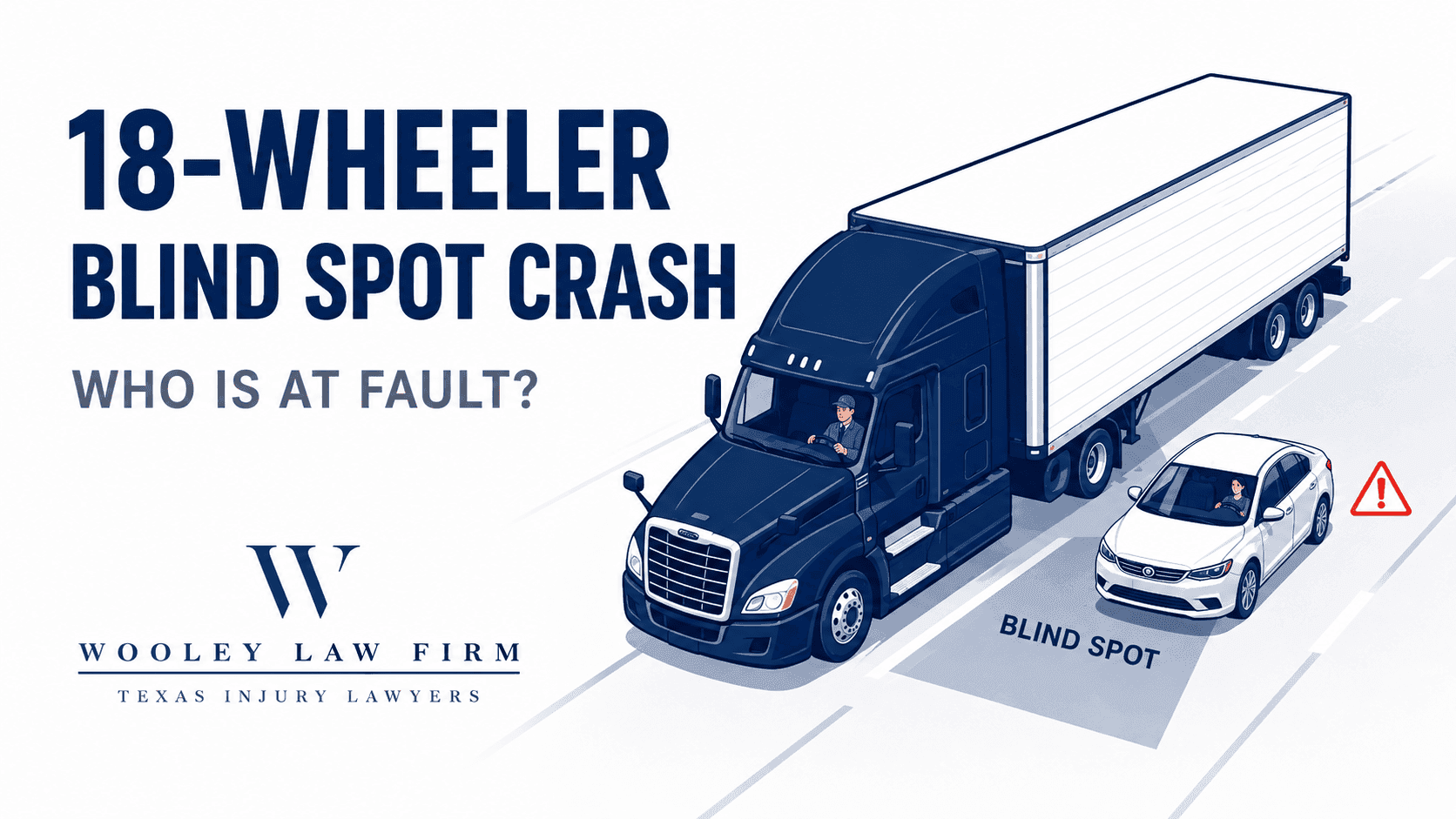
If an 18-wheeler changed lanes into your vehicle on I-35E, I-30, I-45, I-635, US-75, or another Dallas highway, the truck driver or trucking company may immediately offer an explanation:
“You were in the truck’s blind spot.”
That explanation may sound convincing because everyone knows tractor-trailers have large blind spots.
But it raises an even more important question:
If the truck driver could not see whether another vehicle was beside the truck, why did the driver move an 18-wheeler into that lane?
A blind spot is a known limitation of a commercial truck. It is not a lane that belongs to the truck driver. Passenger cars do not lose their right to occupy a traffic lane simply because a tractor-trailer has limited visibility.
Texas law generally requires a driver traveling on a roadway with marked lanes to remain within a single lane and provides that the driver may not move from that lane unless the movement can be made safely.
That rule applies to commercial drivers too.
If you were injured because an 18-wheeler merged, drifted, or changed lanes into your vehicle, a Dallas 18-wheeler accident lawyer can investigate whether the driver properly checked mirrors, monitored surrounding traffic, maintained the truck's lane, used a turn signal, and made sure the adjacent lane was clear before moving a massive commercial vehicle into it.
“You Were in My Blind Spot” Is Not the End of the Investigation
Large trucks unquestionably have areas around them where visibility is limited.
The Federal Motor Carrier Safety Administration warns both passenger drivers and commercial drivers about these blind spots. FMCSA specifically advises truck and bus drivers to check their mirrors every eight to ten seconds to remain aware of vehicles entering blind spots.
FMCSA also describes crashes in which a commercial driver begins changing lanes without recognizing that another vehicle is already traveling beside the truck.
That is exactly why professional truck drivers are expected to account for the limitations of the vehicles they operate.
When a truck driver says:
“I didn't see the car because it was in my blind spot,”
the investigation should not stop there.
It should begin there.
Questions may include:
How long had the car been beside the tractor-trailer?
Did the truck driver check all of the truck’s mirrors before changing lanes?
How frequently was the truck driver scanning the mirrors?
Was the truck driver distracted?
Did the truck driver signal before beginning the lane change?
Did the truck drift unexpectedly or deliberately change lanes?
Was the driver attempting to merge into heavy Dallas traffic?
Was another vehicle blocking the truck driver's view?
Were the mirrors properly positioned?
Was a mirror damaged or defective?
Did the truck have blind-spot monitoring technology?
Was that technology functioning?
Did the trucking company properly train the driver?
Does dash-camera or highway video contradict the driver's account?
These questions can change the entire liability analysis.
Truck Drivers Do Not “Own” the Road Around Their Blind Spots
One of the troubling attitudes that sometimes appears after an 18-wheeler wreck is the idea that motorists should simply stay away from every area a truck driver cannot see.
Drivers should certainly use reasonable care around large commercial vehicles. FMCSA encourages motorists to avoid lingering in truck blind spots when possible.
But sharing the road goes both ways.
A passenger vehicle traveling legally in its lane does not automatically become responsible for a crash because the truck driver's mirrors did not provide a direct view of that vehicle.
An 18-wheeler's blind spot is not reserved road space.
It is a safety hazard that the professional driver knows, or should know, exists.
The trucking industry's response cannot simply be:
“Everyone else should stay out of our way because our trucks are difficult to see around.”
Commercial trucks operate on the same Dallas highways as families going to work, parents taking children to school, commuters, motorcyclists, delivery drivers, and thousands of other motorists.
The responsibility that comes with operating a tractor-trailer includes knowing its limitations and taking precautions before changing lanes.
What Texas Law Says About Unsafe Lane Changes
Texas Transportation Code § 545.060 provides that a driver on a roadway divided into marked lanes must drive as nearly as practical entirely within one lane and may not move from that lane unless the movement can be made safely.
That language can be extremely important after a Dallas blind spot truck accident.
The central question may not be whether the truck driver could see your vehicle at one particular instant.
It may be whether the truck driver took reasonable steps to determine that the lane was clear before moving into it.
A commercial driver who cannot determine whether another vehicle is occupying an adjacent lane may need to remain in the current lane until the movement can safely be made.
Common Dallas 18-Wheeler Blind Spot Accidents
Blind-spot collisions frequently happen during highway lane changes and merging maneuvers.
Common scenarios include:
An 18-Wheeler Changes Lanes Into a Car
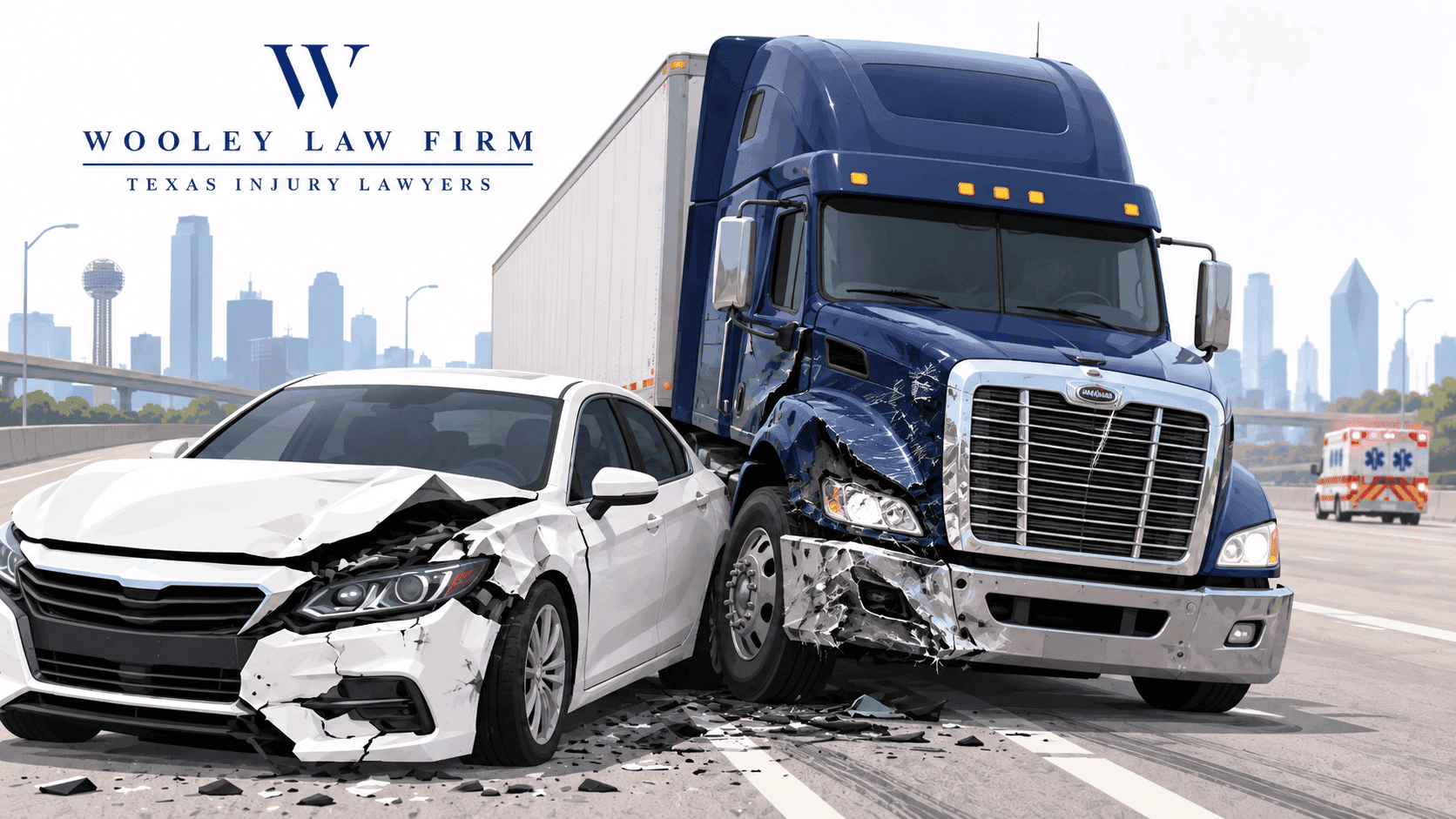
A passenger vehicle is traveling beside the tractor or trailer when the truck suddenly begins moving into the vehicle's lane.
The car may be struck directly, pushed toward a concrete barrier, forced onto a shoulder, or spun into surrounding traffic.
These crashes are closely related to 18-wheeler sideswipe accidents in Dallas-Fort Worth.
Injured in an Accident?
Free consultation. Tell us what happened and learn what options may be available.
An 18-Wheeler Merges Onto a Dallas Highway
Merging can become particularly dangerous on heavily traveled Dallas routes such as I-35E, I-635, I-30, US-75, and I-45.
A driver entering the freeway may fail to recognize a vehicle already traveling beside the trailer.
A Truck Drifts Into Another Lane
Not every blind-spot collision involves a deliberate lane change.
A distracted, fatigued, or inattentive truck driver may simply allow the tractor-trailer to drift across the lane line.
A Truck Changes Multiple Lanes
A truck driver trying to reach an exit or move around slower traffic may attempt to cross multiple lanes quickly.
The faster the maneuver, the less opportunity the driver may have to carefully monitor surrounding traffic.
Blind Spot Problems During Wide Turns
Blind spots can also become an issue when a tractor-trailer makes a wide turn at an intersection or commercial driveway.
Our guide to wide-turn 18-wheeler accidents in Dallas-Fort Worth discusses how driver positioning, mirror use, training, and surrounding traffic may affect liability.
The Trucking Company May Also Be Responsible
The truck driver is not necessarily the only person or business whose conduct should be investigated.
Depending on the facts, the trucking company may also bear responsibility.
Potential issues include:
inadequate driver training;
poor lane-change training;
inadequate supervision;
hiring an unsafe or inexperienced driver;
retaining a driver after prior preventable crashes;
failure to enforce company safety policies;
improper mirror inspection or maintenance;
pressure to meet unrealistic delivery schedules;
distracted-driving practices;
inadequate monitoring of driver performance; and
ignoring previous complaints or safety violations.
A trucking company cannot put a professional driver behind the wheel of an enormous tractor-trailer and then blame the motoring public for being where the driver failed to look.
What If the Trucking Company Blames You?
Trucking insurers frequently try to shift responsibility after lane-change and sideswipe crashes.
You may hear claims such as:
“You were riding in the blind spot.”
“You should have backed off.”
“You accelerated when the truck tried to merge.”
“The truck had its turn signal on.”
“You should have seen the truck coming over.”
“The driver could not see you.”
“Everyone knows not to drive beside an 18-wheeler.”
Do not assume these statements establish fault.
A turn signal, for example, communicates an intention to move. It does not automatically give a truck driver the right to enter an occupied lane.
Likewise, the fact that the truck driver did not see you does not necessarily mean you did anything wrong.
The physical and electronic evidence may tell a very different story.
Evidence That Can Prove What Happened
Blind-spot truck cases can become disputes over competing stories.
The truck driver may say the car suddenly entered the blind spot.
The injured driver may say the car had been traveling steadily in the lane before the truck moved over.
That makes objective evidence extremely important.
Dash-Camera Video
Many commercial trucks have forward-facing or driver-facing cameras. Some systems may capture side views as well.
Video can potentially show lane position, traffic conditions, timing, turn signals, and driver behavior.
Nearby Vehicle Video
Tesla cameras, aftermarket dashcams, delivery vehicles, rideshare vehicles, and other motorists may have captured the crash.
Dallas Traffic and Business Cameras
Highway, intersection, tollway, warehouse, gas station, or nearby business cameras may contain useful footage.
Electronic Truck Data
Commercial trucks may contain electronic control module or other vehicle data that can provide information about speed, braking, throttle use, and vehicle operation.
Read more about 18-wheeler black box data after a Dallas-Fort Worth truck wreck.
Trucking Company Records
Important records can include:
driver qualification files;
training records;
safety manuals;
prior crash history;
disciplinary records;
electronic logging data;
dispatch communications;
GPS and telematics data;
driver performance monitoring;
inspection records;
repair and maintenance records; and
company policies concerning mirror checks and lane changes.
Our guide on evidence that can help prove an 18-wheeler accident case explains why trucking evidence should be identified and preserved quickly.
Why Evidence Preservation Matters After a Blind Spot Crash
Trucking companies often begin investigating serious crashes almost immediately.
The driver's employer may be notified. The insurance carrier may assign an adjuster. Investigators may inspect the truck, obtain a driver statement, photograph the vehicles, and begin developing a liability defense.
An injured motorist should not assume that important evidence will automatically be preserved forever.
Depending on the system and company, electronic information or video may be overwritten, vehicles may be repaired, and records may become more difficult to obtain.
A truck accident attorney can send evidence-preservation demands and investigate what electronic and physical evidence exists before critical information disappears.
Serious Injuries Caused by Blind Spot Truck Wrecks
An unsafe lane change by an 18-wheeler can produce much more than a minor sideswipe.
A tractor-trailer may push a passenger vehicle:
into a concrete median;
beneath the trailer;
into another vehicle;
off the roadway;
into a guardrail; or
into a rollover.
Victims can suffer traumatic brain injuries, spinal injuries, broken bones, shoulder injuries, knee injuries, internal injuries, burns, amputations, and other life-changing harm.
When evaluating a serious claim, damages may include medical expenses, future medical care, lost wages, lost earning capacity, physical pain, mental anguish, impairment, disfigurement, property damage, and other losses recognized under Texas law.
For more information, see our guide explaining what a Dallas 18-wheeler accident case may be worth.
A Blind Spot Is a Reason to Be More Careful—not an Excuse for a Crash
Trucking companies know tractor-trailers have blind spots.
Truck drivers know tractor-trailers have blind spots.
Commercial-driver training addresses blind spots and mirror use precisely because these visibility limitations can cause devastating crashes. Texas's Commercial Motor Vehicle Driver Handbook discusses monitoring mirrors and blind spots when changing lanes, while FMCSA specifically instructs commercial drivers to monitor mirrors frequently.
That is why the statement “I didn't see you because you were in my blind spot” can raise serious questions about the driver's conduct rather than automatically eliminating liability.
The issue is whether the driver exercised reasonable care before moving a tractor-trailer weighing many times more than the passenger vehicle beside it.
If the driver could not determine whether the lane was clear, the safer choice may have been simple:
Stay in the lane until the driver could confirm the movement was safe.
Talk to a Dallas Truck Wreck Lawyer After a Blind Spot Accident
If you were injured in a Dallas car accident because an 18-wheeler changed lanes, merged into you, sideswiped your vehicle, or forced you off the road, do not accept the trucking company's statement that you were “in the blind spot” as the final word on fault.
The Wooley Law Firm can investigate the driver, trucking company, video evidence, electronic truck data, training records, company policies, and other evidence that may show why the collision happened.
Learn more about how we handle Dallas 18-wheeler and truck accident cases.
If you were injured in a Dallas 18-wheeler accident, blind spot crash, unsafe lane-change collision, or serious commercial truck wreck, you may have the right to seek justice and pursue compensation for medical expenses, pain and suffering, lost wages, mental anguish, impairment, disfigurement, and other damages.
Call (214) 699-6524 for a free consultation. You don’t pay unless we win.
Frequently Asked Questions About Dallas 18-Wheeler Blind Spot Accidents
Is the car automatically at fault for driving in an 18-wheeler's blind spot?
No. The location of the vehicles is only one part of the investigation. Texas law provides that a driver should not move from a marked lane unless the movement can be made safely. Investigators should determine how long each vehicle occupied its lane, whether the truck driver checked mirrors, whether a signal was used, and what video or electronic evidence shows.
Can an 18-wheeler change lanes if a car is beside it?
A commercial driver should not move into another lane unless the lane change can be made safely. A vehicle already occupying the adjacent lane can therefore be crucial evidence in determining whether the maneuver was reasonable and lawful.
What if the truck driver says he never saw my vehicle?
That statement does not necessarily excuse the driver. It may make mirror use, driver attention, training, visibility, lane position, dash-camera footage, and blind-spot monitoring even more important to the investigation.
What if the truck had its turn signal on?
A turn signal warns other motorists about an intended maneuver. It does not automatically establish that the truck had the right to enter an occupied lane. The lane change still must be made safely.
Can the trucking company be responsible for a blind spot accident?
Potentially. Depending on the evidence, claims may involve driver training, supervision, hiring, retention, maintenance, company safety practices, or other corporate conduct. Liability depends on the particular facts.
What evidence should I preserve?
Photographs, video, witness information, vehicle damage, medical records, dashcam footage, and communications with the trucking company can all matter. An attorney may also seek preservation of truck camera footage, telematics, electronic data, driver logs, training records, inspection records, and company policies.
Disclaimer
This article is for general informational purposes only and is not legal advice. Reading it does not create an attorney-client relationship. Every case is different, and past results do not guarantee a similar outcome.
Topics
Share This Article

Andrew J. Wooley
Personal Injury Attorney
Andrew J. Wooley is a dedicated personal injury attorney based in Dallas, Texas. He focuses on helping accident victims recover fair compensation for their injuries. With a commitment to personalized service, Andrew works directly with each client to understand their unique situation and fight for their rights.