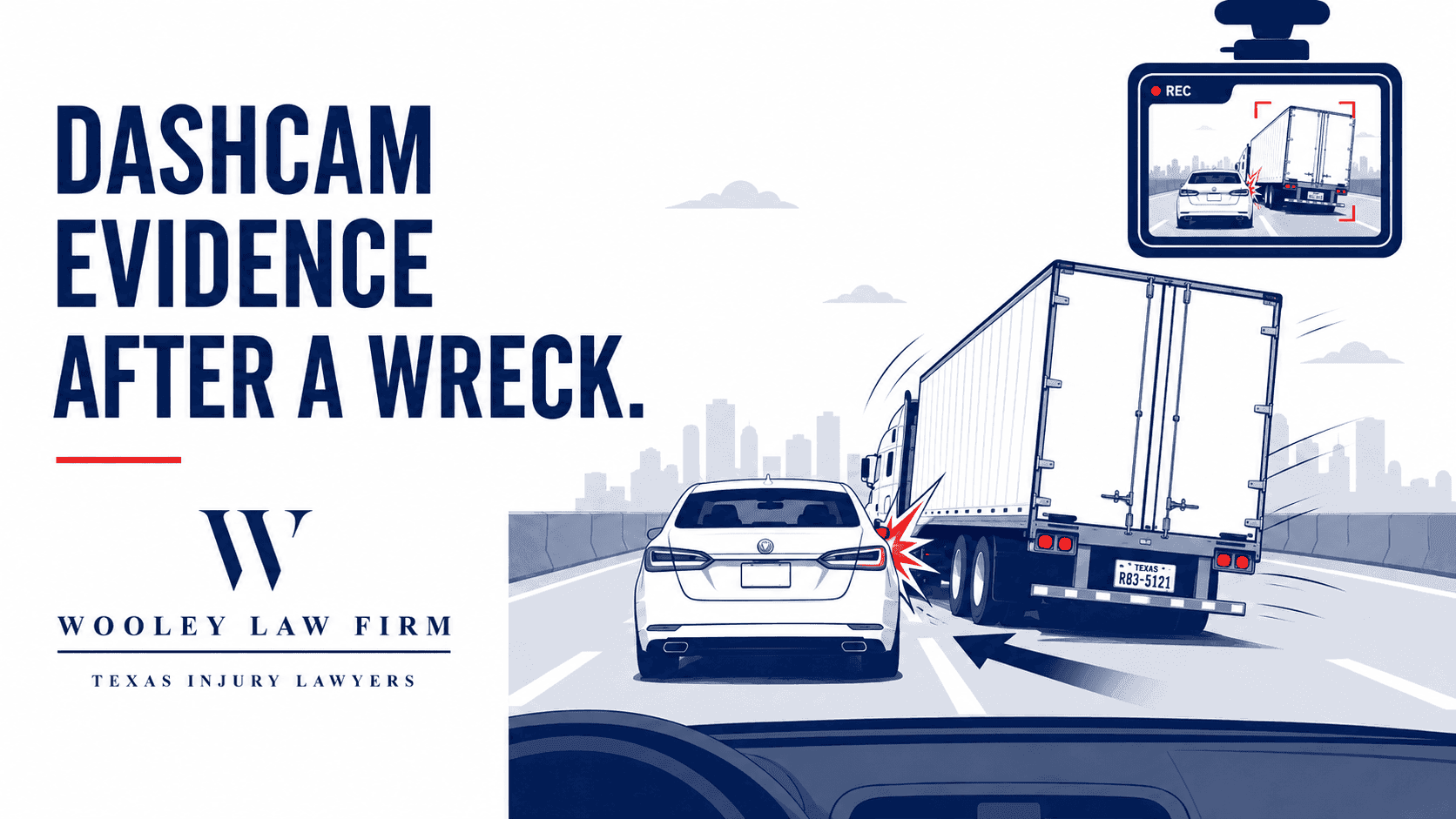
Dash-camera footage can become some of the strongest evidence after a Dallas car accident or 18-wheeler wreck. It may capture the collision, show which driver caused it, and record the other vehicle’s license plate or identifying information.
That evidence can be especially important when a driver leaves the scene or later gives an inaccurate version of what happened.
We recently represented a client whose vehicle was struck by an 18-wheeler. The truck driver did not stop and fled the scene. Fortunately, our client’s dash camera captured both the collision and the 18-wheeler’s license plate.
The footage showed how the crash happened and provided critical identifying information that could be used to locate the truck and investigate the trucking company connected to it.
Without the dash-camera footage, the trucking company or its insurance carrier might have disputed how the collision occurred or the truck might never have been identified. Instead, our client had objective video evidence of both the crash and the fleeing vehicle’s license plate.
What Can a Dash Camera Prove After a Car Accident?
Drivers often disagree about how a wreck happened. One driver may claim that the other person changed lanes, ran a red light, stopped suddenly, or caused the collision in some other way.
A dash camera may provide an objective view of the moments before, during, and after the crash. Depending on the camera’s position and video quality, the recording may show:
Which vehicle had the right of way
Whether a driver ran a red light or stop sign
An unsafe lane change
A vehicle following too closely
A driver failing to yield
Sudden or unsafe braking
Road and weather conditions
Traffic congestion
Construction zones or missing warning signs
The location and movement of surrounding vehicles
The point of impact
Whether the other driver stopped or fled
Dashcam footage can support your account of the collision and make it more difficult for an insurance company to unfairly shift blame onto you.
A dash camera does not automatically prove every part of an injury claim. The video should be examined together with the police report, witness statements, vehicle damage, photographs, medical records, and other available evidence. However, clear footage of the collision may significantly strengthen the investigation.
A Dash Camera Can Capture the Crash and Identify a Fleeing Driver
Identifying a fleeing driver is one of the most valuable uses of a dash camera.
In our client’s case, the footage did more than capture the 18-wheeler’s license plate. It also recorded the collision itself.
That distinction matters. The license plate helped identify the truck, while the video of the impact helped establish how the wreck occurred. Together, those details provided important evidence for investigating the truck driver, motor carrier, owners of the tractor and trailer, and applicable insurance coverage.
Depending on the camera’s position and video quality, hit-and-run footage may reveal:
The collision itself
How each vehicle was moving before impact
The point of impact
An unsafe lane change or other dangerous maneuver
A license plate
A United States Department of Transportation number
A motor-carrier number
A company name or logo
A tractor, trailer, or unit number
Distinctive markings or vehicle damage
The direction the truck traveled after leaving the scene
Even if a license plate is difficult to read, the complete video may contain other details that help identify the commercial vehicle and prove how the crash happened.
Additional evidence may then be obtained from traffic cameras, nearby businesses, witnesses, dispatch records, toll records, GPS information, or license-plate reader systems. Our article about Flock cameras and Texas hit-and-run accident claims explains how license-plate reader technology may also assist an investigation.
Why Dashcam Video Matters in an 18-Wheeler Accident
Commercial trucking companies and their insurance carriers may begin investigating a serious collision almost immediately. They may send representatives to the scene, inspect the vehicles, interview the truck driver, and collect electronic information.
An injured person should not have to rely entirely on evidence controlled by the trucking company.
Dash-camera footage may independently show:
The truck drifting between lanes
The truck entering the passenger vehicle’s lane
A wide or unsafe turn
A trailer swinging into another lane
An unsafe lane change
The truck following too closely
Sudden braking
Missing lights or reflective markings
Cargo falling from the truck
The truck continuing to travel after impact
Video can also help an accident-reconstruction expert evaluate the sequence of events. Individual frames may be compared with vehicle damage, roadway markings, electronic-control-module data, GPS records, and other physical evidence.
Evidence in a commercial-truck case may be lost, erased, or overwritten. Anyone injured in a collision with a semi should consider speaking with a Dallas truck accident lawyer about preserving the video and requesting evidence from the trucking company.
Identifying the Truck Does Not Always Identify Every Responsible Company
Commercial trucks are often connected to multiple businesses. One company may own the tractor, another may own the trailer, and a different motor carrier may employ the driver or operate the truck.
Depending on the circumstances, potentially responsible parties may include:
The truck driver
The truck driver’s employer
The motor carrier
The tractor’s owner
The trailer’s owner
A freight broker
A shipper
A cargo-loading company
A maintenance provider
Another company exercising control over the driver or shipment
A license plate can provide an important starting point, but a complete investigation may be necessary to determine who controlled the truck and which insurance policies apply.
The identifying information captured by a dash camera may be compared with registration records, federal motor-carrier records, insurance information, dispatch documents, bills of lading, and other trucking records.
Injured in an Accident?
Free consultation. Tell us what happened and learn what options may be available.
What Should You Do With Dashcam Footage After a Wreck?
Save the original recording immediately
Many dash cameras continuously record over older footage. If the recording is not protected, the video of your crash could be erased.
Remove the memory card or follow the manufacturer’s instructions to lock and preserve the relevant footage. Do not assume the recording will remain on the device indefinitely.
Make multiple backup copies
Preserve the original file and create backup copies. Copies may be stored on a computer, separate drive, or secure cloud-storage account.
Keep the original video in its native file format whenever possible.
Preserve the minutes before and after the crash
Do not save only a short clip of the impact. Preserve several minutes before and after the collision.
Earlier footage may show the other driver’s unsafe conduct before the wreck. Later footage may capture the vehicle leaving the scene, its license plate, company markings, witnesses, or statements made immediately after the collision.
Do not edit the original video
Trimming, filtering, compressing, adding captions, or otherwise altering the original file can create questions about whether the video is complete and authentic.
You may create a shorter copy for convenient viewing, but the complete original recording should remain unchanged.
Photograph the dash camera and memory card
Take photographs showing where the camera was installed and how it was positioned. This may help establish the camera’s field of view and explain the angle of the recording.
Keep the camera and original memory card in a secure location.
Tell the investigating officer about the video
Let the police officer know that your dash camera recorded the collision. If the other driver fled, provide the officer with the license plate, company name, truck number, USDOT number, or other identifying information shown in the footage.
Texas law generally requires drivers involved in collisions to stop and comply with certain post-crash duties. Those duties are addressed in Chapter 550 of the Texas Transportation Code.
Do not post the footage on social media
Posting the recording online may feel like a good way to identify the driver, but it can also create problems.
Insurance companies and defense attorneys may examine your posts, captions, comments, and any edited clips. A short excerpt may leave out important context or lead people to draw inaccurate conclusions about the crash.
Consider allowing law enforcement and your attorney to review the complete recording before publishing it.
What If Another Driver Recorded the Wreck?
You may still be able to obtain valuable dashcam footage even if you did not have a camera in your vehicle.
Possible sources include:
Other motorists
Rideshare drivers
Delivery vehicles
Commercial fleets
Police vehicles
Buses
Tow trucks
Nearby homes or businesses
The problem is that these recordings may be overwritten quickly. Witnesses may also leave before anyone obtains their names or telephone numbers.
Try to identify other vehicles that were near the collision. If possible, photograph their license plates and obtain the drivers’ contact information. A lawyer may then contact those witnesses and ask whether their cameras recorded the crash.
Our guide to preserving dashcam and surveillance video after a Texas wreck discusses why acting quickly is important.
Can You Still Have a Claim If the Fleeing Driver Is Never Found?
Possibly. If the fleeing driver cannot be located, uninsured-motorist coverage may apply depending on the insurance policy, available evidence, and circumstances of the collision.
These claims can still be disputed. Your insurance company may question:
Whether another vehicle caused the crash
Whether physical contact occurred
How the collision happened
Whether you were partially responsible
Whether the crash was reported promptly
Whether the policy’s notice requirements were satisfied
Whether your injuries were caused by the collision
Dash-camera footage may help establish that an unknown vehicle caused the wreck. Learn more about Texas uninsured and underinsured motorist coverage and the challenges involved in hit-and-run accident claims.
Can Dashcam Footage Hurt Your Case?
Yes. A dash camera records what happened. It does not automatically favor the person who owns it.
The video might show that the camera owner was speeding, following too closely, distracted, or otherwise partially responsible. Audio may also capture statements made inside the vehicle before or after the collision.
Do not delete footage because you believe it may be unfavorable. Destroying relevant evidence can create serious legal problems. Preserve the complete recording and allow your attorney to evaluate it.
Texas follows a proportionate-responsibility system. That means an insurance company may attempt to assign some of the fault to you and reduce or defeat your recovery.
A Dallas car accident lawyer can examine the entire recording, explain how it affects your claim, and evaluate it alongside the remaining evidence.
How a Dallas Car or Truck Wreck Lawyer Can Use Dashcam Evidence
When dash-camera footage captures a collision or a fleeing commercial vehicle, an attorney can use it as the starting point for a broader investigation.
Depending on the case, an attorney may:
Preserve the original video and its file information
Examine individual frames for identifying details
Identify the vehicle’s registered owner
Locate the truck’s motor carrier
Search federal trucking records
Obtain nearby surveillance footage
Interview witnesses
Send evidence-preservation letters
Request GPS, telematics, camera, and dispatch records
Obtain information about the tractor and trailer
Identify the truck driver and the driver’s employer
Compare the video with black-box or electronic-control-module data
Identify available insurance policies
Present the evidence to the responsible parties and insurers
In a truck-accident case, preserving evidence quickly is especially important. The trucking company may possess driver logs, inspection records, maintenance records, inward- and outward-facing camera footage, GPS data, electronic communications, and other evidence that could help explain the collision.
Read more about the evidence that can help prove an 18-wheeler wreck case.
Talk With a Dallas Car or Truck Wreck Lawyer
If your dash camera recorded a Dallas car accident, hit-and-run collision, or 18-wheeler wreck, preserve the original recording before it is overwritten. Do not edit or post the footage before obtaining legal advice.
The Wooley Law Firm represents people injured in car and truck wrecks throughout Dallas–Fort Worth and across Texas. We can review the video, investigate the other vehicle, preserve additional evidence, identify potentially responsible companies, and pursue available insurance coverage.
If you were injured in a Dallas car accident, a collision with an 18-wheeler, or a hit-and-run wreck, you may have the right to pursue compensation for medical expenses, pain and suffering, lost wages, mental anguish, impairment, and other damages.
Call (214) 699-6524 for a free consultation. You don’t pay unless we win.
Frequently Asked Questions
Should I give my dashcam footage to the insurance company?
Preserve the footage, but consider speaking with an attorney before sending the file or providing a recorded statement. The complete video should be reviewed in context with the other available evidence.
What if the truck’s license plate is difficult to read?
Other details may still identify the truck, including its company logo, USDOT number, unit number, trailer number, color, distinctive markings, damage, or direction of travel. Nearby cameras and witnesses may provide additional information.
How long should I keep dashcam footage?
Keep the original footage and multiple backup copies throughout the insurance claim or lawsuit. Do not delete the original simply because you sent a copy to the police, an insurance company, or an attorney.
Does dashcam footage automatically prove fault?
No. The video must be evaluated together with the applicable traffic laws and other evidence. However, footage showing the collision may provide strong evidence of how the wreck happened.
Is dashcam footage admissible in a Texas court?
It may be, but it is not automatically admissible. The person offering the video generally must establish that it is authentic and accurately depicts the relevant events. Admissibility depends on the recording and circumstances.
Disclaimer: This article is for general informational purposes only and is not legal advice. Reading it does not create an attorney-client relationship. Every case is different, and past results do not guarantee a similar outcome.
Topics
Share This Article

Andrew J. Wooley
Personal Injury Attorney
Andrew J. Wooley is a dedicated personal injury attorney based in Dallas, Texas. He focuses on helping accident victims recover fair compensation for their injuries. With a commitment to personalized service, Andrew works directly with each client to understand their unique situation and fight for their rights.