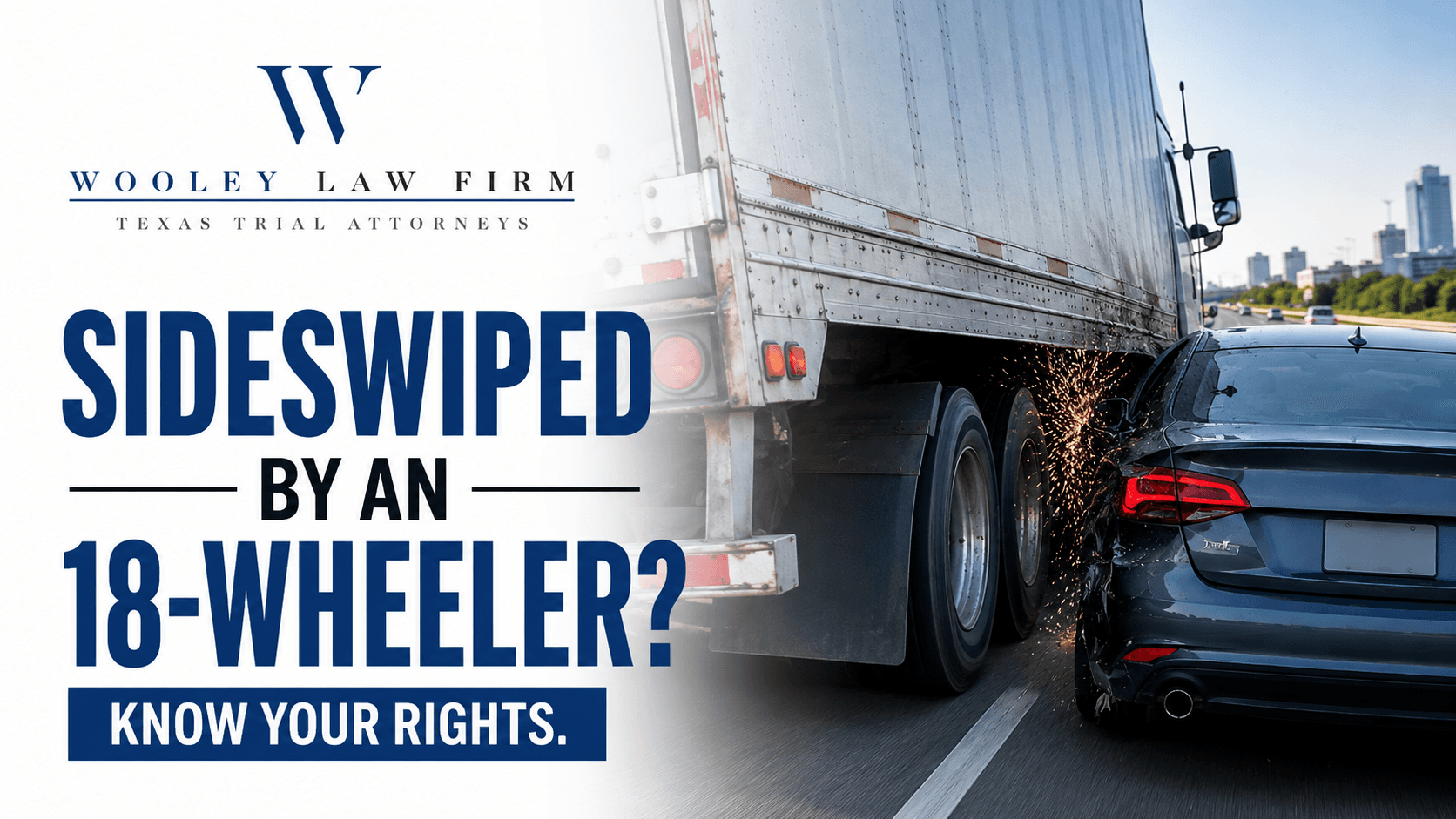
Being sideswiped by an 18-wheeler is terrifying. One moment you are driving through Dallas, Fort Worth, Arlington, Irving, Mesquite, Garland, Plano, Lewisville, Denton, or another North Texas roadway, and the next moment a massive tractor-trailer drifts into your lane, scrapes the side of your vehicle, forces you off the road, or causes a serious collision.
Because 18-wheelers are so large and heavy, even a sideswipe crash can cause serious injuries, major vehicle damage, and long-term consequences. If you were just sideswiped by an 18-wheeler in DFW, it is important to understand what may have caused the crash, what evidence needs to be preserved, and why you should speak with a Dallas Truck Accident Lawyer before dealing with the trucking company or its insurance carrier.
Sideswiped by an 18-Wheeler in DFW?
A sideswipe accident happens when the side of one vehicle strikes or scrapes the side of another vehicle. With passenger cars, these crashes may sometimes be minor. But when the vehicle that sideswipes you is an 18-wheeler, semi-truck, tractor-trailer, box truck, dump truck, delivery truck, or other commercial motor vehicle, the results can be devastating.
A truck sideswipe may happen on busy DFW highways such as:
I-35E
I-35W
I-20
I-30
I-45
I-635
US-75
SH-121
SH-183
SH-360
SH-114
Loop 12
George Bush Turnpike
Dallas North Tollway
These wrecks are especially dangerous because a tractor-trailer can weigh tens of thousands of pounds. When a truck moves into another lane, drifts across traffic, or turns too wide, the smaller vehicle has very little protection from the force of the collision. If you were hit by a tractor-trailer, you may want to speak with a Dallas 18-Wheeler Accident Lawyer as soon as possible.
Why 18-Wheeler Sideswipe Accidents Happen
Many people who search “I just got sideswiped by an 18-wheeler” are trying to understand how the crash happened and what they should do next. Trucking companies and insurance carriers may try to blame the injured driver, but many sideswipe truck crashes are caused by preventable truck driver negligence.
Common causes of 18-wheeler sideswipe accidents include:
Unsafe Lane Changes
Truck drivers have large blind spots on both sides of the tractor-trailer. Before changing lanes, a truck driver must carefully check mirrors, monitor surrounding traffic, use turn signals, and make sure the lane is clear. When a truck driver changes lanes without properly looking, the trailer can strike the side of a car, SUV, motorcycle, or pickup.
Failure to Stay in One Lane
A truck driver may drift out of the lane due to distraction, fatigue, speeding, poor training, or inattention. On narrow lanes, construction zones, bridges, entrance ramps, and congested highways, even a small lane deviation can cause the trailer to sideswipe another vehicle.
Wide Turns
Many 18-wheeler sideswipe crashes happen when a truck driver makes a wide right or left turn. The truck may swing into another lane, cut across traffic, or cause the trailer to strike a vehicle that had the right to continue forward. These crashes are often similar to wide-turn 18-wheeler accidents where the trailer cuts across nearby lanes and strikes another vehicle.
Driver Fatigue
Truck drivers often spend long hours behind the wheel. Fatigue can affect reaction time, judgment, lane control, and awareness. A tired truck driver may drift into another lane without realizing it.
Distracted Driving
Texting, checking GPS, using dispatch systems, eating, adjusting controls, or looking away from the road can cause a truck driver to miss nearby vehicles. A brief distraction can be enough for an 18-wheeler to cross into another lane.
Improper Training or Supervision
Commercial truck drivers need proper training to safely operate large vehicles in traffic. A trucking company may be responsible if it hired an unsafe driver, failed to train the driver, ignored prior violations, or put an unqualified driver on the road.
Poor Truck Maintenance
Mechanical problems can contribute to sideswipe crashes. Issues with steering, tires, brakes, mirrors, lighting, or trailer equipment may make it harder for the driver to safely control the truck.
Trucks on Roads Where They Should Not Be
Some sideswipe collisions happen when commercial vehicles travel on roads that were not designed or intended for large trucks. In DFW, certain city streets may have truck restrictions, “No Truck” signs, or local ordinances limiting commercial vehicle traffic. When a truck enters a restricted area, narrow street, or improper route, the risk of a sideswipe or wide-turn crash can increase. Learn more about No Truck route accidents in DFW.
Common Injuries After Being Sideswiped by an 18-Wheeler
A sideswipe from an 18-wheeler can cause more than vehicle damage. The impact may push a vehicle into another lane, into a concrete barrier, into a guardrail, or into another vehicle. The sudden force can also cause the body to twist, jerk, or slam into the inside of the vehicle.
Common injuries after an 18-wheeler sideswipe accident include:
Neck injuries
Whiplash
Back injuries
Herniated discs
Shoulder injuries
Arm and wrist injuries
Hip injuries
Knee injuries
Foot and ankle injuries
Head injuries
Concussions
Radiating pain, tingling, or numbness
Nerve injuries
Soft tissue injuries
Broken bones
Anxiety, fear of driving, and emotional distress
Many truck wreck victims experience neck and back pain after the collision. If you are dealing with spinal pain, stiffness, or limited movement, read more about back injuries after a car accident and neck injuries after a car accident.
Some symptoms may also travel into the arms or legs. Radiating pain, numbness, tingling, burning, or weakness can be signs of nerve involvement. Learn more about radiating arm pain, tingling, and numbness and radiating leg pain, tingling, and numbness after a crash.
Some injuries do not appear immediately. Pain, stiffness, headaches, numbness, tingling, weakness, and radiating symptoms may develop hours or days after the crash. That is why it is important to seek medical care and continue treatment if symptoms persist.
Injured in an Accident?
Free consultation. Tell us what happened and learn what options may be available.
What To Do After an 18-Wheeler Sideswipe Accident in DFW
If you were sideswiped by an 18-wheeler in Dallas-Fort Worth, what you do next can affect your health, your claim, and your ability to prove what happened.
1. Call 911 and Report the Crash
A police crash report can be important evidence. Tell the officer exactly what happened. Explain if the truck changed lanes into you, drifted into your lane, made a wide turn, forced you off the road, or left the scene.
2. Get Medical Treatment
Do not ignore pain after a truck wreck. Emergency room records, urgent care records, imaging, specialist visits, physical therapy, and follow-up treatment may all help document your injuries.
3. Take Photos and Videos
If it is safe, take pictures of:
Your vehicle damage
The truck and trailer
Company names and logos
License plates
DOT numbers
Trailer numbers
Skid marks
Road conditions
Lane markings
Traffic signs
Construction zones
Your visible injuries
In a sideswipe case, damage patterns can help prove how the collision happened.
4. Get Witness Information
Witnesses may have seen the truck drift, change lanes, turn wide, or strike your vehicle. Get names and phone numbers if possible.
5. Do Not Give a Recorded Statement Without Legal Advice
The trucking company’s insurance carrier may call quickly. They may sound helpful, but their job is to protect the trucking company and reduce what they pay. Before giving a recorded statement, signing paperwork, or accepting a settlement, speak with a truck accident lawyer.
6. Contact a Dallas-Fort Worth 18-Wheeler Accident Lawyer
Truck wreck cases are different from regular car accident cases. The evidence can disappear quickly. The trucking company may have driver logs, dash camera footage, black box data, GPS records, inspection reports, maintenance records, dispatch records, and safety documents that need to be preserved immediately.
If your crash involved a passenger vehicle and a commercial truck, you may also want to review how a Dallas Car Accident Lawyer can help injured victims protect their rights after a serious collision.
Evidence That Can Help Prove an 18-Wheeler Sideswipe Case
One of the most important steps after a truck accident is preserving evidence. A trucking company may have information that proves the driver was unsafe, distracted, fatigued, speeding, improperly trained, or in violation of safety rules.
Important evidence may include:
Driver qualification file
Hours-of-service records
Electronic logging device data
Event data recorder or “black box” data
Dash camera footage
Forward-facing or driver-facing camera footage
GPS data
Dispatch records
Bills of lading
Pre-trip and post-trip inspection reports
Maintenance records
Repair records
Cell phone records
Drug and alcohol testing records
Company safety policies
Prior crash history
Prior driver violations
Photos of the vehicles
Police crash report
Witness statements
Scene evidence
Black box and electronic data can be especially important in a sideswipe truck crash. This evidence may help show speed, braking, steering, hours of service, and other information that can support or contradict the truck driver’s version of events. Learn more about truck accident black box data and why it should be preserved quickly after a wreck.
The sooner this evidence is requested and preserved, the better. Waiting too long can make it harder to prove exactly what happened.
The Trucking Company May Try to Blame You
After a sideswipe collision, trucking companies and insurers often try to shift blame to the injured driver. They may claim:
You were in the truck’s blind spot
You sped up beside the truck
You failed to avoid the crash
You changed lanes first
The truck driver never felt the impact
Your injuries were pre-existing
The crash was “minor”
Your vehicle damage does not match your injury complaints
These arguments are common. But they do not mean they are true.
A truck driver is responsible for operating the 18-wheeler safely. That includes maintaining a proper lookout, staying in the correct lane, checking blind spots, signaling lane changes, controlling the trailer, and making safe turns.
Why Sideswipe Truck Accidents Can Cause Serious Injuries
Insurance companies sometimes downplay sideswipe crashes because the impact may not look as dramatic as a head-on collision or underride crash. But a sideswipe by an 18-wheeler can still cause serious injuries.
A sideswipe may:
Push your vehicle into another lane
Force you into a guardrail or concrete barrier
Cause a spinout
Cause a rollover
Trigger a multi-vehicle crash
Crush one side of the vehicle
Cause your body to twist violently
Lead to neck, back, shoulder, hip, or knee injuries
Cause nerve symptoms such as numbness, tingling, or radiating pain
The size difference between an 18-wheeler and a passenger vehicle matters. A commercial truck does not need to be traveling at highway speed to cause serious harm. Even a slower impact can cause major injuries because of the truck’s weight, size, and force. Read more about why low-speed 18-wheeler wrecks can still cause serious injuries.
Compensation After Being Sideswiped by an 18-Wheeler
If another party caused your truck accident, you may be able to pursue compensation for your damages. Depending on the facts of your case, damages may include:
Emergency room bills
Ambulance bills
Hospital treatment
Doctor visits
Physical therapy
Chiropractic treatment
Pain management
Surgery
Future medical care
Lost wages
Loss of earning capacity
Pain and suffering
Mental anguish
Physical impairment
Disfigurement
Vehicle damage
Rental car expenses
Out-of-pocket expenses
Every case is different. The value of a truck accident claim depends on the injuries, medical treatment, liability evidence, available insurance, long-term impact, and the conduct of the truck driver and trucking company.
Who Can Be Responsible for an 18-Wheeler Sideswipe Crash?
In a DFW truck accident case, more than one party may be legally responsible. Potential defendants may include:
The truck driver
The trucking company
The motor carrier
The trailer owner
A freight broker
A maintenance company
A loading company
Another negligent driver
A company that hired or supervised the driver
A manufacturer, if a defective part contributed to the crash
A proper investigation can help determine who controlled the truck, who employed the driver, who owned the trailer, who maintained the vehicle, and whether the company followed safety rules.
Hit by an 18-Wheeler That Kept Going?
Some drivers are sideswiped by a truck and the truck driver does not stop. This may happen because the driver claims they did not feel the impact, or because they intentionally left the scene.
If an 18-wheeler sideswiped you and kept going, try to document:
Trucking company name
Logo or color of the truck
Trailer number
DOT number
License plate
Direction of travel
Time and location
Nearby businesses with cameras
Witnesses
Dash cam footage
Even if you do not have all of the information, a lawyer may be able to investigate nearby camera footage, crash reports, toll records, police information, and other evidence.
Talk to a Dallas-Fort Worth 18-Wheeler Accident Lawyer
If you were sideswiped by an 18-wheeler in Dallas-Fort Worth, do not let the trucking company or insurance adjuster control the investigation. These cases can move quickly, and important evidence may be lost if action is not taken.
The Wooley Law Firm represents injured victims after serious truck wrecks in Dallas, Fort Worth, Arlington, Irving, Mesquite, Garland, Plano, Frisco, Lewisville, Denton, McKinney, Richardson, Grand Prairie, and throughout North Texas.
If you were sideswiped by an 18-wheeler, tractor-trailer, semi-truck, delivery truck, box truck, or commercial vehicle, contact The Wooley Law Firm today for a free consultation.
You do not pay unless we win.
Frequently Asked Questions About 18-Wheeler Sideswipe Accidents
What should I do if I was sideswiped by an 18-wheeler?
Call 911, get medical treatment, take photos, get witness information, avoid giving a recorded statement, and contact a truck accident lawyer as soon as possible.
Can I sue if an 18-wheeler sideswiped me?
Yes, if the truck driver, trucking company, or another party caused the crash, you may have a claim for your injuries, medical bills, lost wages, pain and suffering, and other damages.
What if the truck driver says I was in the blind spot?
Truck drivers are trained to understand blind spots and must make sure it is safe before changing lanes or turning. A blind spot does not automatically excuse a truck driver from responsibility.
What if the 18-wheeler sideswiped me and drove away?
You may still have options. Evidence such as dash camera footage, nearby surveillance video, witness statements, license plate information, DOT numbers, and police investigation may help identify the truck.
Why is an 18-wheeler sideswipe different from a regular car accident?
Truck accident cases often involve commercial trucking regulations, company safety policies, black box data, driver logs, maintenance records, and higher insurance coverage. These cases require a more detailed investigation than a typical car wreck.
Should I give a recorded statement to the trucking company’s insurance adjuster?
You should speak with a lawyer before giving a recorded statement. Insurance adjusters may ask questions designed to minimize your claim or shift blame onto you.
How long do I have to file a truck accident lawsuit in Texas?
In many Texas personal injury cases, the general deadline is two years from the date of the crash. However, some cases may have shorter notice requirements or unique deadlines. You should speak with a lawyer quickly to protect your rights.
Topics
Share This Article

Andrew J. Wooley
Personal Injury Attorney
Andrew J. Wooley is a dedicated personal injury attorney based in Dallas, Texas. He focuses on helping accident victims recover fair compensation for their injuries. With a commitment to personalized service, Andrew works directly with each client to understand their unique situation and fight for their rights.