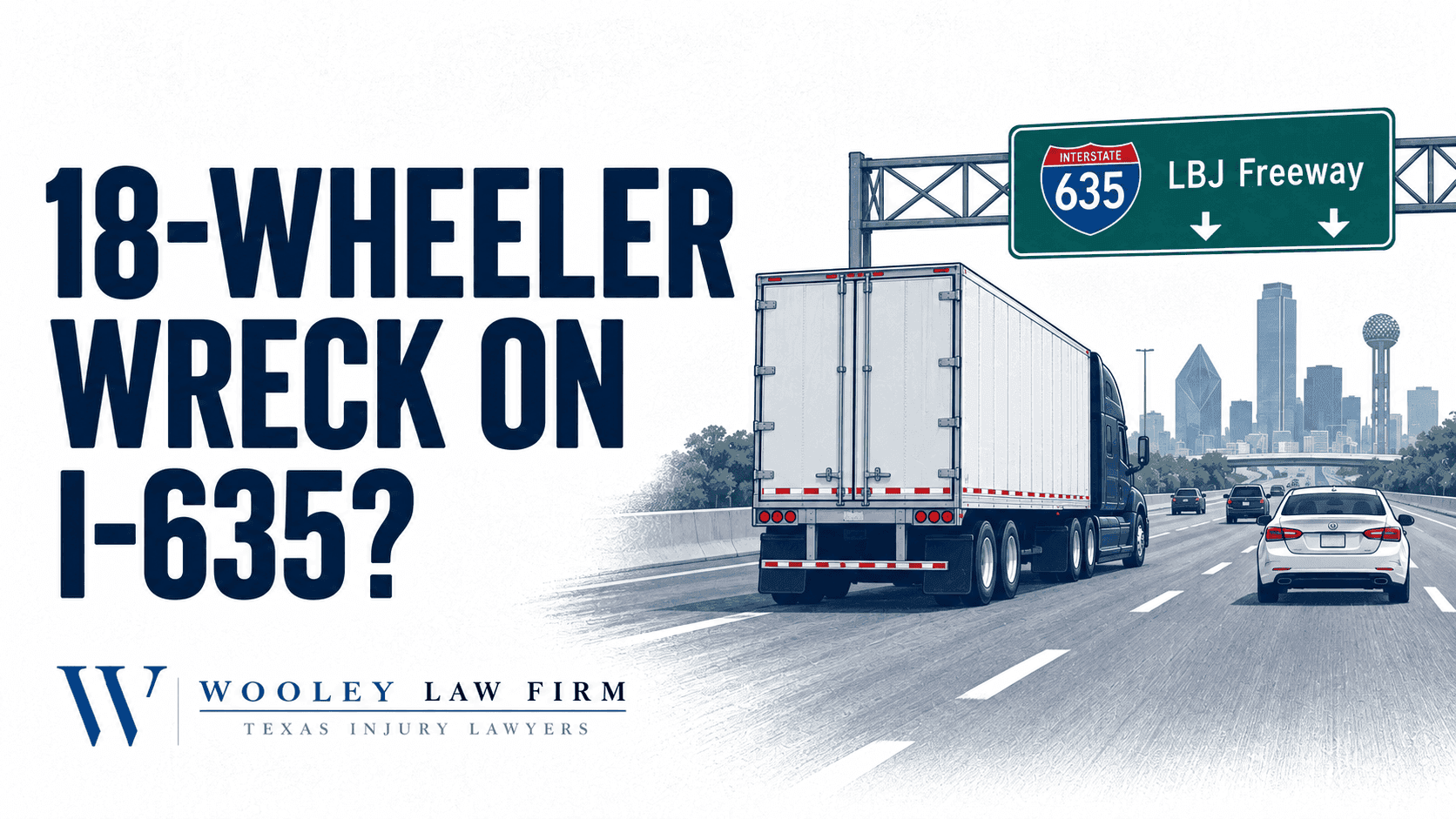
Driving beside an 18-wheeler on I-635 can become dangerous in seconds. The tractor may begin moving toward your lane. The trailer may drift across the lane marker. A truck trying to reach an exit may cross several lanes. A passenger vehicle can become trapped between a trailer and a concrete barrier with nowhere safe to go.
For someone injured on I-635, also known as LBJ Freeway, the truck driver’s explanation should not automatically determine what happened. Commercial trucks may contain cameras, digital mirrors, GPS, telematics, electronic logs, blind-spot alerts, lane-departure data, and other information that can provide an objective view of the moments before impact.
For broader information about commercial-truck claims, visit our Dallas truck accident lawyer page.
Why Lane Changes on I-635 Can Become Dangerous
An 18-wheeler is a combination vehicle, not simply a long passenger car. The driver sits near the front while the trailer extends far behind. That creates visibility and clearance problems that require deliberate planning before the truck moves laterally.
The position of the tractor
The front, middle, and rear of the trailer
The trailer wheels
Vehicles beside the tractor
Vehicles beside the trailer
Vehicles approaching from behind
Traffic already occupying the destination lane
Barriers, shoulders, lane shifts, and construction
What Should a Truck Driver Do Before Changing Lanes?
A careful commercial lane change should involve continuous observation, not a single mirror check. The driver should monitor traffic, signal, check flat and convex mirrors, account for blind areas, confirm adequate space, recheck before crossing the lane line, and continue monitoring the trailer until the maneuver is complete.
Our full guide explains what truck drivers should do before changing lanes in Dallas.
“You Were in My Blind Spot” Is Not the End of the Case
Commercial trucks have known blind areas. That is one reason careful mirror use, repeated checks, and a gradual lane change matter. A blind spot is a hazard the driver should account for, not automatically an excuse after a collision.
When the driver last saw the passenger vehicle
How long the vehicle had been beside the truck
Which mirrors were checked
Whether mirrors were properly adjusted
Whether a side camera or digital-mirror system was installed
Whether a blind-spot alert activated
Whether the driver lost track of a vehicle known to be nearby
Read our detailed discussion of 18-wheeler blind-spot accidents in Dallas.
The Driver Should Keep Track of Vehicles Beside the Trailer
Suppose a driver sees a car behind the cab, looks forward, and a few seconds later no longer sees that car in the same mirror. The vehicle may now be beside the middle or rear of the trailer. A professional driver should be cautious about starting a lane change after losing track of a vehicle that was recently next to the truck.
The Tractor Can Clear Your Car Before the Trailer Does
This is one of the most important I-635 lane-change scenarios. The tractor moves ahead of the passenger car. The driver sees open pavement near the cab and begins moving into the adjacent lane. But the car is still beside the trailer, and the trailer strikes the side of the vehicle.
The impact may push the smaller vehicle toward another lane, a median, a concrete barrier, or the trailer wheels. Damage location and scrape patterns can become important when reconstructing whether the trailer moved into the car or the car moved into the trailer.
See The Tractor Cleared My Car, but the 18-Wheeler’s Trailer Hit Me for a deeper discussion.
Digital Mirrors May Show Whether Your Vehicle Was There
Camera-monitor systems can provide side views that are different from traditional mirrors. Depending on the truck, these systems may offer views along the trailer and may record or retain video. When a driver says the lane was clear, the exact equipment installed should be identified and preserved.
Our article about digital mirrors on 18-wheelers explains why these systems can matter in a disputed sideswipe case.
What If the Truck Cuts Across Several I-635 Lanes to Reach an Exit?
A driver who realizes an exit is approaching may be tempted to cross several lanes quickly. But crossing three lanes is not one simple lane change. Traffic must be reassessed during each movement. A car can approach from behind, a motorcycle can become hidden beside the trailer, traffic ahead can slow, or another vehicle can enter from a ramp.
GPS and dispatch records may show the planned route, destination, missed exit, or timing pressure that preceded the maneuver. Missing an exit and rerouting is generally safer than forcing a large combination vehicle through occupied lanes.
Read our article about an 18-wheeler crossing multiple Dallas highway lanes to reach an exit.
Construction Can Make a Bad Lane Change Worse
Construction areas can reduce the room available for evasive action. Narrow lanes, temporary barriers, lane shifts, closed shoulders, changing pavement markings, and sudden congestion can leave a passenger driver trapped beside a commercial vehicle.
In those circumstances, the truck driver should account for the reduced margin for error. The lane-change analysis may include roadway photographs, work-zone diagrams, lane widths, temporary markings, video, and the positions of barriers.
What If the Truck Forces You Into a Barrier?
A passenger driver confronted with a trailer entering the lane may have only seconds to decide whether to brake, accelerate, move toward a barrier, or maintain position. If the passenger car ultimately strikes the wall instead of the truck, the investigation should still ask what created the emergency.
See our guide to an 18-wheeler forcing a driver off the road in Dallas.
What If Several Vehicles Crash Because of the Truck?
An unsafe lane change can create a multi-vehicle sequence without the truck touching every vehicle. One car may swerve, another may brake, and a third may rear-end the second. The complete event should be reconstructed from the first unsafe movement forward.
Our article about an 18-wheeler lane change causing a multi-vehicle Dallas wreck explains why the last impact may not reveal the real cause.
Evidence That Can Prove an Unsafe I-635 Lane Change
Dash-camera video from the truck or surrounding vehicles
Side-camera or digital-mirror footage
Paint transfer, scrape patterns, and impact location
Lane markings and barrier positions
Neutral witness statements
GPS and telematics
Driver statements made at the scene
Training materials on mirror use, blind spots, and lane changes
Safety alerts or lane-departure events
Injured in an Accident?
Free consultation. Tell us what happened and learn what options may be available.
The Trucking Company May Have Evidence Before You Do
Commercial carriers often begin investigating quickly. They may obtain driver statements, video, telematics, tractor and trailer photographs, maintenance records, and internal safety data. At the same time, electronic files may be overwritten and equipment may be repaired. That is why evidence preservation can become important early.
Who May Be Responsible After an I-635 Truck Wreck?
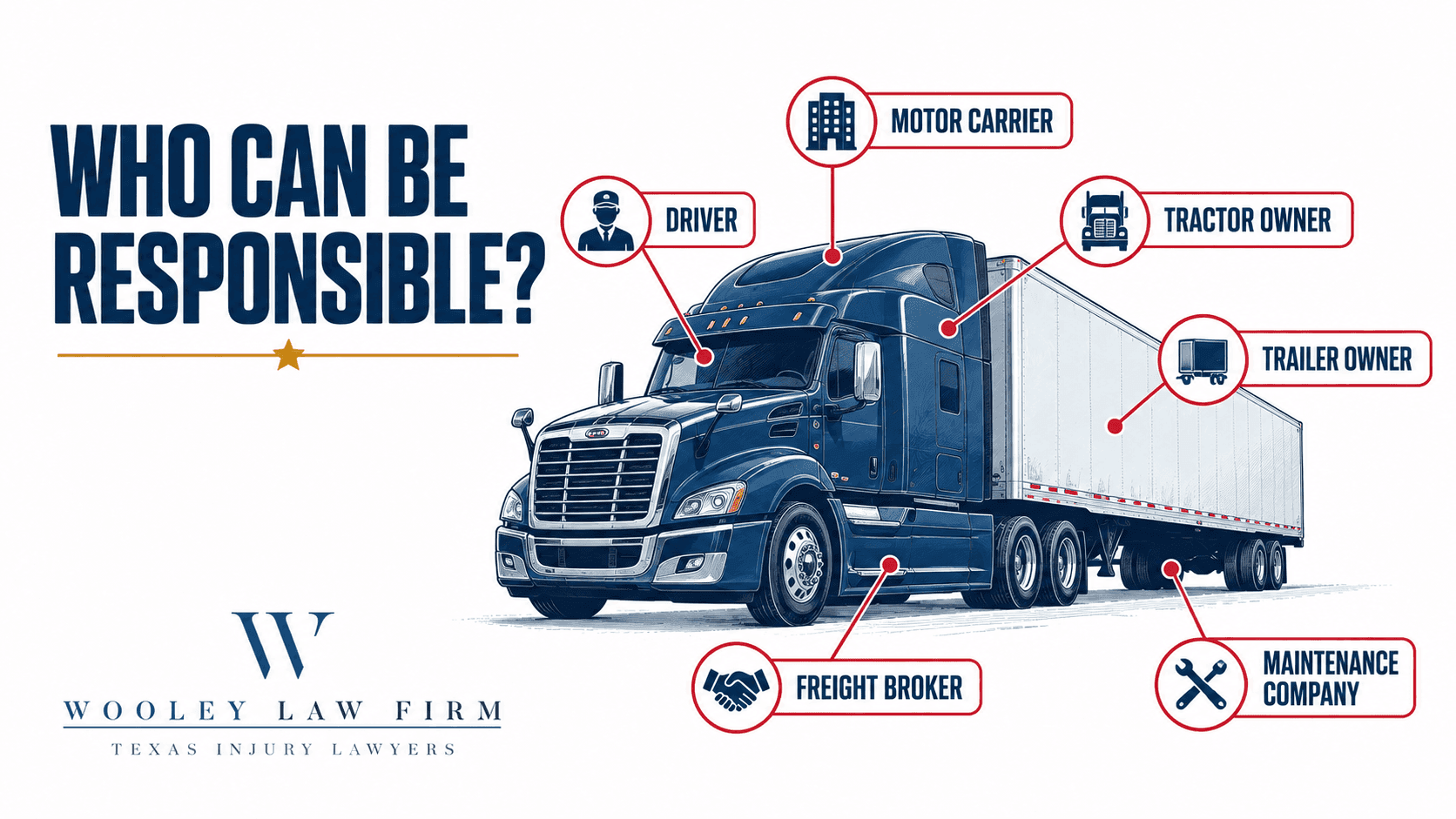
Potentially responsible parties can include the driver, motor carrier, employer, tractor owner, trailer owner, leasing company, maintenance contractor, or another negligent driver. Responsibility should be based on the facts and each party’s role, not simply on the company name printed on the tractor.
Our article on suing the trucking company after a Dallas 18-wheeler wreck explains why the carrier itself may need to be investigated.
Why a Highway-Speed Sideswipe Can Cause Serious Injuries
The word “sideswipe” can sound minor. But when a long trailer contacts a passenger vehicle at highway speed, the smaller vehicle can be pushed into a wall, spun across lanes, struck again, rolled, or drawn toward the trailer wheels. Secondary impacts may cause more force than the initial contact.
Traumatic brain injuries
Neck and back injuries
Fractures
Shoulder injuries
Internal injuries
Crush injuries
Nerve injuries
Scarring and disfigurement
Permanent impairment
What Evidence Should Be Preserved?
Forward-facing, driver-facing, side, and rear camera footage, if installed
Engine-control-module and event data
Electronic logging-device records and hours-of-service information
GPS, telematics, hard-braking, speed, and safety-alert data
Dispatch messages, trip assignments, bills of lading, and delivery records
Driver qualification, training, safety, and disciplinary records
Tractor and trailer inspection, maintenance, and repair records
Post-crash photographs, measurements, tow records, and witness information
The condition of the tractor, trailer, tires, brakes, lights, and other relevant components
What Should You Do After an I-635 Truck Wreck?
Call police and EMS.
Seek appropriate medical care.
Photograph both sides of the tractor and trailer if safe.
Photograph trailer wheels, markings, license plates, USDOT information, lane markings, and barriers.
Get witness names and contact information.
Save original dash-camera footage.
Preserve photographs of all damage before repairs.
Keep tow, repair, rental, and medical records.
Be cautious about assuming the truck driver’s explanation is correct.
Consider legal advice concerning preservation of trucking-company evidence.
Talk to a Dallas Truck Wreck Lawyer About an I-635 Collision
If an 18-wheeler changes lanes into you on LBJ Freeway, the carrier may argue that you were in the driver’s blind spot. The investigation should determine what the driver could see, which mirrors were checked, whether cameras existed, whether the driver lost track of your vehicle, when the trailer moved, and what electronic evidence was created.
The Wooley Law Firm represents individuals and families after serious commercial-truck wrecks throughout Dallas and North Texas.
Call (214) 699-6524 for a free consultation. You don’t pay unless we win.
Why a Lane-Change Case Often Turns on Seconds of Pre-Crash History
A disputed I-635 sideswipe is rarely resolved by looking only at the instant of impact. The most useful question may be where the passenger vehicle was five, ten, or fifteen seconds earlier. If the car approached from behind and remained visible for several seconds before moving alongside the trailer, that history may undermine a claim that the vehicle suddenly appeared. If the car accelerated into a narrowing gap after the truck had already signaled, that fact may point in a different direction.
Video, GPS timing, dash-camera footage, and witness observations can help reconstruct that short pre-crash window. The goal is to understand what each driver could reasonably see and what choices were available before the vehicles touched.
How Mirror Adjustment and Truck Configuration Can Affect Visibility
Not every tractor has the same mirror configuration. Flat mirrors, convex mirrors, hood-mounted mirrors, digital camera-monitor systems, and blind-spot warning technology can create different fields of view. Trailer length and tractor configuration can also affect what the driver sees. That is why a generic diagram of an 18-wheeler blind spot may be less useful than identifying the actual equipment on the truck involved.
Inspection photographs can show the mirrors and cameras that were installed. Company specifications or maintenance records may identify the system. Driver training materials may show how the carrier expected drivers to use those tools. If the driver says a vehicle was impossible to see, the actual equipment should be examined before accepting that statement.
Turn Signals, Lane Position, and the Beginning of the Maneuver
Whether the truck signaled can matter, but a turn signal does not create the right to enter an occupied lane. The signal is a warning of intent. The driver still needs enough space to make the movement safely. Video can sometimes show whether the signal activated before the truck began moving or only after the tractor was already crossing the lane line.
Lane position is also important. A tractor-trailer that rides the lane marker for several seconds may create uncertainty for surrounding drivers. Construction shifts and narrow lanes can make small lateral movements more significant. Photographs and video should therefore document the lane configuration rather than treating the crash as if it occurred on a generic straight freeway.
Why Trailer Damage Can Be More Important Than Tractor Damage
In a typical sideswipe, the tractor may show little or no damage. The relevant contact may be along the trailer rub rail, side panel, reflective tape, rear wheels, or underride structure. If the trailer is repaired before it is inspected, those marks can disappear. That is why the trailer’s location and condition should be identified as early as possible.
Damage direction can also matter. Long horizontal scrapes, paint transfer, wheel marks, and deformation can help distinguish a brief contact from a sustained lateral movement. Those physical clues should be compared with the passenger vehicle’s damage and the drivers’ accounts.
What Happens When the Truck Keeps Driving?
Some I-635 lane-change collisions involve a truck that does not stop immediately. The driver may not realize the trailer made contact, or the truck may continue for another reason. Identification can then depend on a partial trailer number, license plate, company markings, USDOT number, dash-camera footage, nearby business video, witnesses, or law-enforcement records.
The absence of an immediate stop can make preservation more difficult because the tractor and trailer may separate after the trip. Once the equipment is identified, the investigation should determine where each piece is located and whether repairs occurred.
How Comparative-Fault Arguments Arise in I-635 Sideswipes
A trucking insurer may argue that the passenger driver accelerated into the truck’s blind area, failed to yield after seeing a turn signal, drifted across the line, or attempted to pass on the right. Those allegations should be tested against lane markings, damage, video, witness statements, and timing. A turn signal does not automatically resolve the issue, and neither does the simple fact that a passenger vehicle was beside the trailer.
Texas proportionate-responsibility law can make fault allocation important when more than one driver may have contributed. That is another reason to preserve evidence showing the actual sequence instead of relying on assumptions about which vehicle was larger or which driver received a citation.
Medical and Property Evidence After a Highway Sideswipe
A sideswipe may produce multiple forces. The passenger vehicle can be hit from the side, pushed into a barrier, spin, or be struck again. Medical records should therefore document all symptoms, not just the body part nearest the initial contact. Head, neck, back, shoulder, hip, knee, and nerve complaints may arise from different parts of the sequence.
Property photographs should likewise capture more than one panel. Wide views can show scrape direction and secondary impacts. Repair estimates, total-loss documentation, tow records, and photographs taken before repairs may later help explain the mechanics of the collision.
How an I-635 Truck-Wreck Claim Develops After the Initial Investigation
Once the vehicles, companies, and major evidence sources are identified, the case often moves into a second phase: documenting injuries, losses, and the defense positions. Medical records, wage information, repair or total-loss documents, photographs, and witness statements should be organized alongside the liability evidence. This allows the claim to tell one coherent story instead of presenting the truck evidence and the injury evidence as unrelated subjects.
If suit becomes necessary, discovery can focus on the specific disputed issues: lane-change procedure, mirror use, camera systems, driver training, dispatch records, trailer ownership, maintenance, insurance coverage, and the company’s investigation. A focused approach is usually more useful than requesting every document the carrier has ever created. The goal is to obtain evidence that helps answer why the truck moved into the lane, what the driver could see, and what the company knew or preserved afterward.
Settlement discussions should also account for future medical needs and unresolved liability disputes. A quick offer made before the full extent of an injury is known may not reflect future treatment, time away from work, impairment, or the effect of the wreck on daily life. The appropriate timing depends on the facts, but a serious commercial-vehicle claim should generally be evaluated with a complete understanding of both liability and damages.
Why Timing Matters Before Accepting a Settlement
A serious I-635 claim can look very different a few weeks after the crash than it does during the first phone call from an insurer. Early on, the injured person may not yet know whether therapy will resolve the symptoms, whether injections or surgery will be recommended, whether work restrictions will continue, or whether the injuries will interfere with normal activities for months. At the same time, the liability investigation may still be developing because camera footage, digital-mirror records, driver logs, trailer information, or company documents have not yet been obtained.
For that reason, an early settlement should be evaluated carefully. Once a claim is fully released, later medical developments generally cannot be added back into the settlement. The better approach is to understand the known injuries, likely future treatment, available insurance, and strength of the liability evidence before deciding whether an offer fairly resolves the claim. That does not mean every case should be delayed or litigated; it means the decision should be made with enough information to understand what is being given up.
Frequently Asked Questions
Is the truck driver automatically at fault for changing lanes into me?
Fault depends on the evidence, but the lane movement should be evaluated against what the driver knew, saw, and did before crossing the lane line.
What if I was in the truck’s blind spot?
That does not automatically establish fault. Blind areas are known hazards that commercial drivers should account for when changing lanes.
Can digital mirrors prove where my car was?
Potentially. It depends on the equipment and whether recordings or system data were retained.
What if the trailer hit me after the tractor passed?
Trailer clearance is central to the investigation because the driver must account for the entire combination vehicle.
What if I hit a wall but never touched the truck?
The investigation should determine what caused the emergency and whether the truck’s movement forced the evasive action.
Disclaimer: This article is for general informational purposes only and is not legal advice. Reading it does not create an attorney-client relationship. Every case is different.
Topics
Share This Article

Andrew J. Wooley
Personal Injury Attorney
Andrew J. Wooley is a dedicated personal injury attorney based in Dallas, Texas. He focuses on helping accident victims recover fair compensation for their injuries. With a commitment to personalized service, Andrew works directly with each client to understand their unique situation and fight for their rights.