Finding Insurance After a Dallas 18-Wheeler Wreck: Why the Crash Report May Not Tell the Whole Story
After an 18-wheeler hits your vehicle, you may turn to the crash report to find out which insurance company should pay for your injuries. The report lists an insurer, so you open a claim and assume that is the available coverage.
That assumption can leave important questions unanswered. Not all potentially applicable insurance is listed on a crash report.
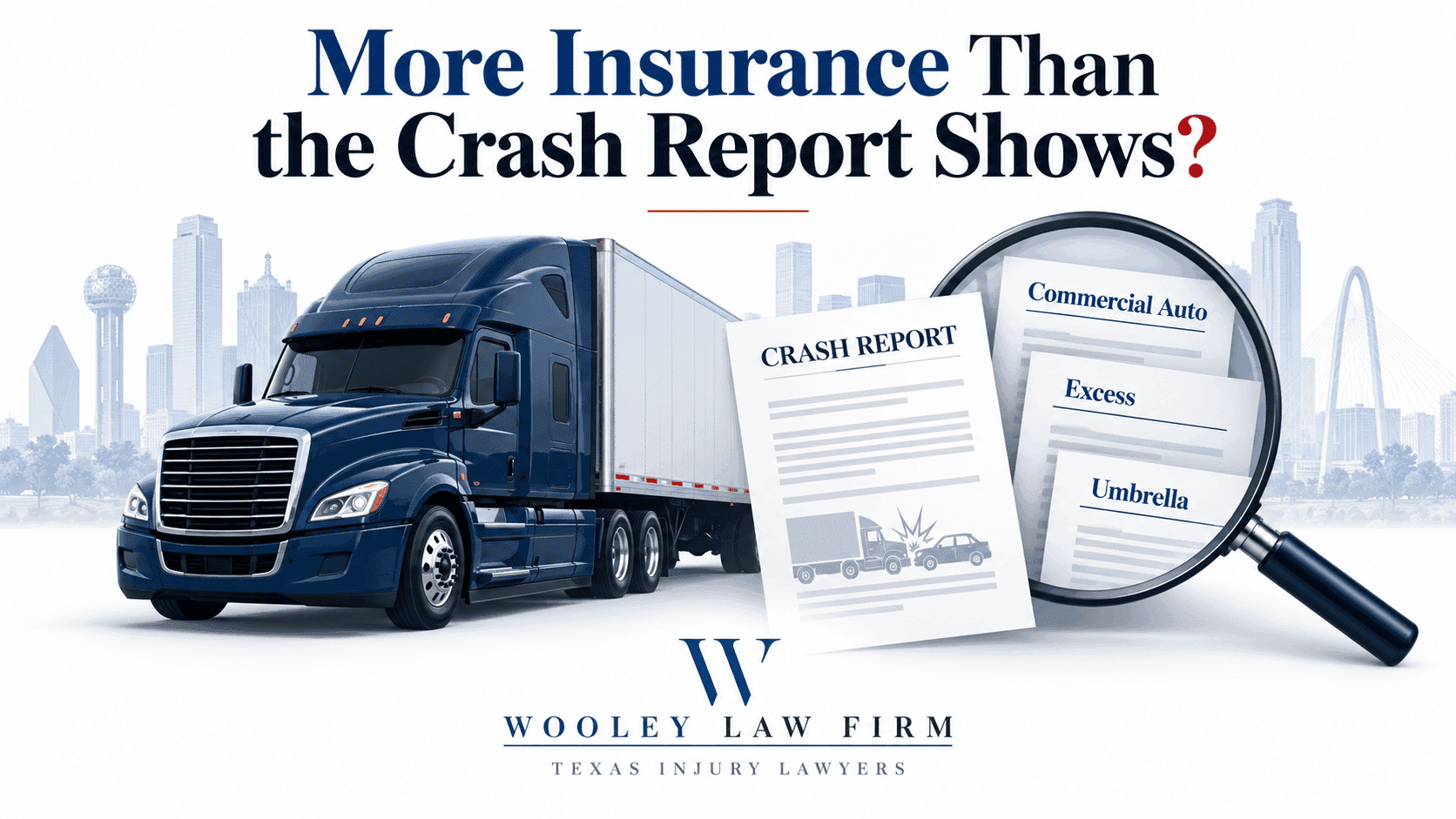
A commercial truck collision can involve a driver, a motor carrier, a tractor owner, a trailer owner, and other businesses. Those relationships may lead to additional insurance policies, including excess or umbrella coverage that does not appear in the report.
A Dallas truck accident lawyer can investigate those relationships, request policy documents, and determine which coverage may apply. For someone facing surgery, lost income, or lasting injuries, that investigation can be a significant part of the case.
Why Doesn’t the Crash Report List All the Trucking Insurance?
A crash report records information gathered during the collision investigation. It is not a complete insurance coverage analysis.
An officer may receive an insurance card from the driver without having access to the trucking company’s full insurance program. The officer may not have the tractor lease, trailer lease, hauling agreement, or excess policies needed to understand every potentially relevant source of coverage.
The report may therefore omit:
Excess or umbrella liability policies;
Insurance issued to another potentially responsible company;
Policies connected to leased or borrowed equipment;
Endorsements extending coverage to additional insureds; or
Information needed to determine which insurer covers the particular trip.
The absence of another insurer from the report does not establish that no additional coverage exists. Likewise, the presence of an insurer’s name does not establish that its policy covers every claim arising from the wreck.
The crash report is a starting point for the insurance investigation.
An Attorney Identifies the Companies Behind the Truck
The name on the trailer may differ from the company operating the tractor. An owner-operator may own the truck while hauling freight under another motor carrier’s authority. The trailer may belong to a leasing company.
An attorney can investigate:
Who employed or contracted with the driver;
Which motor carrier operated the truck on the collision date;
Who owned and leased the tractor and trailer;
Who dispatched the driver and arranged the trip; and
Whether another company’s conduct contributed to the collision.
Photographs, vehicle identification numbers, license plates, USDOT numbers, dispatch records, and shipping documents can help connect the equipment to the businesses involved.
Identifying a company does not automatically make it liable. Ownership, leasing, or arranging transportation alone does not necessarily establish responsibility. The evidence must support a legal claim, and the policy must cover the relevant person, business, and occurrence.
Our article explaining when you can sue a trucking company after a Dallas 18-wheeler wreck discusses why these business relationships matter.
Federal Trucking Records Can Provide Insurance Leads
The Federal Motor Carrier Safety Administration maintains records that can help identify a motor carrier and investigate its insurance filings.
The FMCSA Company Snapshot provides identifying and operational information. Federal insurance filings can provide additional leads concerning the insurer associated with a carrier’s operating authority.
However, a public filing is not the same as the complete insurance policy. It should not be treated as a complete inventory of every policy or every dollar potentially available for a claim.
An attorney should investigate the coverage in effect on the date of the wreck. A company may have changed insurers since the collision, and a current search may not answer the historical coverage question.
The FMCSA’s insurance filing requirements also distinguish bodily injury and property damage liability insurance from cargo insurance and broker financial responsibility requirements. Those distinctions matter: a cargo policy or freight broker bond should not automatically be counted as money available to compensate an injured motorist.
The Tractor and Trailer May Involve Different Insurance Questions
An 18-wheeler consists of separate pieces of equipment. The tractor and trailer can have different owners, registrations, leases, and insurance arrangements.
For example, a motor carrier may operate a tractor pulling a trailer owned by another company. The carrier’s liability policy may be relevant, while the trailer owner’s responsibility and insurance require separate investigation.
If defective trailer brakes or another equipment problem contributed to the wreck, maintenance responsibilities and repair records may become important. An attorney may need to determine who controlled the equipment, who had a duty to maintain it, and whether a covered act or omission caused the injuries.
Separate ownership does not automatically mean separate recoverable policy limits. Policies may overlap, exclude particular risks, or contain provisions governing how they interact. Insurance covering damage to the trailer itself also differs from liability insurance potentially covering injuries to someone else.
Injured in an Accident?
Free consultation. Tell us what happened and learn what options may be available.
Excess and Umbrella Coverage May Be Missing From the Report
Some trucking businesses carry liability insurance above their primary policy. This additional coverage may be especially important when a collision causes catastrophic injuries or harms several people.
Excess insurance generally provides another layer above specified underlying coverage, subject to its terms. Umbrella policies may provide additional limits and sometimes broader protection, but their operation depends on the actual policy language.
An attorney can investigate:
Whether excess or umbrella policies existed on the collision date;
Which businesses and individuals qualify as insureds;
Whether the primary policy is scheduled as underlying insurance;
What conditions must be satisfied before another layer responds; and
Whether exclusions or other claims affect the available coverage.
Finding a policy does not guarantee payment. But failing to investigate additional layers can leave the injured person without a complete understanding of the potential sources of recovery.
A Lawyer Requests the Policies, Not Just the Insurance Card
An insurance card or certificate can provide useful contact information. It usually does not answer every coverage question.
An attorney may request the declarations, policy forms, endorsements, applicable vehicle schedules, and excess policies. Lease and transportation agreements may also identify contractual insurance requirements or additional insured provisions that deserve investigation.
If a supported lawsuit becomes necessary, formal discovery can provide a means to obtain relevant insurance agreements and investigate incomplete responses, subject to the applicable court rules.
Reviewing the documents helps distinguish several different questions:
Does this policy insure a potentially responsible defendant?
Does it cover the truck’s use at the time of the wreck?
Does it cover the type of liability alleged?
What limits and exclusions apply?
How does it interact with other insurance?
Our insurance coverage practice page explains how The Wooley Law Firm helps injured people address coverage questions and disputed claims.
What If an Insurer Says the Truck Wasn’t Covered?
A denial from one insurer does not necessarily resolve the entire insurance investigation.
The insurer may contend that the policy had expired, that a different company operated the truck, or that the vehicle’s use fell outside the policy. An attorney can request the written explanation, compare it with the policy and trip records, and investigate other potentially applicable insurance.
For an owner-operator, the truck’s activity at the time can matter. Commercial auto, non-trucking liability, and other specialized policies do not necessarily cover the same circumstances. Driving without a trailer does not, by itself, answer which policy applies.
The appropriate response depends on the documents and facts. It may involve challenging a denial, identifying another insurer, or pursuing a different responsible party.
Texas and Federal Minimum Insurance Requirements Are Different
The minimum insurance requirement depends on the trucking operation. An attorney should determine whether the truck was engaged in Texas intrastate commerce or interstate commerce and what cargo it was transporting.
Texas Intrastate Trucking: Generally $500,000 for an Ordinary 18-Wheeler
Under 43 Texas Administrative Code § 218.16, a typical 18-wheeler transporting nonhazardous property solely in Texas intrastate commerce generally must carry at least $500,000 in liability insurance.
The applicable category generally covers private and for-hire motor carriers operating commercial motor vehicles with a gross weight, registered weight, or gross weight rating exceeding 26,000 pounds. Hazardous materials and certain other operations have different requirements.
The Texas motor carrier insurance rule addresses the applicable categories and minimum limits.
Interstate Trucking: Generally $750,000 for Covered Nonhazardous Freight Operations
Under 49 C.F.R. § 387.9, the federal minimum for covered for-hire interstate or foreign commerce carriers transporting nonhazardous property in vehicles with a gross vehicle weight rating of at least 10,001 pounds is generally $750,000.
Different requirements apply to certain other operations and cargo.
A Trip Entirely Within Texas May Still Be Interstate Commerce
A truck does not have to cross the state line during the particular trip to be engaged in interstate commerce. A Texas leg of a shipment moving to or from another state may qualify, depending on the shipment’s overall movement and the facts.
For example, freight moving from another state to its intended destination in Dallas may involve a final delivery leg entirely within Texas. Looking only at that driver’s route could miss the larger transportation arrangement.
An attorney can examine shipping documents, bills of lading, dispatch records, and the shipment’s origin and intended destination before determining which requirements apply.
Minimum Requirements Are Not Coverage Ceilings or Settlement Values
Neither the Texas minimum nor the federal minimum establishes the total insurance a trucking company actually carries. A company may have higher primary limits, excess coverage, or umbrella insurance.
A minimum requirement also does not guarantee that the stated amount is available for a particular claim or establish what an injured person’s case is worth.
Actual recovery depends on liability, damages, applicable coverage, competing claims, and other case-specific issues. Multiple injured people may have claims against the same occurrence limit.
The investigation should identify the actual policies and available limits rather than stop at the minimum required by law.
Your Own Insurance May Also Matter
The search should also consider policies that may protect you.
Depending on your coverage and the facts, uninsured/underinsured motorist coverage, personal injury protection, or medical payments coverage may be relevant. Your lawyer can review applicable personal or commercial auto policies and identify notice or settlement requirements that need attention.
Our page about uninsured and underinsured motorist claims in Dallas explains why your own coverage may matter when an at-fault driver’s insurance is missing or insufficient.
What You Can Preserve to Help Locate Coverage
You do not need to solve the insurance questions at the scene. If you can safely obtain information, preserve:
Photographs of the tractor and trailer, including each license plate;
Company names, USDOT numbers, and equipment numbers;
Insurance cards or documents the driver provides;
The crash report number and witness information; and
Letters, emails, claim numbers, and denial notices from insurers.
If you were transported by ambulance and could not take photographs, an attorney may be able to obtain identifying information from police materials, witnesses, towing records, or other evidence.
Before signing a settlement release, have its effect on other defendants, policies, and your own coverage evaluated. A release can affect more than the claim you intended to settle.
Frequently Asked Questions About Trucking Insurance After a Dallas Wreck
Does every 18-wheeler have multiple insurance policies?
No. Some wrecks involve one applicable liability policy. Others involve additional layers or separately insured defendants. Investigation determines what exists and what applies.
Can I pursue insurance that isn’t listed on the crash report?
Potentially. Its omission from the report does not eliminate otherwise applicable coverage. Your attorney still must establish the legal and policy requirements for recovery.
Is the truck’s insurance information on the crash report enough to evaluate coverage?
Usually, more information is needed. The report may identify an insurer, but the actual policy documents establish the insureds, covered risks, limits, exclusions, and other conditions.
Is the minimum trucking insurance requirement in Texas $500,000 or $750,000?
For a typical 18-wheeler hauling nonhazardous property solely in Texas intrastate commerce, the minimum is generally $500,000. For covered for-hire interstate operations hauling nonhazardous property, the federal minimum is generally $750,000. Different requirements can apply based on the cargo and operation.
Does hiring an attorney guarantee more insurance will be found?
No. An attorney can investigate beyond the report, obtain documents, and evaluate available coverage. The investigation may reveal additional insurance or confirm that coverage is limited.
Talk With The Wooley Law Firm About Insurance After a Dallas Truck Wreck
When an 18-wheeler causes serious injuries, identifying insurance should be part of the investigation from the beginning. The insurer named on the crash report may be only one piece of the picture.
The Wooley Law Firm represents people injured in truck wrecks in Dallas–Fort Worth and throughout Texas. We can investigate the companies involved, evaluate potentially applicable policies, and pursue compensation supported by the evidence and law.
Call (214) 699-6524 or contact The Wooley Law Firm for a free consultation. Bring the crash report and any insurance correspondence you have, even if the coverage information appears incomplete.
This article provides general information and is not legal advice. Reading it does not create an attorney-client relationship. Every case is different, and past results do not guarantee a similar outcome.
Topics
Share This Article

Andrew J. Wooley
Personal Injury Attorney
Andrew J. Wooley is a dedicated personal injury attorney based in Dallas, Texas. He focuses on helping accident victims recover fair compensation for their injuries. With a commitment to personalized service, Andrew works directly with each client to understand their unique situation and fight for their rights.