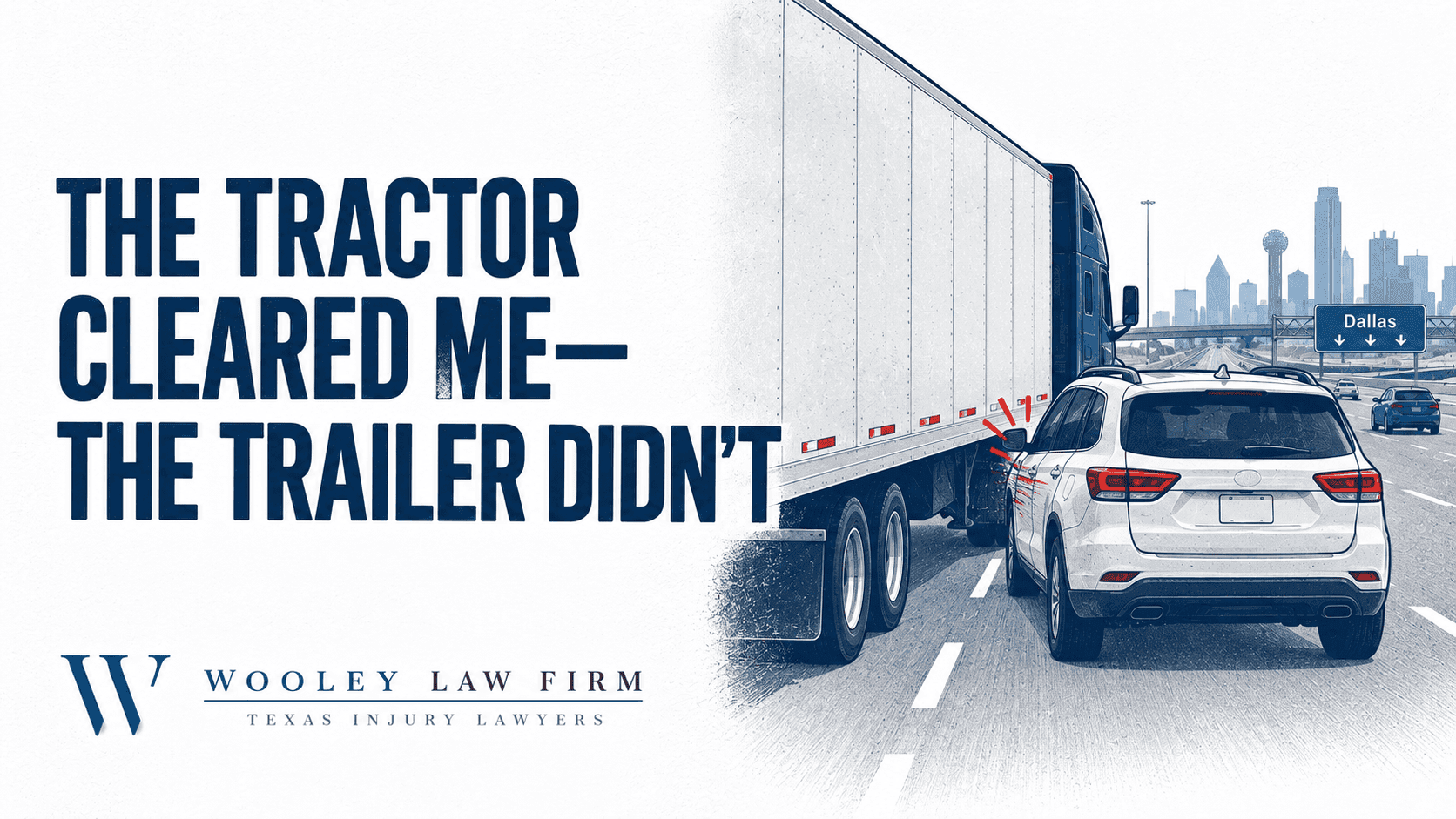
An 18-wheeler driver may pass your vehicle, look ahead, and believe there is enough room to change lanes.
But there is an obvious problem:
The truck does not end at the back of the tractor.
The trailer may extend dozens of feet behind the driver's seat.
That means the cab can completely pass your car while your vehicle is still traveling beside the middle or rear of the trailer.
If the truck driver starts changing lanes too soon, the trailer may move directly into your vehicle.
You may suddenly hear scraping metal.
The trailer may strike your door.
The rear trailer wheels may begin moving toward you.
Or the trailer may push your vehicle out of its lane before you even understand what is happening.
A collision like this can force a passenger vehicle:
toward a concrete median;
onto the shoulder;
into another vehicle;
underneath the trailer;
into a guardrail;
across several lanes of traffic; or
into a spin or rollover.
The important question after this type of Dallas truck wreck is not simply whether the tractor had enough room.
It is whether the driver made sure the entire tractor-trailer had enough room before moving into your lane.
The Wooley Law Firm represents individuals and families after serious commercial-truck crashes throughout Dallas and North Texas. Learn more about how we investigate these cases on our Dallas 18-wheeler accident lawyer page.
The Truck Driver Must Account for the Entire Tractor-Trailer
A common misconception after an 18-wheeler lane-change wreck is:
“The truck passed me before it changed lanes.”
That statement may describe only the tractor.
The trailer is another matter.
A commercial driver controls the entire combination vehicle—not simply the cab where the driver is sitting.
During a lane change, the driver needs to know where the trailer is relative to surrounding traffic.
Consider this sequence:
Your car is traveling in the right lane.
An 18-wheeler is traveling in the lane to your left.
The tractor begins passing your vehicle.
The tractor reaches a point where it is ahead of your car.
Your vehicle remains beside the trailer.
The truck driver begins moving right.
The trailer crosses the lane marker.
The trailer strikes the side of your vehicle.
The driver may later say:
“I was already ahead of the car.”
That does not necessarily answer whether there was enough room for the trailer.
The better question is:
Where was the rear of the trailer when the driver started moving over?
Texas Law Requires the Lane Change to Be Safe
Texas Transportation Code § 545.060 provides that a driver on a roadway divided into marked lanes may not move from the lane unless the movement can be made safely.
That obligation applies to the movement of the entire vehicle.
The fact that the tractor has cleared a passenger car does not necessarily mean the tractor-trailer can safely enter that car's lane.
A professional driver should consider:
the length of the trailer;
the location of vehicles beside it;
vehicles approaching from behind;
traffic in the destination lane;
blind spots;
mirror visibility;
the speed difference between vehicles; and
whether sufficient space exists for the entire combination vehicle.
Our article explaining what truck drivers should do before changing lanes in Dallas discusses the complete lane-change process, including checking traffic, using flat and convex mirrors, accounting for blind spots, signaling, rechecking the mirrors, and making sure the entire tractor-trailer can enter the new lane safely.
Why the Trailer Creates a Different Danger Than the Tractor
A tractor-trailer is not simply a long car.
The geometry is different.
The tractor steers.
The trailer follows behind through the fifth-wheel connection.
During normal highway lane changes, the trailer generally follows the path of the tractor, but its length creates a major visibility and clearance problem.
The truck driver can be far ahead of a passenger vehicle while the trailer remains directly beside it.
The driver may look through the windshield and see open road ahead.
That does not tell the driver what is happening 30, 40, or more feet behind the cab.
That is why mirrors and other visibility systems are so important.
FMCSA recognizes that large trucks have extensive areas around them that can be obscured from direct and indirect view and that those blind areas can contribute to crashes during maneuvers such as lane changes and merges.
Commercial Drivers Should Keep Rechecking Their Mirrors
A proper lane change is not:
Look once → signal → move.
Commercial-driver guidance emphasizes repeated mirror checks.
FMCSA guidance has instructed drivers to check mirrors:
before changing lanes;
after signaling;
right after beginning the lane change; and
after completing the lane change.
There is a reason for that repeated process.
Traffic moves.
A passenger vehicle that was several car lengths behind the trailer when the truck driver first checked may be beside the trailer a few seconds later.
Likewise, a car that the driver previously passed does not simply disappear.
The driver should keep track of surrounding vehicles.
If a car was beside the truck and the driver cannot determine where that vehicle went, the driver should not simply assume there is now enough space to move over.
The Driver Should Know When the Trailer Has Cleared Your Vehicle
One of the central questions in these cases is:
How did the truck driver determine that the trailer had cleared the passenger vehicle?
That question may seem simple.
It often is not.
The driver may claim:
“I saw the car behind me.”
“I thought I had enough room.”
“I checked my mirrors.”
“The car sped up.”
“The car entered my lane.”
“The car was in my blind spot.”
Each answer creates additional questions.
For example:
“I Saw the Car Behind Me”
Which mirror?
When?
Was the entire vehicle visible?
How much distance existed between the car and the rear of the trailer?
Did the driver recheck immediately before moving?
“I Thought I Had Enough Room”
What did the driver rely upon?
A flat mirror?
A convex mirror?
A digital camera?
Experience?
Guesswork?
“The Car Sped Up”
What electronic or video evidence supports that statement?
Does the passenger vehicle's event data show acceleration?
Does dash-camera footage show relative speed?
Does the truck's side-camera footage show where the car actually was?
“The Car Was in My Blind Spot”
If the driver did not know where the vehicle was, why did the driver begin changing lanes?
That is why these cases should be investigated rather than reduced to competing statements from the two drivers.
“I Checked My Mirrors” Should Not End the Investigation
A truck driver saying “I checked my mirrors” does not necessarily establish that the lane was clear.
The investigation should determine:
which mirrors were checked;
when they were checked;
how they were adjusted;
whether the driver checked both flat and convex mirrors;
whether the driver rechecked after signaling;
whether the driver checked after beginning the lane change;
whether the passenger car was visible;
whether the truck had digital mirrors;
whether cameras recorded the area beside the trailer; and
whether the driver had previously seen your vehicle.
FMCSA advises commercial drivers to check mirrors frequently and before changing lanes, turning, or merging. Frequent scanning is intended to help drivers recognize changing traffic conditions and vehicles moving into blind spots.
Flat Mirrors and Convex Mirrors Show Different Things
Traditional commercial trucks commonly use multiple mirrors.
A driver may have:
large flat mirrors;
convex mirrors;
hood mirrors; and
additional spot mirrors.
These mirrors do not all provide the same view.
Flat mirrors generally provide a less distorted view but may cover a narrower area.
Convex mirrors provide a wider field of view but make vehicles appear smaller and farther away.
That matters in a trailer-clearance case.
The driver may see a passenger vehicle in a convex mirror but misjudge how close it remains to the trailer.
Investigators may therefore need to determine:
what mirrors were installed;
whether they were properly positioned;
whether any were damaged;
whether they were obscured;
what the driver could actually see from the seat; and
whether the driver had been trained to use them correctly.
Digital Mirrors May Show Whether Your Vehicle Was Still Beside the Trailer
Modern trucks may contain even more useful evidence.
Some 18-wheelers use digital mirrors, also called:
camera-monitor systems;
electronic mirrors;
camera mirrors; or
e-mirrors.
These systems use exterior cameras to provide live video views on screens inside the cab.
Depending on the equipment, they may give the driver views along the tractor and trailer that traditional mirrors cannot provide as clearly.
More importantly after a crash, some systems may record or preserve video.
That creates a critical question:
Does video exist showing your car beside the trailer immediately before impact?
Our article about digital mirrors on 18-wheelers after a Dallas truck wreck discusses this issue in depth.
That page specifically addresses an important scenario:
the tractor clears another vehicle, but the longer trailer does not.
Digital-mirror footage may potentially show:
when your vehicle first appeared beside the truck;
how long it remained visible;
whether the tractor passed your vehicle;
whether your vehicle was still beside the trailer;
when the truck crossed the lane marker;
whether the driver had room to move;
traffic around both vehicles; and
the collision itself.
The Trailer's Rear Wheels May Be Especially Dangerous
The rear portion of the trailer deserves particular attention.
A passenger car may initially be struck by the side of the trailer.
As the truck continues moving laterally, the passenger vehicle may be pushed toward the trailer's wheels.
That can create an extremely dangerous situation.
Depending on the collision geometry, the passenger driver may be trying simultaneously to:
steer away from the trailer;
avoid another vehicle;
stay away from a concrete barrier; and
avoid being pulled toward or beneath the trailer.
This is one reason describing these cases as a simple “sideswipe” can understate what actually occurred.
A highway-speed trailer sideswipe can change the direction of a much smaller passenger vehicle and create secondary collisions far more serious than the initial contact.
Injured in an Accident?
Free consultation. Tell us what happened and learn what options may be available.
Damage to the Car May Help Show Which Vehicle Moved
Physical damage can tell part of the story.
Suppose the truck driver claims:
“The passenger car changed lanes into my trailer.”
The damage patterns should be examined before accepting that explanation.
Potentially important evidence includes:
the first point of impact;
the direction of scrape marks;
paint transfer;
dents;
crushed panels;
wheel damage;
tire marks;
broken mirrors;
gouges;
trailer rub marks; and
damage height.
Investigators may compare the marks on the passenger vehicle with corresponding areas of the trailer.
For example, a continuous scrape running along the passenger vehicle may provide information about the relative movement of the two vehicles.
Damage by itself may not conclusively establish which vehicle crossed the lane line.
But it can be combined with video, witnesses, final positions, roadway marks, and electronic evidence.
Damage to the Trailer Matters Too
The passenger vehicle should not be the only vehicle inspected.
The trailer itself may contain:
paint transfer;
scrape marks;
dents;
tire marks;
broken lights;
rubbed-off dirt;
damaged reflective tape;
wheel or tire damage; or
marks from the passenger vehicle.
Where those marks are located can be especially important.
If the impact occurred near the middle or rear portion of the trailer, that may fit a scenario where the tractor had passed the passenger car before the driver started moving over.
Photographs should document the entire side of the trailer—not merely the most obvious mark.
Do Not Let the Trailer Be Repaired Before It Is Investigated
Commercial trailers are working equipment.
A trucking company may want to return one to service quickly.
That means important physical evidence can disappear.
After a crash, a trailer may be:
washed;
repaired;
repainted;
have reflective tape replaced;
have damaged components removed;
moved to another terminal;
returned to service;
sold;
leased to another company; or
inspected privately by the trucking company's representatives.
A preservation request may therefore need to identify the trailer specifically by:
VIN;
trailer number;
license plate;
owner;
motor carrier; and
other available identifying information.
The goal is to prevent important evidence from being altered before it can be documented and evaluated.
Dash-Camera Video May Show Which Vehicle Crossed the Lane Line
Dash cameras can be powerful evidence in a trailer sideswipe.
Your own camera may show:
your vehicle maintaining its lane;
the tractor passing you;
the trailer remaining beside you;
the truck's turn signal;
the tractor beginning to move;
the trailer crossing the lane marker;
the moment of impact;
your evasive response; and
the truck's movement after the collision.
A rear-facing or side-facing camera may be even more useful in some cases.
Another motorist's dash camera may also provide a clearer view of both vehicles.
Your article about dash-camera evidence after a Dallas car or truck wreck explains why the original video should be preserved before a device overwrites it.
The Truck's Forward Camera May Not Show the Collision
This point is easy to miss.
A trucking company may say:
“We reviewed the truck's camera.”
But which camera?
A forward-facing dash camera may show only the roadway ahead.
If your vehicle was beside the rear half of the trailer, it may never appear in that footage at all.
That does not mean no useful video exists.
A complete investigation should determine whether the tractor or trailer also had:
driver-side cameras;
passenger-side cameras;
digital mirror cameras;
rear cameras;
trailer cameras; or
blind-spot camera systems.
Your existing digital-mirror evidence article is an important supporting resource because side-facing systems may provide evidence that an ordinary windshield camera cannot.
What If the Truck Driver Says You Were in the Blind Spot?
“You were in my blind spot” is one of the most common explanations after a lane-change truck wreck.
But it does not automatically establish fault.
Large commercial trucks have significant blind spots.
Those blind spots are known hazards.
The driver is supposed to account for them.
The investigation should ask:
When did the truck driver last see your car?
How long had you been beside the trailer?
Did the driver watch you approach?
Did the driver know you were passing?
Did the driver lose track of your vehicle?
Which mirror did the driver check?
Was the mirror properly adjusted?
Did the driver check again before moving?
Did the truck have cameras?
Did the truck have blind-spot monitoring?
Our guide to 18-wheeler blind-spot accidents in Dallas explains why blind spots should be investigated as a visibility and lookout issue rather than automatically blamed on the passenger driver.
If the Driver Lost Sight of Your Car, Why Did the Truck Move Over?
This can be one of the most important questions in the entire case.
Suppose the driver admits seeing your vehicle moments earlier.
Then the driver says:
“I checked again and couldn't see it.”
Where did the driver think your vehicle went?
If you did not appear ahead of the tractor and did not appear safely behind the trailer, your vehicle may still have been beside the truck.
A driver who loses track of another vehicle should be cautious about beginning a lateral movement.
That issue becomes especially important when the car is traveling beside the trailer rather than beside the tractor.
Electronic Data May Help Establish Speed and Timing
The truck's electronic systems may provide another piece of the reconstruction.
Depending on the equipment installed, evidence may include:
speed;
brake application;
throttle;
GPS information;
telematics;
electronic logging-device data;
steering-related events;
lane-departure alerts;
collision warnings; and
camera-triggered safety events.
Electronic data may help determine the relative timing.
For example:
The truck is traveling 65 mph.
The tractor passes the passenger vehicle.
Three seconds later, the truck begins changing lanes.
Digital-mirror footage shows the passenger vehicle still beside the trailer.
Dash-camera footage shows the trailer crossing the lane marker.
Physical damage matches the rear half of the trailer.
Those pieces of evidence can be analyzed together.
GPS and Telematics Can Help Place the Truck at the Crash
GPS evidence may not directly show the trailer striking the car, but it can confirm other important details.
It may help establish:
which tractor was involved;
the truck's location;
direction of travel;
approximate speed;
route;
time of the collision; and
what the truck did immediately afterward.
That can become especially useful if the truck continues driving after the sideswipe or if the trucking company initially disputes which vehicle was involved.
Driver Training Records May Matter
The driver's actions during the lane change are important.
So is the driver's training.
A motor carrier may have:
lane-change training;
mirror-use policies;
blind-spot training;
defensive-driving programs;
digital-mirror training;
safety videos;
written procedures;
coaching records; and
prior safety evaluations.
The investigation may ask whether the driver was taught to:
identify passing vehicles;
track vehicles through the mirrors;
check flat and convex mirrors;
recheck after signaling;
make gradual lane changes;
make sure the trailer clears another vehicle; and
discontinue the maneuver when the lane is not clear.
Your related article about what truck drivers should do before changing lanes in Dallas provides the broader safety framework for these questions.
The Trucking Company May Have Already Reviewed Video
After a serious crash, the trucking company may begin its investigation immediately.
It may:
contact the driver;
inspect the tractor;
inspect the trailer;
download camera footage;
review telematics;
photograph damage;
communicate with its insurer;
obtain a driver statement; and
return the equipment to service.
That creates another important question:
What evidence did the trucking company obtain before anyone contacted the injured driver?
If company representatives viewed or downloaded video, those records may become important even if the system later overwrote the original footage.
Witnesses Can Be Extremely Helpful in a Trailer Sideswipe
A driver inside the passenger vehicle may not have a complete view of what happened.
The truck driver also may not see the rear half of the trailer directly.
A witness behind the vehicles may have the best perspective.
Witnesses may be able to describe:
which vehicle maintained its lane;
whether the tractor passed the passenger car;
when the truck began changing lanes;
whether the trailer crossed the lane marker;
whether the passenger vehicle attempted to escape;
how the collision occurred; and
whether the truck stopped afterward.
Whenever possible, obtain names and contact information before everyone leaves the scene.
Secondary Impacts Can Be More Serious Than the Initial Sideswipe
Sometimes the trailer contact is only the beginning.
After impact, the passenger vehicle may:
hit a concrete median;
collide with another car;
cross several lanes;
leave the highway;
roll over; or
strike a fixed object.
The trucking company may focus on what appears to be relatively minor scrape damage where the trailer first touched the car.
But the severity of the wreck should be evaluated based on the entire collision sequence.
A seemingly brief lateral impact can cause a much more violent secondary collision.
Serious Injuries After a Trailer Lane-Change Wreck
Potential injuries can include:
traumatic brain injuries;
concussions;
cervical injuries;
lumbar injuries;
spinal cord injuries;
herniated discs;
shoulder injuries;
knee injuries;
fractures;
internal injuries;
crush injuries;
scarring;
disfigurement;
physical impairment; and
fatal injuries.
In serious cases, the full effects may include future medical care, lost earning capacity, permanent limitations, and long-term pain or impairment.
What If the Trucking Company Says You Changed Lanes Into the Trailer?
This is exactly why evidence matters.
Two drivers may give completely different accounts.
The passenger driver says:
“I stayed in my lane and the trailer moved into me.”
The truck driver says:
“The car came over and hit my trailer.”
Instead of choosing one statement, the investigation should look for objective evidence.
That can include:
lane markings;
dash-camera footage;
digital-mirror footage;
highway cameras;
witness testimony;
vehicle damage;
trailer damage;
paint transfer;
tire marks;
final resting positions;
GPS information; and
electronic truck data.
The more independent evidence that exists, the less the case depends solely on competing memories.
What Should You Do After an 18-Wheeler Trailer Hits Your Car?
If you are able to do so safely:
Call 911. Explain that the trailer of an 18-wheeler changed lanes into your vehicle.
Get medical attention. Do not judge the seriousness of an injury solely from the amount of visible vehicle damage.
Photograph your entire vehicle. Take close-up and wide-angle photographs.
Photograph the trailer. If possible, document the precise location of marks on the trailer.
Identify the tractor and trailer separately. Record the tractor number, trailer number, license plates, company information, and USDOT number.
Preserve dash-camera footage. Save the complete original recording before it is overwritten.
Get witness information.
Document the lane configuration. Photograph lane markers, shoulders, barriers, ramps, and other roadway features.
Preserve evidence quickly. The truck's camera footage and electronic records may not remain available indefinitely.
What Evidence Should Be Preserved From the Trucking Company?
Depending on the facts, a preservation request may need to cover:
the tractor;
the trailer;
photographs of both;
physical damage;
forward-facing cameras;
driver-facing cameras;
side cameras;
digital-mirror recordings;
trailer cameras;
GPS records;
telematics;
event data;
electronic logs;
lane-departure alerts;
blind-spot warnings;
dispatch communications;
driver qualification materials;
lane-change training;
safety policies;
prior coaching records;
post-crash inspection materials;
company crash reports; and
insurer or third-party inspection photographs.
Our guide to evidence that can help prove an 18-wheeler wreck explains other categories of trucking-company evidence that may become important after a serious collision.
How This Page Fits With Other Dallas Truck Lane-Change Resources
Several different issues can arise from the same wreck.
If the question is what the driver should have done before moving over, read what truck drivers should do before changing lanes in Dallas.
If the trucking company says your vehicle was hidden from view, read our guide to 18-wheeler blind-spot accidents in Dallas.
If the truck had newer camera technology, read about digital mirrors and evidence after a Dallas truck wreck.
If video from your car or another vehicle exists, see our guide to dash-camera evidence after a Dallas car or truck wreck.
For the broader physical-contact version of these crashes, see our article on being sideswiped by an 18-wheeler in Dallas-Fort Worth.
Those pages answer different questions while supporting the same central investigation:
Did the truck driver know—or should the driver have known—that your vehicle was still beside the trailer before changing lanes?
Talk to a Dallas Truck Wreck Lawyer After a Trailer Sideswipe
If the tractor passed your vehicle but the trailer moved into your lane and struck you, the trucking company may describe the collision as a minor sideswipe.
That description does not determine how the crash occurred or how serious its consequences were.
The investigation should determine:
where your vehicle was before impact;
when the tractor passed you;
whether the trailer had actually cleared your vehicle;
what mirrors the driver checked;
whether the driver rechecked after signaling;
whether digital-mirror footage exists;
what dash-camera footage shows;
whether the driver lost track of your vehicle;
where the damage appears on the trailer;
what electronic evidence was recorded; and
what training the driver received.
The Wooley Law Firm represents people who have suffered serious injuries when 18-wheelers negligently change lanes, sideswipe passenger vehicles, push cars from the roadway, or cause other serious commercial-truck wrecks in Dallas and throughout North Texas.
Call (214) 699-6524 for a free consultation. You don't pay unless we win.
Frequently Asked Questions About 18-Wheeler Trailer Sideswipes
Can the trailer hit my car even after the tractor passes me?
Yes. The tractor may be ahead of your vehicle while your car remains beside the much longer trailer. The driver should make sure the entire tractor-trailer has sufficient clearance before moving into another lane.
Who is usually at fault when an 18-wheeler trailer changes lanes into a car?
Fault depends on the evidence. Important questions include which vehicle moved laterally, whether the truck driver maintained a proper lookout, where the vehicles were positioned, and what video, physical damage, witnesses, and electronic records show.
What if the truck driver says I drove into the trailer?
That claim should be compared against objective evidence such as damage patterns, lane markings, dash-camera footage, digital-mirror video, witnesses, trailer damage, and electronic information.
What if the truck driver says my car was in the blind spot?
A blind spot does not automatically establish fault. The investigation should determine whether the driver had previously seen your vehicle, whether the mirrors were properly checked, whether other camera systems existed, and whether the driver could safely begin the lane change.
Can digital mirrors show whether my car was still beside the trailer?
Potentially. Some digital-mirror systems provide side and rearward views, and some may record video. The exact system installed on the truck should be identified.
Does the location of the damage on the trailer matter?
It can. Damage toward the middle or rear of the trailer may help investigators understand the positions of the vehicles when contact occurred, particularly when combined with video and witness testimony.
What if the trailer pushed me into another vehicle or concrete barrier?
The entire collision sequence should be investigated. The first contact with the trailer may have caused a more serious secondary collision.
Should the tractor and trailer both be preserved?
Depending on the facts, yes. They are separate pieces of physical evidence, and both may contain damage, markings, electronic equipment, cameras, or other information relevant to the crash.
Disclaimer:
This article is for general informational purposes only and is not legal advice. Reading it does not create an attorney-client relationship. Every case is different.
Topics
Share This Article

Andrew J. Wooley
Personal Injury Attorney
Andrew J. Wooley is a dedicated personal injury attorney based in Dallas, Texas. He focuses on helping accident victims recover fair compensation for their injuries. With a commitment to personalized service, Andrew works directly with each client to understand their unique situation and fight for their rights.