
After a multi-vehicle wreck, people naturally focus on the vehicle that physically hit them.
But that vehicle may not be the vehicle that caused the emergency.
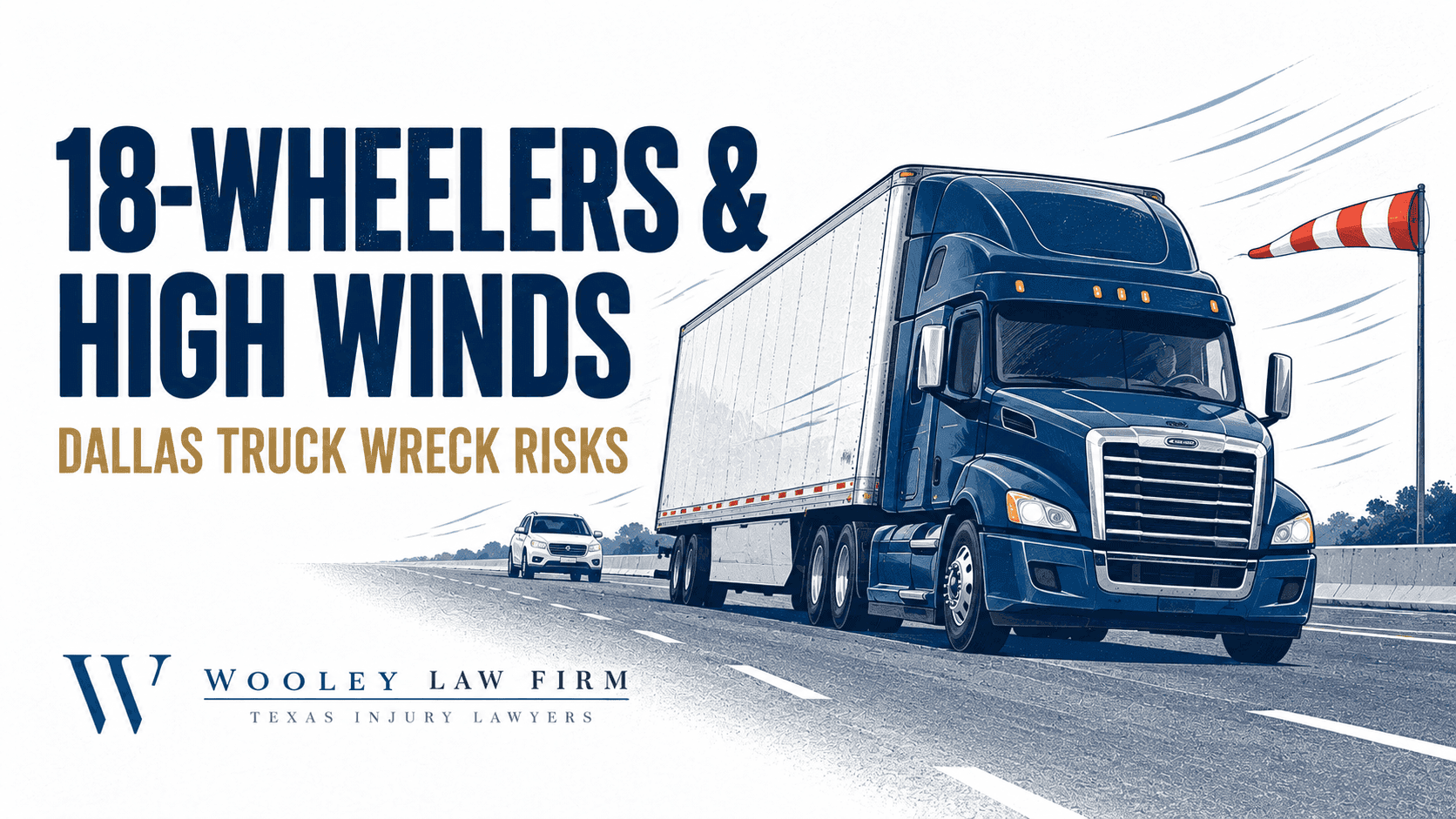
Imagine driving on I-35E in Dallas when an 18-wheeler suddenly begins changing lanes into a passenger car.
The passenger driver swerves.
Another driver brakes.
A third vehicle cannot stop in time.
One car hits the concrete median.
Another vehicle gets rear-ended.
Several vehicles collide within seconds.
When everything stops, the 18-wheeler may be hundreds of feet down the highway.
It may have struck only one vehicle.
It may not have physically struck anyone at all.
Yet the truck driver's lane change may have started the entire chain of events.
That is why a serious Dallas multi-vehicle truck wreck should not always be investigated by simply asking:
“Who hit whom?”
The better question may be:
“What happened first, and what caused every driver afterward to react?”
The Wooley Law Firm represents individuals and families after serious 18-wheeler and commercial-truck wrecks throughout Dallas and North Texas. Learn more about our approach to these cases on our Dallas truck accident lawyer page.
The Vehicle That Hit You May Not Be the Vehicle That Caused the Wreck
A chain-reaction collision can involve several separate impacts.
For example:
An 18-wheeler begins changing lanes.
Vehicle A swerves to avoid the trailer.
Vehicle B brakes hard because Vehicle A suddenly enters its lane.
Vehicle C rear-ends Vehicle B.
Vehicle A strikes the concrete median.
Vehicle D collides with Vehicle C.
The truck continues down the highway.
If Vehicle C hit you, it may be tempting to conclude that Vehicle C is the only vehicle that matters.
But the investigation should go farther back.
Why did Vehicle B suddenly brake?
Why did Vehicle A leave its lane?
What caused the emergency?
Was the truck entering an occupied lane?
Did the trailer force another driver to take evasive action?
Was the truck driver trying to reach an exit?
Did the truck driver ever see the passenger vehicle?
A proper investigation may need to reconstruct the wreck second by second.
Unsafe 18-Wheeler Lane Changes Can Affect Several Vehicles at Once
An 18-wheeler occupies much more highway space than an ordinary passenger car.
When a tractor-trailer suddenly moves laterally, several motorists can be affected simultaneously.
One vehicle may be beside the tractor.
Another may be beside the trailer.
A third may be approaching from behind.
Another vehicle may be merging onto the highway.
Someone else may be traveling on the shoulder side of the affected vehicle.
When the truck begins moving over, drivers may react differently.
One brakes.
One accelerates.
One swerves.
One moves onto the shoulder.
Another freezes.
A following driver may have no idea why traffic suddenly stopped.
What started as one lane-change decision can become a multi-car collision almost immediately.
Texas Law Requires a Lane Change to Be Made Safely
Texas Transportation Code § 545.060 generally provides that a driver traveling on a roadway divided into marked lanes may not move from the lane unless the movement can be made safely.
That obligation applies to commercial drivers.
An 18-wheeler driver should therefore not focus merely on whether there appears to be enough room for the tractor.
The driver should account for:
vehicles beside the tractor;
vehicles beside the trailer;
cars approaching from behind;
traffic slowing ahead;
motorcycles;
vehicles entering from ramps;
other motorists changing lanes;
construction barriers;
weather and visibility;
blind spots; and
whether the entire tractor-trailer has sufficient room.
Your related article explaining discusses those safety steps in greater detail.
The important point in a multi-vehicle case is that an unsafe lane change can affect vehicles the truck driver never actually touches.
A Turn Signal Does Not Give an 18-Wheeler Ownership of the Next Lane
After a wreck, a truck driver may say:
“I had my turn signal on.”
That fact may be relevant.
But a turn signal communicates an intention to change lanes.
It does not automatically make the destination lane clear.
It does not automatically require a passenger vehicle already occupying that lane to disappear.
And it does not necessarily resolve whether the truck driver had enough room for the tractor and trailer.
The investigation should determine:
when the signal was activated;
where the passenger vehicles were at that moment;
how soon the truck started moving;
whether the driver rechecked the mirrors;
whether surrounding drivers had time to respond; and
whether the movement could actually be made safely.
Why the First Collision Matters More Than the Last Collision
Imagine a five-vehicle crash.
Vehicle 5 hits Vehicle 4.
Vehicle 4 hits Vehicle 3.
Vehicle 3 has already stopped because Vehicle 2 swerved.
Vehicle 2 swerved because an 18-wheeler entered its lane.
Looking only at the final rear-end collision misses the central event.
That is why investigators may create a detailed sequence showing:
Truck begins lane change → Vehicle A swerves → Vehicle B brakes → Vehicle C rear-ends B → Vehicle D strikes C.
Each movement may have occurred only fractions of a second apart.
But the order matters.
The investigation should attempt to identify what created the first dangerous condition.
What If the 18-Wheeler Never Hit Your Vehicle?
The truck does not necessarily need to physically strike your vehicle for its movement to become relevant to the wreck.
Suppose an 18-wheeler enters another car's lane.
That car swerves into your lane and hits you.
The truck never comes within several feet of your vehicle.
The trucking company may say:
“Our truck didn't hit the injured person.”
That does not necessarily answer what caused the crash.
The investigation should determine whether the first passenger driver was reacting to the truck's movement.
This is one reason video evidence and independent witnesses can become especially important.
What If the 18-Wheeler Did Not Hit Anyone?
Sometimes the truck causes an emergency without contacting any vehicle.
An 18-wheeler may:
move toward an occupied lane;
drift across a lane marker;
force another vehicle toward the shoulder;
cut across several lanes toward an exit; or
merge into traffic without sufficient clearance.
Passenger drivers then take evasive action.
A serious multi-vehicle collision follows.
The truck continues driving.
That type of no-contact truck wreck can be difficult because there may be no paint transfer or collision damage connecting the tractor-trailer to the scene.
Evidence showing the truck's movement becomes critical.
“The Passenger Cars Overreacted” Should Be Tested Against the Evidence
A trucking company's insurer may argue that the truck merely moved slightly and surrounding motorists overreacted.
That is not something that should simply be accepted.
Video may show otherwise.
Important questions include:
How far did the truck enter the lane?
How close did the trailer come to another vehicle?
How fast were the vehicles traveling?
Was a concrete barrier beside the passenger car?
Did the driver have somewhere else to go?
Was another vehicle already occupying the next lane?
How suddenly did the truck move?
Did the passenger driver sound the horn?
Did the truck continue moving after the horn?
How quickly did the crash follow the truck's movement?
What looks minor on a written diagram may appear very different on video at highway speed.
Blind Spots Can Become an Issue in Multi-Vehicle Lane-Change Wrecks
The truck driver may say:
“I never saw the car beside me.”
That statement can lead to an important part of the investigation.
If another vehicle was beside the truck, investigators may ask:
When was it last visible?
How long had it been beside the tractor or trailer?
Did the driver check both flat and convex mirrors?
Did the driver recheck before moving?
Was the vehicle approaching from behind?
Did the truck driver lose track of it?
Did the truck have blind-spot technology?
Were additional cameras installed?
Was the driver trained on those systems?
Your Dallas 18-wheeler blind-spot accident guide explains why “the vehicle was in my blind spot” should not automatically end the investigation.
A known blind spot is something the professional driver is expected to account for.
Digital Mirrors May Show What Was Beside the Truck
Some newer commercial trucks have camera-monitor systems commonly called digital mirrors.
Depending on the equipment installed, cameras may provide views beside and behind the tractor-trailer.
That evidence can be particularly important in a chain-reaction crash.
The footage may potentially show:
Vehicle A beside the trailer;
surrounding traffic before the lane change;
when the truck began crossing the lane marker;
whether Vehicle A was forced away from the truck;
whether another vehicle occupied the next lane;
the movement of the trailer; and
what happened immediately after the maneuver.
Your article about digital mirrors on 18-wheelers after a Dallas truck wreck explains why an investigation should determine exactly what camera system was installed and whether recordings were preserved.
Dash-Camera Video Can Show the Entire Collision Sequence
Dash-camera footage may be one of the best forms of evidence in a multi-vehicle wreck.
Unlike a driver who may see only one part of the collision, a camera continues recording.
Video from your vehicle may show:
traffic conditions before the wreck;
the truck traveling beside another vehicle;
the truck's turn signal;
the tractor beginning to cross the lane marker;
the trailer moving toward another car;
the first driver's evasive maneuver;
brake lights appearing ahead;
the first collision;
secondary collisions; and
the truck's movements afterward.
Video from a vehicle behind the crash may be even more helpful because it may capture several vehicles simultaneously.
Your guide to dash-camera evidence after a Dallas car or truck wreck explains why original recordings should be preserved before a camera overwrites them.
Look for Video From Every Vehicle—Not Just the People Who Were Hit
A five-car wreck potentially means five or more vehicles with cameras.
And motorists who avoided the collision may have even better footage.
Potential video sources can include:
personal dash cameras;
Tesla and other factory camera systems;
commercial fleet cameras;
rideshare cameras;
delivery-vehicle cameras;
truck digital-mirror cameras;
forward-facing truck cameras;
highway cameras;
business surveillance;
toll-road cameras;
construction cameras; and
cellphone recordings.
The best video may belong to someone whose vehicle never made contact.
Injured in an Accident?
Free consultation. Tell us what happened and learn what options may be available.
The Truck's Black-Box and Electronic Data Can Help Establish the Timeline
Multi-vehicle wrecks often happen in seconds.
Electronic truck evidence can help place events on a timeline.
Depending on the truck and systems installed, investigators may look for:
speed;
braking;
throttle position;
hard-braking events;
sudden deceleration;
GPS location;
telematics;
electronic logging-device information;
lane-departure alerts;
collision warnings;
steering-related safety events;
dash-camera triggers; and
driver-monitoring alerts.
Your detailed guide to 18-wheeler black-box data after a Dallas-Fort Worth truck wreck explains the different electronic systems that may exist.
That information can become particularly useful when synchronized with video.
For example:
10:32:14 — Camera shows the truck beginning to move right.
10:32:15 — Vehicle A swerves.
10:32:16 — Vehicle B brakes.
10:32:17 — Truck records a steering or safety event.
10:32:18 — First impact occurs.
10:32:19 — Secondary impact occurs.
A reconstructed timeline can help explain a collision that otherwise appears chaotic.
Passenger Vehicles May Have Their Own Event Data
The truck is not the only vehicle that may contain electronic evidence.
Depending on the vehicles involved, passenger-vehicle event data may provide information concerning:
speed;
braking;
acceleration;
seat-belt status;
airbag deployment; and
other crash-related parameters.
That evidence may help answer whether a passenger driver braked suddenly or made another evasive maneuver immediately after the truck began changing lanes.
It can also help test allegations that a passenger vehicle was speeding or accelerating before the crash.
Vehicle Damage May Reveal the Order of the Impacts
Physical damage can help reconstruct a chain-reaction wreck.
Investigators may look at:
which part of each vehicle was damaged;
overlapping impact areas;
paint transfer;
crush patterns;
trailer marks;
wheel damage;
broken glass;
debris;
airbag deployment;
barrier damage; and
where the vehicles eventually stopped.
The location of damage may help determine whether one vehicle:
sideswiped another;
was rear-ended;
was pushed into another vehicle;
struck the barrier before another impact; or
experienced multiple separate collisions.
This becomes particularly important when everyone involved remembers the sequence differently.
The Trailer May Cause the First Collision Even After the Tractor Passes
The driver sits in the tractor.
The first vehicle in the chain reaction may be beside the trailer.
For example:
The tractor passes Vehicle A.
Vehicle A is still beside the middle of the trailer.
The truck driver begins moving into Vehicle A's lane.
Vehicle A swerves away.
Vehicle B reacts.
The multi-car crash begins.
The tractor may never touch anyone.
The trailer may strike Vehicle A—or Vehicle A may avoid the trailer entirely.
Either way, the driver's responsibility for controlling the entire tractor-trailer should be examined.
Police Reports Are Important—but May Not Tell the Entire Story
Police officers investigating a five- or six-vehicle collision face a difficult job.
By the time officers arrive:
the collision has already ended;
injured drivers may have left by ambulance;
vehicles may have been moved;
traffic may be blocked;
witnesses may leave;
drivers may remember events differently; and
the truck may no longer be at the scene.
The report is important evidence.
But it is not necessarily the complete investigation.
A Dallas truck wreck lawyer may also examine:
911 recordings;
body-camera footage;
dash-camera recordings;
photographs taken by police;
witness interviews;
diagrams;
roadway measurements;
towing records;
vehicle inspections;
electronic truck data; and
trucking-company records.
911 Calls Can Capture What Witnesses Saw Immediately
A 911 caller may describe the collision before anyone has had time to discuss what happened.
For example:
“An 18-wheeler came into a car's lane and everybody started crashing.”
Or:
“The truck ran that SUV into the barrier.”
Those contemporaneous observations may help identify witnesses or provide context for the later investigation.
The actual recording may be more informative than a short summary appearing in the police report.
Police Body-Camera and Dash-Camera Video May Preserve Important Statements
Body-camera footage can record drivers and witnesses shortly after a wreck.
The truck driver may tell an officer:
“I was changing lanes.”
“I didn't see the car.”
“I thought I had enough room.”
“I was trying to get over.”
“I had my signal on.”
“I didn't realize the cars crashed.”
Passenger drivers may also give immediate accounts of what they saw.
Those recordings can later be compared with depositions, written statements, and electronic evidence.
Different Witnesses May Have Seen Different Parts of the Crash
A chain reaction can unfold across hundreds of feet.
One witness may see the truck's initial lane change.
Another may see Vehicle A swerve.
A third may see only the rear-end impacts.
None of those witnesses necessarily has the full picture.
That is why witness accounts should be compared rather than assuming one person's view describes the entire event.
An investigation may ask each witness:
Where were you?
Which direction were you looking?
When did you first notice the truck?
Did the truck use a turn signal?
Which vehicle moved first?
Did you see a passenger car swerve?
Did you hear a horn?
Which collision happened first?
Did the truck stop?
Several Insurance Companies May Immediately Start Blaming One Another
A multi-car accident can create a complicated insurance situation.
Potential carriers may include:
the trucking company's liability insurer;
the truck driver's insurer, depending on the arrangement;
Vehicle A's insurer;
Vehicle B's insurer;
Vehicle C's insurer;
your own automobile insurer; and
other commercial policies.
Each carrier may have an incentive to shift responsibility elsewhere.
One insurer says:
“The truck caused it.”
Another says:
“Vehicle A overreacted.”
Another says:
“Vehicle B followed too closely.”
The trucking carrier says:
“Our driver never made contact.”
The investigation should not simply accept whichever carrier calls first.
The evidence should determine what happened.
More Than One Driver May Share Responsibility
A chain-reaction collision does not necessarily have to have only one responsible person.
Depending on the evidence, several acts may have contributed.
For example:
An 18-wheeler may have made an unsafe lane change.
A following driver may also have been traveling too closely.
Another driver may have been distracted.
Comparative responsibility questions can become complicated when several drivers and insurance companies are involved.
That is another reason identifying the original triggering event matters.
Multiple Injured People Can Create Additional Insurance Problems
A serious 18-wheeler chain-reaction crash may injure several people.
That can create another issue:
multiple claims against available insurance coverage.
Different injured occupants may have:
emergency-room bills;
surgery;
hospitalization;
lost wages;
permanent injuries; and
future medical needs.
The existence of several claimants can affect how insurers evaluate and respond to claims.
This is another reason all potentially responsible parties and applicable insurance coverage should be investigated rather than assuming only one policy is relevant.
The Trucking Company May Possess Evidence No Passenger Driver Can Access
A commercial trucking company can possess information that an ordinary motorist does not have.
Potential evidence includes:
driver qualification records;
driver training;
lane-change policies;
safety manuals;
digital-mirror video;
dash-camera footage;
driver-facing video;
GPS records;
telematics;
electronic logs;
dispatch communications;
safety-system alerts;
driver coaching records;
post-crash reports; and
internal communications.
Your broader guide to evidence that can help prove an 18-wheeler wreck explains why trucking-company evidence should be identified and preserved promptly.
The Trucking Company's Own Investigation May Have Started Before Yours
After a serious multi-car wreck, the trucking company may begin protecting its interests almost immediately.
It may:
contact the driver;
send an investigator;
take photographs;
inspect the tractor;
inspect the trailer;
obtain a driver statement;
download electronic information;
retrieve camera footage;
contact witnesses;
notify insurers; and
begin preparing its defense.
That means potentially important evidence may already be in the company's possession.
A preservation request should be specific enough to identify the different categories of evidence that may exist.
Driver Training May Matter in a Chain-Reaction Lane-Change Case
The investigation may also examine what the truck driver was taught about changing lanes.
Potential questions include:
Was the driver trained to check flat and convex mirrors?
Was the driver trained to identify vehicles beside the trailer?
Was the driver required to recheck after signaling?
Was the driver taught to cancel a maneuver if the lane became occupied?
Was the driver trained on digital-mirror technology?
Did company policy require gradual lane changes?
Had the driver received prior lane-change coaching?
Were there previous lane-departure warnings?
Your related lane-change article discusses the proper safety sequence in detail and can serve as a supporting resource for this issue.
Distraction Can Turn a Routine Lane Change Into a Multi-Car Crash
A distracted truck driver may fail to recognize vehicles surrounding the tractor-trailer before beginning a lane change.
Potential distractions may include:
cellphone use;
navigation systems;
dispatch messages;
eating;
drinking;
paperwork;
adjusting equipment; or
looking away from the roadway.
The investigation may compare driver activity with the precise timeline of the wreck.
If the truck driver suddenly moved laterally without recognizing several vehicles nearby, distraction may be one of the issues considered.
Fatigue Can Affect Lane Control and Decision-Making
Not every multi-vehicle wreck involves a deliberate lane change.
A fatigued driver may allow the tractor-trailer to drift into another lane.
Surrounding drivers react.
A chain reaction follows.
Depending on the facts, investigators may examine:
electronic logs;
duty status;
dispatch records;
GPS history;
trip timing;
driver communications; and
other evidence concerning the driver's schedule.
The evidence should determine whether fatigue played a role rather than assuming it solely because the truck left its lane.
What Evidence Should Be Preserved After a Multi-Vehicle Truck Wreck?
A serious chain-reaction crash may require preservation of evidence from several different sources.
Evidence From the Truck
Potential evidence includes:
tractor and trailer;
vehicle damage;
forward-facing cameras;
driver-facing cameras;
digital-mirror footage;
side cameras;
rear or trailer cameras;
electronic control data;
GPS;
telematics;
electronic logs;
lane-departure warnings;
collision warnings;
braking data; and
other safety-system information.
Evidence From Every Passenger Vehicle
Potential evidence includes:
dash-camera footage;
factory camera footage;
event data;
photographs;
damage;
airbag information; and
vehicle location.
Crash-Scene Evidence
Potential evidence includes:
skid marks;
tire marks;
debris;
gouges;
barrier damage;
lane markings;
final resting positions;
road signs;
construction barriers; and
traffic conditions.
Witness and Police Evidence
Potential evidence includes:
witness contact information;
911 recordings;
police body-camera video;
patrol-car video;
officer photographs;
accident diagrams; and
witness statements.
Trucking-Company Records
Potential evidence includes:
driver qualification files;
training records;
company safety policies;
dispatch communications;
internal crash investigations;
driver coaching;
prior safety events; and
communications concerning the wreck.
The more complicated the sequence, the more important it may be to gather evidence from several independent sources.
What Should You Do After an 18-Wheeler Causes a Multi-Car Wreck?
If you are able to do so safely:
Call 911. Tell the dispatcher if an 18-wheeler's lane change appears to have started the collision.
Get medical attention. Multi-impact crashes can cause serious injuries even when one particular impact seems minor.
Preserve your dash-camera footage. Save the complete original recording, including the time before the first impact.
Photograph every vehicle you safely can. The location and type of damage may later help reconstruct the sequence.
Photograph the tractor and trailer separately. Record company markings, tractor number, trailer number, license plates, and USDOT information.
Identify witnesses. Someone who was never struck may have had the best view.
Write down what happened while it is fresh. Describe what you saw before the first collision, not only the moment your vehicle was hit.
Preserve communications. Save photographs, videos, texts, and insurance communications.
Do not assume the last vehicle to hit you is necessarily the only responsible party.
Consider preservation of truck evidence early. Video and electronic information may not be stored indefinitely.
Serious Injuries Can Result From Several Separate Impacts
A multi-vehicle truck crash may subject an occupant to more than one impact.
A vehicle can be:
sideswiped by the trailer;
rear-ended;
pushed into another vehicle;
spun into a median;
struck again by following traffic; or
forced off the roadway.
Potential injuries may include:
traumatic brain injuries;
concussions;
spinal cord injuries;
cervical and lumbar injuries;
fractures;
shoulder injuries;
knee injuries;
internal injuries;
crush injuries;
burns;
scarring;
disfigurement;
physical impairment; and
fatal injuries.
A medical investigation may also need to determine which injuries resulted from the overall collision sequence rather than attempting to assign each injury to a single impact.
What Damages May Be Available After a Dallas Multi-Vehicle Truck Wreck?
Depending on the facts and evidence, an injured person may pursue legally recoverable damages that can include:
past medical expenses;
future medical expenses;
lost wages;
loss of earning capacity;
physical pain;
mental anguish;
physical impairment;
disfigurement;
property damage; and
other losses recognized by Texas law.
Your detailed guide to damages after a Dallas 18-wheeler wreck explains these categories in greater detail.
The existence of several insurance carriers or several injured claimants can make evaluating available coverage more complicated.
Why a Dallas Truck Wreck Lawyer Should Investigate the Entire Sequence
A multi-vehicle collision can produce a misleadingly simple story:
“Car B rear-ended Car A.”
But a truck-wreck investigation may reveal:
An 18-wheeler moved into Car A's lane, Car A swerved, Car B reacted, and the crash followed.
That is why the investigation should begin before the first impact.
Questions may include:
What was the truck doing five seconds before the wreck?
Where was every passenger vehicle?
Did the truck use a turn signal?
Was another car beside the trailer?
Did the truck cross the lane marker?
Did the first passenger driver brake or swerve?
Did another vehicle have enough time to react?
What does dash-camera footage show?
What do digital mirrors show?
What does black-box data show?
What did independent witnesses see?
What statements did drivers give police?
Did the trucking company preserve its cameras?
Did the truck driver have prior lane-change training?
The purpose is to reconstruct the collision rather than assume the last impact tells the entire story.
Talk to a Dallas Truck Wreck Lawyer About the Entire Chain-Reaction Crash
When an 18-wheeler changes lanes and several vehicles crash, the vehicle that physically struck you may not be the vehicle that started the wreck.
The investigation should start at the beginning.
What did the truck do?
Where was every vehicle?
Why did the first driver brake or swerve?
What does the video show?
What does the electronic truck data show?
What did independent witnesses see?
Did the trucking company preserve its evidence?
The Wooley Law Firm represents individuals and families after serious 18-wheeler, tractor-trailer, and commercial-truck accidents in Dallas and throughout North Texas.
If an unsafe lane change by an 18-wheeler caused your multi-vehicle wreck, call (214) 699-6524 for a free consultation. You don't pay unless we win.
Frequently Asked Questions About Dallas Multi-Vehicle Truck Wrecks
Can an 18-wheeler be responsible if another car actually hit me?
Potentially. The important question is what caused the collision sequence. If another vehicle hit you while reacting to an unsafe movement by the truck, the truck driver's conduct may still be part of the liability analysis.
What if the 18-wheeler never touched any vehicle?
Physical contact is not necessarily the only relevant issue. Video, witnesses, physical evidence, and electronic information may help determine whether the truck created the emergency that caused surrounding drivers to brake or swerve.
Is the driver who rear-ended me automatically responsible?
Not necessarily. Rear-end impacts are important evidence, but multi-vehicle collisions can involve several contributing events or drivers. The full sequence should be investigated.
What if several drivers share responsibility?
Texas cases can involve comparative responsibility among multiple parties. Determining percentages of responsibility depends on the evidence and circumstances of the particular crash.
What if the trucking company says the first driver overreacted?
That allegation should be tested against objective evidence showing how far the truck moved, how close it came to the vehicle, traffic conditions, available escape routes, video, and witness testimony.
Can dash-camera footage show who started a chain-reaction wreck?
Potentially. Video may show the truck's movement, the first driver's reaction, braking by following vehicles, and the order of subsequent impacts.
Can the truck's black-box data prove a lane change?
Electronic data varies by truck and system. It may provide information about speed, braking, GPS location, safety events, or other vehicle activity. Camera evidence and physical evidence may be needed to establish lateral movement more directly.
What if the truck driver claims a car was in the blind spot?
That does not automatically resolve fault. Investigators may examine mirror use, vehicle position, how long the vehicle was beside the truck, digital cameras, training, and whether the lane change could safely be made.
Why does the order of impacts matter?
The order can help identify what created the initial emergency and how later impacts developed. A reconstruction may show that the vehicle that eventually hit you was reacting to an earlier unsafe truck maneuver.
Can several insurance companies be involved?
Yes. A multi-car wreck may involve several passenger-vehicle insurers in addition to the trucking carrier and potentially other commercial coverage. Identifying all responsible parties and available insurance can become an important part of the investigation.
Topics
Share This Article

Andrew J. Wooley
Personal Injury Attorney
Andrew J. Wooley is a dedicated personal injury attorney based in Dallas, Texas. He focuses on helping accident victims recover fair compensation for their injuries. With a commitment to personalized service, Andrew works directly with each client to understand their unique situation and fight for their rights.