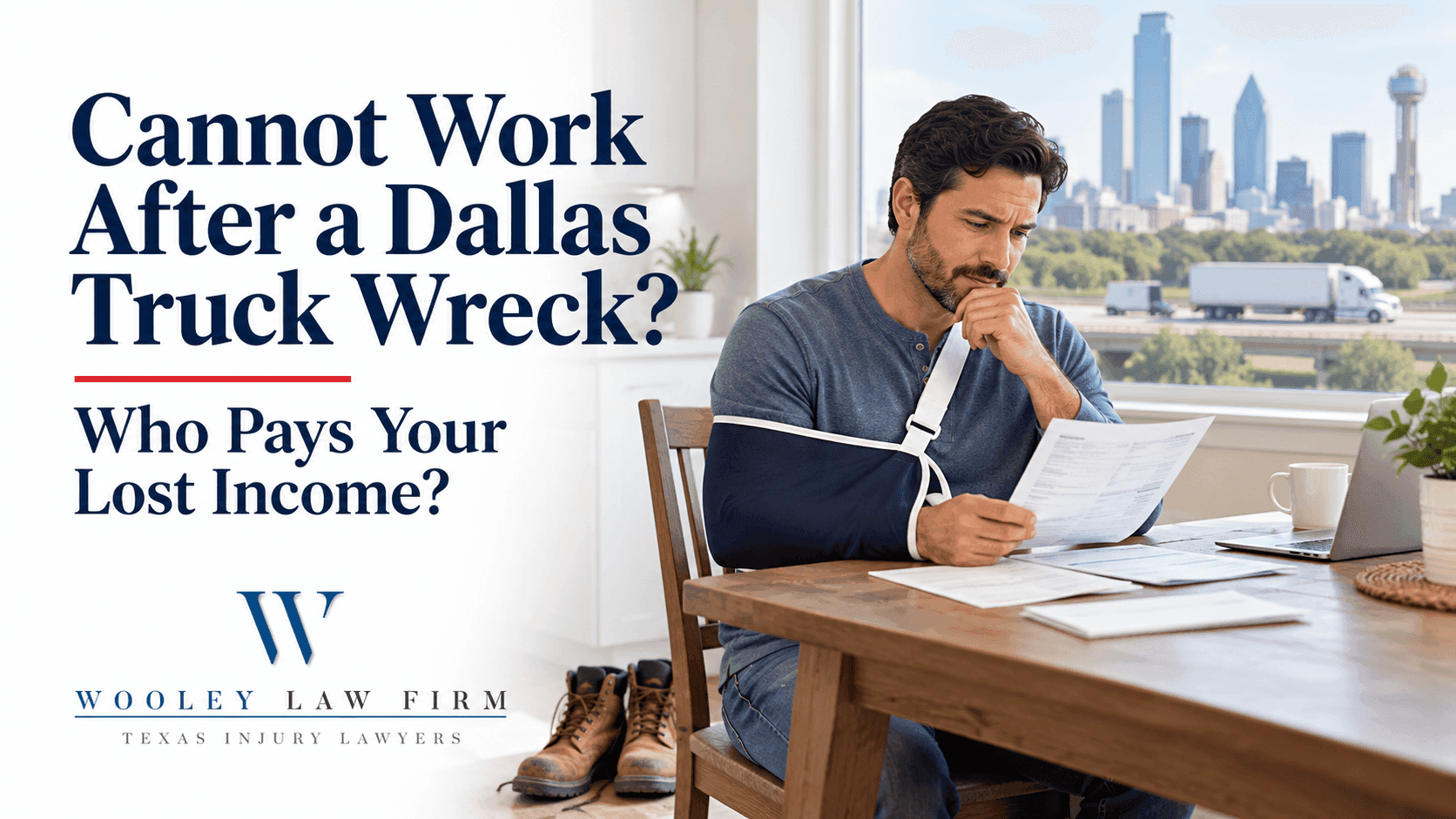
Your doctor says you cannot return to work. Your paycheck has stopped, but your mortgage, rent, groceries, and car payment have not.
If an 18-wheeler hit you in Dallas and your injuries prevent you from working, you may be able to recover lost income from the truck driver, trucking company, or another legally responsible party. Depending on your coverage and circumstances, personal injury protection, disability benefits, workers’ compensation, or uninsured/underinsured motorist insurance may also help.
But there is an important practical problem: the trucking company’s insurance carrier generally will not start sending weekly paychecks while your injury claim is pending. Establishing responsibility, documenting your losses, and obtaining payment can take time.
At The Wooley Law Firm, our Dallas truck wreck lawyer helps injured people pursue compensation that accounts for how a serious collision affects their ability to earn a living.
Who Is Responsible for Lost Wages After a Dallas Truck Accident?
A lost-income claim requires more than showing that you missed work after a collision. The evidence must connect the wreck to your injuries and those injuries to your inability to work.
Depending on the evidence, responsible parties may include:
The negligent truck driver.
The trucking company legally responsible for the driver’s conduct.
Another business whose negligence contributed to the collision.
For example, an investigation may reveal unsafe driving, negligent maintenance, or improperly secured cargo. The name on the trailer does not automatically identify every responsible company.
Our article on who else can be sued after a Dallas 18-wheeler wreck explains why identifying the correct parties matters.
Having commercial insurance does not establish fault or guarantee that enough coverage exists to pay every loss. Liability, policy terms, other claims, and available coverage all affect recovery.
Will the Trucking Company’s Insurance Pay Me While I Am Off Work?
Usually, a liability claim is resolved through a negotiated settlement or a judgment rather than automatic wage payments every payday.
Even if an adjuster accepts responsibility for the collision, the insurer may dispute:
How long you needed to miss work.
Whether your injuries prevented you from performing your job.
Whether light duty was available.
Whether overtime or commissions would actually have been earned.
Whether another medical condition contributed to your absence.
Accepting fault for the crash does not necessarily mean accepting your entire lost-income claim.
Be careful about signing a release to obtain quick payment. A bodily injury settlement may release claims for future treatment and future earning losses as well as the income you have already missed. Have the release reviewed before signing it.
What Can Help Replace Income Before the Truck Wreck Case Settles?
Personal Injury Protection Coverage
Personal injury protection, commonly called PIP, may be available through an applicable auto policy regardless of who caused the wreck.
The Texas Office of Public Insurance Counsel explains that PIP pays 80% of covered lost wages, subject to available policy limits and supporting proof. Texas policies generally must include at least $2,500 per person unless PIP is rejected in writing; higher limits may have been purchased.
PIP is a limited benefit. Medical expenses and wage benefits generally draw from the same available limit, so it may not replace months of missed income.
Medical payments coverage is different: Med-Pay generally covers eligible medical expenses, not lost wages.
Short-Term or Long-Term Disability Benefits
If you have disability coverage through work or an individual policy, ask for the policy and claim requirements.
Eligibility depends on the plan’s definition of disability, waiting period, medical documentation, and other terms. Some plans contain reimbursement or offset provisions that must be considered when resolving the truck accident case.
Do not assume that receiving disability benefits eliminates your claim against the responsible trucking company.
Workers’ Compensation if You Were Injured While Working
If the collision happened while you were performing your job and your employer carries applicable workers’ compensation coverage, benefits may be available.
The Texas Department of Insurance describes workers’ compensation income benefits that can replace part of qualifying income losses. Eligibility and payment amounts depend on the circumstances.
A claim against an outside trucking company may also exist. However, the workers’ compensation carrier may have reimbursement rights in a third-party recovery, so both claims need to be coordinated.
Uninsured or Underinsured Motorist Coverage
An applicable UM/UIM policy may provide another source of recovery if the responsible driver is uninsured or available liability coverage is insufficient. It is not an automatic weekly wage benefit.
Coverage requirements, proof of damages, policy limits, and settlement-consent provisions need review before you release the truck driver or trucking company. The Texas Department of Insurance’s auto insurance guide explains the basic coverage categories.
Injured in an Accident?
Free consultation. Tell us what happened and learn what options may be available.
What Lost Income Can I Claim After an 18-Wheeler Wreck?
Depending on the evidence, an income claim may include:
Missed wages or salary: Income lost during medically necessary time off.
Reduced hours: Lower earnings from shorter shifts or fewer working days.
Lost overtime: Supported by an established work history and available work.
Commissions, tips, or bonuses: Supported by reliable compensation records.
Time missed for treatment: Income lost while attending necessary appointments.
Future earning losses: Financial consequences of lasting limitations on your ability to work.
A possible promotion or occasional overtime opportunity is harder to prove than a consistent earnings history. The goal is to establish a reasonable, documented loss rather than speculate.
Texas law also affects the calculation. Civil Practice and Remedies Code Section 18.091 requires evidence of specified earnings and earning-capacity losses to be presented net of applicable federal income taxes.
Your gross paycheck can be a starting point for gathering records, but it is not necessarily the final measure used in court.
How Do I Prove I Cannot Work Because of My Injuries?
Two types of evidence should work together: medical records explaining your limitations and employment records establishing their financial effect.
Ask Your Doctor to Address Your Actual Job Duties
Tell your treating provider what your work requires.
“I work in a warehouse” does not explain whether you lift 50-pound boxes, drive a forklift, climb ladders, or stand for ten hours.
Useful documentation may identify:
The dates you should remain off work.
Restrictions on lifting, bending, standing, sitting, or driving.
Whether reduced hours or light duty are medically appropriate.
When your work status should be reassessed.
A desk job may also be difficult if your documented limitations affect prolonged sitting, concentration, or screen use. The medical evidence should explain the specific problem.
Follow your provider’s advice and obtain updated restrictions when your condition changes.
Keep Payroll and Employer Records
Save:
Pay stubs from before and after the collision.
W-2s, 1099s, and relevant tax returns.
Work schedules and attendance records.
Communications about missed shifts or reduced duties.
Records showing regular overtime, commissions, or bonuses.
Employer verification of your pay rate and missed work.
An employer’s verification can also help establish whether suitable light duty was available.
For variable compensation, preserve enough history to show typical earnings and seasonal changes. A single unusually strong or weak paycheck may not accurately reflect what you normally earn.
Keep a calendar of appointments and hours missed. Reconstructing those details months later can be difficult.
What if I Am Self-Employed or Paid in Cash?
You may still have a claim, but documentation is especially important.
Independent contractors, owner-operators, and business owners should preserve tax records, invoices, bank deposits, contracts, appointment calendars, canceled jobs, and records of replacement labor.
Business revenue is not automatically the same as personal lost income. A calculation may need to account for operating expenses, work performed by others, and whether a project was canceled or merely delayed.
For example, a contractor who postponed a project and later completed it may have a different loss than a contractor whose customer permanently hired someone else.
If you receive cash, preserve receipts, customer communications, deposit records, and accurate tax documentation. Do not create or alter records to fill gaps.
What if I Can Return to Work but Cannot Earn What I Earned Before?
Returning to work does not necessarily end the financial consequences of a truck wreck.
You may be able to work fewer hours, perform a lower-paying job, or return with restrictions that limit overtime and advancement. A claim for reduced earning capacity addresses an injury’s effect on your ability to earn a living.
Consider a hypothetical Dallas electrician who earned a substantial part of his income performing physically demanding work. If permanent restrictions prevent climbing and heavy lifting, a lower-paying office position may not restore his former earning capacity.
A serious claim may require medical opinions, a vocational evaluation, and economic analysis. The assessment should account for realistic employment options and avoid counting the same loss twice.
For a broader discussion of recoverable losses, read our guide to damages after a Dallas 18-wheeler wreck.
What if I Need Surgery and Will Miss More Work?
A settlement should account for supported future losses as well as missed paychecks.
If surgery is recommended, relevant questions include:
How long will you likely remain off work?
Will rehabilitation require additional time away?
Can you return to your previous occupation?
Will restrictions be temporary or permanent?
Will you need reduced hours or a different position?
Those questions require medical support. A surgery recommendation alone does not establish permanent disability.
Our article, I Need Surgery After an 18-Wheeler Wreck in Dallas: What Is My Case Worth?, discusses how surgery and long-term limitations may affect a claim.
How a Dallas Truck Wreck Lawyer Can Help Protect Your Income Claim
A strong case must establish both why the trucking defendants are responsible and how the injuries affected your work.
Depending on the circumstances, that can involve preserving truck video and electronic records, identifying available insurance, obtaining medical work restrictions, verifying earnings, and evaluating future employment limitations.
If an insurer argues that you could have returned sooner, the response should address the actual medical restrictions, job requirements, and available duties.
Be accurate about any work you perform after the wreck. A partial return can support a reduced-income claim, but inconsistent statements can undermine your credibility.
The financial impact of a serious truck wreck should be documented before a settlement permanently closes the claim.
Why Choose The Wooley Law Firm After a Serious Dallas Truck Wreck?
When your injuries threaten your livelihood, you need a lawyer prepared to document the financial consequences and challenge unsupported insurance arguments.
Attorney Andrew Wooley’s awards and professional recognitions include:
Texas Rising Stars recognition from Super Lawyers, 2020–2026.
Selection to America’s Top 100 High Stakes Litigators® for 2026.
Membership in the Million Dollar Advocates Forum.
An Avvo rating of 10.0, “Superb.”
The firm’s results have also received TopVerdict recognition, including a Top 50 Texas jury verdict in 2025 and a Top 20 Texas wrongful death settlement in 2024.
These recognitions reflect work in serious personal injury litigation. Awards and past results do not guarantee a particular recovery in your case.
Frequently Asked Questions About Lost Income After Dallas Truck Wrecks
Do I need a doctor’s note to claim lost wages?
Medical work restrictions can be important evidence connecting your absence to the collision. Payroll records show what you lost; medical evidence helps explain why you could not work.
Can I claim lost income if I only missed part of my workday?
Potentially. Keep records of time missed for injury-related limitations or necessary treatment, along with evidence showing the resulting income loss.
What if I used vacation or sick leave?
Preserve your leave records. Whether used benefits support an additional recoverable loss depends on the employer’s policies, the benefit’s value, and applicable law. Avoid assuming every hour of paid leave creates a separate wage claim.
Does being unemployed when the wreck happened rule out a claim?
Not necessarily. An injury may affect earning capacity even without a current paycheck, but the claim requires concrete evidence of your ability to work and how the injury impaired it.
How long do I have to file a truck accident lawsuit in Texas?
Many Texas personal injury claims are subject to a two-year limitations period under Section 16.003. Exceptions, notice requirements, and other deadlines can change the analysis. Evidence and insurance deadlines may require action much sooner.
Cannot Work After a Dallas 18-Wheeler Wreck? Contact The Wooley Law Firm.
A serious truck wreck can affect both your next paycheck and your ability to support your family for years.
The Wooley Law Firm represents injured people in Dallas and throughout North Texas. We can evaluate responsibility, available coverage, missed earnings, and whether your injuries support a claim for reduced future earning capacity.
Call (214) 699-6524 for a free consultation, or contact The Wooley Law Firm online. You don’t pay unless we win.
Topics
Share This Article

Andrew J. Wooley
Personal Injury Attorney
Andrew J. Wooley is a dedicated personal injury attorney based in Dallas, Texas. He focuses on helping accident victims recover fair compensation for their injuries. With a commitment to personalized service, Andrew works directly with each client to understand their unique situation and fight for their rights.