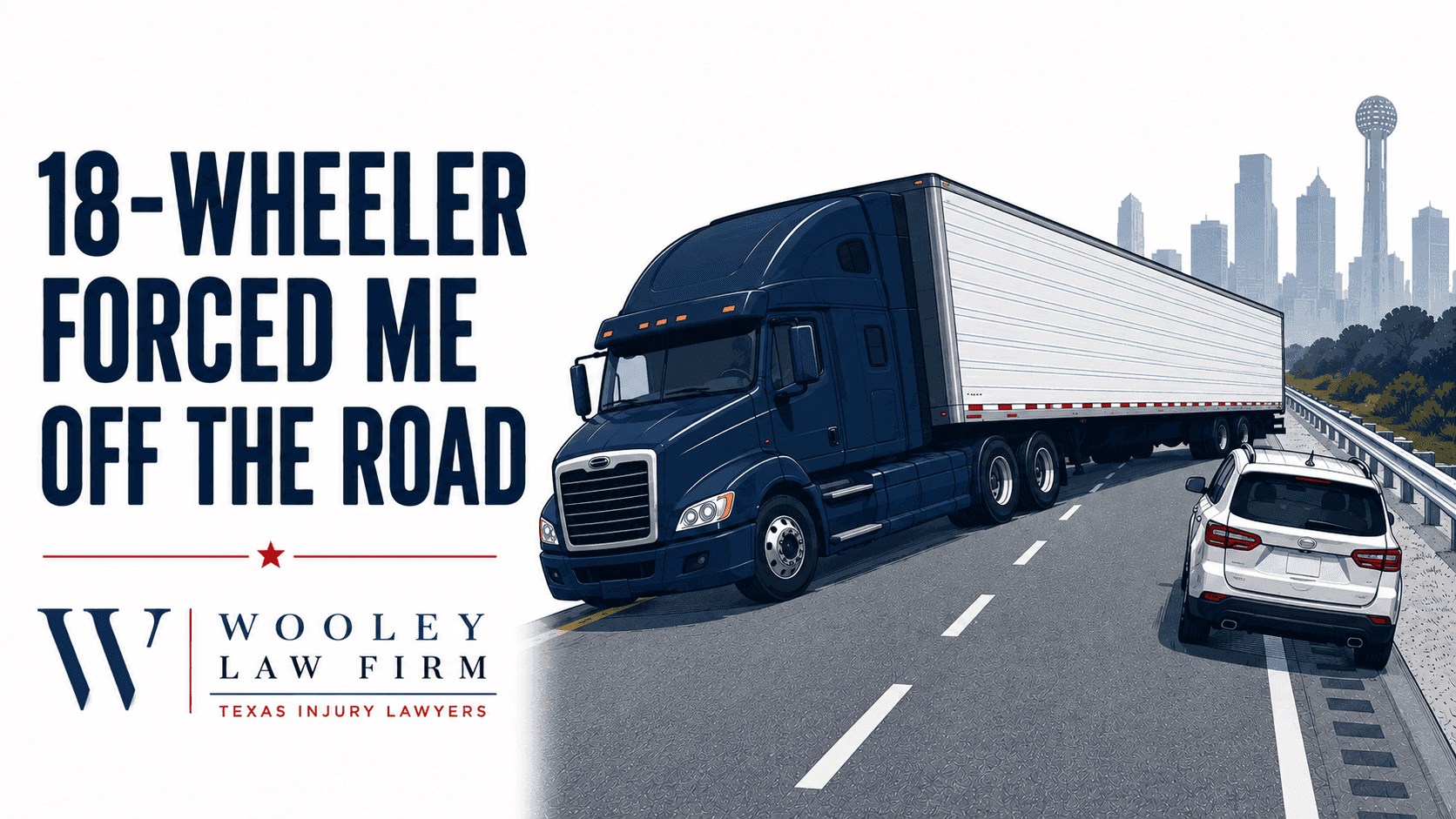
If an 18-wheeler suddenly starts moving into your lane, you may have only a second or two to decide what to do.
Do you stay in your lane and risk being struck by the tractor-trailer?
Or do you move away from the truck?
Sometimes a Dallas driver avoids being physically struck by the 18-wheeler but ends up hitting a concrete barrier, leaving the roadway, spinning across traffic, rolling over, or colliding with another vehicle.
Then the trucking company or insurance carrier may argue:
“Our truck never hit you.”
That does not necessarily answer who caused the wreck.
An 18-wheeler does not have to physically touch your vehicle before the truck driver's actions become part of the liability investigation. If a truck driver makes an unsafe lane change and forces another driver to take reasonable evasive action, the important question is what caused the resulting crash.
For someone seriously injured in this type of collision, proving what happened may require much more than looking for damage on the side of the truck.
It may require dash-camera footage, digital-mirror video, witnesses, electronic truck data, GPS information, physical evidence, driver training records, and evidence showing exactly where each vehicle was before the driver started changing lanes.
The Wooley Law Firm represents people seriously injured in tractor-trailer wrecks throughout Dallas and North Texas. Learn more about how we investigate these cases on our Dallas 18-wheeler accident lawyer page.
Can an 18-Wheeler Cause a Wreck Without Actually Hitting Your Car?
Yes.
Physical contact is not the only way one driver's actions can cause another vehicle to crash.
Consider a common highway scenario.
You are traveling in your lane on I-35E in Dallas. An 18-wheeler is traveling beside you.
Without warning, the truck begins crossing the lane marker toward your vehicle.
You sound your horn.
The truck continues moving over.
You steer left to avoid being sideswiped or pushed underneath the trailer.
Your vehicle then hits the concrete median.
The tractor-trailer never touches you.
But that does not mean the truck's movement should be ignored.
The investigation should ask why you were forced to leave your lane in the first place.
The same issue can arise when a truck forces a driver:
onto the shoulder;
into a concrete barrier;
into a guardrail;
down an embankment;
into another lane;
into another vehicle;
into a construction barrier;
into a spin; or
into a rollover.
This is sometimes described as a no-contact truck wreck.
The absence of physical contact can make the evidence more important because the trucking company may dispute that its driver did anything wrong at all.
Texas Law Requires a Driver to Make a Lane Change Safely
Texas Transportation Code § 545.060 provides that an operator on a roadway divided into clearly marked lanes must drive as nearly as practical entirely within one lane and may not move from the lane unless that movement can be made safely.
That rule applies to passenger vehicles and commercial trucks.
But changing lanes in a tractor-trailer presents additional problems because the truck is far longer than an ordinary passenger vehicle and has significant areas around the tractor and trailer that can be difficult for the driver to see.
A turn signal alone does not make the movement safe.
A truck driver should determine that the destination lane is clear before moving the tractor and should continue monitoring surrounding traffic while completing the maneuver.
Our detailed article about what truck drivers should do before changing lanes in Dallas explains the lane-change process in greater detail, including checking flat and convex mirrors, accounting for blind spots, signaling, rechecking the mirrors, and making sure there is enough room for the entire tractor-trailer.
Why an 18-Wheeler Can Force a Car Off the Road
An unsafe truck lane change can happen in several different ways.
The Driver Never Sees the Vehicle Beside the Trailer
A passenger vehicle may be traveling beside the tractor or trailer when the truck driver decides to change lanes.
If the driver fails to properly check the mirrors or loses track of the vehicle, the tractor-trailer may begin entering an occupied lane.
FMCSA advises commercial drivers to check their mirrors regularly and before lane changes and merges because surrounding vehicles can enter areas that are difficult to see.
A driver who cannot locate a vehicle that was recently traveling beside the truck should not simply assume the vehicle is gone.
Our article about 18-wheeler blind-spot accidents in Dallas explains why a trucking company should not be able to end the investigation simply by saying:
“The car was in the truck's blind spot.”
A blind spot is a known limitation of the commercial vehicle. It is not reserved highway space belonging to the truck.
The Truck Driver Starts Moving Before Rechecking the Mirrors
Traffic on Dallas highways changes quickly.
A lane may appear open when the truck driver activates the turn signal.
Several seconds later, another vehicle may be traveling beside the trailer.
That is why mirror checks should continue during the lane-change process.
A driver who glances once, activates the signal, and then moves a 70- or 80-foot tractor-trailer without checking again may fail to recognize that the traffic situation has changed.
The Driver Tries to Cross Several Lanes at Once
A truck driver who realizes an exit is approaching may attempt to move rapidly across several lanes of traffic.
That can be particularly dangerous on highways such as:
I-35E;
I-30;
I-20;
I-45;
I-635;
US-75;
SH-114;
SH-183;
the Dallas North Tollway; and
President George Bush Turnpike.
A missed exit does not justify forcing another vehicle from its lane.
The Driver Drifts Because of Distraction or Fatigue
Not every lane departure is intentional.
A truck driver may drift across a lane marker because the driver is:
looking at a cellphone;
checking GPS directions;
interacting with a dispatch system;
eating or drinking;
looking away from the road;
fatigued;
drowsy; or
simply failing to maintain proper lane position.
For the passenger driver, the effect can be the same.
A massive tractor-trailer begins entering the vehicle's lane, and the driver moves away to avoid being hit.
The Tractor Clears the Vehicle but the Trailer Does Not
Another dangerous situation develops when the tractor moves ahead of a passenger vehicle and the truck driver begins changing lanes before the entire trailer has cleared it.
The driver may believe there is enough space because the cab has passed the vehicle.
But the passenger car may still be beside the middle or rear of the trailer.
A driver trying to avoid being struck by that trailer may be forced off the roadway even before actual contact occurs.
If the trailer does make contact, our related article on being sideswiped by an 18-wheeler in Dallas-Fort Worth explains how trailer position, damage patterns, mirrors, and electronic evidence may help determine what happened.
What If the Truck Driver Says, “I Never Hit You”?
That statement should not end the investigation.
It should begin it.
The issue is not simply:
Did the truck touch the car?
The questions should include:
Which lane was each vehicle traveling in?
Was your vehicle established in its lane before the truck moved?
When did the truck begin crossing the lane marker?
Did the truck driver use a turn signal?
How long had your vehicle been beside the tractor or trailer?
Did you sound your horn?
Did the truck react when you sounded the horn?
Did the truck continue moving toward your vehicle?
Did witnesses see the lane change?
Did you have a dash camera?
Did another driver have a dash camera?
Did the truck have side-mounted cameras?
Did the truck have digital mirrors?
Did the truck have blind-spot monitoring?
Was the truck attempting to reach an exit?
Did the truck continue driving after you crashed?
What does GPS data show?
Did the truck's electronic systems record a steering, braking, or safety event?
A trucking company's argument that there was “no impact” may mean the evidence needs to be reconstructed differently.
Dash-Camera Video Can Be Especially Powerful in a No-Contact Truck Wreck
Video evidence can be extremely important when the truck never physically strikes your car.
Without video, the trucking company may argue that:
the truck stayed entirely within its lane;
you overreacted;
another vehicle caused you to leave the roadway;
you lost control for some unrelated reason; or
the truck was never involved at all.
A dash camera may show exactly what happened.
Depending on its position, the footage may capture:
the 18-wheeler crossing the lane marker;
how close the truck came to your vehicle;
the tractor or trailer moving toward you;
your vehicle's position before the evasive maneuver;
the moment you moved away from the truck;
whether you sounded your horn;
road and traffic conditions;
the truck's company markings;
a tractor or trailer number;
a license plate;
a USDOT number; and
the direction the truck traveled afterward.
Our article explaining how dash-camera evidence can help after a Dallas car or truck wreck discusses why preserving the original video can be so important after a serious collision.
Injured in an Accident?
Free consultation. Tell us what happened and learn what options may be available.
Save the Original Video Immediately
Many dash cameras continuously record and eventually overwrite older footage.
If you were forced from the road by an 18-wheeler, preserve the original file as soon as possible.
Do not rely only on a short cellphone recording of the screen.
When possible, preserve the actual original video file along with its metadata.
What If the 18-Wheeler Had Digital Mirrors?
This is becoming an increasingly important question.
Some newer commercial trucks use camera-monitor systems commonly referred to as:
digital mirrors;
camera mirrors;
electronic mirrors;
e-mirrors; or
camera-monitor systems.
Instead of relying entirely on traditional exterior mirrors, cameras mounted outside the tractor provide live views on monitors inside the cab.
Depending on the system, those cameras may provide a view of traffic beside or behind the tractor-trailer.
Some systems may also record video.
That can be especially significant when the truck driver claims:
“I never saw the car.”
The investigation should determine what technology was actually installed on the tractor involved in your wreck.
Questions may include:
What digital-mirror system was installed?
Where were its cameras located?
What views appeared on the driver's monitors?
Was your vehicle visible in those views?
Was the equipment functioning correctly?
Did the system record video?
How long was that video retained?
Was footage automatically uploaded?
Did anyone download footage after the crash?
Were there error codes or system malfunctions?
Was any footage overwritten or deleted?
Our article about digital mirrors on 18-wheelers after a Dallas truck wreck discusses this evidence in much greater detail.
A no-contact lane-change wreck is one of the situations in which digital-mirror evidence may be particularly valuable because the footage could potentially show that a passenger vehicle was beside the truck before the driver started moving over.
A Truck Driver's Blind Spot Should Be Investigated, Not Accepted as an Excuse
Tractor-trailers have substantial blind spots.
That is not disputed.
The more important question is what the professional driver did about those blind spots.
If the truck driver says your vehicle was hidden from view, an investigation may consider:
when your vehicle first became visible;
how long it traveled beside the truck;
whether the driver had previously seen it;
how often the driver checked the mirrors;
whether flat and convex mirrors were properly adjusted;
whether the truck had additional cameras;
whether the driver checked again immediately before moving;
whether blind-spot monitoring was installed; and
whether the driver had been properly trained.
FMCSA identifies lane changes and merges as maneuvers where blind spots and inadequate surveillance can create serious risks.
The existence of a blind spot is therefore part of the safety problem a professional truck driver is expected to manage.
For a deeper discussion, see our guide to who may be at fault after an 18-wheeler blind-spot accident in Dallas.
What Other Electronic Evidence Could Prove the Truck's Movement?
Modern commercial trucks can generate large amounts of electronic information.
A no-contact crash investigation may need to identify what systems were installed on the specific tractor.
Depending on the truck and equipment, relevant information could include:
GPS location;
telematics;
speed;
braking information;
throttle data;
electronic logging-device information;
lane-departure alerts;
lane-keeping information;
collision warnings;
hard-braking events;
camera-triggered safety events;
driver-monitoring alerts;
dispatch communications; and
fleet-management records.
No single piece of data necessarily proves the entire collision.
But multiple sources can be compared.
For example, dash-camera video may show the truck beginning to move laterally at a particular moment.
GPS and telematics may establish the truck's location.
Digital-mirror footage may show your vehicle beside the trailer.
A safety-system event may show that the truck crossed a lane marking.
Witnesses may confirm that your car was forced toward the shoulder.
Together, that evidence may provide a much clearer picture of the crash than simply asking whether the vehicles touched.
The Truck May Have Continued Driving
A particularly frustrating version of this wreck occurs when the 18-wheeler keeps going.
The truck driver may not stop because the vehicles never made contact.
Or the driver may claim never to have realized that anything happened.
That makes identifying the truck important.
Useful information may include:
the trucking company's name;
markings on the tractor;
markings on the trailer;
the trailer number;
the tractor number;
the license plate;
the USDOT number;
the color of the tractor;
the color and type of trailer;
distinctive graphics or damage;
the highway and direction of travel;
the nearest exit;
the approximate time; and
the direction the truck continued traveling.
Dash-camera footage can be especially useful because a few seconds of video may preserve identification information that is nearly impossible to remember after a frightening collision.
Nearby Drivers May Have Captured the Wreck
Your own vehicle is not the only possible source of video.
Investigators may look for:
dash cameras in surrounding vehicles;
Tesla and other vehicle-camera systems;
highway surveillance;
toll-road cameras;
nearby business cameras;
construction cameras;
police cameras; and
cellphone recordings.
Witnesses should also be identified quickly.
Someone traveling a few cars behind you may have had a much better view of the truck crossing into your lane than you did.
Physical Evidence Still Matters Even When the Truck Never Hit You
A lack of truck-to-car contact does not mean there is no physical evidence.
Important evidence may include:
tire marks;
scrape marks on a concrete barrier;
damaged guardrails;
debris;
your vehicle's final resting position;
roadway gouges;
photographs showing the lane configuration;
damaged wheels or suspension;
airbag deployment;
event data from your vehicle; and
damage caused when your car struck another object.
The scene itself may help reconstruct the evasive maneuver.
For example, evidence that your vehicle traveled sharply toward the shoulder at the same location where witnesses saw an 18-wheeler moving into your lane may support the overall reconstruction.
The Trucking Company's Driver Training May Matter
Unsafe lane-change cases are not always limited to what the driver did during a few seconds before the wreck.
The investigation may also examine how the driver was trained.
Relevant questions can include:
Did the company train drivers on mirror use?
Did it train the driver to identify passenger vehicles beside the trailer?
Was the driver trained on flat and convex mirrors?
Was the driver trained on digital-mirror equipment installed in the tractor?
Did company policy require repeated mirror checks?
Had the driver received lane-change safety training?
Were there prior safety complaints?
Had the driver previously been involved in similar incidents?
Did the company monitor safety-system alerts?
Did the company coach drivers after unsafe lane-departure events?
Your related article about what truck drivers should do before changing lanes in Dallas is the best supporting page for readers who want a deeper explanation of the actual lane-change procedure.
Could the Trucking Company Also Be Responsible?
Depending on the facts, the investigation may extend beyond the individual truck driver.
Potential issues can include:
negligent driver training;
unsafe company policies;
inadequate supervision;
failure to respond to prior safety problems;
defective or poorly maintained mirrors;
malfunctioning camera systems;
failure to maintain safety technology;
pressure to meet schedules or delivery deadlines; and
failure to preserve relevant evidence after the crash.
Which parties may ultimately be responsible depends on the facts and applicable law.
Serious Injuries Can Happen Without Truck-to-Car Contact
A no-contact wreck can still be violent.
A passenger vehicle traveling at highway speed may strike a fixed object or another moving vehicle while attempting to avoid the truck.
Potential injuries can include:
traumatic brain injuries;
concussions;
spinal cord injuries;
cervical and lumbar injuries;
fractures;
shoulder injuries;
knee injuries;
internal injuries;
crush injuries;
burns;
scarring;
physical impairment;
paralysis; and
fatal injuries.
Whether the truck left paint on your vehicle has little to do with the severity of the forces involved when your car strikes a concrete barrier at highway speed.
What Should You Do If an 18-Wheeler Forces You Off the Road?
If you are able to do so safely after the wreck:
Call 911. Report the crash and tell the dispatcher that an 18-wheeler forced you from your lane, particularly if the truck continued driving.
Get medical attention. Serious injuries may not always be obvious immediately after a high-speed collision.
Preserve your dash-camera footage. Save the original file before it is overwritten.
Photograph the scene. Include lane markings, barriers, debris, skid marks, your vehicle, and surrounding roadway.
Write down identifying information about the truck. Company name, tractor number, trailer number, license plate, USDOT number, colors, logos, and direction of travel can all matter.
Identify witnesses. Obtain names and contact information where possible.
Do not assume there is no case because the truck did not hit you. No-contact truck crashes can require a different type of evidence, but the absence of impact does not by itself explain why the crash occurred.
Preserve evidence quickly. Commercial video and electronic information may be subject to retention periods or overwriting.
Why Evidence Preservation Is Especially Important in a No-Contact 18-Wheeler Wreck
When there is no damage connecting the truck directly to your vehicle, video and electronic evidence can become even more important.
A preservation request may need to address much more than a generic request for “black-box data.”
Depending on the facts, relevant evidence may include:
forward-facing dash-camera video;
driver-facing video;
digital-mirror video;
side-camera footage;
rear or trailer cameras;
GPS information;
telematics;
electronic logs;
safety alerts;
lane-departure events;
dispatch messages;
driver qualification records;
training records;
mirror inspection records;
camera-system maintenance;
company accident reports; and
communications after the wreck.
The specific truck should be identified whenever possible because the technology installed can vary significantly from one tractor to another.
How Your Other Evidence Can Fit Together
A strong investigation may involve several pieces of evidence that tell the same story from different perspectives.
Lane-Change Procedure
Your article on what truck drivers should do before changing lanes helps establish the safety issues involved before the truck ever crosses the lane marker.
Blind-Spot Evidence
Your Dallas 18-wheeler blind-spot accident guide addresses the common trucking-company argument that the passenger vehicle simply could not be seen.
Digital-Mirror Evidence
Your article about digital mirrors on 18-wheelers addresses whether newer camera systems may show what was actually beside the tractor-trailer.
Dash-Camera Evidence
Your Dallas dash-camera evidence guide explains how independent video can establish both what the truck did and which commercial vehicle was involved.
Actual Sideswipe Contact
If the truck did make contact with your vehicle, your article about being sideswiped by an 18-wheeler in Dallas-Fort Worth addresses the related physical-contact version of an unsafe lane-change wreck.
Together, these issues can help reconstruct what the truck driver saw, what the driver should have seen, how the truck moved, and why the passenger vehicle left its lane.
Talk to a Dallas Truck Wreck Lawyer After an 18-Wheeler Forces You Off the Road
If an 18-wheeler changed lanes into you and forced you off a Dallas highway, do not assume there is nothing to investigate simply because the truck never physically struck your vehicle.
The central question is:
What caused you to leave your lane and crash?
A serious no-contact 18-wheeler case may require investigation of the truck driver's lane-change procedure, blind spots, mirrors, cameras, GPS records, telematics, electronic data, company safety policies, training records, witnesses, highway video, and your own dash-camera footage.
The Wooley Law Firm represents individuals who have been seriously injured in 18-wheeler and commercial-truck wrecks in Dallas and throughout North Texas.
Call (214) 699-6524 for a free consultation. You don't pay unless we win.
Frequently Asked Questions About No-Contact 18-Wheeler Wrecks in Dallas
Can I have a truck accident claim if the 18-wheeler never touched my vehicle?
Potentially. The lack of physical contact does not necessarily determine who caused the wreck. The investigation should determine whether the truck driver's actions caused you to take evasive action that resulted in the collision.
What if I swerved because I thought the truck was going to hit me?
The circumstances matter. Evidence may be needed to determine how close the truck was, whether it was actually entering your lane, what a reasonable driver would have perceived, and whether your reaction was connected to the truck's movement.
What if the trucking company says I overreacted?
That is one reason objective evidence can matter. Dash-camera video, witness statements, roadway video, physical evidence, digital-mirror footage, and electronic truck data may help show whether the truck was actually moving into your lane.
What if the truck driver says I was in the blind spot?
Being in an area that is difficult for the truck driver to see does not automatically establish fault. The investigation should examine mirror use, lookout, how long the vehicle was beside the truck, driver training, available camera systems, and whether the lane change could be made safely.
Could digital mirrors show that my vehicle was beside the truck?
Possibly. It depends on what system was installed, its camera angles, whether it was operating, and whether it recorded or retained video. That information should be investigated rather than assumed.
What if the 18-wheeler drove away?
Try to preserve any identifying information available, including dash-camera footage, company markings, trailer numbers, tractor numbers, license plates, USDOT numbers, witnesses, and the exact time and location.
Is this the same as being sideswiped by an 18-wheeler?
They are closely related but different. A sideswipe generally involves physical contact. A no-contact lane-change wreck occurs when the truck's movement allegedly causes the passenger driver to crash while avoiding contact.
How quickly should truck video be requested?
As soon as reasonably possible. Camera footage and other electronic information may be overwritten or retained only for limited periods depending on the system and company.
Disclaimer:
This article is for general informational purposes only and is not legal advice. Reading it does not create an attorney-client relationship. Every case is different.
Topics
Share This Article

Andrew J. Wooley
Personal Injury Attorney
Andrew J. Wooley is a dedicated personal injury attorney based in Dallas, Texas. He focuses on helping accident victims recover fair compensation for their injuries. With a commitment to personalized service, Andrew works directly with each client to understand their unique situation and fight for their rights.