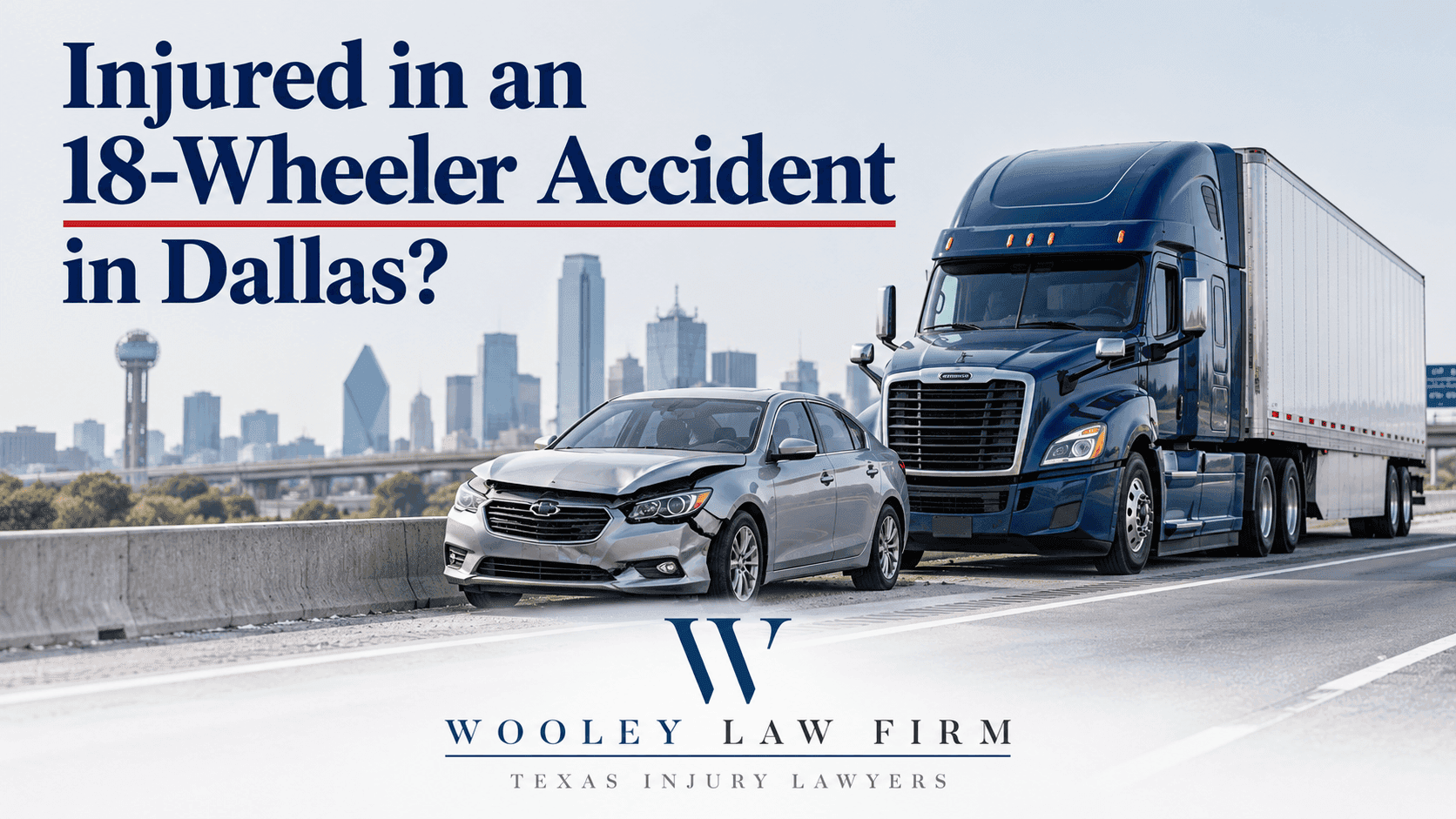
An underride crash happens when a passenger vehicle travels partly or substantially underneath a larger commercial truck or trailer.
These collisions can be catastrophic because the trailer may enter the passenger compartment above the areas of the car designed to absorb crash forces. But not every underride accident happens the same way.
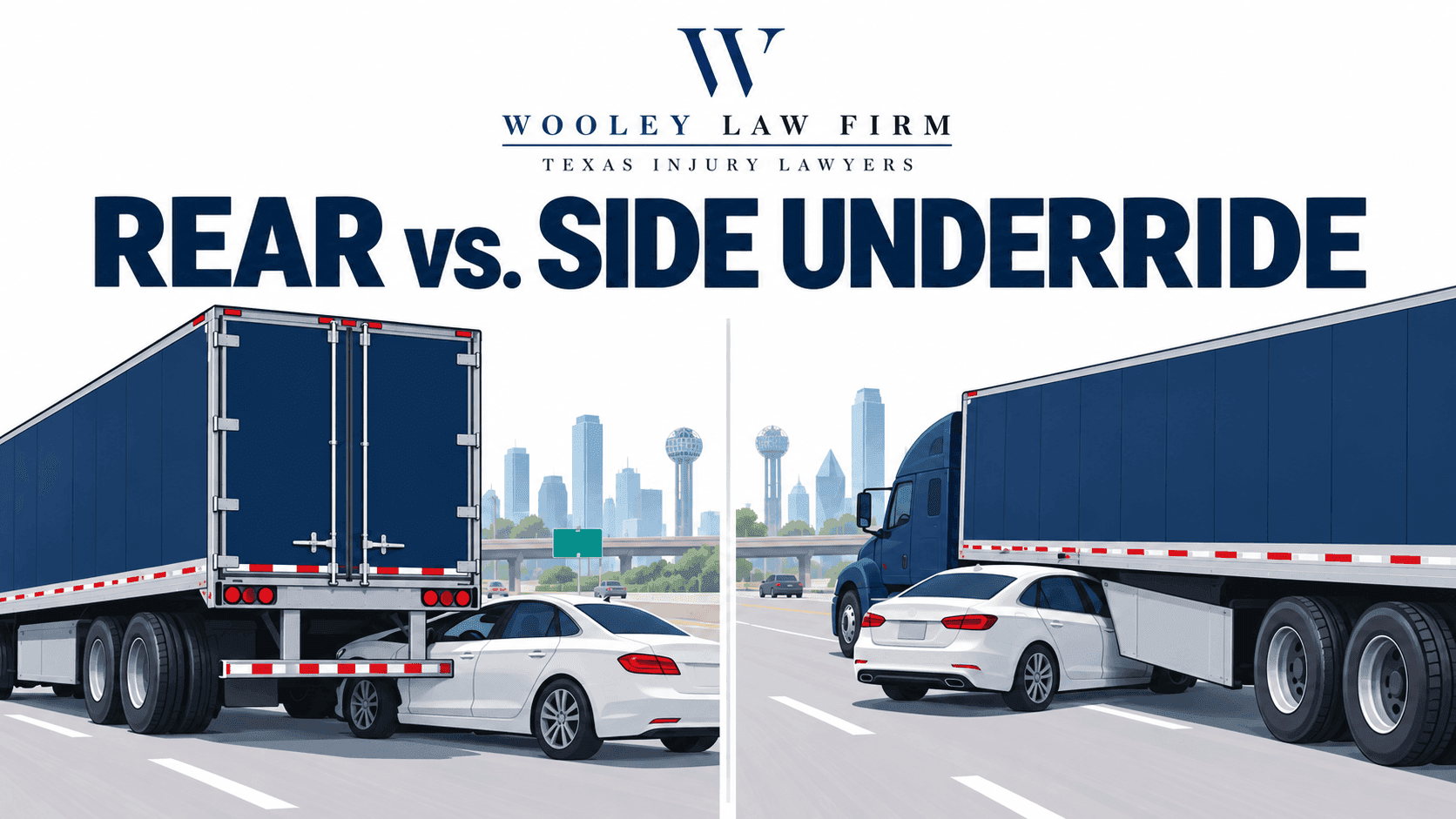
A rear underride typically occurs when a passenger vehicle strikes the back of a trailer and travels beneath it.
A side underride can occur when a passenger vehicle enters underneath the side of a trailer. That may happen when a tractor-trailer crosses traffic, makes a turn, changes lanes, or leaves part of its trailer exposed across a roadway.
That difference matters.
If you were injured in an underride collision in Dallas, determining how the car came underneath the trailer can change what evidence needs to be preserved, which parts of the truck need to be inspected, and what questions should be asked of the truck driver and trucking company.
The Wooley Law Firm investigates serious commercial-truck crashes throughout Dallas and North Texas. You can learn more about our approach on our Dallas 18-wheeler accident lawyer page.
What Is an Underride Truck Accident?
A tractor-trailer sits much higher off the roadway than an ordinary passenger car.
That height difference creates a particular danger.
During some collisions, the front or side structure of the passenger vehicle can pass underneath the trailer rather than engaging it in the way it would another passenger vehicle.
NHTSA describes rear underride as a crash in which the front of a smaller vehicle strikes the rear of a larger truck or trailer and slides underneath it. Federal safety standards require rear impact protection on many trailers and semitrailers specifically to address this danger.
Underride can occur at the:
rear of the trailer;
side of the trailer; or
in some circumstances, the front of a large truck.
For an injured motorist, however, simply calling the collision an “underride accident” is not enough. The investigation should determine where the passenger vehicle entered underneath the commercial vehicle and what caused the vehicles to reach that position.
What Is a Rear Underride Accident?
A rear underride crash generally occurs when a passenger vehicle approaches the back of a tractor-trailer and the front of the passenger vehicle travels underneath the trailer.
Imagine a car approaching an 18-wheeler from behind.
The trailer may be:
slowing in traffic;
stopped at a red light;
stopped because of congestion;
disabled on the highway;
parked partly in a travel lane;
stopped on a highway shoulder;
moving substantially slower than surrounding traffic; or
difficult to see because of darkness, weather, roadway configuration, or other circumstances.
The car strikes the rear of the trailer.
Instead of the passenger vehicle's front structure fully engaging the rear of the trailer, some portion of the car travels underneath it.
That is a rear underride collision.
Rear Impact Guards Are an Important Part of the Investigation
Many people recognize the metal structure hanging below the rear of a semi-trailer. It is commonly called an underride guard, rear impact guard, or sometimes a Mansfield bar.
Its purpose is important.
Federal regulations require rear impact protection on many trailers and semitrailers, subject to regulatory requirements and exceptions. FMCSA also includes rear impact guards among the components addressed through commercial-vehicle inspection requirements.
NHTSA strengthened federal rear-impact protection standards in 2022. The updated requirements address performance of rear impact guards in specified 35-mph crash-test conditions.
After a Dallas rear-underride wreck, the investigation may therefore include:
whether the trailer was required to have a rear impact guard;
the guard's dimensions and configuration;
whether the guard was bent, cracked, corroded, repaired, or otherwise damaged before the collision;
whether previous damage weakened the guard;
whether the guard remained attached during impact;
maintenance and inspection history;
prior repairs to the trailer or guard;
post-crash deformation; and
whether the trailer complied with the standards applicable to that particular trailer.
The fact that an underride occurred does not automatically prove that the guard was defective or that the trucking company violated a regulation. Crash speed, angle, overlap, trailer design, vehicle geometry, and other circumstances can all matter.
That is why preserving and inspecting the actual trailer can be so important.
What If the 18-Wheeler Was Stopped When the Rear Underride Happened?
A stopped-trailer case can present very different questions from a crash involving two vehicles traveling at highway speed.
Suppose a tractor-trailer is stopped partially within a traffic lane at night.
The investigation may need to determine:
Why was the truck stopped?
How long had it been there?
Was it entirely on the shoulder?
Was any portion of the trailer extending into a travel lane?
Were the truck's lights operating?
Were hazard flashers activated?
Were required warning devices deployed?
Could approaching motorists see the trailer?
Was roadway lighting adequate?
Were there curves, hills, construction barriers, or other visibility problems?
Did another vehicle block the driver's view of the trailer?
These questions concern much more than the underride guard itself.
Our article on 18-wheelers stopped on the shoulder and warning-device requirements discusses the evidence that may become important when a commercial truck is disabled or stopped along a Texas highway.
What Is a Side Underride Accident?
A side underride collision is different.
Instead of approaching directly behind the trailer, the passenger vehicle travels underneath some portion of its side.
Consider a tractor-trailer making a turn across a roadway.
The tractor begins turning, but the trailer remains stretched across one or more lanes. A vehicle approaching from another direction may encounter the broad side of the trailer.
Another scenario involves a tractor-trailer changing lanes while a car is traveling beside it.
The trailer contacts the passenger vehicle, pushes or rotates it, and the car becomes drawn underneath the trailer.
The final scene might show a car trapped beneath an 18-wheeler, but that does not tell investigators how the collision began.
That sequence has to be reconstructed.
Rear Guards and Side Guards Are Not the Same Issue
This distinction is important when discussing federal safety regulations.
Federal standards establish rear impact protection requirements for many trailers and semitrailers. NHTSA has also researched side-underride protection and has considered potential requirements for side underride guards.
The federal regulatory treatment of rear and side underride protection therefore should not be treated as identical.
An investigation into a side-underride crash should not simply assume that the rules governing the trailer's rear impact guard answer what should have existed along the side of the trailer.
Instead, the investigation should examine the actual trailer, its equipment, its design, the driver's maneuver, the roadway, and the complete collision sequence.
Injured in an Accident?
Free consultation. Tell us what happened and learn what options may be available.
A Side Underride During a Truck Turn
A turning tractor-trailer creates a unique geometry.
The tractor and trailer do not follow exactly the same path.
During a turn, the tractor may move through an intersection while the trailer follows behind at a different angle. At certain points, a long trailer may extend across lanes used by other traffic.
After a side-underride collision involving a turn, investigators may ask:
When did the truck begin turning?
From which lane did the turn begin?
How far did the tractor travel before the collision?
What angle did the trailer create across the roadway?
Was the trailer blocking one lane or several?
Were the trailer's lights and reflective materials visible?
What could the passenger-vehicle driver see?
Was the truck driver able to see the approaching vehicle?
Did the truck stop during the maneuver?
Was the truck attempting a wide turn?
Was another vehicle or obstacle affecting the maneuver?
Scene measurements and photographs can become extremely important because the position of the tractor alone may not show where the trailer was when the collision occurred.
A Side Underride During an 18-Wheeler Lane Change
Another very different scenario occurs when both vehicles are moving in the same direction.
A passenger vehicle may be traveling beside the trailer when the truck begins moving laterally.
The initial contact might be a sideswipe.
But that does not necessarily mean the collision remains a simple sideswipe.
The trailer may push the car sideways. The car may rotate. Its front end may move underneath the trailer. The passenger vehicle may then encounter the trailer's wheels or another vehicle.
This is why a serious side-underride investigation should identify the first contact, not merely photograph where the vehicles finally stopped.
Our article about what happens when the tractor clears a car but the trailer hits it explains why the movement of the entire trailer matters during a lane change.
If the trucking company claims the passenger vehicle was in a blind spot, our Dallas 18-wheeler blind-spot accident guide discusses the mirror, camera, and visibility evidence that should be investigated.
Photographs Can Tell the Story of an Underride Collision
Photographs should document much more than a single picture of the damaged car.
In a serious underride case, investigators may want photographs of the passenger vehicle from every side, including:
hood deformation;
windshield and roof damage;
A-pillar damage;
door damage;
scrape marks;
paint transfer;
tire marks;
intrusion into the passenger compartment; and
the height of relevant damage from the ground.
The trailer should receive the same attention.
Photographs may document:
the rear impact guard;
guard mounting points;
deformation;
broken welds or fasteners;
rear doors;
trailer frame;
reflective tape;
side panels;
rub rails;
landing gear;
trailer axles and wheels;
side skirts or other equipment;
paint transfer; and
scrape or contact marks.
A small mark on a trailer can correspond to major damage on a passenger vehicle.
The relative heights of those marks may help a qualified reconstruction expert determine how the vehicles interacted.
Do Not Assume an Aerodynamic Trailer Skirt Is an Underride Guard
Many trailers have panels underneath their sides.
Those panels may look like barriers, but some are aerodynamic skirts designed primarily to improve fuel efficiency, not structures designed to stop a passenger vehicle from traveling beneath a trailer.
NHTSA has specifically distinguished aerodynamic skirts and certain lateral protection devices from structures designed to prevent passenger-vehicle side underride.
That means photographs should identify exactly what equipment was installed rather than simply describing every structure beneath a trailer as an underride guard.
Why the Passenger Vehicle Should Be Preserved
The car itself may be one of the most important pieces of evidence.
Before it is destroyed, sold for salvage, or substantially altered, an inspection may document:
crush depth;
direction of deformation;
contact marks;
roof intrusion;
windshield damage;
wheel and suspension damage;
paint or material transfer;
seatbelt evidence;
airbag deployment;
event data, when available; and
the relationship between the damaged areas and the trailer.
The trailer may need to be inspected as well.
When possible, comparing both vehicles can be much more informative than examining photographs of only one.
The Trailer May Be Repaired Quickly
Commercial equipment earns money when it is operating.
After a wreck, a trailer may therefore be repaired and returned to service.
That can create an evidence problem.
A bent guard can be replaced.
Damaged side panels can be repaired.
Reflective tape can be changed.
Scrapes can disappear.
A damaged wheel assembly can be removed.
Electronic information may also be overwritten depending on the system.
A preservation letter can request that relevant physical and electronic evidence be maintained while the collision is investigated.
Dash-Camera and Video Evidence May Show How the Underride Started
Video can be particularly important in a side-underride case.
A photograph of a car beneath a trailer shows the result.
Video may show the sequence.
It may establish whether:
the passenger vehicle struck a stationary trailer;
the truck pulled across the passenger vehicle's path;
the truck began a turn when the vehicle was approaching;
the truck changed lanes into the passenger vehicle;
the passenger vehicle moved toward the truck;
another collision pushed the vehicle underneath the trailer; or
several impacts occurred before the final underride.
Potential sources include the passenger vehicle's dash camera, truck cameras, nearby vehicles, businesses, traffic cameras, and other available surveillance systems.
Our guide to dash-camera evidence after a Dallas car or truck wreck explains why original video files should be preserved whenever possible.
Electronic Truck Data Can Help Reconstruct the Seconds Before Impact
Depending on the equipment installed, a commercial truck may contain electronic information concerning speed, braking, throttle position, GPS location, safety events, or other vehicle activity.
That information may help answer questions such as:
Was the truck moving or stationary?
Was it accelerating through a turn?
When did it brake?
Did it change speed immediately before impact?
Where was it positioned along its route?
Did an onboard safety system generate an event?
Electronic data does not replace physical evidence. It can be most useful when combined with photographs, measurements, video, witness testimony, and the damage patterns on both vehicles.
For more information, see our article on 18-wheeler black-box data after a Dallas-Fort Worth truck wreck.
A Lane-Change Underride Case May Require Looking Back Several Seconds
If a side underride occurred during a lane change, the moment the car went underneath the trailer may be only the end of the story.
Investigators may need to determine where the vehicles were five, ten, or fifteen seconds earlier.
Was the passenger vehicle already beside the trailer?
Did the truck driver previously see the car in a mirror?
Did the driver activate a turn signal?
Was the passenger vehicle overtaking the truck?
Did the tractor move into the lane before the trailer?
Where did the first contact occur?
Your vehicle's damage, trailer damage, video, roadway markings, and witness statements may help reconstruct that sequence.
Our article about an 18-wheeler changing lanes and causing a multi-vehicle Dallas wreck provides a deeper look at these collision-sequence issues.
Who May Be Responsible for a Dallas Underride Truck Wreck?
There is no single answer for every underride collision.
Depending on the evidence, an investigation may examine the conduct of the:
truck driver;
motor carrier;
tractor owner;
trailer owner;
maintenance or repair company;
company responsible for inspecting the trailer; and
other drivers or businesses whose conduct contributed to the collision.
A product defect may also need to be investigated in an appropriate case, but the occurrence of underride alone does not establish that a trailer, guard, or other component was defective.
The objective is to determine why the underride happened, rather than deciding responsibility from the final position of the vehicles.
What Evidence Should Be Preserved After an Underride Crash?
Important evidence may include:
the passenger vehicle;
the tractor and trailer;
rear impact guard measurements and condition;
photographs before repairs;
repair and maintenance records;
annual inspection records;
prior guard repairs or replacements;
dash-camera footage;
side- and rear-facing truck-camera footage, if available;
digital-mirror footage, if available;
ECM or other electronic vehicle data;
GPS and telematics information;
electronic logging information;
driver qualification and training records;
dispatch communications;
tow-yard photographs;
police photographs and measurements;
roadway surveillance;
witness information; and
measurements of roadway and vehicle damage.
Which evidence matters most will depend heavily on whether the collision was a rear underride, turning side underride, lane-change side underride, or another type of crash.
Frequently Asked Questions About Dallas Truck Underride Accidents
What is the difference between rear underride and side underride?
Rear underride generally involves a passenger vehicle traveling underneath the back of a truck or trailer. Side underride involves a vehicle traveling beneath the side of the trailer. The difference can substantially change the collision investigation.
Are underride guards required on every 18-wheeler trailer?
No. Federal rear-impact protection requirements apply to many trailers and semitrailers, but the regulations contain requirements and exceptions that depend on the vehicle. The particular trailer and its manufacture date, design, configuration, and use should be identified before reaching conclusions about regulatory compliance.
Are side underride guards federally required?
Federal rear-impact standards should not be confused with side-underride protection. NHTSA has studied side underride guards and initiated rulemaking proceedings concerning possible side-underride requirements.
Can a side underride happen during a lane change?
Yes. A passenger vehicle can initially be struck along its side or front quarter during a truck's lateral movement and then rotate or become drawn beneath the trailer. Determining the initial contact and movement of both vehicles can be critical.
What if the trailer was stopped when I hit it?
The investigation may focus on why and where the trailer was stopped, whether it occupied a travel lane, lighting and visibility, warning devices, reflective materials, roadway conditions, and the condition of the rear impact protection.
Should the damaged car be inspected before it is totaled?
In a serious or disputed underride case, preserving the vehicle long enough for an appropriate inspection may be important. Damage patterns, measurements, material transfer, electronic data, and intrusion can help reconstruct how the collision occurred.
Talk to a Dallas Truck Underride Accident Lawyer
Rear and side underride collisions can look similar in post-crash photographs while involving completely different events.
A car underneath the rear of a trailer raises questions about rear impact protection, visibility, stopping, and the movement of the vehicles before impact.
A car underneath the side of a trailer may require a different investigation involving a turn, lane change, trailer angle, blind spots, side cameras, roadway geometry, and the precise location of the first contact.
The evidence should be used to reconstruct that sequence before the vehicles are repaired, salvaged, or returned to service.
If you or a family member was seriously injured in an underride collision involving an 18-wheeler in Dallas or North Texas, contact The Wooley Law Firm.
Call (214) 699-6524 for a free consultation. You don't pay unless we win.
Disclaimer
This article is for general informational purposes only and is not legal advice. Reading it does not create an attorney-client relationship. Every case is different.
Topics
Share This Article

Andrew J. Wooley
Personal Injury Attorney
Andrew J. Wooley is a dedicated personal injury attorney based in Dallas, Texas. He focuses on helping accident victims recover fair compensation for their injuries. With a commitment to personalized service, Andrew works directly with each client to understand their unique situation and fight for their rights.