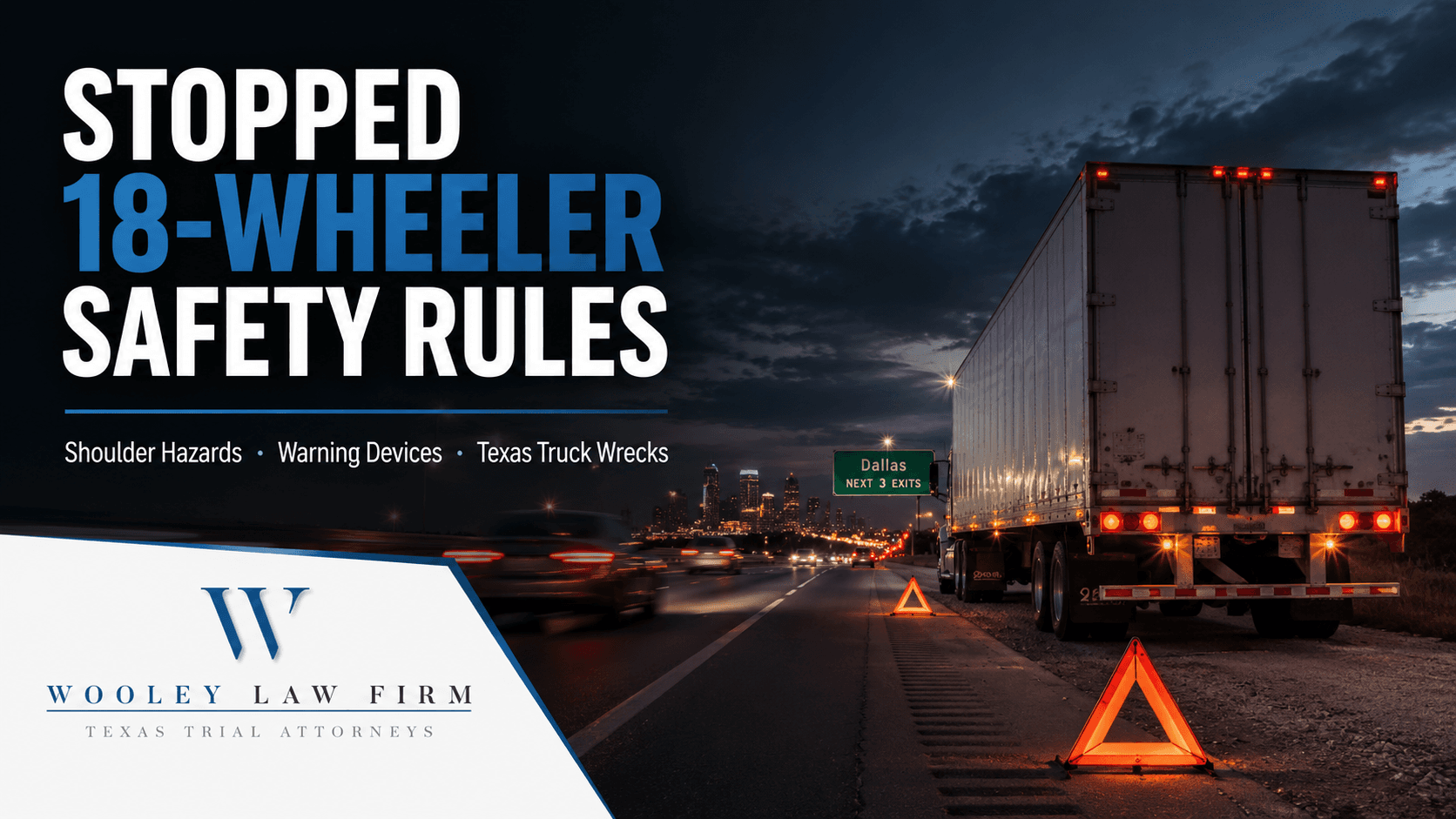
When an 18-wheeler stops on the shoulder of a highway, it can create an immediate danger for everyone nearby. A tractor-trailer parked on the side of I-35E, I-20, I-30, I-635, US-75, Loop 12, or another Dallas-Fort Worth roadway is not just a disabled vehicle. It is a massive roadside hazard that can lead to catastrophic rear-end crashes, underride collisions, multi-vehicle pileups, and fatal injuries.
Federal and Texas law recognize this danger. Commercial truck drivers are required to take specific safety steps when their truck is stopped on the traveled portion of a highway or on the shoulder. Those steps include activating hazard lights, placing warning devices, and carrying required emergency equipment.
When a truck driver or trucking company fails to follow these safety rules, the results can be devastating.
Why Stopped 18-Wheelers Are So Dangerous
A passenger vehicle driver may have only seconds to react when an 18-wheeler is stopped on the shoulder or partially blocking a lane. The danger is even greater at night, in rain, in fog, near construction zones, around curves, on exit ramps, or on high-speed highways.
A stopped tractor-trailer can cause serious crashes when:
The truck is partially in a travel lane;
The trailer is dark or poorly lit;
The driver fails to activate hazard lights;
Warning triangles are missing, placed too late, or placed incorrectly;
The truck stops near a curve, hill, bridge, ramp, or merge area;
The driver stops in a dangerous location instead of moving to a safer place;
The trucking company failed to equip the truck with required emergency equipment;
Other drivers do not have enough time or distance to recognize the hazard.
Because 18-wheelers are much larger and heavier than passenger vehicles, a collision with a stopped tractor-trailer can cause life-changing injuries, including traumatic brain injuries, spinal injuries, amputations, internal injuries, burns, and wrongful death.
Federal Rule: Truck Drivers Must Immediately Use Hazard Lights
Under 49 C.F.R. § 392.22, when a commercial motor vehicle is stopped on the traveled portion of a highway or on the shoulder for any reason other than a necessary traffic stop, the driver must immediately activate the vehicle’s hazard warning signal flashers. Those flashers must continue until the driver places the required warning devices.
This rule matters because hazard lights are often the first warning approaching drivers receive. A stopped 18-wheeler without flashing lights can be extremely difficult to see, especially at highway speeds or in low-light conditions.
Federal Rule: Warning Devices Must Be Placed Within 10 Minutes
Federal regulations also require truck drivers to place warning devices as soon as possible, and in any event within 10 minutes, when a commercial motor vehicle is stopped on the roadway or shoulder for reasons other than necessary traffic stops.
Under the general federal rule, the driver must place warning devices in three locations:
One warning device on the traffic side of the stopped truck, approximately 10 feet from the vehicle, in the direction of approaching traffic;
One warning device approximately 100 feet from the stopped truck in the direction of approaching traffic;
One warning device approximately 100 feet from the stopped truck in the direction away from approaching traffic.
These distances are important. Warning triangles are not just technical paperwork requirements. They are designed to give approaching drivers time to identify the hazard, slow down, change lanes, or avoid a crash.
Federal Rule: 18-Wheelers Must Carry Emergency Equipment
Federal law also requires commercial motor vehicles to carry emergency equipment. Under 49 C.F.R. § 393.95, power units must carry required warning devices for stopped vehicles. The regulation identifies options including three bidirectional emergency reflective triangles that comply with federal standards, or at least six fusees, with additional fusees when needed to satisfy the warning-device requirements.
If a truck did not have warning triangles, reflective devices, fusees, or other required emergency equipment, that may be evidence of negligence by the driver, the motor carrier, or both.
Texas Law Also Requires Warning Devices for Certain Stopped Trucks
Texas law contains its own vehicle-equipment and warning-device requirements. Under Texas Transportation Code § 547.502, certain trucks, buses, truck-tractors, and vehicles towing house trailers must carry visible warning devices when operating outside an urban district or on a divided highway. The statute includes requirements for red flags during the daytime and flares, fusees, red electric lanterns, or portable red emergency reflectors at nighttime.
Under Texas Transportation Code § 547.504, when certain covered vehicles are disabled or stopped for more than 10 minutes on the roadway of a divided highway, warning devices must be placed at specified distances, including approximately 200 feet from the vehicle, approximately 100 feet from the vehicle, and approximately 10 feet from the vehicle on the traffic side.
Texas law also addresses vehicles stopped entirely on the shoulder. Under Texas Transportation Code § 547.506, when a covered vehicle is stopped entirely on the shoulder, the required warning devices must be placed on the shoulder as close as practicable to the edge of the roadway.
These Texas rules may become important evidence after a Dallas truck accident involving a stopped or disabled 18-wheeler.
Hazard Lights Are Not Enough
One common mistake after a truck wreck is assuming that flashing lights alone satisfy the driver’s safety obligations. Federal law makes clear that hazard lights may be used while a commercial motor vehicle is stopped, but they are not a substitute for required warning devices.
That means a truck driver generally cannot simply turn on flashers and wait. The driver must take the additional steps required by the federal safety rules, including placing warning triangles or other required devices when the rule applies.
Dangerous Stopping Locations Can Make a Truck Wreck More Likely
Even when a truck driver has a mechanical problem or emergency, the location of the stop matters. A stopped 18-wheeler can be especially dangerous when it is parked:
Just beyond a hill or curve;
Near an entrance or exit ramp;
Partially inside a travel lane;
On a narrow shoulder;
In or near a construction zone;
Near an interchange such as I-35E and I-635, I-30 and Loop 12, or US-75 and I-635;
At night without proper lighting;
During rain, fog, or low-visibility conditions.
A professional truck driver is expected to understand that a tractor-trailer stopped in a dangerous location can become a deadly road hazard. Trucking companies should train drivers on what to do when a vehicle becomes disabled, where to stop, how to warn traffic, and when to request emergency help.
Injured in an Accident?
Free consultation. Tell us what happened and learn what options may be available.
Common Causes of Shoulder and Roadside 18-Wheeler Crashes
Crashes involving stopped commercial vehicles may happen for many reasons, including:
Failure to place warning triangles within 10 minutes;
Warning triangles placed too close to the truck;
No hazard lights or defective hazard lights;
Poor trailer lighting or reflective tape;
Truck stopped partly in the lane of travel;
Driver fatigue or poor judgment;
Unsafe parking on a shoulder;
Mechanical breakdown caused by poor maintenance;
Failure to inspect tires, brakes, lights, or reflective equipment;
Lack of required emergency equipment;
Poor company training;
Failure to call law enforcement or roadside assistance;
Failure to move the truck to a safer location when possible.
In a serious truck wreck case, the question is rarely limited to what happened in the final seconds before impact. A proper investigation should examine why the truck stopped, whether it should have been on the shoulder, whether the driver followed federal safety rules, and whether the trucking company created or ignored a dangerous condition.
Evidence That Should Be Preserved After a Stopped 18-Wheeler Crash
After a crash involving a stopped or disabled tractor-trailer, evidence can disappear quickly. Warning triangles can be picked up. The truck can be moved. Dash camera footage can be overwritten. Electronic data can be lost. The scene can change within minutes.
Important evidence may include:
Dash camera video;
Police body camera footage;
911 calls;
Photographs of the truck’s position;
Photographs showing whether warning triangles were placed;
Measurements showing the distance between the truck and warning devices;
Lighting and visibility conditions;
Electronic control module data;
GPS and telematics data;
Driver logs;
Inspection and maintenance records;
Pre-trip and post-trip inspection reports;
Roadside-assistance records;
Dispatch communications;
Driver qualification and training records;
Company policies on disabled vehicles and emergency stops;
Prior violations involving equipment, lighting, or roadside safety.
This evidence can help determine whether the truck driver complied with federal and Texas safety regulations or whether a preventable roadside hazard caused the crash.
Trucking Company Liability After a Stopped-Truck Crash
The truck driver may not be the only responsible party. The trucking company may also be liable if it failed to properly train, supervise, inspect, maintain, or equip the truck.
A trucking company may be responsible when:
The truck lacked required emergency warning equipment;
The company failed to train drivers on 49 C.F.R. § 392.22;
The company ignored maintenance issues that caused the breakdown;
The company pressured a driver to keep operating an unsafe truck;
The company failed to inspect lights, tires, brakes, or reflective devices;
The company failed to enforce safety policies;
The company hired or retained an unsafe driver.
A stopped 18-wheeler crash may involve negligence, negligent training, negligent supervision, negligent maintenance, negligent entrustment, and violations of federal motor carrier safety regulations.
Dallas-Fort Worth Highways Make These Crashes Especially Dangerous
Dallas-Fort Worth has some of the busiest truck routes in Texas. Commercial motor vehicles travel daily through major corridors including I-35E, I-20, I-30, I-45, I-635, US-75, US-287, SH-183, Loop 12, and the President George Bush Turnpike.
When an 18-wheeler becomes disabled or stops on the shoulder of one of these roads, the danger is magnified by:
High-speed traffic;
Heavy congestion;
Limited shoulders;
Construction zones;
Nighttime freight traffic;
Sudden lane changes;
Distracted drivers;
Multiple merging lanes;
Poor visibility around ramps and interchanges.
A truck driver who fails to follow safety rules on a busy DFW highway can put countless drivers and passengers at risk.
What Injured Victims Should Know After a Crash With a Stopped 18-Wheeler
If you were injured after hitting or being involved in a crash with a stopped 18-wheeler, the trucking company or insurance carrier may try to blame you. They may argue that the truck was visible, that you should have changed lanes, or that you should have stopped sooner.
But those arguments do not answer the key safety questions:
Why was the truck stopped there?
Was the truck fully on the shoulder or partially in the lane?
Were the hazard lights activated immediately?
Were warning triangles placed within 10 minutes?
Were the triangles placed at the correct distances?
Did the truck have the required emergency equipment?
Was the truck properly maintained?
Did the driver choose a dangerous stopping location?
Did the trucking company train the driver on roadside emergency procedures?
These questions can make a major difference in a Dallas truck accident case.
Talk to a Dallas Truck Wreck Lawyer After a Stopped 18-Wheeler Crash
Crashes involving stopped or disabled 18-wheelers require immediate investigation. Federal regulations, Texas safety rules, physical evidence, electronic data, and witness statements may all be important to proving what happened.
The Wooley Law Firm represents people injured in serious truck wrecks across Dallas, Fort Worth, and throughout Texas. If you were injured in a crash involving a stopped 18-wheeler, disabled tractor-trailer, roadside commercial vehicle, or truck parked on the shoulder, you may have the right to seek justice and pursue compensation for medical expenses, pain and suffering, lost wages, mental anguish, impairment, disfigurement, and other damages.
Call The Wooley Law Firm for a free consultation (214) 699-6524. You don’t pay unless we win. Contact Us Today!
Frequently Asked Questions About Stopped 18-Wheeler Crashes in Texas
What is a truck driver required to do when an 18-wheeler stops on the shoulder?
When a commercial motor vehicle stops on the traveled portion of a highway or on the shoulder, federal law generally requires the driver to immediately activate the truck’s hazard warning flashers. The driver must then place required warning devices, such as reflective triangles, as soon as possible and generally within 10 minutes. These rules are found in 49 C.F.R. § 392.22.
Does an 18-wheeler driver have to place warning triangles?
Yes. When the federal rule applies, the driver must place warning devices around the stopped commercial vehicle. In most situations, that includes one device approximately 10 feet from the truck on the traffic side, one approximately 100 feet behind the truck in the direction of approaching traffic, and one approximately 100 feet in the opposite direction. Different placement rules may apply depending on whether the truck is stopped near a curve, hill, obstruction, divided highway, or one-way roadway.
How long does a truck driver have to put out warning triangles?
Under federal trucking regulations, the driver must place warning devices as soon as possible and, in any event, within 10 minutes after stopping. Waiting too long can create a serious hazard for approaching drivers, especially at night, during bad weather, or on high-speed roadways.
Are hazard lights enough if an 18-wheeler is stopped on the side of the road?
Usually, no. Hazard lights are important, but they generally do not replace the requirement to place warning triangles or other required warning devices. Federal law requires hazard lights immediately, followed by warning devices when the rule applies.
What emergency equipment must an 18-wheeler carry?
Federal regulations require commercial motor vehicles to carry certain emergency equipment, including a fire extinguisher and required warning devices for stopped vehicles. Warning devices may include three bidirectional emergency reflective triangles or other approved equipment under 49 C.F.R. § 393.95.
Can a trucking company be liable if its driver failed to place warning triangles?
Yes. A trucking company may be liable if the driver failed to follow federal safety rules, if the company failed to train the driver, if the truck lacked required emergency equipment, or if poor maintenance caused the truck to break down in a dangerous location. The company may also be responsible if it failed to enforce safety policies for disabled trucks and roadside emergencies.
What if the truck was stopped because of a mechanical problem?
A mechanical problem does not automatically excuse the driver or trucking company. The investigation should determine why the truck broke down, whether the problem should have been discovered during inspection or maintenance, whether the driver stopped in the safest available location, and whether proper warnings were placed after the stop.
What if I hit the back of a stopped 18-wheeler?
The trucking company or insurance carrier may try to blame you, but that does not end the case. A stopped tractor-trailer can be extremely dangerous if it is partly in the lane, poorly lit, stopped in an unsafe location, or missing required warning devices. The key questions include whether the truck driver followed federal and Texas safety rules and whether approaching drivers had a reasonable opportunity to see and avoid the hazard.
Why are stopped 18-wheeler crashes often so serious?
A tractor-trailer is much larger, heavier, and taller than a passenger vehicle. When a car strikes a stopped trailer, especially at highway speed, the collision can cause underride injuries, traumatic brain injuries, spinal injuries, internal injuries, fractures, amputations, or death. These crashes are especially dangerous at night or on busy Dallas-Fort Worth highways.
What evidence is important after a stopped-truck crash?
Important evidence may include scene photographs, warning-triangle placement, dash camera video, police body camera footage, 911 calls, truck lighting, reflective tape, ECM data, GPS data, driver logs, maintenance records, roadside-assistance records, dispatch messages, and company safety policies. This evidence should be preserved as quickly as possible.
Do Texas laws apply in addition to federal trucking regulations?
Yes. Federal motor carrier safety regulations may apply to commercial trucks, and Texas law also contains requirements involving warning devices for certain stopped or disabled vehicles. In a Texas truck wreck case, both federal and state safety rules may be important.
Should I contact a Dallas truck wreck lawyer after a crash involving a stopped 18-wheeler?
Yes. These cases can involve federal regulations, Texas statutes, trucking company safety policies, electronic data, and fast-disappearing physical evidence. A Dallas truck wreck lawyer can help investigate whether the truck driver followed required safety procedures and whether the trucking company may be responsible.
Disclaimer
This article is for general informational purposes only and is not legal advice. Reading this article does not create an attorney-client relationship. Every truck wreck case is different, and you should speak with a qualified attorney about the specific facts of your case.
Topics
Share This Article

Andrew J. Wooley
Personal Injury Attorney
Andrew J. Wooley is a dedicated personal injury attorney based in Dallas, Texas. He focuses on helping accident victims recover fair compensation for their injuries. With a commitment to personalized service, Andrew works directly with each client to understand their unique situation and fight for their rights.