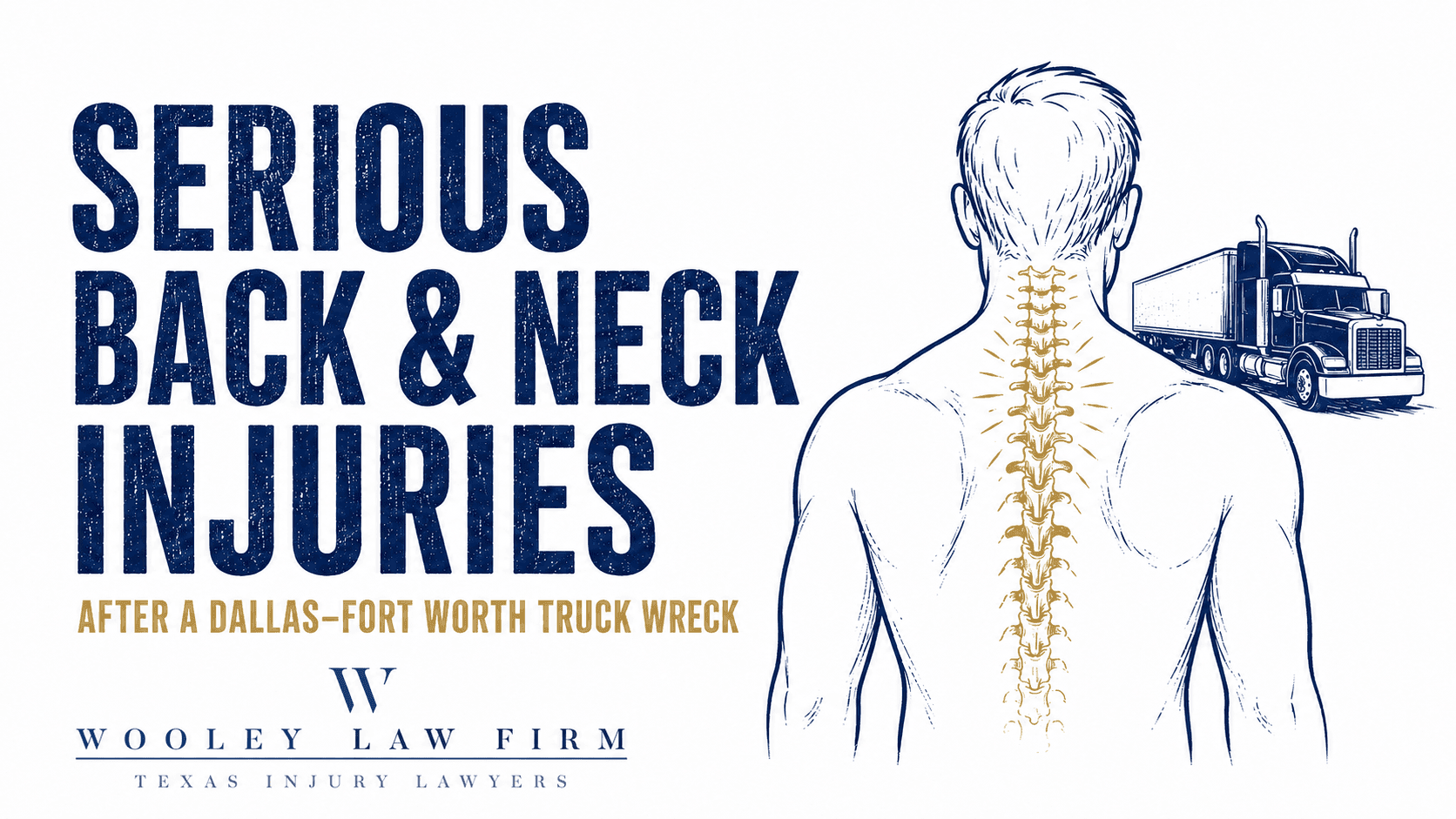
A collision with an 18-wheeler can place enormous force on the neck, back, and spine. A driver or passenger may be thrown forward, backward, or sideways while the vehicle is crushed, pushed into traffic, or forced against a concrete barrier.
The result may be far more serious than temporary soreness.
Truck-wreck victims can suffer herniated discs, fractured vertebrae, spinal instability, nerve compression, cervical radiculopathy, sciatica, spinal stenosis, and other injuries that cause persistent pain, weakness, numbness, and reduced mobility. Some people require injections, nerve procedures, spinal fusion, disc replacement, or other surgery.
Back injuries can result from the sudden jolt of a motor-vehicle accident and may include sprains, strains, herniated discs, and fractured vertebrae. These injuries can cause significant pain and limit movement.
If you or someone you love suffered a serious neck or back injury after an 18-wheeler, semi-truck, tractor-trailer, or commercial-vehicle wreck in Dallas-Fort Worth, your claim may involve much more than the cost of the first emergency-room visit.
You may be facing months or years of treatment, time away from work, reduced earning capacity, chronic pain, permanent physical limitations, and uncertainty about whether you will ever return to your previous life.
The Wooley Law Firm represents people seriously injured in wrecks involving:
18-wheelers and tractor-trailers
Semi-trucks
Flatbed trucks
Box trucks
Delivery trucks and vans
Tanker trucks
Dump trucks
Construction vehicles
Garbage and sanitation trucks
Buses and other commercial vehicles
Learn more about how we handle these cases on our 18-wheeler and truck accident lawyer page.
Call 214-699-6524 for a free consultation. You do not pay attorney’s fees unless we recover compensation for you.
How Truck Wrecks Cause Back and Neck Injuries
The neck and back contain vertebrae, discs, joints, muscles, ligaments, nerves, and the spinal cord. A high-force collision can damage several of these structures at the same time.
Serious injuries may occur when:
An 18-wheeler rear-ends a stopped vehicle
A tractor-trailer strikes the side of a car
A truck pushes a vehicle into another lane or barrier
A passenger vehicle rolls over
A car becomes trapped beneath a trailer
A jackknifed truck sweeps across traffic
A wide-turning trailer crushes a nearby vehicle
The roof or passenger compartment collapses
A victim is ejected
Cargo falls from a trailer
The head or torso strikes the steering wheel, dashboard, door, or window
A seat belt restrains the body while the head and neck move violently
The body may experience sudden acceleration, deceleration, compression, twisting, and direct impact during the same wreck.
Even a collision that occurs at a relatively low speed may cause serious injuries because of the size and weight of the truck. Read more about why a low-speed 18-wheeler wreck can still cause serious injuries.
Common Back and Neck Injuries After an 18-Wheeler Wreck
Truck-wreck injuries can affect the cervical spine in the neck, the thoracic spine in the upper and middle back, or the lumbar spine in the lower back.
Common injuries include:
Cervical sprains and strains
Lumbar sprains and strains
Herniated or ruptured discs
Disc protrusions and extrusions
Annular tears
Vertebral fractures
Facet-joint injuries
Cervical radiculopathy
Lumbar radiculopathy
Sciatica
Spinal stenosis
Spinal instability
Ligament injuries
Nerve damage
Spinal cord compression
Chronic pain
A victim may suffer more than one condition. For example, a collision may cause a herniated lumbar disc, nerve compression, muscle spasms, and weakness in the same leg.
Cervical Spine Injuries
The cervical spine consists of the vertebrae in the neck.
A violent truck collision may force the neck beyond its normal range of motion. The victim may experience immediate pain or may notice worsening stiffness, headaches, weakness, or arm symptoms over the following hours or days.
Possible cervical-spine injuries include:
Muscle strains
Ligament sprains
Disc herniations
Facet-joint injuries
Vertebral fractures
Nerve-root compression
Spinal cord compression
Instability
Reduced range of motion
Neck pain may originate from muscles, ligaments, nerves, vertebrae, or spinal discs.
Symptoms of a Serious Neck Injury
Possible symptoms include:
Neck pain
Stiffness
Muscle spasms
Headaches
Shoulder pain
Pain between the shoulder blades
Pain traveling into the arm
Numbness or tingling
Hand weakness
Reduced grip strength
Difficulty turning the head
Balance problems
Loss of coordination
Pain radiating from the neck into the shoulder, arm, or hand may indicate nerve-root irritation or compression.
Cervical Radiculopathy
Cervical radiculopathy is commonly called a pinched nerve in the neck.
It occurs when a nerve root leaving the cervical spine becomes compressed or irritated. A sudden injury that causes a herniated cervical disc can produce cervical radiculopathy, particularly in younger patients.
Symptoms may include:
Sharp or burning neck pain
Shoulder pain
Pain traveling down the arm
Numbness
Tingling
Hand weakness
Reduced grip strength
Changes in reflexes
Symptoms may become worse with certain neck movements, lifting, driving, or prolonged sitting.
Although some cases improve with conservative treatment, others require injections or surgery when pain, weakness, or neurological symptoms continue.
Herniated Discs After a Truck Accident
Discs are soft structures located between the vertebrae. They help absorb force and allow the spine to move.
A herniated disc occurs when disc material pushes through a weakened or damaged area. The displaced material may place pressure on nearby nerves or the spinal cord.
Truck-wreck victims may be diagnosed with:
Disc bulges
Disc protrusions
Disc extrusions
Ruptured discs
Sequestered disc fragments
Annular tears
A lumbar disc herniation may cause back pain, leg pain, numbness, tingling, or weakness. A cervical disc herniation may cause neck pain and symptoms traveling into the shoulders, arms, or hands.
Symptoms of a Herniated Cervical Disc
Symptoms may include:
Neck pain
Shoulder-blade pain
Arm pain
Hand numbness
Tingling
Weakness
Reduced grip strength
Symptoms of a Herniated Lumbar Disc
Symptoms may include:
Lower-back pain
Buttock pain
Pain traveling down the leg
Numbness or tingling
Foot weakness
Difficulty standing or walking
Pain when sitting
Reduced range of motion
A herniated lumbar disc that presses on spinal nerves is a common cause of lower-back pain and sciatica.
Annular Tears
The annulus fibrosus is the tough outer portion of a spinal disc.
A sudden collision may cause or worsen a tear in this outer layer. An annular tear may cause localized pain, inflammation, or allow inner disc material to protrude outward.
Symptoms may include:
Deep neck or back pain
Pain with bending or twisting
Muscle spasms
Pain while sitting
Pain during lifting
Radiating nerve symptoms when disc material affects a nerve
An insurance company may attempt to describe an annular tear as a routine degenerative finding. The medical evidence must be evaluated in the context of the collision, symptoms, prior medical history, imaging, and treating physicians’ opinions.
Lumbar Radiculopathy and Sciatica
Lumbar radiculopathy occurs when a nerve root in the lower spine becomes compressed or irritated.
Sciatica generally describes pain that travels along the sciatic nerve from the lower back or buttock into the leg. Causes can include a herniated disc, spinal stenosis, spondylolisthesis, or pelvic injury.
Symptoms may include:
Lower-back pain
Buttock pain
Burning leg pain
Tingling
Numbness
Leg weakness
Foot weakness
Difficulty walking
Pain aggravated by sitting
Pain when coughing or sneezing
Some victims describe the pain as an electrical shock traveling down the leg. Others have numbness or weakness with little back pain.
Vertebral Fractures
The vertebrae are the bones that form the spinal column.
A high-force truck wreck may fracture one or more vertebrae in the cervical, thoracic, or lumbar spine.
Possible fractures include:
Compression fractures
Burst fractures
Flexion-distraction injuries
Fracture-dislocations
Transverse-process fractures
Spinous-process fractures
A vertebral fracture may be stable or unstable. An unstable fracture may allow movement that threatens the spinal cord or nerve roots.
Symptoms may include:
Severe neck or back pain
Pain with movement
Muscle spasms
Weakness
Numbness
Tingling
Difficulty standing or walking
Loss of bladder or bowel control
Paralysis in the most severe cases
Spinal injuries can begin with a force that fractures or dislocates the vertebrae. Bone fragments or displaced structures may then press on or damage the spinal cord.
Facet-Joint Injuries
Facet joints connect the vertebrae and help guide movement.
A truck wreck may compress, twist, or inflame these joints.
Facet-joint injuries may cause:
Localized neck or back pain
Pain with extension or rotation
Stiffness
Muscle spasms
Headaches
Pain radiating into nearby areas
Cervical facet pain may travel into the shoulders or upper back. Lumbar facet pain may extend into the buttocks or upper thighs.
Diagnostic injections may sometimes be used to determine whether a facet joint is causing the pain.
Spinal Stenosis and Nerve Compression
Spinal stenosis is a narrowing of the spinal canal or the spaces where nerves leave the spine. The narrowing can place pressure on the spinal cord or nerves and cause pain or neurological symptoms.
A truck wreck may cause new compression or aggravate previously asymptomatic narrowing through:
Disc herniation
Swelling
Fractures
Ligament injury
Vertebral displacement
Symptoms may include:
Neck or back pain
Arm or leg pain
Numbness
Weakness
Balance problems
Difficulty walking
Reduced endurance
Leg heaviness
The fact that imaging shows preexisting narrowing does not automatically mean the collision caused no injury. A wreck may aggravate a condition that previously caused no significant symptoms.
Spinal Cord Compression and Myelopathy
Compression of the spinal cord is more serious than compression of an individual nerve root.
Possible symptoms include:
Difficulty walking
Loss of balance
Hand clumsiness
Weakness in the arms or legs
Numbness
Loss of coordination
Changes in bladder or bowel function
Paralysis
Spinal cord compression requires prompt medical evaluation.
Learn more about spinal cord injuries and paralysis after a Dallas-Fort Worth truck wreck.
Emergency Warning Signs After a Truck Wreck
Some neck and back symptoms require immediate emergency care.
Warning signs may include:
New arm or leg weakness
Inability to stand or walk
Loss of bladder or bowel control
Numbness around the groin or inner thighs
Severe or worsening neck or back pain
Loss of coordination
Difficulty breathing
Paralysis
Numbness affecting multiple limbs
Increasing neurological symptoms
A victim should not attempt to diagnose a potentially serious spinal injury at home.
Call 911 or seek emergency medical care when a spinal fracture, spinal cord injury, or serious neurological condition is suspected.
Injured in an Accident?
Free consultation. Tell us what happened and learn what options may be available.
Cauda Equina Syndrome
The cauda equina is a group of nerves located near the lower end of the spinal cord.
Severe compression of these nerves can cause:
Saddle-area numbness
Loss of bladder control
Loss of bowel control
Severe leg weakness
Sexual dysfunction
Difficulty walking
Cauda equina syndrome is a medical emergency. Delayed treatment may lead to permanent neurological damage.
Why Symptoms May Appear After the Collision
Not every back or neck injury is immediately apparent.
After a truck wreck, adrenaline, shock, and other injuries may distract the victim from spinal pain. Inflammation and muscle spasms may also worsen over time.
Symptoms may appear or increase during the following hours or days, including:
Stiffness
Reduced range of motion
Radiating pain
Tingling
Numbness
Weakness
Headaches
Muscle spasms
A person should seek medical evaluation when new or worsening symptoms develop after the wreck.
How Doctors Diagnose Back and Neck Injuries
Evaluation may involve emergency physicians, orthopedic surgeons, neurologists, neurosurgeons, pain-management physicians, and rehabilitation specialists.
The diagnostic process may include:
Physical Examination
Doctors may evaluate:
Range of motion
Tenderness
Muscle strength
Reflexes
Sensation
Balance
Coordination
Walking ability
Grip strength
X-Rays
X-rays may identify:
Fractures
Dislocations
Alignment problems
Instability
Degenerative changes
CT Scans
CT imaging may provide detailed information about:
Vertebral fractures
Bone fragments
Spinal alignment
Canal narrowing
Complex traumatic injuries
MRI Scans
An MRI may show:
Disc herniations
Annular tears
Ligament injuries
Nerve compression
Spinal cord compression
Swelling
Soft-tissue damage
Electrodiagnostic Testing
Nerve-conduction studies or electromyography may help evaluate nerve damage, weakness, or persistent radiating symptoms.
Doctors use medical history, physical examination, and imaging or other testing to identify the source of back pain and select an appropriate treatment plan.
Treatment for Serious Back and Neck Injuries
Treatment depends on the diagnosis, neurological symptoms, functional limitations, and response to prior care.
Possible treatment includes:
Medication
Activity modification
Physical therapy
Chiropractic treatment when medically appropriate
Home exercises
Steroid injections
Epidural injections
Facet injections
Medial branch blocks
Radiofrequency ablation
Nerve treatment
Bracing
Surgery
Some injuries improve with conservative care. Others require more aggressive treatment because of ongoing pain, weakness, instability, or nerve compression.
Physical Therapy
Physical therapy may help improve:
Strength
Flexibility
Range of motion
Posture
Balance
Endurance
Movement mechanics
Therapy may also help the victim safely return to work and daily activities.
However, therapy does not automatically eliminate structural damage. Some victims continue experiencing pain or neurological symptoms despite completing conservative treatment.
Spinal Injections and Pain-Management Procedures
When symptoms continue, a physician may recommend injections or other procedures.
These may include:
Epidural steroid injections
Facet-joint injections
Medial branch blocks
Trigger-point injections
Radiofrequency ablation
Selective nerve-root blocks
These procedures may be used to reduce inflammation, identify pain sources, or provide temporary relief.
The need for repeated procedures may be relevant when evaluating future medical expenses.
Spine Surgery After a Truck Wreck
Surgery may be considered when the victim has:
Persistent severe pain
Progressive weakness
Spinal instability
Significant nerve compression
Spinal cord compression
Fractures
Loss of function
Failure of conservative treatment
Possible procedures include:
Discectomy
A discectomy removes disc material pressing on a nerve or the spinal cord. A herniated disc can place pressure on the spinal cord or nerves leaving the spine.
Laminectomy or Decompression
These procedures create more space for the spinal cord or nerve roots by removing part of the bone or other structures causing compression.
Spinal Fusion
A fusion joins vertebrae together to stabilize the spine.
The procedure may use:
Screws
Rods
Plates
Cages
Bone graft material
Artificial Disc Replacement
In selected cervical cases, damaged disc material may be removed and replaced with an artificial disc. This may serve as an alternative to fusion for some patients.
Fracture Stabilization
Traumatic vertebral fractures may require surgery to restore alignment and stabilize the spine.
Spine surgery can involve extensive recovery, rehabilitation, activity restrictions, and future medical monitoring.
Failed Surgery and Ongoing Pain
Surgery does not guarantee that all symptoms will disappear.
Some patients continue experiencing:
Back or neck pain
Nerve pain
Numbness
Weakness
Reduced mobility
Adjacent-level problems
Need for additional procedures
A serious injury claim should account for the possibility of future treatment when supported by medical evidence.
Chronic Pain After a Truck Wreck
Back or neck pain may become chronic when it continues for months or longer.
Chronic pain can affect:
Sleep
Mood
Concentration
Work
Exercise
Parenting
Relationships
Independence
The victim may need medication, injections, therapy, counseling, or long-term medical management.
Back pain may begin suddenly after an injury and, for some people, become a long-term problem.
How Back and Neck Injuries Affect Work
Spine injuries may prevent a person from returning to the same occupation.
The impact may be especially serious for workers whose jobs require:
Heavy lifting
Repeated bending
Twisting
Prolonged sitting
Prolonged standing
Driving
Climbing
Operating machinery
Construction work
Warehouse labor
Patient care
Even office workers may struggle with prolonged sitting, typing, commuting, or maintaining concentration while in pain.
Employment losses may include:
Missed wages
Lost overtime
Reduced hours
Light-duty assignments
Lower-paying work
Lost promotions
Vocational retraining
Early retirement
Permanent inability to work
A claim may include past lost income and loss of future earning capacity.
Physical Impairment Caused by Spine Injuries
Physical impairment concerns the loss of the ability to participate in ordinary life activities.
A serious back or neck injury may prevent a person from:
Lifting children
Exercising
Driving comfortably
Performing household work
Sitting through family events
Traveling
Sleeping normally
Playing sports
Working in the yard
Participating in former hobbies
Living without assistance
These losses may not be reflected in the medical bills.
Evidence should show what the victim could do before the wreck and what they can no longer do afterward.
Emotional Effects of Chronic Spine Pain
Persistent pain and physical limitations may lead to:
Anxiety
Depression
Irritability
Sleep problems
Social withdrawal
Fear of reinjury
Loss of confidence
Frustration
Post-traumatic stress
Learn more about post-traumatic stress and emotional trauma after a Dallas-Fort Worth truck wreck.
Compensation for Serious Back and Neck Injuries
Depending on the facts and evidence, compensation may be available for:
Ambulance transportation
Emergency-room treatment
Diagnostic imaging
Specialist care
Physical therapy
Pain-management procedures
Injections
Surgery
Rehabilitation
Medication
Future medical treatment
Lost wages
Loss of earning capacity
Physical pain and suffering
Mental anguish
Physical impairment
Disfigurement from surgery
Out-of-pocket expenses
Property damage
A back or neck injury claim should not be evaluated solely by adding up the medical bills already incurred.
The claim may also involve future injections, surgery, reduced employment capacity, chronic pain, permanent restrictions, and a substantial loss of quality of life.
Read more about potential compensation in our guide to truck accident damages after a Dallas 18-wheeler wreck.
Preexisting Degenerative Changes and Truck-Wreck Injuries
Insurance companies frequently argue that disc problems, arthritis, or spinal stenosis existed before the truck wreck.
Many adults have age-related changes in the spine. The important questions may include:
Did the victim have symptoms before the wreck?
Did the collision cause new symptoms?
Did pain become significantly worse?
Did the victim require new treatment?
Did the wreck cause a new herniation or aggravate an existing condition?
Was the victim able to work and participate in normal activities before the collision?
A preexisting condition does not automatically prevent recovery. A truck wreck may aggravate or make symptomatic a condition that previously caused little or no difficulty.
Medical records, prior imaging, testimony, and treating physicians’ opinions may be important.
How Insurance Companies Defend Back and Neck Injury Claims
Insurance companies often challenge spinal-injury claims.
The trucking company’s insurer may argue that:
The impact was not severe enough
The injuries are only soft tissue
MRI findings are degenerative
The victim had prior back or neck problems
Treatment began too late
There was a gap in treatment
Injections or surgery are unnecessary
The victim can return to work
Symptoms are exaggerated
Future treatment is speculative
The insurer may also request broad medical records in an effort to find prior complaints.
A careful claim should connect the collision, medical findings, symptoms, treatment, work limitations, and effect on daily life.
Who May Be Responsible for a Truck Wreck Causing Spine Injuries?
Serious truck cases may involve multiple responsible parties.
The Truck Driver
A driver may cause the wreck through:
Speeding
Following too closely
Fatigued driving
Distracted driving
Unsafe lane changes
Failure to check blind spots
Running a red light
Driving while impaired
Making an unsafe wide turn
Failing to control speed
Failing to maintain a proper lookout
The Trucking Company
A motor carrier may be responsible for the driver’s conduct and its own unsafe practices.
Potential company negligence may include:
Hiring an unqualified driver
Inadequate training
Negligent supervision
Retaining an unsafe driver
Pressuring drivers to meet unsafe schedules
Failing to inspect or maintain the truck
Ignoring prior safety violations
Unsafe dispatch practices
Failure to enforce fatigue policies
The Cargo Loader or Shipper
Improperly loaded or unsecured cargo can cause a truck to roll over, jackknife, or lose control.
Learn more about flatbed truck accidents, cargo securement, and liability.
A Maintenance or Repair Company
A maintenance provider may share responsibility when negligent work contributes to:
Brake failure
Tire separation
Steering failure
Wheel detachment
Trailer separation
Mechanical breakdown
A Truck or Parts Manufacturer
A defective truck or trailer component may cause or worsen the collision.
Evidence That Should Be Preserved
The trucking company and its insurer may begin investigating immediately.
Important evidence may include:
Engine control module data
Electronic logging-device records
GPS and telematics data
Dash-camera footage
Driver-facing camera footage
Dispatch communications
Cellphone records
Driver qualification files
Training records
Hours-of-service logs
Drug and alcohol testing records
Maintenance records
Inspection reports
Cargo-loading records
Bills of lading
Weight tickets
Photographs and videos
Surveillance footage
Witness statements
Police body-camera footage
911 recordings
Physical vehicle evidence
Electronic information may be overwritten or lost unless prompt steps are taken to preserve it.
Learn more about the evidence that matters after a Texas 18-wheeler wreck and 18-wheeler black-box data after a Dallas-Fort Worth truck crash.
Medical Evidence Needed for a Back or Neck Injury Claim
Relevant evidence may include:
Ambulance records
Emergency-room records
Primary-care records
Orthopedic evaluations
Neurosurgical records
MRI and CT imaging
Physical-therapy records
Pain-management records
Injection records
Operative reports
Work restrictions
Functional-capacity evaluations
Future-treatment recommendations
Employment records
The evidence should explain:
The diagnosis
The connection to the wreck
The treatment required
Whether symptoms are permanent
Whether surgery may be needed
How the injury affects work
How the injury affects daily life
What to Do After a Back or Neck Injury
Seek Prompt Medical Evaluation
Tell medical providers about all neck, back, arm, hand, leg, and foot symptoms.
Report Neurological Changes
Immediately report:
Weakness
Numbness
Tingling
Balance problems
Walking difficulties
Loss of bladder or bowel control
Follow Treatment Recommendations
Attend therapy, imaging, specialist appointments, and other recommended treatment.
Avoid Minimizing Your Symptoms
Your doctors can only document and treat the problems you report.
Keep Records
Preserve:
Medical bills
Imaging reports
Work restrictions
Pay records
Prescription receipts
Travel expenses
Insurance correspondence
Document Daily Limitations
Record how the injury affects:
Sleep
Driving
Work
Exercise
Household tasks
Parenting
Hobbies
Social activities
Avoid a Premature Settlement
Do not resolve the claim before understanding the prognosis, future care, work limitations, and available insurance coverage.
Contact a Truck Wreck Lawyer Promptly
Early legal involvement can help preserve truck data, identify responsible parties, and document the full effect of the spinal injuries.
How The Wooley Law Firm Handles Serious Spine-Injury Claims
Depending on the facts, The Wooley Law Firm may:
Investigate the collision
Obtain the crash report
Send evidence-preservation demands
Secure electronic truck data
Identify the driver and motor carrier
Review driver qualification records
Examine hours-of-service evidence
Obtain maintenance and inspection records
Locate witnesses
Obtain available video footage
Analyze medical and imaging records
Document future treatment needs
Calculate lost wages
Evaluate reduced earning capacity
Investigate available insurance coverage
Consult qualified experts
File suit when necessary
Prepare the case for trial
The goal is to determine why the wreck happened, identify every responsible party, and demonstrate how the back or neck injury changed the victim’s health, employment, independence, and daily life.
Dallas-Fort Worth Back and Neck Injury Lawyer
The Wooley Law Firm represents seriously injured people throughout:
Dallas
Fort Worth
Arlington
Irving
Garland
Mesquite
Richardson
Plano
Frisco
McKinney
Allen
Denton
Lewisville
Carrollton
Grand Prairie
Grapevine
Mansfield
Keller
Southlake
North Texas
We also handle serious truck and commercial-vehicle injury cases throughout Texas.
If you or a loved one suffered herniated discs, radiculopathy, spinal fractures, nerve damage, or another serious back or neck injury after an 18-wheeler wreck, call 214-699-6524.
You can also learn more by visiting our Dallas truck accident lawyer page.
Your consultation is free and confidential. You do not pay attorney’s fees unless we obtain a recovery for you.
Frequently Asked Questions About Back and Neck Injuries
Can an 18-wheeler wreck cause a herniated disc?
Yes. A sudden collision may damage a disc and cause disc material to place pressure on nearby nerves or the spinal cord.
What is the difference between a bulging and herniated disc?
Both conditions involve displacement of disc material. A herniated disc generally involves a more focal area where inner material pushes through a weakened or torn outer layer. The medical significance depends on the location, nerve compression, symptoms, and other findings.
Can a herniated disc cause arm or leg pain?
Yes. A cervical disc injury may cause pain, numbness, tingling, or weakness in the shoulder, arm, or hand. A lumbar disc injury may cause symptoms in the buttock, leg, or foot.
What is radiculopathy?
Radiculopathy occurs when a spinal nerve root becomes compressed or irritated. It may cause radiating pain, numbness, tingling, weakness, or changes in reflexes.
Can back or neck symptoms begin days after the wreck?
Yes. Inflammation, swelling, and muscle spasms may develop or worsen after the initial collision. New neurological symptoms should be reported promptly.
What if my MRI shows degenerative changes?
Degenerative findings do not automatically mean the wreck caused no injury. The collision may have caused a new condition or aggravated a previously asymptomatic condition.
Will I need surgery?
Many spinal injuries are treated without surgery. Surgery may be considered when there is severe pain, instability, progressive weakness, spinal cord compression, or failure of conservative treatment.
Can I recover compensation for future injections or surgery?
Future medical treatment may be included when supported by appropriate medical evidence showing that the treatment is reasonably necessary because of the wreck.
Can I recover compensation if I cannot return to my former job?
A victim may be able to pursue lost wages and loss of earning capacity when a back or neck injury reduces the ability to perform previous work.
What if I had prior back pain?
A prior condition does not automatically prevent recovery. The question may be whether the truck wreck caused a new injury or aggravated the prior condition.
How long do I have to file a truck-accident claim in Texas?
Texas law imposes deadlines on personal-injury claims. Different or shorter notice requirements may apply when a government-owned truck or public entity is involved.
Important truck data and video may disappear well before the filing deadline, so the investigation should begin promptly.
How much does it cost to hire The Wooley Law Firm?
The Wooley Law Firm handles personal-injury cases on a contingency-fee basis. You pay no upfront attorney’s fee and owe no attorney’s fee unless the firm obtains a recovery for you.
Speak With a Dallas-Fort Worth Truck Wreck Lawyer
A serious back or neck injury can affect every part of a person’s life.
You may be facing chronic pain, radiating nerve symptoms, injections, spinal surgery, missed work, and permanent physical limitations. Meanwhile, the trucking company and its insurer may already be collecting evidence and preparing to minimize your claim.
You deserve someone protecting your interests.
Call The Wooley Law Firm at 214-699-6524 for a free consultation about a back or neck injury caused by a Dallas-Fort Worth truck wreck.
You do not pay attorney’s fees unless we win.
Disclaimer:
This article is provided for general informational purposes only and does not constitute medical or legal advice. Serious spinal injuries, fractures, spinal cord compression, weakness, paralysis, and loss of bladder or bowel control may be medical emergencies. Call 911 or seek immediate medical care for severe or worsening symptoms after a collision. Reading this article or contacting The Wooley Law Firm does not create an attorney-client relationship. Every case is different, and past results do not guarantee a similar outcome. Legal deadlines may apply, so you should consult a qualified Texas attorney regarding your specific circumstances.
Topics
Share This Article

Andrew J. Wooley
Personal Injury Attorney
Andrew J. Wooley is a dedicated personal injury attorney based in Dallas, Texas. He focuses on helping accident victims recover fair compensation for their injuries. With a commitment to personalized service, Andrew works directly with each client to understand their unique situation and fight for their rights.