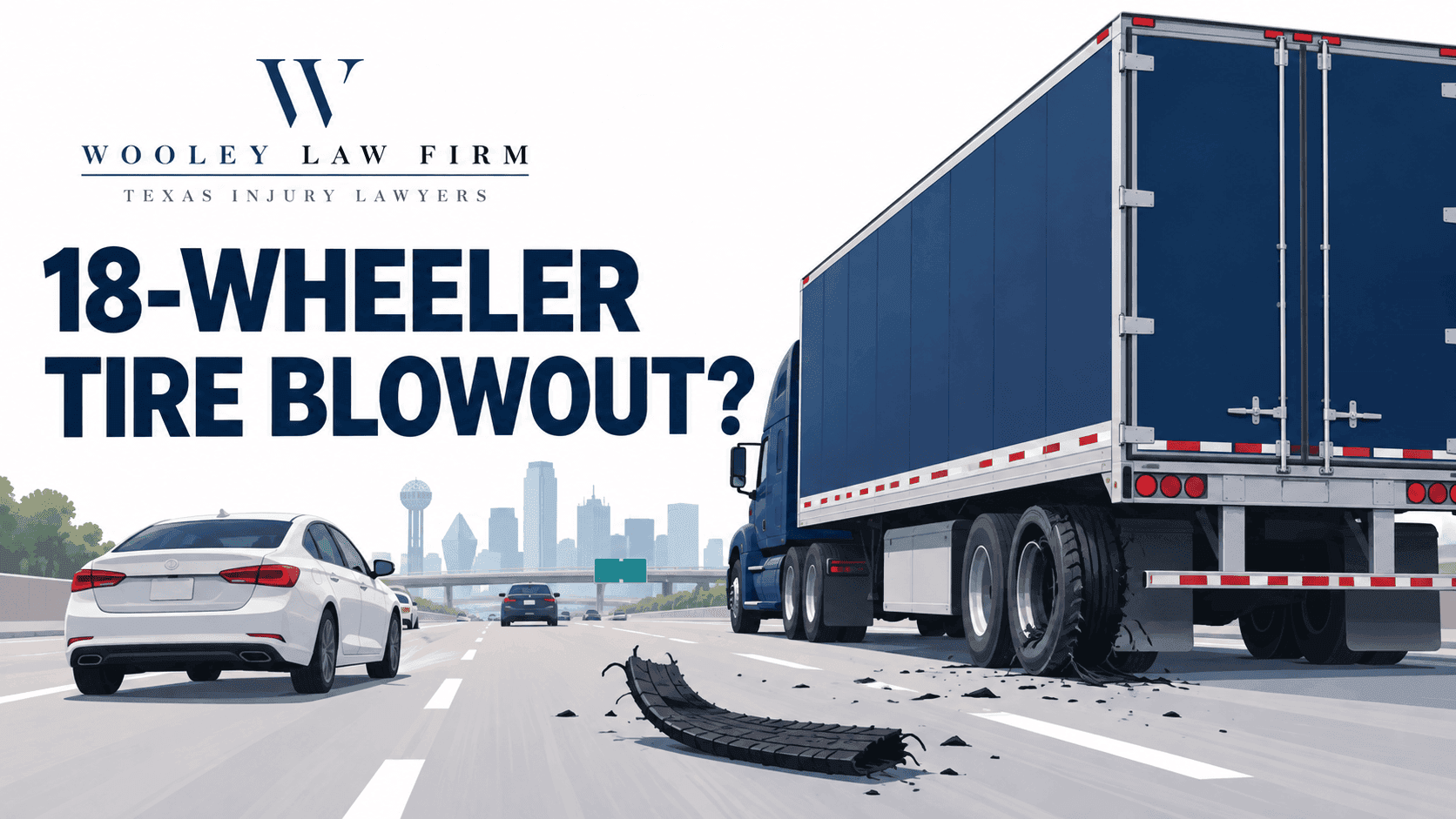
An 18-wheeler is traveling down I-35E, I-30, I-20, U.S. 75, I-635, or another Dallas-area highway when one of its tires suddenly fails.
The tire may blow apart.
A section of tread may separate and fly into traffic.
The truck may suddenly move into another lane.
Or a large piece of tire may remain in the roadway, forcing another driver to brake, swerve, or lose control.
If an 18-wheeler tire blowout caused your accident in Dallas, determining who may be responsible often requires much more than showing that a truck lost a tire.
A tire blowout does not automatically prove negligence.
Some tires fail because of sudden road hazards or other circumstances that may not have been reasonably detectable before the wreck. But a tire can also fail because it was worn, damaged, underinflated, overloaded, improperly repaired, poorly maintained, or allowed to remain in service despite warning signs.
The important questions are:
Why did the tire fail?
Who was responsible for inspecting and maintaining it?
Did the driver or trucking company know—or should they have known—that there was a problem?
And in a tire-debris case:
Can you prove that the tire actually came from the 18-wheeler involved in your wreck?
Those questions can turn an ordinary roadway-debris accident into a much more complicated commercial-truck investigation.
If you were injured in this type of collision, our Dallas 18-wheeler accident lawyer page explains more about how commercial-truck wrecks differ from ordinary passenger-vehicle accidents.
How an 18-Wheeler Tire Blowout Can Cause a Dallas Wreck
A truck tire does not have to physically strike your vehicle for the tire failure to cause a serious collision.
There are several ways an 18-wheeler tire blowout can lead to a wreck.
The Truck Driver Loses Control
A sudden tire failure can affect the driver's ability to maintain the tractor-trailer's direction and stability.
The truck may:
Move unexpectedly into another lane;
Strike a neighboring vehicle;
Hit a concrete barrier;
Jackknife;
Leave the roadway;
Overcorrect after the blowout; or
Force surrounding drivers to take evasive action.
At highway speeds, even a brief loss of control by a tractor-trailer can involve several vehicles.
If the blowout causes a series of impacts, it is important to determine what started the collision sequence rather than looking only at the final vehicle that made contact.
Our article on who is responsible when an 18-wheeler causes a chain-reaction crash in Dallas explains why the vehicle that physically hits you may not be the vehicle that actually caused the wreck.
Tire Tread or Debris Enters Traffic
Sometimes the truck stays under control, but part of the tire separates and enters the roadway.
A large strip of commercial-truck tire tread can create an immediate hazard for vehicles traveling behind or beside the truck.
A driver may:
Strike the tire debris;
Brake suddenly;
Swerve to avoid it;
Hit another vehicle;
Lose control;
Strike a median or guardrail; or
Trigger a multi-vehicle wreck.
In those cases, one of the first questions becomes:
Where did the tire debris come from?
That issue may become especially important if the tractor-trailer never stopped or if the trucking company denies that the tire came from its equipment.
A Tire Blowout Does Not Automatically Mean the Trucking Company Was Negligent
It is important not to assume that every commercial-truck tire blowout is evidence of negligence.
The National Highway Traffic Safety Administration explains that a tire blowout involves a rapid loss of air pressure that can cause a driver to lose control. NHTSA also recognizes that although proper tire maintenance can help reduce the risk of blowouts, not every blowout can necessarily be prevented.
A tire may be damaged by:
Metal in the roadway;
A pothole;
Construction debris;
Another sudden impact;
A puncture;
An unexpected road hazard; or
A defect that was not reasonably apparent during prior inspections.
That is why a serious 18-wheeler tire blowout accident in Dallas should focus on what actually caused the tire to fail.
The investigation should examine the tire itself, its maintenance history, inspection records, service records, truck data, video, and the circumstances immediately before the failure.
Worn or Damaged Truck Tires Can Point to a Maintenance Problem
Commercial truck tires operate under significant weight, mileage, heat, and highway use.
Federal regulations contain specific requirements governing tires used on commercial motor vehicles.
Under 49 C.F.R. § 393.75, certain commercial vehicles may not be operated on tires with exposed body ply or belt material, tread or sidewall separation, a flat or audible leak, or certain cuts exposing the ply or belt. The regulation also establishes minimum tread-depth requirements: generally at least 4/32 of an inch on the front wheels of a truck or truck tractor and 2/32 of an inch on other tires covered by the rule.
Investigators may therefore look for evidence such as:
Excessive tread wear;
Uneven tire wear;
Exposed cords;
Sidewall damage;
Cracking;
Cuts or punctures;
Tread separation;
Prior tire repairs;
Repeated air loss;
Improper inflation;
Overloading;
Heat damage; or
Other deterioration that may have existed before the crash.
But the tire's post-crash appearance should still be interpreted carefully.
A tire can suffer extensive damage when it fails, when the wheel contacts the pavement, or during the collision itself.
That is one reason preservation of the actual tire can be so important.
What If the Trucking Company Says the Tire Hit Road Debris?
A common explanation after a tire failure may be:
“The tire was fine. The truck hit something in the roadway.”
That could be true.
A road hazard can damage an otherwise serviceable tire.
But that explanation can often be tested against other evidence.
Relevant evidence may include:
Forward-facing dash-camera footage;
Police body-camera or dash-camera footage;
Photographs of the roadway;
Photographs of the failed tire;
Witness statements;
Nearby motorists' dash cameras;
Traffic-camera footage;
Damage to the wheel or rim;
Truck telematics;
Electronic truck data; and
The location of tire debris.
For example, video might show the tractor-trailer striking a large piece of metal immediately before the tire failed.
On the other hand, investigators may find no obvious roadway hazard while inspection of the tire shows substantial wear, separation, or another condition that appears to have developed over time.
The evidence should determine the theory of the case.
The fact that a tire blew out should not substitute for proving why it blew out.
What If the Truck Driver Lost Control After the Blowout?
The cause of the tire failure and the driver's response to the tire failure are two different issues.
Even if a blowout was unavoidable, the investigation may still consider what the driver did immediately afterward.
NHTSA advises drivers experiencing a blowout to maintain control, avoid overreaction, gradually release the accelerator, stabilize the vehicle, and then slow and move off the roadway when it is safe to do so.
After an 18-wheeler wreck, investigators may therefore consider:
Why did the tire fail?
How did the truck driver respond after the failure?
The tire could have failed without negligence while the driver's reaction contributed to the wreck.
Or the driver may have responded appropriately to an emergency created by a tire that should never have remained in service.
Both issues should be investigated separately.
Injured in an Accident?
Free consultation. Tell us what happened and learn what options may be available.
The Truck's Inspection and Maintenance History Can Be Critical
Federal regulations generally require motor carriers to systematically inspect, repair, and maintain commercial motor vehicles under their control and to keep certain inspection and maintenance records.
In a tire-failure case, those records may help answer whether the tire showed warning signs before the collision.
Important records may include:
Preventive-maintenance records;
Tire inspection records;
Tire replacement records;
Repair invoices;
Roadside-service invoices;
Driver-reported defects;
Periodic inspection records;
Roadside inspection reports;
Work orders;
Tire-pressure records;
Tire rotation records; and
Post-crash maintenance records.
Investigators may want to determine:
When was the failed tire installed?
How many miles had been placed on it?
When was it last inspected?
Had it previously lost air?
Was abnormal tread wear noted?
Had anyone recommended replacing it?
Was there a prior puncture or repair?
Was the tire appropriate for the axle position?
Was it being operated at the proper inflation pressure?
Who decided that the tire could remain in service?
These records may provide evidence that cannot be determined merely by looking at photographs taken after the wreck.
Tire-Service Records May Identify Another Company
A trucking company does not necessarily perform all of its own tire work.
Commercial carriers may use outside vendors for:
Tire installation;
Tire replacement;
Roadside tire service;
Inflation checks;
Tire repair;
Preventive maintenance; and
Emergency roadside work.
A tire-service company's records may show:
When the tire was installed;
The tire manufacturer;
Tire size;
Tire identification information;
The axle or wheel position;
Whether the tire was new or retreaded;
Prior repairs;
Technician observations;
Air pressure; and
Recommendations for replacement.
If a tire was improperly installed or negligently repaired, an outside service company may need to be investigated.
That does not mean the tire company is automatically responsible simply because it previously worked on the truck.
Its conduct still has to be connected to the tire failure and the collision.
The Tractor and Trailer May Have Different Owners and Different Tire Records
Another reason these cases can become complicated is that the tractor and trailer may be owned by completely different companies.
For example:
The driver may own the tractor;
A motor carrier may operate the tractor;
A leasing company may own the trailer;
Another business may be responsible for trailer maintenance; and
A separate tire vendor may have serviced the failed tire.
This becomes particularly important when the failed tire was mounted on the trailer rather than the tractor.
The tractor's maintenance records may tell you very little about the tire that actually failed.
Our guide to truck owner and leasing company liability after a Dallas 18-wheeler wreck explains why identifying the tractor owner, trailer owner, motor carrier, and the company responsible for maintenance can matter.
That article also discusses how trailer-specific conditions—including worn or damaged tires—can make trailer ownership and maintenance responsibility relevant.
Who Could Potentially Be Responsible for an 18-Wheeler Tire Blowout Accident?
Responsibility depends on the evidence.
Potentially relevant parties could include:
The Truck Driver
The driver's conduct may become relevant if evidence shows the driver:
Failed to inspect an obvious tire problem;
Continued operating after noticing a problem;
Ignored vibration or tire warnings;
Continued driving on a visibly damaged tire; or
Responded negligently after the blowout.
The Motor Carrier or Trucking Company
The trucking company may become relevant if the evidence shows problems with inspection, maintenance, repair, or allowing unsafe equipment to remain in service.
For more on carrier liability, see our guide discussing when you may be able to sue the trucking company after a Dallas 18-wheeler wreck.
The Tractor or Trailer Owner
The equipment owner may be important if it retained responsibility for maintaining or repairing the failed tire.
Ownership alone does not automatically establish liability.
The maintenance agreements, lease documents, repair history, and actual responsibilities of the parties should be examined.
A Maintenance or Tire-Service Company
An outside company may be relevant if negligent inspection, installation, repair, or maintenance contributed to the failure.
A Tire Manufacturer
Sometimes the evidence may point away from maintenance and toward a possible product defect.
That is a different type of investigation and often makes preservation of the failed tire especially important.
A broader discussion of the different businesses that may be involved in a commercial-truck claim is available in our article on who else can be sued besides the trucking company after a Dallas 18-wheeler wreck.
How Do You Prove the Tire Came From the 18-Wheeler?
This may be one of the most important questions in a tire-debris case.
Imagine you are traveling on I-635.
A large strip of truck tire suddenly enters your lane.
You hit it, lose control, and crash.
You remember seeing an 18-wheeler immediately ahead of you.
But the truck did not stop.
It may seem obvious that the tire came from that truck.
But proving it can be another matter.
There may already have been tire debris in the roadway before the truck arrived.
A strong investigation looks for evidence connecting the debris to the particular tractor or trailer.
Dash-Camera Video
Video may show:
The tire exploding;
Tread separating from the truck;
Debris falling directly from the truck;
The truck moving suddenly after the tire fails; or
The truck continuing down the highway with a damaged or missing tire.
Your own dash camera may capture this.
So might another driver's camera or an onboard camera from the truck itself.
Witnesses
A motorist traveling nearby may have seen the tire fail.
A witness may be able to describe:
Which axle the tire came from;
Whether the tire exploded;
Whether debris separated from the truck;
Whether the truck lost control; and
What happened immediately before your wreck.
The Actual Tire Debris
If the tire or tread is recovered, it may contain information that helps connect it to the truck.
An expert may be able to compare:
Tire size;
Manufacturer;
Model;
Construction;
Identification numbers;
Tread design; and
Physical damage.
Photographs of the Tractor and Trailer
Post-wreck photographs may show:
A shredded tire;
A missing tire;
Exposed wheel components;
Wheel or rim damage;
A newly replaced tire; or
Damage around the axle or suspension.
Photographs can also help identify:
USDOT numbers;
Company markings;
Unit numbers;
Tractor plate;
Trailer plate; and
Trailer ownership.
Police Evidence
Police photographs, officer observations, witness statements, roadway debris locations, and crash-scene documentation may also help connect the tire to the truck.
But the police report should not necessarily be the end of the investigation.
Post-Crash Repair Records
One of the more important sources may be what happened to the truck immediately after the collision.
Records could show that the carrier:
Called a tire-service company;
Purchased a replacement tire;
Replaced a wheel;
Had the truck towed;
Documented a tire failure;
Performed emergency roadside service; or
Took the tractor or trailer out of service.
Those records may help establish a connection even when the truck itself never struck your vehicle.
Preserve the Failed Tire
A destroyed commercial-truck tire may look like scrap rubber after a wreck.
But it may be critical physical evidence.
A tire expert may examine the remaining components for evidence involving:
Tread separation;
Sidewall failure;
Underinflation;
Overinflation;
Heat damage;
Impact damage;
Prior punctures;
Repairs;
Excessive wear;
Manufacturing issues; or
Other failure mechanisms.
The tire may also help answer whether the damage developed gradually or resulted from a sudden roadway impact.
If the tire is discarded before it can be examined, important evidence may disappear.
The same concern applies to the tractor and trailer because trucking equipment may be repaired and returned to service quickly.
Important Evidence After a Dallas Truck Tire Blowout Wreck
Depending on the circumstances, evidence worth investigating may include:
The failed tire;
Separated tread;
Tractor;
Trailer;
Photographs of every tire and wheel position;
Tire identification numbers;
Tire purchase records;
Tire installation records;
Tire-service invoices;
Maintenance history;
Inspection records;
Driver defect reports;
Roadside inspection reports;
Post-crash repair records;
Tow records;
Roadside-service records;
Dash-camera footage;
Driver-facing camera footage;
Third-party dash-camera footage;
Traffic-camera footage;
Electronic truck data;
GPS data;
Telematics;
Dispatch communications;
Cargo and weight information;
Police photographs; and
Witness statements.
A commercial-truck case can therefore involve evidence that would never exist in a typical two-car accident.
What If Nobody Knows Why the Tire Blew Out?
That is not unusual.
The driver may say there was no warning.
The trucking company may say the tire recently passed inspection.
The repair facility may say it never observed a problem.
A tire company may say the failure came from road impact.
The injured driver may only remember an explosion, flying rubber, and a sudden loss of control.
The investigation can work backward from the evidence.
Important questions include:
Which tire failed?
Was it on the tractor or trailer?
How old was it?
When was it last serviced?
What condition was it in?
Was it previously repaired?
Was it losing air?
Was abnormal wear documented?
Was the vehicle overloaded?
Did video show a road hazard?
What did the driver report after the wreck?
Was the tire immediately replaced?
What do the service and repair records show?
Those answers may distinguish a sudden unavoidable tire failure from a maintenance problem that should have been identified before the truck entered Dallas traffic.
Frequently Asked Questions About 18-Wheeler Tire Blowout Accidents in Dallas
Is the trucking company automatically liable if its tire blows out?
No.
The fact that a tire failed does not automatically establish negligence.
The reason for the tire failure, its condition, maintenance history, inspections, prior repairs, and the circumstances immediately before the blowout should be investigated.
Can I have a claim if tire debris caused my wreck but the truck never hit me?
Potentially.
The important issue is whether the evidence can establish that the truck or its tire created the hazard that caused the collision.
Direct vehicle-to-vehicle contact is not always necessary.
What if I swerved to avoid a truck tire?
A sudden evasive maneuver can still be part of the collision sequence.
Video, witness testimony, roadway evidence, vehicle damage, and the location of tire debris may help determine why you swerved and where the tire came from.
What if the trucking company already replaced the tire?
Other evidence may still exist.
That may include repair invoices, tire-service records, photographs, maintenance files, dash-camera footage, driver reports, roadside-service records, purchase records, or the removed tire itself.
What if the failed tire was on the trailer?
That can be especially important.
The trailer may have a different owner or maintenance provider than the tractor.
Trailer ownership, lease documents, tire records, and maintenance agreements may help determine which company had responsibility for the failed tire.
What if the blowout happened because the truck hit something in the roadway?
That is possible.
Road debris or another sudden impact may cause an otherwise serviceable tire to fail.
The investigation should compare that explanation against video, roadway evidence, the physical tire, the wheel, maintenance history, and witness testimony.
Talk to a Dallas Truck Wreck Lawyer About an 18-Wheeler Tire Blowout Accident
If an 18-wheeler tire blowout, tread separation, or truck-tire debris caused your wreck, the investigation should go beyond the simple fact that a tire failed.
The important question is why the tire failed and how that failure caused the collision.
At The Wooley Law Firm, we investigate serious commercial-truck wrecks in Dallas and throughout North Texas.
Depending on the facts, that investigation may include:
The truck driver;
Motor carrier;
Tractor owner;
Trailer owner;
Leasing company;
Maintenance provider;
Tire-service company;
Tire manufacturer;
Inspection history;
Tire-service records;
Electronic truck data;
Dash cameras;
Maintenance records;
Witnesses; and
Available insurance coverage.
You can learn more about these investigations on our Dallas 18-wheeler accident lawyer page.
If you or a family member was seriously injured because an 18-wheeler tire blew out, separated, or left tire debris in the roadway, contact The Wooley Law Firm.
Call (214) 699-6524 for a free consultation. You don't pay unless we win.
Disclaimer
This article is for general informational purposes only and is not legal advice. Reading it does not create an attorney-client relationship. Every truck wreck depends on its particular facts, evidence, parties, and applicable law.
Topics
Share This Article

Andrew J. Wooley
Personal Injury Attorney
Andrew J. Wooley is a dedicated personal injury attorney based in Dallas, Texas. He focuses on helping accident victims recover fair compensation for their injuries. With a commitment to personalized service, Andrew works directly with each client to understand their unique situation and fight for their rights.