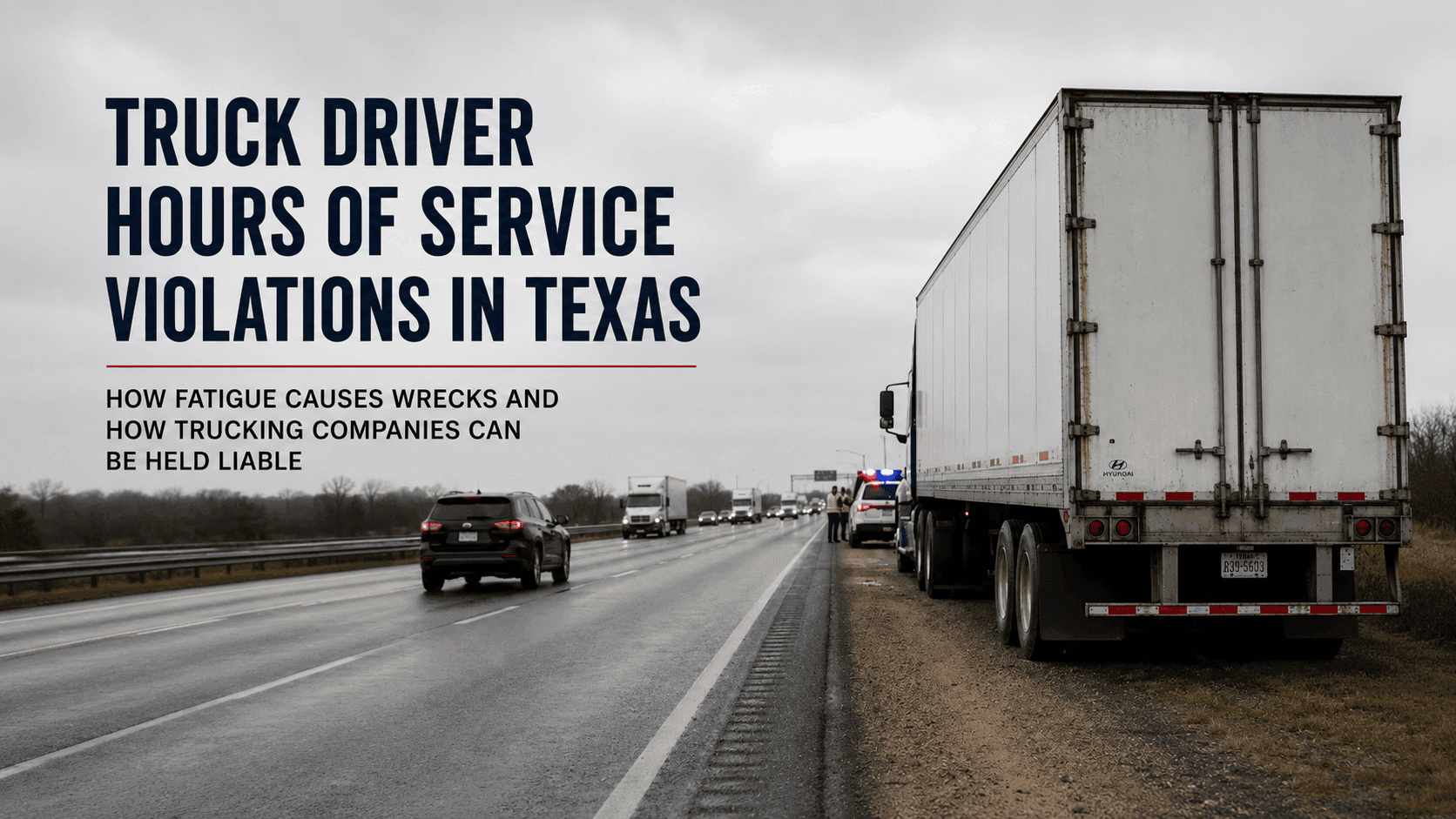
Commercial truck drivers are subject to strict federal safety rules that limit how long they can drive and how long they can remain on duty. These rules are known as Hours of Service regulations, and they exist for one simple reason: tired truck drivers are dangerous.
When a commercial driver is exhausted, reaction time slows, judgment suffers, and the risk of a serious crash increases. A fatigued truck driver may fail to brake in time, drift out of a lane, miss stopped traffic, or make a dangerous turn without fully appreciating the speed and distance of oncoming vehicles.
For ordinary drivers, fatigue is dangerous. For someone operating an 18-wheeler, tractor-trailer, tanker, box truck, or other commercial vehicle, fatigue can be catastrophic.
What Are Hours of Service Rules?
Hours of Service rules are federal regulations enforced by the Federal Motor Carrier Safety Administration. These rules limit how many hours commercial truck drivers may drive, how long they may remain on duty, when they must take breaks, and how many hours they may work over multiple days.
The purpose of these rules is to prevent fatigued driving and reduce the risk of serious truck accidents.
Many commercial trucks operating in Texas are subject to these federal regulations, especially when they transport freight across state lines. In many cases, these rules apply to drivers operating large commercial vehicles, vehicles transporting hazardous materials, or vehicles used in interstate commerce.
The 11-Hour Driving Limit
One of the most important Hours of Service rules is the 11-hour driving limit.
A property-carrying truck driver may drive a maximum of 11 hours after taking at least 10 consecutive hours off duty.
For example, if a driver completes a 10-hour off-duty period and begins driving at 7:00 a.m., the driver generally cannot drive more than 11 total hours that day. Once those 11 hours are used, the driver must stop driving until another qualifying rest period is completed.
This rule matters because a driver may still be under pressure to “finish the run” even after legally running out of driving time. A delivery may be close. A dispatcher may be pushing. The driver may believe they can make it a little farther.
But when a driver keeps operating after exceeding the legal driving limit, everyone on the road is put at risk.
The 14-Hour On-Duty Limit
The 14-hour rule is different from the 11-hour driving rule.
The 14-hour rule limits the total window of time in which a truck driver may drive after coming on duty. Once the driver starts the workday, the clock begins running.
For example, if a driver reports to work at 6:00 a.m., the driver generally cannot continue driving after 8:00 p.m., even if the driver has not used all 11 hours of driving time.
The 14-hour clock can include time spent:
Inspecting the truck
Loading cargo
Unloading cargo
Fueling
Completing paperwork
Waiting at a shipping facility
Communicating with dispatch
Performing other work-related duties
This rule is important because fatigue does not only come from driving. A driver who has spent hours loading freight, waiting at a warehouse, fueling, inspecting equipment, and dealing with dispatch may be exhausted even if the truck has not been moving the entire time.
The Required 30-Minute Break
Truck drivers are also required to take breaks.
After eight cumulative hours of driving, a commercial driver generally must take at least a 30-minute non-driving break before continuing.
For example, if a truck driver begins driving at 7:00 a.m. and drives until 3:00 p.m., the driver has accumulated eight hours of driving time. Before continuing to drive, the driver must take a break of at least 30 minutes.
If a driver skips this break and continues driving, that violation may become important evidence after a crash. The missed break may show that the driver was operating while fatigued, rushing, or under pressure to meet an unrealistic schedule.
The 60/70-Hour Weekly Limits
Hours of Service rules also limit how many total hours a commercial driver may work over multiple days.
Depending on the motor carrier’s operating schedule, a driver generally may not drive after accumulating:
60 hours on duty in 7 consecutive days, or
70 hours on duty in 8 consecutive days.
For example, if a driver working for a company that operates every day logs 72 on-duty hours over an 8-day period, the driver may be over the legal weekly limit. The driver generally cannot continue driving until enough hours fall outside the rolling 8-day window or the driver completes a qualifying restart.
These weekly limits are designed to prevent chronic fatigue. A driver may not be exhausted from one shift alone, but repeated long days can cause serious fatigue to build over time.
Injured in an Accident?
Free consultation. Tell us what happened and learn what options may be available.
How Hours of Service Violations Cause Truck Accidents
Hours of Service violations can lead directly to serious and fatal truck crashes.
A fatigued truck driver may:
Rear-end stopped or slowing traffic
Drift into another lane
Fail to brake in time
Run a red light or stop sign
Make an unsafe turn
Misjudge the speed of another vehicle
Lose control of the truck
Fall asleep behind the wheel
At highway speeds, a tractor-trailer can travel the length of a football field in only a few seconds. If a fatigued driver looks away, nods off, or reacts too slowly, the results can be devastating.
Texas Examples of Fatigue, Hours-of-Service Violations, and Trucking Company Liability
Texas truck crashes show why Hours of Service rules matter. These regulations are not technicalities. They are safety rules designed to protect families, commuters, workers, and everyone else sharing the road with commercial trucks.
Midland / Ector County: Alleged 11-Hour and 14-Hour Violations
In a fatal Midland-area crash, a Texas jury returned a $49 million verdict against OPG Logistics LLC and its driver. A jury found the truck driver caused the crash when failed to yield and made an unsafe left turn. According to reports, the plaintiffs alleged that the truck driver had been driving for more than 12 hours and had been on duty for more than 15 hours after her last qualifying rest period.
Those allegations directly relate to the federal 11-hour driving limit and 14-hour on-duty limit.
Plaintiffs also alleged that the driver falsified duty records and that the trucking company had access to electronic logging data and alerts that could have revealed Hours of Service violations before the crash.
Terrell / I-20: Driver Allegedly Fell Asleep Before a Mass-Casualty Crash
In June 2025, a tractor-trailer crash on Interstate 20 near Terrell killed five people. Reports state that the truck driver told police he fell asleep before the collision.
A wrongful death lawsuit later alleged that the trucking company, Hope Trans, falsified driver logs and backdated shipping records. Reports also stated that former drivers accused the company of pressuring exhausted solo drivers into unsafe long-haul routes that violated federal safety rules.
This example shows how a truck accident investigation may go beyond the driver’s conduct in the moments before impact. If a company pressures drivers to break Hours of Service rules, manipulates paperwork, ignores fatigue risks, or rewards unrealistic delivery schedules, the company may be held responsible when that conduct leads to a crash.
Read the People news story here.
Read the WFAA investigation here.
Austin / I-35: Lawsuits Alleging Hours-of-Service Violations After Deadly Pileup
After a deadly 18-vehicle crash on I-35 in North Austin, lawsuits alleged Hours of Service violations involving the truck driver, along with other safety failures. Reports stated that the crash killed five people and injured numerous others.
According to news reports, the lawsuit claimed the driver’s required Hours of Service log and electronic logging device showed several violations during the seven days before the crash.
This case is another reminder that major truck wrecks often require a deep investigation into driver logs, electronic logging device data, dispatch records, cell phone records, company policies, and communications between the driver and motor carrier.
How Trucking Companies Can Be Held Liable
After a truck crash, many people assume the driver is the only responsible party. That is often not true.
A trucking company may be liable when its own negligence contributes to the crash. This may include:
Hiring an unsafe driver
Failing to train the driver
Failing to supervise the driver
Ignoring prior safety violations
Encouraging illegal driving hours
Creating unrealistic delivery schedules
Failing to review ELD data
Allowing falsified logs
Failing to enforce safety policies
Trucking companies are not allowed to put profits ahead of public safety. When a motor carrier pressures drivers to violate Hours of Service rules or ignores evidence that drivers are operating illegally, the company may be held accountable for the harm that follows.
Evidence That Can Prove Hours of Service Violations
Truck accident cases often turn on evidence that is controlled by the trucking company. That is why early investigation is so important.
Important evidence may include:
Electronic Logging Device data
Driver logs
Driver qualification files
Dispatch messages
GPS data
Fuel receipts
Toll records
Bills of lading
Delivery schedules
Cell phone records
Dash camera footage
Event data recorder information
Internal company emails
Prior safety violations
Maintenance records
This evidence may show that a driver exceeded legal driving limits, skipped required breaks, falsified records, or was pressured by the company to keep driving.
Why Electronic Logging Devices Matter
Most commercial trucks are required to use Electronic Logging Devices, often called ELDs. These devices record key information about the truck and driver’s activity.
ELDs may show:
When the truck was moving
How long the driver was operating
When the driver went on duty
When the driver went off duty
Whether the driver’s log matches the truck’s actual movement
Whether alerts were generated before the crash
In serious truck accident cases, ELD data can be some of the most important evidence in proving what really happened.
If the trucking company had access to ELD data showing violations before a crash, that may support a claim that the company failed to supervise the driver or ignored known safety risks.
Why Early Legal Action Matters
Evidence in truck accident cases can disappear quickly.
Electronic data may be overwritten. Dash camera footage may be deleted. Documents may be changed or lost. Witnesses may become harder to locate. Vehicles may be repaired or destroyed.
An attorney can send a preservation letter demanding that the trucking company preserve evidence related to the crash. This may include driver logs, ELD data, dispatch communications, maintenance records, and other critical information.
The sooner this happens, the better the chance of uncovering the truth.
Compensation After a Truck Accident
Victims injured in truck accidents may be entitled to pursue compensation for:
Medical expenses
Future medical care
Lost wages
Loss of earning capacity
Pain and suffering
Mental anguish
Physical impairment
Disfigurement
Property damage
When a truck crash causes death, surviving family members may also have the right to pursue a wrongful death claim under Texas law.
Speak With a Dallas Truck Accident Lawyer
Hours of Service violations can leave a trail of evidence. Driver logs, ELD data, dispatch records, shipping documents, and company communications may reveal whether a truck driver or trucking company violated federal safety rules before a crash.
At Wooley Law Firm, we investigate serious truck accidents, preserve critical evidence, and pursue negligent drivers and trucking companies that put the public at risk.
If you were injured in a Dallas truck accident, North Central Expressway crash, Interstate 35 collision, Interstate 20 wreck, or another commercial vehicle crash, you may have the right to seek justice and pursue compensation for medical expenses, pain and suffering, lost wages, mental anguish, impairment, and other damages.
Call (214) 699-6524 for a free consultation. You don’t pay unless we win. Contact Us Today!
Topics
Share This Article

Andrew J. Wooley
Personal Injury Attorney
Andrew J. Wooley is a dedicated personal injury attorney based in Dallas, Texas. He focuses on helping accident victims recover fair compensation for their injuries. With a commitment to personalized service, Andrew works directly with each client to understand their unique situation and fight for their rights.