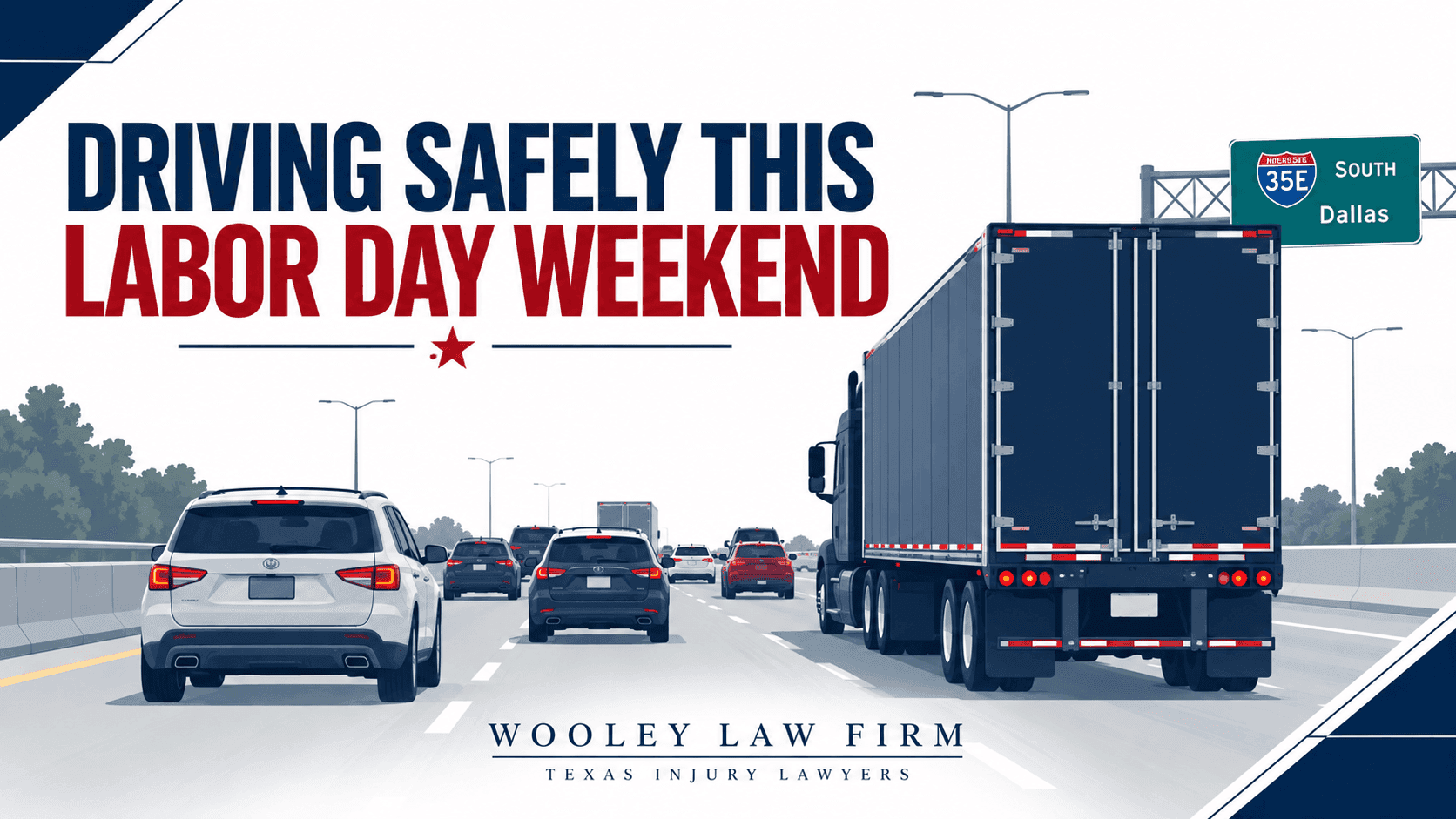
Labor Day weekend is one of the final big travel weekends of the summer. Across Dallas–Fort Worth, families may be heading to the lake, visiting relatives, attending football games, traveling out of town, or simply driving across the Metroplex for a holiday gathering.
That can mean more vehicles, and more opportunities for serious car and truck wrecks, on I-35E, I-30, I-20, I-635, US-75, the Dallas North Tollway, President George Bush Turnpike, and other major North Texas roads.
For Labor Day weekend 2026, the Texas Department of Public Safety announced increased enforcement from Friday, September 4 through Monday, September 7, with troopers specifically watching for speeding, intoxicated driving, Move Over/Slow Down violations, and other dangerous driving behaviors.
There is good reason for the increased attention. TxDOT reported that during Labor Day weekend 2025, 57% of Texas traffic fatalities were drug- or alcohol-related, with 26 people killed in less than four days.
Whether you are driving across Dallas or several hours across Texas, a few decisions before and during your trip can make a significant difference.
Why Labor Day Weekend Can Be Dangerous on Dallas Roads
There is not one single cause of Labor Day weekend car accidents.
Instead, holiday travel can bring together several risks at the same time:
Increased traffic volume
Drivers traveling on unfamiliar roads
Speeding
Drinking and driving
Drug-impaired driving
Distracted driving
Driver fatigue
Sudden lane changes
Heavy highway congestion
Stop-and-go traffic
Passenger vehicles traveling alongside 18-wheelers and other commercial trucks
A driver who is rushing to reach a destination may follow another vehicle too closely or make an unsafe lane change.
Someone returning from a party may get behind the wheel after drinking.
A family driving several hours home on Monday evening may have a fatigued driver who has difficulty maintaining attention.
An 18-wheeler traveling through congested holiday traffic may need substantially more room to react when traffic suddenly slows.
Any of these situations can result in a serious Dallas car accident or truck wreck.
Do Not Drink and Drive This Labor Day Weekend
One of the most important Labor Day driving precautions is also one of the simplest: do not drive impaired.
The National Highway Traffic Safety Administration reports that 505 people were killed in traffic crashes nationwide during Labor Day weekend 2024, and 33% of those deaths involved a drunk driver.
If you plan on drinking at a Labor Day celebration, make your transportation plans before you begin drinking.
That may mean:
Selecting a designated sober driver
Using a rideshare service
Taking public transportation
Staying overnight
Arranging for a friend or family member to pick you up
The same principle applies to drugs or medication that may impair your ability to operate a vehicle safely.
A serious impaired-driving crash can happen in seconds. The injuries and consequences can last much longer.
Expect Heavy Traffic on Dallas–Fort Worth Highways
Holiday weekends can mean heavy traffic leaving Dallas on Friday and returning Monday.
Major routes such as I-35E, I-30, I-20, I-635, and US-75 already carry substantial daily traffic.
Our review of Texas crash data found that Dallas recorded 2,246 crashes during July 2026 alone, while I-35, I-20, I-30, and I-35E were among the Texas interstate corridors reporting hundreds of crashes during that month.
Heavy Labor Day traffic makes defensive driving particularly important.
Leave additional distance between your vehicle and the vehicle ahead. Give yourself time to react when traffic suddenly slows.
Avoid aggressive lane changes simply to move one or two vehicles ahead.
And if congestion develops, remember that getting to your destination a few minutes sooner is not worth creating a dangerous situation.
Be Especially Careful Around 18-Wheelers
Passenger vehicles and commercial trucks will be sharing Texas highways throughout Labor Day weekend.
Drivers should remember that an 18-wheeler cannot maneuver like a passenger vehicle.
Large trucks have significant blind spots. They also require additional space to slow down and may need more room when changing lanes or making turns.
Texas DPS specifically advises drivers not to cut directly in front of large trucks or brake suddenly in front of them.
When traveling near a tractor-trailer:
Avoid lingering beside the trailer unnecessarily.
Do not assume the truck driver can see you.
Give the truck room before moving back into its lane after passing.
Do not cut across several lanes immediately in front of an 18-wheeler to reach an exit.
Expect trucks to require additional stopping distance.
Pay attention to the truck's turn signals and movement within its lane.
Unsafe lane changes are particularly dangerous because the tractor may clear another vehicle while the trailer does not.
We discuss that issue further in our article about who may be responsible when an 18-wheeler causes a chain-reaction crash in Dallas.
Injured in an Accident?
Free consultation. Tell us what happened and learn what options may be available.
Watch for Sudden Traffic Backups
Dallas drivers know how quickly highway traffic can go from highway speeds to nearly stopped.
Construction, another collision, lane closures, holiday traffic, or congestion around an interchange can cause vehicles ahead to brake suddenly.
These conditions create a particular risk of rear-end crashes.
A passenger vehicle may be able to stop quickly. A fully loaded commercial truck may need significantly more distance.
That is why drivers should avoid following too closely and continually watch several vehicles ahead rather than focusing only on the bumper directly in front of them.
If you are stopped in traffic when an 18-wheeler approaches from behind, the consequences can be especially severe. We explain these cases in more detail in our article on being rear-ended by an 18-wheeler while stopped in Dallas traffic.
Put the Phone Away
Holiday travel often means using a phone for directions, finding a restaurant, changing music, answering messages, or communicating with family members.
Those tasks should not compete with driving.
Texas DPS is reminding drivers this Labor Day weekend to eliminate distractions and notes that Texas law prohibits reading, writing, or sending electronic messages on a portable wireless device while driving unless the vehicle is stopped.
Set your navigation before leaving.
If you have a passenger, let that person handle directions, messages, music, and other tasks.
If something requires your attention, pull safely off the roadway before using your phone.
Do Not Drive When You Are Too Tired
Fatigue can become a serious concern during long holiday drives.
You may be returning from a lake, family gathering, football game, or weekend trip late Sunday or Monday night.
Trying to complete the final hour or two of a trip when you are struggling to stay awake can put everyone in your vehicle, and everyone around you, at risk.
Warning signs can include:
Repeated yawning
Difficulty keeping your eyes open
Missing exits
Drifting within your lane
Difficulty remembering the last several miles
Driving onto the shoulder
Delayed reactions
If you are becoming too tired to safely drive, stop.
What If an 18-Wheeler Causes a Labor Day Weekend Wreck?
Truck wreck claims can involve evidence that does not exist in an ordinary passenger-vehicle collision.
Depending on the circumstances, important evidence may include:
Electronic logging device information
Engine control module or other electronic vehicle data
Dash-camera and onboard-camera recordings
Driver qualification records
Hours-of-service information
Dispatch communications
Maintenance and inspection records
Cell phone records
Automatic emergency braking information
Forward-collision warning data
Post-crash photographs and videos
For example, modern truck safety systems may contain information showing whether the truck detected traffic ahead or warned the driver before impact. Our article on automatic emergency braking evidence after a truck wreck explains why that information may matter.
Likewise, if a truck fails to slow before a rear-end crash, investigators may need to determine whether the driver simply failed to react or whether a mechanical problem contributed to the wreck. Read more about brake failure after a rear-end 18-wheeler accident in Dallas.
The Truck Driver May Blame the Vehicle Ahead
After a rear-end collision, a truck driver or trucking company's insurer may argue that the passenger vehicle stopped too suddenly.
That allegation does not automatically determine responsibility.
Investigators may need to look at:
How much distance the truck driver maintained
Traffic conditions
Vehicle speeds
When braking began
Whether the driver was distracted
Whether the driver was fatigued
Whether forward-collision warnings activated
Whether the truck's brakes were functioning properly
Whether dash-camera video captured the collision
We address this defense in greater detail in The Truck Driver Says I Stopped Suddenly—Who Is at Fault After a Dallas Truck Wreck?.
What Should You Do After a Labor Day Weekend Car or Truck Wreck?
The first priority is safety and medical care.
If you are involved in a serious wreck:
Call 911. Report the collision and request medical assistance if anyone may be injured.
Move to a safe location when appropriate. If the crash involves no injuries and the vehicles can safely be moved, Texas DPS encourages drivers to “Steer It, Clear It.”
Get medical attention. Some injuries may not be obvious immediately after the impact.
Photograph the vehicles and scene. If it can be done safely, document vehicle damage, license plates, road conditions, debris, skid marks, traffic signals, and the surrounding area.
Get witness information. Independent witnesses can become important when drivers disagree about what happened.
Save dash-camera footage. Make sure the recording is not automatically overwritten.
Do not assume the insurance company has the entire story. Multi-vehicle and truck wrecks can require much more investigation than simply reading the police crash report.
Be careful about giving a recorded statement immediately. What you say early in the claim may later be compared against medical records, testimony, photographs, and other evidence.
If several vehicles were involved, identifying who actually caused the collision can become particularly complicated. Our guide to multi-vehicle car wrecks in Dallas explains why the vehicle that physically hit you may not always be the vehicle that started the wreck.
Who May Be Responsible for a Dallas Labor Day Wreck?
Responsibility depends on the facts.
Potentially responsible parties could include:
A negligent passenger-vehicle driver
An impaired driver
A distracted driver
An 18-wheeler driver
A trucking company
The employer of a commercial driver
A maintenance or repair company
Another company responsible for the commercial vehicle
Truck cases are particularly important to investigate promptly because potentially relevant electronic and company records may be controlled by the trucking company or other businesses.
If you were seriously injured in a commercial truck collision, our Dallas truck accident lawyer page explains some of the additional issues that may arise in an 18-wheeler claim.
Frequently Asked Questions About Labor Day Car and Truck Wrecks in Dallas
Is Labor Day weekend dangerous for driving?
Holiday weekends can combine heavier traffic, long-distance travel, impaired drivers, distracted driving, speeding, and driver fatigue. TxDOT reported that 57% of Texas traffic deaths during Labor Day weekend 2025 were drug- or alcohol-related.
Are Texas troopers increasing enforcement for Labor Day 2026?
Yes. Texas DPS announced increased Labor Day enforcement from September 4 through September 7, 2026, with troopers looking for offenses including speeding, impaired driving, and Move Over/Slow Down violations.
What should I do if a drunk driver hits me in Dallas?
Call police, seek appropriate medical care, document the scene if possible, obtain available witness information, and preserve any dash-camera footage or other evidence. A criminal DWI investigation and an injured person's civil claim involve different issues.
What if an 18-wheeler rear-ends me in Labor Day traffic?
Do not assume the crash is simply an ordinary rear-end claim. Evidence from the truck—including electronic data, cameras, driver records, braking information, and trucking-company records—may help determine why the truck did not stop.
Can more than one person be responsible for a holiday weekend wreck?
Potentially. Multi-vehicle crashes can involve several drivers or businesses whose conduct contributed to the collision. The entire sequence should be investigated before responsibility is determined.
Injured in a Dallas Car or Truck Wreck?
Labor Day weekend should be a time to enjoy family, friends, and the end of summer, not deal with the consequences of a serious collision.
If you or a family member has been seriously injured because another driver, 18-wheeler driver, trucking company, or commercial vehicle operator may have caused a Dallas–Fort Worth wreck, The Wooley Law Firm can investigate what happened and help you understand your options.
We represent people injured in serious car accidents, 18-wheeler wrecks, and commercial vehicle collisions throughout Dallas–Fort Worth and across Texas.
Call (214) 699-6524 for a free consultation. You don't pay unless we win.
This article is for general informational purposes only and is not legal advice. Reading it does not create an attorney-client relationship. Every case is different.
Topics
Share This Article

Andrew J. Wooley
Personal Injury Attorney
Andrew J. Wooley is a dedicated personal injury attorney based in Dallas, Texas. He focuses on helping accident victims recover fair compensation for their injuries. With a commitment to personalized service, Andrew works directly with each client to understand their unique situation and fight for their rights.
Related Local News
Recent related coverage