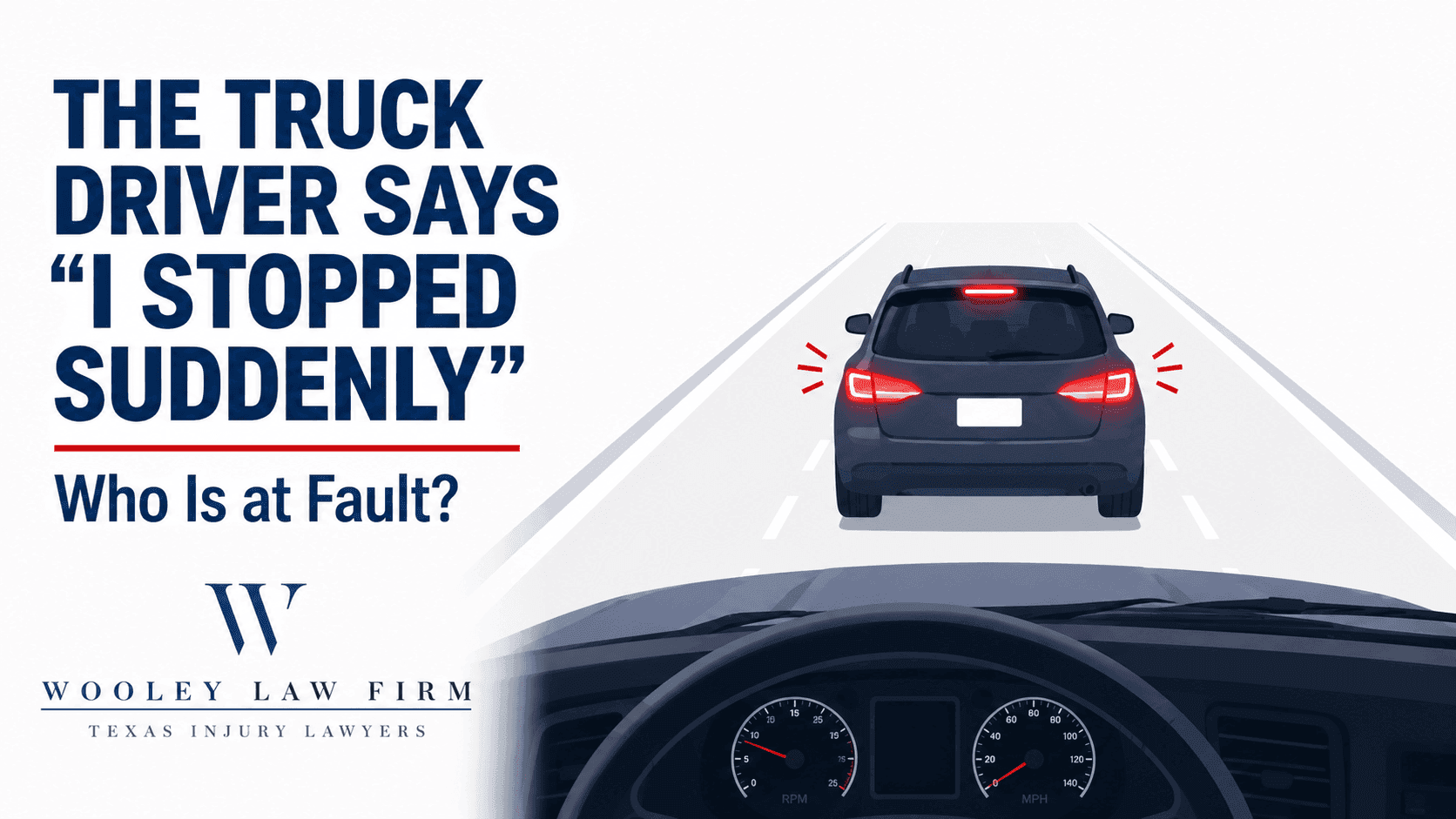
If an 18-wheeler rear-ended your vehicle, the truck driver or trucking company may claim that you “stopped suddenly.” That statement does not automatically make you responsible for the wreck.
Texas drivers must leave enough space to stop safely after considering traffic, speed, road conditions, and the vehicles involved. That duty is especially important for a commercial truck driver operating a heavy tractor-trailer that cannot respond like a passenger car.
If the truck driver was following too closely, driving too fast for traffic, distracted, or slow to react, the driver may still be responsible even if you had to brake quickly.
At the same time, fault in a rear-end truck wreck is not automatic. Investigators should determine:
Why you stopped
How much distance the truck driver left
How fast the 18-wheeler was traveling
When the truck driver noticed your vehicle
When the driver applied the brakes
What the physical and electronic evidence shows
The truck driver’s accusation is only one version of what happened. The objective evidence may tell a very different story.
Does a Sudden Stop Make the Front Driver at Fault in Texas?
Not by itself.
Drivers routinely have to slow down or stop for:
A red light or stop sign
Congested traffic
A vehicle braking ahead
A pedestrian, bicyclist, or animal
Road debris
Construction
A collision or disabled vehicle
Another unexpected roadway hazard
A truck driver must watch the road ahead and maintain enough distance to respond to foreseeable changes in traffic.
Texas Transportation Code § 545.062 requires a following driver to maintain an assured clear distance so the driver can stop safely without colliding with the vehicle ahead.
The real issue is not simply whether your stop happened quickly. The important questions are whether your braking was reasonable under the circumstances and whether the truck driver had been following at a safe distance and paying attention.
Dallas Traffic Frequently Requires Drivers to Stop Quickly
Drivers on Dallas highways regularly encounter sudden traffic slowdowns. Traffic may back up near construction zones, highway interchanges, entrance ramps, disabled vehicles, and prior crashes.
This frequently happens on heavily traveled North Texas roads such as:
Interstate 35E
Interstate 30
Interstate 20
Interstate 45
U.S. Highway 75
Interstate 635
State Highway 121
Dallas North Tollway
President George Bush Turnpike
A professional truck driver traveling through Dallas should expect changing traffic conditions. A driver cannot follow a passenger vehicle too closely and then escape responsibility merely by claiming that traffic stopped unexpectedly.
Why Truck Drivers Need More Space to Stop
An 18-wheeler is larger, heavier, and harder to stop than an ordinary car. A professional truck driver should account for the truck’s size and load as well as traffic, visibility, weather, road grade, and pavement conditions.
When a truck hits a stopped or slowing vehicle from behind, important questions include:
How fast was the truck traveling before the crash?
How far behind your vehicle was the truck?
Was the driver watching the road?
When did the driver first apply the brakes?
Did the driver attempt to steer away?
Were the truck’s brakes and tires properly maintained?
Was the driver fatigued?
Was the driver distracted?
Was the driver under pressure to meet a delivery deadline?
Did the truck’s collision-warning system alert the driver?
The truck driver’s version is only one piece of evidence. A proper investigation should test that statement against the truck’s electronic data, video, physical damage, scene evidence, and witness accounts.
When the Truck Driver May Be Responsible
A truck driver may be responsible for a rear-end collision when the evidence shows that the driver was following too closely, driving too fast, distracted, fatigued, or operating an unsafe truck.
The truck driver was following too closely
A driver who leaves too little space may be unable to stop when ordinary Dallas traffic slows near a signal, interchange, construction zone, or traffic backup.
Calling the event a “sudden stop” does not erase an unsafe following distance.
A truck driver should leave enough room to account for the truck’s size, weight, speed, cargo, and braking ability. The driver should increase that space when traffic is heavy or road conditions are poor.
The truck driver was driving too fast for traffic
The posted speed limit is not always a safe speed.
A truck driver may need to slow down for:
Congested traffic
Rain or wet pavement
Limited visibility
Construction
Curves
Hills
Stop-and-go conditions
Heavy traffic near an interchange
A speed that is legal in ideal conditions may still be unsafe under the circumstances.
The truck driver was distracted
Cellphone records, in-cab video, dispatch messages, or forward-facing camera footage may show that the truck driver did not notice slowing traffic in time.
Commercial drivers may become distracted by:
Cellphones
Text messages
Navigation systems
Electronic dispatch devices
Food or drinks
Paperwork
Communications with the trucking company
If the truck driver was looking down or away from traffic, the driver may not have noticed your brake lights until it was too late.
The truck driver was fatigued
A tired driver may take longer to recognize a hazard and begin braking.
Electronic logging-device records, fuel receipts, dispatch records, GPS information, bills of lading, and delivery records may help determine how long the driver had been working and whether fatigue contributed to the wreck.
The trucking company’s scheduling and dispatch practices may also matter if the company placed pressure on the driver to continue driving while tired.
The truck was not properly maintained
Worn tires, defective brakes, poor brake adjustment, or other mechanical problems may increase stopping distance or prevent the truck from responding properly.
Inspection, maintenance, and repair records can help determine whether the trucking company placed an unsafe truck on the road.
Injured in an Accident?
Free consultation. Tell us what happened and learn what options may be available.
When Could the Front Driver Share Fault?
There are circumstances in which the front driver may share responsibility. Examples may include:
Deliberately brake-checking the truck
Entering the truck’s lane without leaving a safe gap and immediately braking
Driving without functioning brake lights
Stopping in an active traffic lane without a reasonable need
Failing to activate hazard lights after becoming disabled in the roadway
However, the trucking company must support its allegation with evidence. It should not be enough to blame the injured person simply because the truck driver says the stop was unexpected.
Texas applies proportionate responsibility. Under Texas Civil Practice and Remedies Code Chapter 33, an injured person generally cannot recover damages if found more than 50% responsible. If the person is 50% or less responsible, the recovery is reduced by that percentage.
This is one reason trucking companies and insurers may try to turn a rear-end collision into a disputed-liability case.
For more information about these collisions, read our guide on what to do after being rear-ended by an 18-wheeler in Dallas.
Evidence That Can Defeat the “Sudden Stop” Defense
The best response to the truck driver’s allegation is often objective evidence showing what both vehicles were doing before impact.
Truck black-box and telematics data
Depending on the truck and its systems, electronic data may show:
Vehicle speed
Brake application
Throttle position
Cruise-control use
Sudden deceleration
GPS location
Collision-warning alerts
Lane-departure warnings
Hard-braking events
This information may help determine when the truck driver recognized the danger and whether the driver had enough time and distance to stop.
Our guide to 18-wheeler black-box data explains how this information may help reconstruct a collision.
Forward-facing and in-cab video
Road-facing video may show:
Traffic slowing ahead
Your brake lights activating
Why you stopped
How closely the truck was following
When the truck driver began braking
Whether another vehicle cut into your lane
Driver-facing video may show where the truck driver was looking and whether the driver was distracted or drowsy.
Video may be especially important when the truck driver claims that your vehicle stopped for no reason.
Dash-camera and third-party footage
Your dash camera—or video from another vehicle, nearby business, traffic system, or home security camera—may show why you stopped.
Video could establish that you were reacting to a traffic light, congestion, debris, another vehicle, or some other legitimate hazard.
Learn more about using dash-camera evidence after a Dallas car or truck wreck.
Electronic logging and dispatch records
Electronic logging-device records, route data, trip documents, delivery appointments, and company communications may reveal:
Driver fatigue
Hours-of-service problems
An unsafe schedule
Pressure to meet a delivery deadline
Inadequate rest
Inconsistencies in the driver’s account
These records can be compared with GPS data, fuel purchases, toll records, and other documents to determine what the driver was doing before the crash.
Physical and scene evidence
Vehicle damage, skid marks, debris, final resting positions, roadway measurements, and brake-light condition may help experts evaluate:
Vehicle speed
Following distance
Reaction time
Braking
The sequence of impacts
Whether the truck attempted to avoid the collision
The damage may also show whether the truck struck your vehicle directly from behind or at an angle.
Witness statements and 911 recordings
Independent witnesses may have seen traffic stop ahead of you. They may also have observed the truck traveling too close or too fast.
Witness statements can be especially important when the truck driver and the injured person give conflicting accounts.
Our complete guide identifies additional evidence that can prove an 18-wheeler wreck claim.
Why Truck-Wreck Evidence Must Be Preserved Quickly
Some truck camera footage and electronic data may be overwritten. The tractor or trailer may be repaired and returned to service. Nearby surveillance video may disappear under short retention policies.
A targeted preservation letter can demand that the truck driver, motor carrier, insurer, and other involved companies protect relevant evidence.
The preservation demand may include:
The tractor and trailer
Forward-facing and driver-facing video
Black-box and telematics data
Electronic logging-device records
Cellphone records
Dispatch communications
GPS and route information
Maintenance and inspection documents
Driver qualification and training records
Post-crash investigation materials
Photographs and measurements
Collision-warning system data
Do not assume the trucking company will voluntarily preserve everything needed to evaluate its own driver’s story.
Could the Trucking Company Also Be Responsible?
Yes. A rear-end truck wreck claim may involve more than the truck driver’s actions.
Depending on the evidence, the trucking company may be responsible for:
The truck driver’s negligence
Negligent hiring
Inadequate training
Negligent supervision
Retaining an unsafe driver
Unsafe dispatch practices
Pressuring the driver to meet an unreasonable schedule
Failing to maintain the tractor or trailer
Ignoring prior safety violations
Failing to enforce company safety policies
A trucking company may try to frame the case as an unavoidable sudden stop. The investigation should examine whether the company’s own conduct placed an unqualified, tired, distracted, or poorly trained driver behind the wheel.
Who Can Be Liable for a Dallas Rear-End Truck Wreck?
Depending on the evidence and the companies involved, potentially responsible parties may include:
The truck driver
The motor carrier or trucking company
An employer responsible for the driver’s conduct
A company that negligently hired, trained, supervised, or retained the driver
The tractor owner
The trailer owner
A maintenance or repair contractor
A shipper or cargo-loading company
Another company whose conduct contributed to the wreck
Identifying the correct companies may require reviewing the police report, federal motor-carrier information, vehicle ownership, lease documents, shipping records, insurance filings, and documents obtained through a lawsuit.
What Should You Do If the Truck Driver Blames Your Stop?
If your health permits, consider taking the following steps:
Get medical treatment. Follow your healthcare provider’s instructions and report all symptoms.
Save your dash-camera footage. Preserve the original file before it is overwritten.
Keep all photographs and videos. Do not edit or delete the original files.
Photograph the truck and trailer. Capture company markings, license plates, DOT numbers, vehicle damage, the roadway, and the surrounding area.
Write down why you stopped. Record what you observed before the details fade.
Obtain witness information. Get names, telephone numbers, and email addresses if possible.
Avoid arguing about fault. The crash evidence matters more than a roadside argument.
Do not discuss the wreck on social media. The trucking company or insurer may attempt to use your posts against you.
Be careful about recorded statements. Speak with an attorney before providing a recorded statement to the trucking company’s insurer.
Do not sign a release too quickly. A release could end your entire injury claim before you understand the extent of your damages.
Ask an attorney about preserving evidence. Truck data and video may not remain available indefinitely.
Talk With a Dallas Truck Wreck Lawyer
The trucking company’s claim that you “stopped suddenly” is not the final word.
At The Wooley Law Firm, we investigate what caused serious truck wrecks and pursue the physical, electronic, and company evidence that can confirm, or contradict, the truck driver’s account.
We do not simply accept the trucking company’s explanation. We examine why the vehicle stopped, how closely the truck was following, when the driver reacted, and what the available evidence shows.
If you were rear-ended by an 18-wheeler in Dallas, Fort Worth, or elsewhere in Texas, speak with a Dallas truck accident lawyer.
Call The Wooley Law Firm at (214) 699-6524 for a free consultation. You don’t pay unless we win.
Frequently Asked Questions
Is the rear driver always at fault in a Texas truck wreck?
No. A rear impact often points to unsafe following distance or delayed reaction, but fault depends on the evidence. An unsafe lane change, deliberate brake check, defective brake lights, or chain-reaction impact may change the analysis.
What if I stopped for traffic or a red light?
A driver should expect traffic to slow or stop for ordinary roadway conditions. Evidence showing a traffic signal, congestion, construction, or another hazard may undermine the truck driver’s claim that your stop was unreasonable.
What if traffic stopped suddenly on a Dallas highway?
The truck driver should maintain a following distance that accounts for traffic and roadway conditions. Sudden congestion does not necessarily excuse a driver who was following too closely, speeding, distracted, or failing to watch the road.
Can the truck’s black box show whether the driver braked?
Possibly. Available data varies by truck and system, but some electronic modules and telematics platforms record speed, braking, throttle position, sudden deceleration, or warning events.
Can the trucking company blame me even though its truck hit me from behind?
It can make that allegation, but an allegation is not proof. Video, electronic truck data, physical evidence, witnesses, and company records may establish why you stopped and whether the truck driver had enough time and distance to respond.
What if another vehicle caused me to brake?
Video, witness accounts, roadway evidence, and electronic data may show that you were responding reasonably to another vehicle. The investigation should consider the entire traffic sequence, not merely the moment of impact.
How quickly should truck evidence be preserved?
As soon as reasonably possible. Some video and electronic information may be overwritten through continued vehicle operation or ordinary retention practices.
Disclaimer: This article is for general informational purposes only and is not legal advice. Reading it does not create an attorney-client relationship. Every case is different, and past results do not guarantee a similar outcome.
Topics
Share This Article

Andrew J. Wooley
Personal Injury Attorney
Andrew J. Wooley is a dedicated personal injury attorney based in Dallas, Texas. He focuses on helping accident victims recover fair compensation for their injuries. With a commitment to personalized service, Andrew works directly with each client to understand their unique situation and fight for their rights.