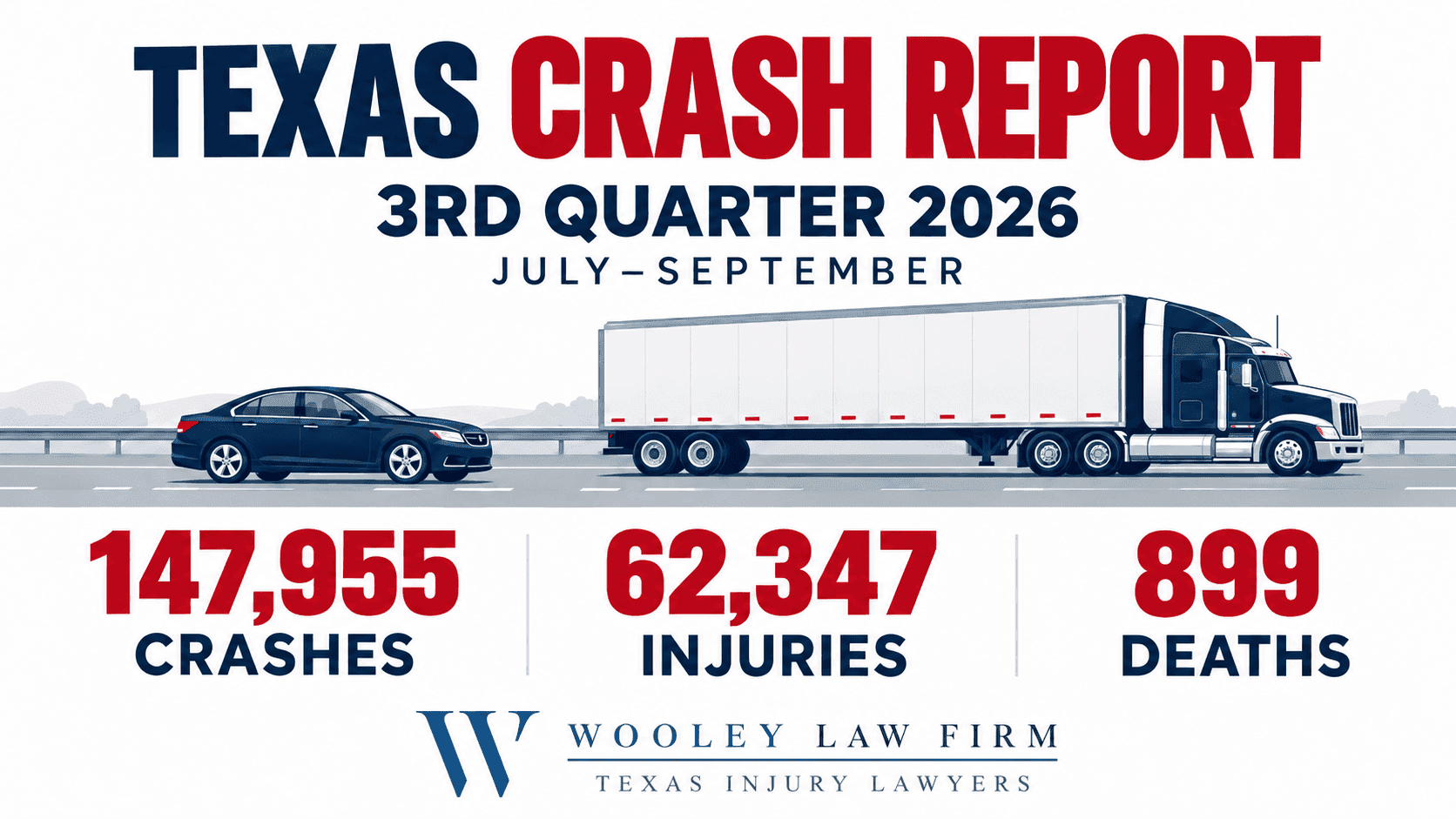
Texas recorded 147,955 crashes, 62,347 injuries and 899 traffic deaths during the third quarter of 2026, based on the combined July, August and September figures compiled for this report. Commercial motor vehicles were involved in 10,681 crashes, with 3,805 injuries and 128 deaths reported in those collisions.
From July 1 through September 30, Dallas recorded 6,469 crashes. Eleven Dallas–Fort Worth cities tracked across all three monthly reports recorded 19,082 crashes combined.
The quarter showed different patterns statewide and locally: commercial motor vehicle crash counts increased each month, while Dallas’s reported crash count declined each month.
For someone injured in a Dallas car wreck or 18-wheeler accident, these figures provide context. Your claim depends on the evidence showing how your collision happened, who was responsible and how the injuries affect your life.
The Wooley Law Firm helps injured people investigate those questions and pursue their claims throughout Dallas–Fort Worth and Texas.
Third-Quarter 2026 Texas Crash Statistics
The third quarter covered 92 days, including July’s 31 days, August’s 31 days and September’s 30 days.
Adding the three monthly reports produces these statewide totals:
147,955 reported crashes
62,347 reported injuries
4,354 suspected serious injuries
899 traffic deaths
Across the quarter, Texas averaged approximately:
1,608 crashes per day
678 injuries per day
47 suspected serious injuries per day
9.8 traffic deaths per day
Suspected serious injuries are included within the injury total. They should not be added again to the 62,347 injuries.
These quarterly figures combine our July 2026 Texas car and truck wreck report, our August 2026 crash report and our September 2026 crash report.
How Did Texas Crashes Change From July Through September?
The monthly statewide totals were:
July: 47,472 crashes, 20,291 injuries and 305 deaths.
August: 50,435 crashes, 21,105 injuries and 296 deaths.
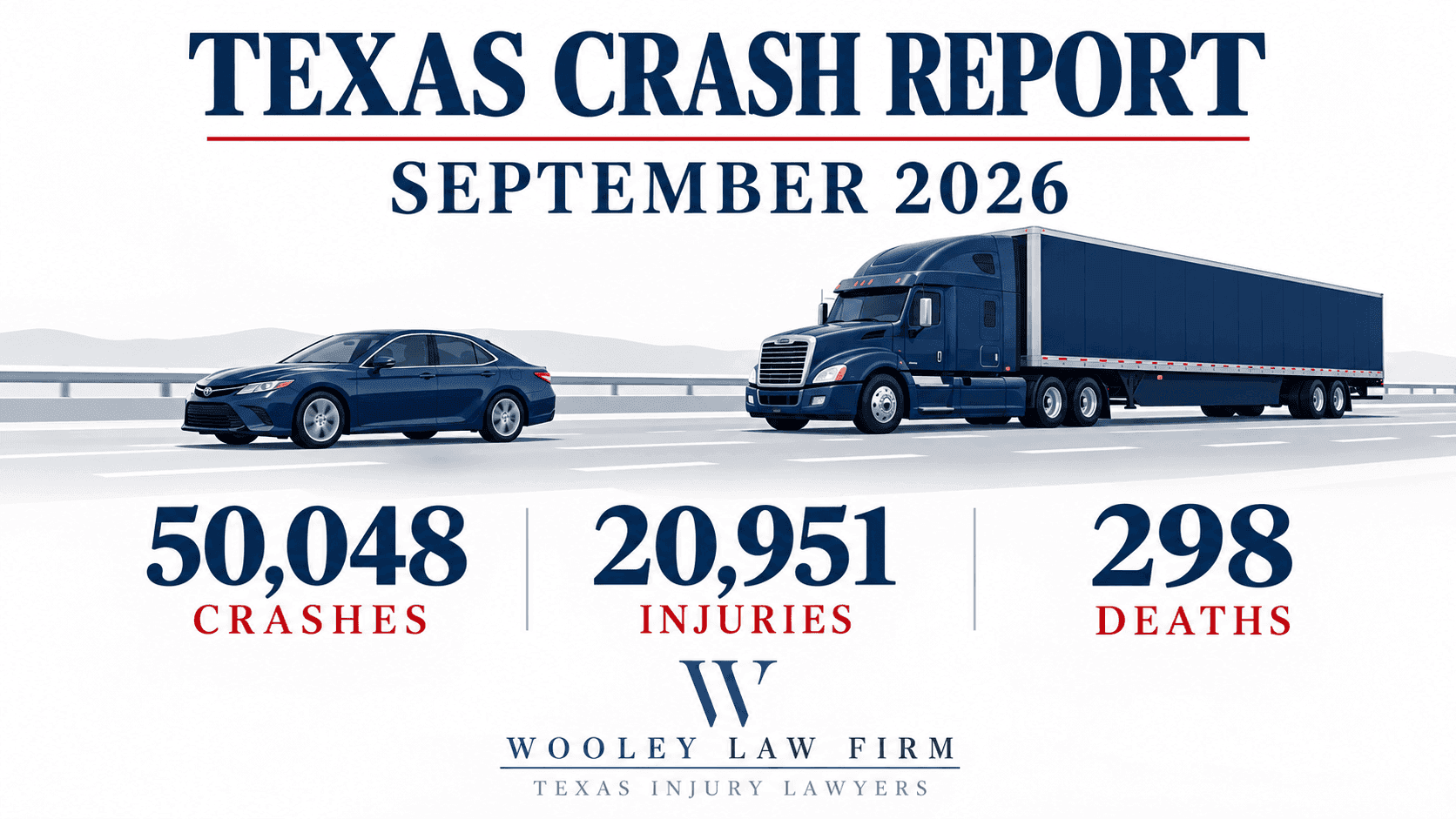
September: 50,048 crashes, 20,951 injuries and 298 deaths.
August had the highest monthly crash and injury totals. July had the highest traffic death total.
However, September had the highest daily crash average because it contained one fewer day:
July: approximately 1,531 crashes per day.
August: approximately 1,627 crashes per day.
September: approximately 1,668 crashes per day.
September’s monthly crash count was 5.4% higher than July’s, while its daily average was 8.9% higher. Compared with August, September had 0.8% fewer total crashes but 2.5% more crashes per day.
Month length matters when comparing totals. Daily averages account for that difference, but they do not account for miles traveled, traffic volume or changes in reporting. These three months alone do not establish a long-term trend or explain why the crashes occurred.
More Than 62,000 Injuries Were Reported During the Quarter
The combined figures include 62,347 injuries, with 4,354 classified as suspected serious injuries. Approximately 7% of reported injuries fell within that serious injury classification.
Behind those numbers are people dealing with hospital treatment, medical appointments, missed work and disruption to family life. A serious collision may require surgery, rehabilitation or ongoing care.
The statistical classification does not establish a person’s diagnosis, recovery time or settlement value. An injury claim requires medical evidence connecting the injuries and treatment to the collision, along with documentation of the person’s losses.
If you are facing these issues after a North Texas collision, our Dallas car accident lawyer page explains how The Wooley Law Firm helps injured drivers and passengers.
Commercial Motor Vehicles Were Involved in 10,681 Texas Crashes
During the third quarter, CMV-involved collisions resulted in:
10,681 crashes
3,805 injuries
392 suspected serious injuries
128 deaths
That averages approximately 116 CMV-involved crashes per day across the quarter.
CMVs were involved in approximately 7.2% of all reported crashes, while CMV-involved collisions accounted for approximately 14.2% of traffic deaths.
Those collisions also accounted for approximately:
6.1% of reported injuries
9% of suspected serious injuries
These figures describe commercial vehicle involvement. They do not establish that commercial drivers caused the collisions or that everyone injured or killed was inside a commercial vehicle.
The category also includes qualifying commercial vehicles beyond tractor-trailers. The 10,681 figure should not be described as 10,681 18-wheeler wrecks.
Commercial Vehicle Crash Counts Increased Each Month
The monthly CMV-involved crash counts were:
July: 3,424 crashes
August: 3,598 crashes
September: 3,659 crashes
September’s count was 6.9% higher than July’s, despite having one fewer day. The daily average increased approximately 10.4%, from about 110 CMV-involved crashes per day in July to 122 in September.
Injuries and deaths did not follow the same steady monthly pattern:
CMV-involved deaths: 50 in July, 37 in August and 41 in September.
Reported injuries: 1,290 in July, 1,212 in August and 1,303 in September.
Suspected serious injuries: 125 in July, 125 in August and 142 in September.
A commercial truck claim may require investigating the driver, motor carrier, equipment, maintenance history and available insurance. Our Dallas truck accident lawyer page discusses how these investigations can differ from passenger-car cases.
Injured in an Accident?
Free consultation. Tell us what happened and learn what options may be available.
Dallas Recorded 6,469 Crashes During the Third Quarter
Dallas’s monthly totals were:
July: 2,246 crashes
August: 2,187 crashes
September: 2,036 crashes
Together, those figures equal 6,469 Dallas crashes, averaging approximately 70 per day during the quarter.
September’s monthly count was 9.3% lower than July’s. Dallas’s daily crash average also declined, from approximately 72 in July to 68 in September.
Fort Worth recorded 4,354 crashes during the quarter:
July: 1,423 crashes
August: 1,426 crashes
September: 1,505 crashes
Dallas and Fort Worth together recorded 10,823 crashes over the three months.
These are all-crash city totals. They do not identify how many collisions involved commercial motor vehicles or how many resulted in injuries.
Eleven Dallas–Fort Worth Cities Recorded 19,082 Crashes
For a consistent regional subtotal, this report uses the same 11 cities with figures available in all three monthly reports:
Dallas — 6,469 crashes
Fort Worth — 4,354
Plano — 1,453
Arlington — 1,227
Irving — 1,097
Denton — 906
Grand Prairie — 879
Garland — 710
Lewisville — 685
Frisco — 674
Mesquite — 628
These cities recorded 19,082 crashes, averaging approximately 207 per day across the quarter.
For this same group, monthly totals were:
July — 6,277 crashes
August — 6,413 crashes
September — 6,392 crashes
This subtotal excludes other Metroplex communities and crashes outside city limits. It should not be described as the total number of DFW wrecks.
The September report includes more cities than the July report. Restricting this calculation to a consistent group avoids comparing regional totals that cover different communities.
Third-Quarter Crash Totals on Major Texas Highways
Combining the monthly figures for selected roadway designations produces the following quarterly totals:
I-10 — 4,181 crashes
I-35 — 3,332
I-45 — 3,159
I-20 — 1,991
I-30 — 1,655
I-69 — 1,481
I-35E — 1,438
U.S. 290 — 1,035
SH 6 — 1,009
I-610 — 919
These are statewide totals for the listed roadway designations. A highway’s count cannot be assigned entirely to Dallas–Fort Worth because the road passes through North Texas.
Raw counts also do not establish which highway is most dangerous. Comparing risk requires considering traffic exposure, roadway length and other factors.
I-20 and I-30
I-20 recorded 1,991 crashes statewide, while I-30 recorded 1,655 during the quarter.
I-20’s monthly count declined from 728 in July to 642 in August and 621 in September.
I-30’s count moved from 542 in July to 532 in August and 581 in September.
After a multi-vehicle wreck, determining the impact sequence can be critical. A vehicle may strike another car because it was pushed forward by a separate collision.
Our article about responsibility for an 18-wheeler chain-reaction crash in Dallas explains why that distinction matters.
I-35E, I-35W and I-635
Quarterly statewide totals included:
I-35E — 1,438 crashes
I-635 — 747
I-35W — 746
The source reports list I-35, I-35E and I-35W separately. This article preserves those separate roadway entries.
For a person injured on one of these corridors, relevant evidence may include vehicle damage, dashcam footage, witness accounts and available electronic data showing vehicle movements before impact.
U.S. 75 and Other Roads Serving North Texas
Additional quarterly statewide totals included:
U.S. 75 — 837 crashes
U.S. 67 — 546
SH 121 — 531
U.S. 287 — 453
The figures show reported crash activity. They do not identify whether a particular collision involved speeding, distraction, a lane change, a truck or another circumstance.
Why Individual Evidence Matters After a Dallas Car or Truck Wreck
Quarterly statistics cannot establish responsibility for an individual crash. A useful investigation may include:
The police crash report and available officer recordings
Photographs of the scene and vehicle damage
Dashcam footage and nearby surveillance video
Independent witness accounts and 911 calls
Available vehicle event data
Medical records and documentation of missed work
Commercial truck cases may also require preserving:
Available onboard camera footage
Engine, braking, GPS and telematics data
Dispatch communications
Applicable electronic logging and hours-of-service records
Inspection, maintenance, brake and tire records
Cargo and loading documents
Tractor and trailer ownership and leasing records
The tractor owner, trailer owner, motor carrier and maintenance provider may be different businesses. Liability depends on evidence connecting a party’s conduct to the collision and injuries.
Some video and electronic records may be overwritten, and repairs can change physical evidence. Identifying and preserving relevant material early can help an attorney evaluate disputed accounts of the wreck.
What to Do After a Serious Dallas Wreck
Call 911 and request appropriate help. Keep the responding agency’s name and report number when available.
Obtain medical attention. Accurately describe your symptoms and follow treatment recommendations.
Preserve photographs and video. When safe, document vehicle damage, roadway conditions and identifying information.
Keep witness contact information. Independent accounts may help resolve conflicting descriptions of the crash.
Save records of your losses. Keep medical paperwork, receipts, wage information and insurance communications.
Understand a proposed release before signing. Consider whether your injuries, ongoing treatment and future needs have been adequately evaluated.
For a truck collision, photographs showing the company name, USDOT number, tractor plate and trailer plate may help identify the businesses connected to the equipment.
Frequently Asked Questions About Third-Quarter 2026 Texas Crashes
How many crashes occurred in Texas during Q3 2026?
The combined July, August and September figures show 147,955 reported crashes from July 1 through September 30, 2026.
How many injuries and deaths were reported?
The combined figures show 62,347 injuries, including 4,354 suspected serious injuries, and 899 deaths.
How many crashes involved commercial motor vehicles?
CMVs were involved in 10,681 crashes, with 3,805 injuries, 392 suspected serious injuries and 128 deaths reported in those collisions.
How many crashes occurred in Dallas?
Dallas recorded 6,469 crashes during the quarter, averaging approximately 70 per day.
Did September have more crashes than August?
September had fewer total crashes: 50,048 compared with 50,435. However, September had the higher daily average because it had 30 days rather than 31.
Are the highway totals limited to Dallas–Fort Worth?
No. The highway figures are statewide counts for the listed roadway designations. The city totals use their respective city boundaries.
Speak With a Dallas Car Wreck or Truck Wreck Lawyer
A serious collision can leave you dealing with injuries, lost income, vehicle damage and disputed insurance claims. Understanding what happened and preserving the evidence are important steps toward evaluating your options.
The Wooley Law Firm represents people injured in car accidents, 18-wheeler wrecks and other commercial vehicle collisions throughout Dallas–Fort Worth and Texas.
Call (214) 699-6524 for a free consultation or contact The Wooley Law Firm online. You don’t pay unless we win.
Sources and Data Note
This report adds the figures published in The Wooley Law Firm’s July and August 2026 crash reports to the September 2026 figures supplied for this analysis. The quarterly totals are calculations from those monthly figures, rather than a separately retrieved quarterly CRIS extract.
TxDOT maintains the Crash Records Information System and explains its resources through its crash data analysis and statistics page. txdot.gov
Crash reports may be supplemented or corrected, and monthly extracts can reflect different retrieval dates. Calculations assume consistent definitions and query settings across the three months. Daily averages use 92 days for the quarter, and percentage changes use unrounded values.
The regional subtotal includes only the same 11 cities available in all three reports. Highway counts are statewide designation totals. CMV figures identify involvement, not fault.
This article is for general informational purposes only and is not legal advice. Reading it does not create an attorney-client relationship. Every case is different.
Topics
Share This Article

Andrew J. Wooley
Personal Injury Attorney
Andrew J. Wooley is a dedicated personal injury attorney based in Dallas, Texas. He focuses on helping accident victims recover fair compensation for their injuries. With a commitment to personalized service, Andrew works directly with each client to understand their unique situation and fight for their rights.
Related Local News
Recent related coverage