
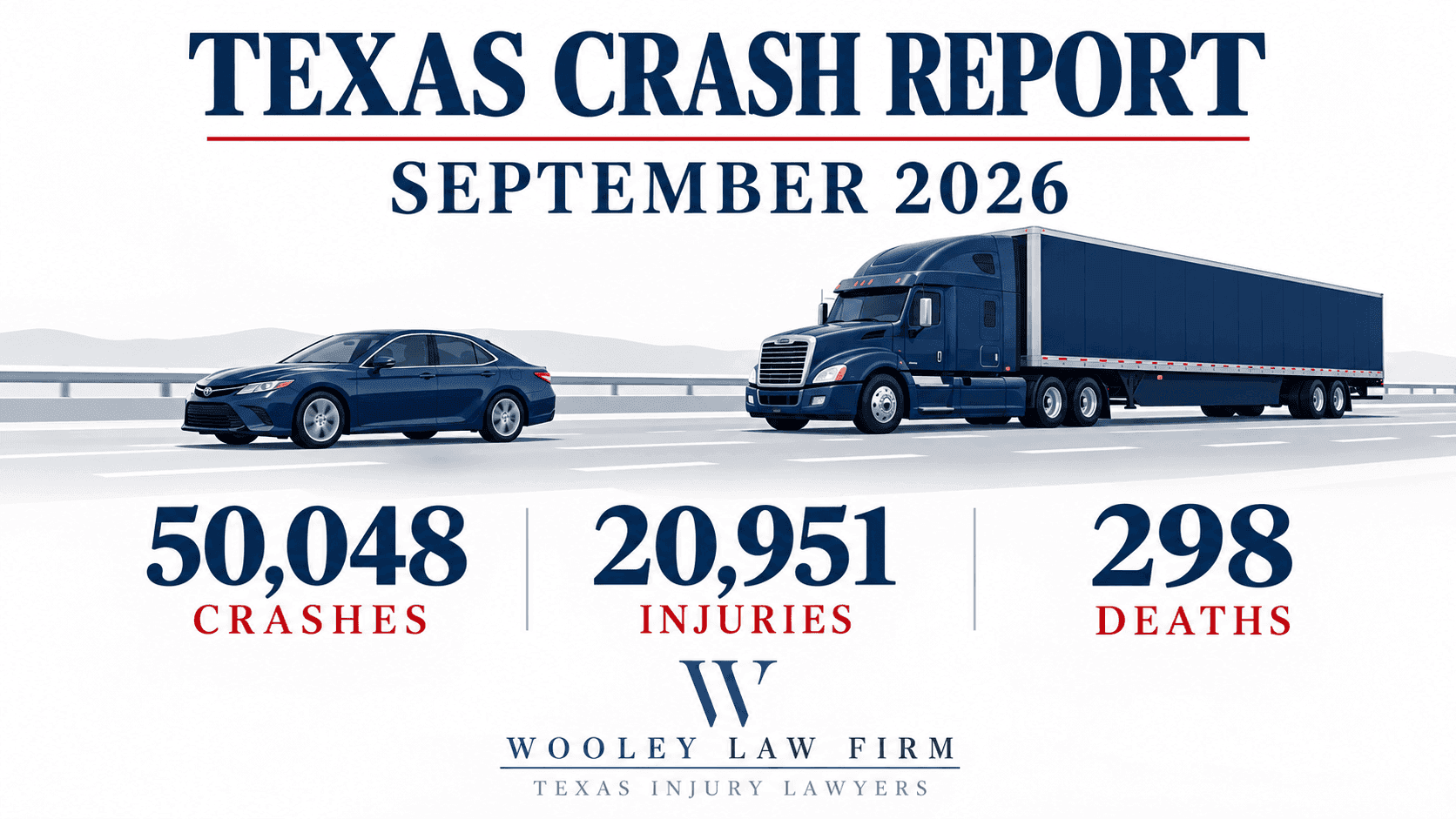
Texas recorded 50,048 crashes, 20,951 injuries and 298 deaths during September 2026, according to the monthly figures compiled for this article. Commercial motor vehicles were involved in 3,659 crashes, resulting in 41 deaths, 1,303 injuries and 142 suspected serious injuries.
In North Texas, Dallas recorded 2,036 crashes, while Fort Worth recorded 1,505. Eighteen selected Dallas–Fort Worth cities accounted for a combined 7,299 wrecks during the month.
Compared with August, September had slightly fewer total crashes but more crashes per day, more traffic deaths and increases across every reported commercial motor vehicle measure.
For someone injured in a Dallas car accident or 18-wheeler wreck, these statistics provide context. An individual claim depends on what caused the collision, who was responsible, what injuries resulted and what evidence remains available.
The Wooley Law Firm represents people injured in serious car and commercial truck collisions throughout Dallas–Fort Worth and Texas. Our Dallas car accident lawyer and Dallas truck accident lawyer pages explain how we help investigate crashes and pursue injury claims.
September 2026 Texas Crash Statistics
The statewide September figures include:
50,048 crashes
101,433 units involved
124,852 people involved
20,951 injuries
1,459 suspected serious injuries
298 deaths
Across September’s 30 days, those figures average approximately:
1,668 crashes per day
698 injuries per day
49 suspected serious injuries per day
10 deaths per day
The number of people involved does not mean every person was injured. Likewise, suspected serious injuries are included within the injury total and should not be added to it.
“Units” retains the terminology of the supplied report and is separate from the number of people involved.
More Than 20,000 People Were Injured in September Texas Wrecks
September crashes resulted in 20,951 reported injuries, including 1,459 suspected serious injuries.
Approximately 7% of reported injuries fell within the suspected serious injury classification.
A serious car or truck wreck can leave someone facing emergency treatment, diagnostic imaging, surgery, rehabilitation and substantial time away from work. Injuries may affect a person’s ability to drive, care for children, perform household tasks or return to the same occupation.
The statistical classification alone does not establish a person’s diagnosis, prognosis or claim value. Those questions require medical records and evidence specific to the person injured.
Before resolving a serious injury claim, it is important to understand ongoing treatment, work restrictions and potential future medical needs.
Commercial Motor Vehicles Were Involved in 3,659 September Crashes
September’s commercial motor vehicle figures include:
3,659 crashes involving a CMV
41 deaths
1,303 injuries
142 suspected serious injuries
That averages approximately 122 CMV-involved crashes per day.
CMVs were involved in approximately 7.3% of Texas crashes, while CMV-involved collisions accounted for approximately 13.8% of traffic deaths.
Those collisions also accounted for approximately:
6.2% of reported injuries
9.7% of suspected serious injuries
These figures describe commercial vehicle involvement. They do not mean commercial drivers caused every collision, or that everyone injured or killed was inside the commercial vehicle.
The CMV category should also not be treated as interchangeable with 18-wheelers. It can encompass qualifying trucks, buses and other commercial vehicles.
Responsibility must be determined from the evidence in each case.
How Did September 2026 Texas Wrecks Compare With August?
Compared with the figures in our August 2026 Texas car and truck wreck report, September had slightly fewer total crashes and injuries, but more traffic deaths and more commercial motor vehicle crashes.
The monthly statewide comparison shows:
Total crashes decreased 0.8%, from 50,435 in August to 50,048 in September—a decline of 387 crashes.
Injuries decreased 0.7%, from 21,105 to 20,951—a decline of 154.
Suspected serious injuries decreased 3.6%, from 1,514 to 1,459—a decline of 55.
Traffic deaths increased from 296 to 298, an increase of two deaths, or approximately 0.7%.
September Had More Crashes Per Day Despite a Lower Monthly Total
August had 31 days, while September had 30.
Accounting for that difference, the daily crash average increased approximately 2.5%, from 1,627 crashes per day in August to 1,668 in September.
Reported injuries increased from approximately 681 per day to 698 per day, a 2.6% increase.
Traffic deaths averaged approximately 9.5 per day in August and 9.9 in September, a 4.0% increase based on the unrounded daily averages.
Although September’s monthly crash total was slightly lower, crashes occurred more frequently per day. These averages account for month length but do not account for traffic volume or miles traveled.
Commercial Vehicle Crashes, Injuries and Deaths All Increased
The commercial motor vehicle comparison showed increases across every reported measure:
CMV-involved crashes increased 1.7%, from 3,598 in August to 3,659 in September.
Injuries in CMV-involved crashes increased 7.5%, from 1,212 to 1,303.
Suspected serious injuries increased 13.6%, from 125 to 142.
Deaths increased 10.8%, from 37 to 41.
Despite having one fewer day, September recorded more CMV-involved crashes and more casualties in those collisions than August.
On a daily basis, CMV-involved crashes increased approximately 5.1%, from 116 to 122 per day.
CMV-involved collisions accounted for approximately 13.8% of September traffic deaths, compared with 12.5% in August.
Dallas Crashes Declined While Fort Worth Crashes Increased
Dallas recorded 2,036 crashes in September, compared with 2,187 in August—a 6.9% decrease.
Its daily average also declined, from approximately 71 crashes to 68.
Fort Worth recorded 1,505 crashes in September, compared with 1,426 in August—a 5.5% increase. Its daily average rose from 46 crashes to approximately 50.
For a consistent regional comparison, the same 12 cities included in the August report recorded 6,573 crashes in September, compared with 6,635 in August.
Those cities were Dallas, Fort Worth, Plano, Arlington, Irving, Denton, Grand Prairie, Frisco, Garland, Carrollton, Lewisville and Mesquite.
That represents a 0.9% decrease in the monthly total, but a 2.4% increase in crashes per day.
September’s larger 7,299-crash subtotal covers 18 cities and should not be compared directly with August’s 12-city subtotal.
I-30 and I-35E Recorded Higher Statewide Crash Totals
Among the roadway designations serving Dallas–Fort Worth:
I-30 increased 9.2%, from 532 crashes in August to 581 in September.
I-35E increased 4.5%, from 464 to 485.
I-35W increased 2.5%, from 239 to 245.
I-635 increased 1.2%, from 252 to 255.
I-20 decreased 3.3%, from 642 to 621.
U.S. 75 decreased 9.0%, from 301 to 274.
These are statewide monthly totals for each roadway designation, not counts limited to Dallas–Fort Worth.
I-20’s daily average was essentially unchanged at approximately 20.7 crashes per day in both months.
The comparison shows how September differed from August. Two months alone do not establish a long-term trend or explain why individual crashes occurred.
Which Texas Cities Had the Most Crashes in September?
The highest city totals in the supplied September breakdown were:
Houston — 4,546 crashes
San Antonio — 3,849
Dallas — 2,036
El Paso — 1,622
Fort Worth — 1,505
Austin — 895
Laredo — 758
Lubbock — 592
Amarillo — 520
Plano — 481
Other substantial totals included:
Corpus Christi — 480 crashes
Arlington — 442
Irving — 398
Tyler — 336
Odessa — 335
Beaumont — 333
Denton — 332
Waco — 319
Conroe — 318
Pasadena — 314
Grand Prairie — 303
Another 11,680 crashes occurred outside city limits statewide. That is a separate geographic category, not a city or a count of DFW crashes.
Raw city totals do not establish which city has the greatest risk per driver. Population, traffic volume, road mileage and travel patterns affect comparisons.
Injured in an Accident?
Free consultation. Tell us what happened and learn what options may be available.
Dallas Recorded Approximately 68 Wrecks Per Day
Dallas’s 2,036 September crashes averaged approximately 68 wrecks per day.
A Dallas car wreck may involve disputed intersection fault, an unsafe lane change, a rear-end impact, a commercial vehicle or a chain-reaction collision.
The citywide count does not establish how any individual crash happened. A proper investigation may require reviewing the police report alongside photographs, video, witness accounts and available vehicle data.
If an insurer disputes responsibility, that evidence may become central to the claim.
Selected Dallas–Fort Worth Cities Recorded 7,299 Crashes
The September figures show how collisions affected communities throughout North Texas:
Dallas — 2,036
Fort Worth — 1,505
Plano — 481
Arlington — 442
Irving — 398
Denton — 332
Grand Prairie — 303
Lewisville — 245
Garland — 234
Mesquite — 211
Frisco — 205
Carrollton — 181
Rockwall — 147
Richardson — 140
McKinney — 122
Waxahachie — 109
Mansfield — 106
Weatherford — 102
Together, these 18 cities recorded 7,299 crashes, averaging approximately 243 per day.
This is a selected-city subtotal, not a complete Metroplex total. It excludes other communities and crashes outside municipal boundaries.
These figures include all reported crashes in the listed cities. The supplied city breakdown does not identify how many involved commercial motor vehicles.
Which Texas Highways Had the Most Reported Crashes?
The highest totals in the supplied roadway breakdown included:
I-10 — 1,370 crashes
I-35 — 1,111
I-45 — 1,036
I-20 — 621
I-30 — 581
I-69 — 501
I-35E — 485
U.S. 290 — 351
I-410 — 335
SH 6 — 320
Other substantial totals included:
I-610 — 300 crashes
Loop 8 — 296
U.S. 281 — 293
U.S. 75 — 274
Loop 1604 — 272
U.S. 69 — 266
I-2 — 256
I-635 — 255
I-35W — 245
U.S. 90 — 242
These are statewide totals for the listed roadway designations. A highway’s total cannot be assigned entirely to Dallas or DFW simply because the road passes through North Texas.
The figures also do not establish which highway is most dangerous. A meaningful comparison of risk would account for traffic exposure, roadway length and other relevant factors.
September Crash Counts on Highways Serving Dallas–Fort Worth
Several roads familiar to North Texas drivers appeared prominently in the statewide breakdown.
I-20 — 621 Crashes
I-20 recorded 621 crashes statewide in September, compared with 642 in August.
For someone injured in an I-20 wreck, the investigation may need to establish whether the collision involved a traffic backup, unsafe lane change, rear-end impact or chain reaction.
The monthly count does not identify which circumstances caused those crashes.
I-30 — 581 Crashes
I-30 recorded 581 crashes statewide, up from 532 in August.
A multi-vehicle collision can require careful reconstruction of the impact sequence. The vehicle that ultimately hits an injured person may have been pushed forward by another vehicle.
Photographs, video and witness accounts may help distinguish the initial collision from later impacts.
I-35E — 485 Crashes
I-35E recorded 485 crashes statewide, compared with 464 in August.
A serious commercial truck collision may require preserving dashcam footage, available electronic vehicle data, dispatch communications and maintenance records.
Our article on 18-wheeler wrecks on I-35E in Dallas discusses issues that may arise after a serious crash on that corridor.
U.S. 75 — 274 Crashes
U.S. 75 recorded 274 crashes statewide, down from 301 in August.
After a disputed lane-change or rear-end collision, investigators may examine vehicle damage, roadway markings, video and available electronic data to determine what happened.
I-635 — 255 Crashes
I-635 recorded 255 crashes, compared with 252 in August.
After a rear-end collision in stopped traffic, evidence may need to establish when the backup became visible, how drivers reacted and whether another impact pushed a vehicle forward.
Read more about being rear-ended by an 18-wheeler while stopped in Dallas traffic.
I-35W — 245 Crashes
I-35W recorded 245 crashes statewide, compared with 239 in August.
The report lists I-35, I-35E and I-35W separately. This article preserves those separate entries rather than combining them into a new total.
Other Roadways Serving North Texas
Additional statewide roadway totals included:
U.S. 183 — 177 crashes
U.S. 67 — 171
SH 121 — 152
SH 183 — 151
U.S. 287 — 147
Loop 12 — 144
I-820 — 134
U.S. 380 — 128
U.S. 80 — 123
U.S. 377 — 121
SH 114 — 105
SH 360 — 98
SH 78 — 83
SH 289 — 78
Dallas North Tollway — 74
U.S. 183 and SH 183 are separate report entries. The Dallas North Tollway figure reflects the supplied designation and should not be represented as including every frontage-road or related street-name entry.
Three Killed in Robertson County Semitruck Crash on September 11
September’s crash reports describe the people and families behind the statistics.
According to KBTX/Gray News reporting carried by Valley News Live, a semitruck hauling livestock crashed near FM 485 and Zane Wallace Road in Robertson County shortly after 9 p.m. on September 11.
Troopers reported that the westbound truck left the roadway, overturned and struck a tree. The driver and two passengers, including a 12-year-old girl, died.
No other vehicles were involved, and the investigation remained ongoing when the report was published.
The reported sequence does not, by itself, establish why the truck left the roadway. A rollover investigation may examine physical evidence, available electronic data, vehicle condition, cargo and roadway conditions without assuming which factor caused the crash.
Two Died After a Freightliner–Honda Crash in Fort Bend County
On September 1, a Freightliner and a Honda collided on U.S. Highway 90 near FM 1952 in Fort Bend County.
ABC13’s initial report attributed preliminary information to DPS indicating that the westbound Honda entered the eastbound lane and collided with the Freightliner.
The 66-year-old truck driver died at the scene, while the teenage Honda driver and a child passenger were hospitalized.
A subsequent Wharton Post report said DPS confirmed that the 16-year-old driver also died from her injuries, bringing the reported death toll to two.
This collision illustrates why commercial vehicle involvement must be distinguished from commercial driver fault. Preliminary accounts described the passenger vehicle entering the truck’s lane; the reason remained under investigation.
Navasota School Bus Carrying 30 Students Was Rear-Ended September 24
The Navasota Examiner reported that a school bus carrying 30 students and two adults was struck on SH 105 near County Road 446 on September 24.
According to the DPS account in the article, the bus was westbound in stop-and-go traffic when a Dodge 3500 failed to control its speed, struck the bus’s rear left side and then sideswiped it.
Eleven students reported minor pain and were taken to a hospital. Other students were transported for optional evaluation or pickup by parents. The pickup driver was also hospitalized with suspected minor injuries.
The report does not establish that all 30 students were injured or that the Dodge was operating as a commercial vehicle. Neither conclusion should be assumed.
Why a Dallas Truck Wreck Requires a Detailed Investigation
A commercial truck case can involve records held by several businesses.
Depending on the vehicle and circumstances, important evidence may include:
Dashcam footage and nearby surveillance video
Available engine, braking, GPS and telematics data
Electronic logging and hours-of-service records, where applicable
Dispatch messages and delivery schedules
Inspection and maintenance records
Brake and tire records
Driver qualification and training records
Cargo and loading documents
Tractor and trailer ownership records
Leasing agreements and insurance information
The driver, motor carrier, equipment owner and maintenance provider may be different people or companies.
Their involvement alone does not establish liability. The evidence must connect a responsible party’s conduct to the collision and resulting harm.
A Dallas truck wreck lawyer can identify which records matter, seek their preservation and evaluate available insurance coverage. Some video and electronic records may be overwritten, and physical evidence may change when vehicles are repaired.
What Evidence Matters After a Dallas Car Accident?
An ordinary passenger-vehicle collision can also require substantial investigation, especially when drivers give conflicting accounts.
Important evidence may include:
The police crash report
Photographs of vehicle damage and the scene
Dashcam footage
Nearby business or residential surveillance video
Independent witness statements
911 calls
Available vehicle event data
Scene measurements and roadway markings
Medical records documenting the injuries
Employment records documenting missed work
Camera availability varies. A camera visible near a highway does not necessarily produce a stored recording, so investigators should also consider dashcams, nearby businesses and other sources.
Statewide statistics cannot establish who caused a particular Dallas car wreck. Evidence from the individual collision is what matters.
What to Do After a Dallas Car or Truck Wreck
After a serious collision, practical steps can help protect your health and preserve information:
Call 911 and request help. Obtain the responding agency’s name and report number when available.
Get appropriate medical attention. Describe your symptoms accurately and follow treatment recommendations.
Preserve photographs and video. If safe, document vehicle positions, damage, lane markings and identifying information on commercial vehicles.
Keep witness information. Independent witnesses may help explain disputed events.
Save records of your losses. Keep medical paperwork, wage information, receipts and insurance communications.
Get advice before settling. A release may resolve claims before you know the full extent of your injuries and future needs.
If a commercial truck was involved, preserve any photographs showing the company name, USDOT number, tractor plate, trailer plate and identifying numbers on the equipment.
Those details may help identify businesses and insurance policies connected to the collision.
Frequently Asked Questions About September 2026 Texas Wrecks
How many crashes happened in Texas in September 2026?
The supplied September figures show 50,048 crashes involving 101,433 units and 124,852 people.
How many people were injured in September Texas crashes?
The figures list 20,951 injuries, including 1,459 suspected serious injuries.
How many people died in Texas traffic crashes in September?
The September figures show 298 deaths, compared with 296 in August.
How many crashes involved commercial motor vehicles?
There were 3,659 CMV-involved crashes, with 41 deaths, 1,303 injuries and 142 suspected serious injuries reported in those collisions.
Did commercial vehicle crashes increase compared with August?
Yes. CMV-involved crashes increased from 3,598 in August to 3,659 in September, a 1.7% increase. Injuries, suspected serious injuries and deaths in those collisions also increased.
How many wrecks occurred in Dallas?
Dallas recorded 2,036 crashes, averaging approximately 68 per day.
Were September crashes lower than August?
The statewide monthly crash total decreased 0.8%, but the daily average increased 2.5% because September had one fewer day.
Were all the I-20 and I-30 crashes in Dallas–Fort Worth?
No. The 621 I-20 crashes and 581 I-30 crashes are statewide roadway-designation totals, not DFW-only counts.
Does a commercial vehicle’s involvement prove the trucking company caused the crash?
No. Responsibility depends on evidence showing how the collision occurred and whose conduct contributed to it.
Talk to a Dallas Car Wreck or Truck Wreck Lawyer
If you were injured in a Dallas car accident or 18-wheeler wreck, your claim depends on the facts of your collision, your injuries, your losses and the available coverage.
The Wooley Law Firm represents people injured in serious car and commercial truck collisions throughout Dallas–Fort Worth and Texas.
We can evaluate disputed liability, identify evidence to preserve and explain the next steps in pursuing a claim.
Call (214) 699-6524 for a free consultation or contact The Wooley Law Firm online. You don’t pay unless we win.
Sources and Data Note
September statistics and geographic breakdowns are based on the figures compiled for this article and supplied by The Wooley Law Firm. August comparisons use the figures published in the firm’s August 2026 crash report.
Totals reflect those datasets and may change as reports are supplemented or corrected. Comparisons assume consistent reporting definitions and query settings. Percentage changes use unrounded figures.
TxDOT explains its crash-data resources through its crash data analysis and statistics page.
Crash-news summaries rely on the linked reporting. They are separate illustrations, not additional crashes or casualties to add to the statewide totals. They should not be treated as proof of a common cause, a statewide trend or any party’s legal liability.
This article is for general informational purposes only and is not legal advice. Reading it does not create an attorney-client relationship. Every case is different.
Topics
Share This Article

Andrew J. Wooley
Personal Injury Attorney
Andrew J. Wooley is a dedicated personal injury attorney based in Dallas, Texas. He focuses on helping accident victims recover fair compensation for their injuries. With a commitment to personalized service, Andrew works directly with each client to understand their unique situation and fight for their rights.
Related Local News
Recent related coverage