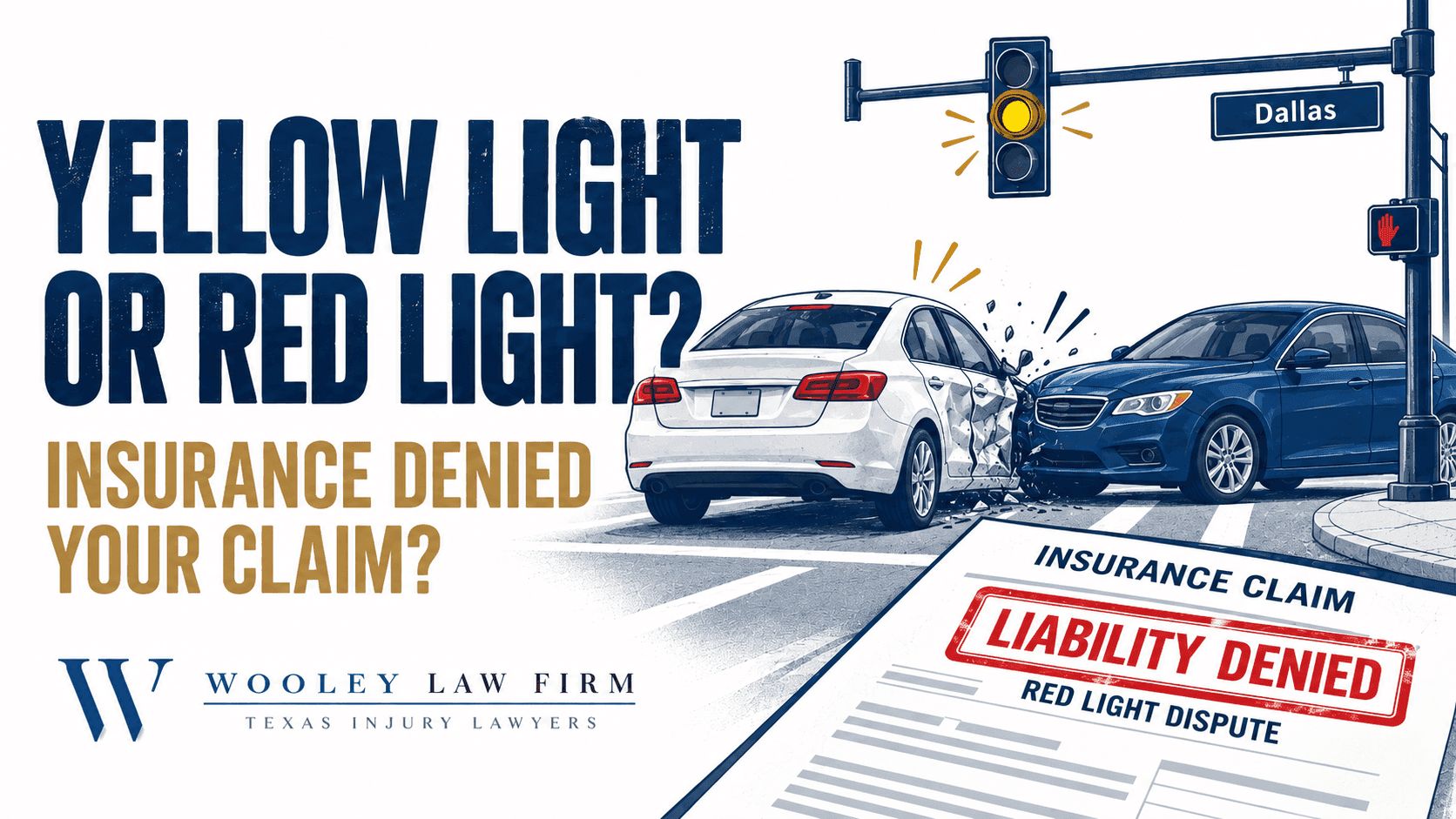
You are approaching an intersection in Dallas when the traffic light turns yellow.
You continue through the intersection.
Then another vehicle enters from the cross street and hits you.
After the wreck, you tell the police that your light was yellow when you entered the intersection.
The other driver tells a completely different story.
They claim your light was already red.
Now their insurance company says you ran the red light, caused the collision, and are responsible for your own injuries.
Or the adjuster tells you there is no way to know who is telling the truth and denies your claim because it is simply “your word against our insured’s.”
Do not assume that ends your case.
A disputed yellow-light intersection crash may come down to fractions of a second, where each vehicle was when the signal changed, the sequence of the traffic lights, surveillance footage, dashcam video, witnesses, vehicle damage, and other evidence the insurance company may not have investigated.
If you were injured in a Dallas intersection accident and the insurance company is blaming you for allegedly running a red light, a Dallas car wreck lawyer can investigate whether objective evidence shows that you actually entered the intersection while your signal was still yellow.
Is It Illegal to Enter an Intersection on a Yellow Light in Texas?
Not simply because the light is yellow.
Texas Transportation Code § 544.007 explains what the different traffic signals mean.
Under Texas law, a steady yellow signal warns a driver that:
The movement authorized by the green signal is ending; or
A red signal is about to be displayed.
That is different from a steady red signal.
A driver facing a steady red light generally must stop at the marked stop line, or at the appropriate location before entering the intersection when there is no stop line.
That distinction can become extremely important after a crash.
If you crossed into the intersection while the signal was still yellow, that is not the same factual situation as entering the intersection after the light had already turned red.
And that may be exactly what the insurance company is disputing.
The Important Question May Be When You Entered the Intersection
After a serious intersection crash, people often focus on what color the light was at the exact moment of impact.
But that may not tell the entire story.
Suppose you entered the intersection while your light was yellow.
While you were crossing the intersection, your light turned red.
A moment later, the cross-traffic signal turned green.
The collision then happened while you were still clearing the intersection.
The fact that your signal may have been red at the instant of impact does not necessarily establish that you entered the intersection against a red light.
The timing matters.
One of the central questions may be:
What color was your traffic signal when your vehicle crossed the stop line and entered the intersection?
That can be very different from asking what color the signal displayed several seconds later when the vehicles collided.
A Driver With a Green Light Does Not Automatically Get to Hit a Vehicle Already in the Intersection
There is another important part of Texas traffic law.
A driver facing a circular green signal may proceed, but Texas law also requires that driver to yield the right of way to vehicles lawfully in the intersection when the green signal is displayed.
That can matter in a yellow-light collision.
Imagine that you lawfully entered an intersection while your signal was yellow.
Before you completely clear the intersection, the perpendicular traffic signal turns green.
A driver on the cross street immediately accelerates into the intersection and hits your vehicle.
That case may require much more analysis than simply saying:
“The other driver had a green light.”
The investigation should determine when each vehicle entered, where each vehicle was located as the lights changed, and whether a vehicle was already lawfully occupying the intersection.
Why Insurance Companies Dispute Yellow-Light Accidents
Yellow-light crashes are attractive cases for an insurance company to dispute because the difference between the two versions may be only a second or two.
You say:
“The light was yellow when I crossed the line.”
Their insured says:
“No. They ran a red light.”
If there is no obvious video and the police officer did not witness the collision, the adjuster may characterize the claim as a credibility contest.
The insurance company may argue:
You entered after the light turned red;
You accelerated to “beat” the yellow light;
You should have stopped when the light changed;
Their insured had a green light;
The police report blames you;
There are no independent witnesses;
There is no proof showing what color the signal was; or
Both drivers give conflicting statements, so liability cannot be established.
But a Dallas intersection wreck does not necessarily have to remain a “he said, she said” case.
The question becomes whether there is independent evidence capable of reconstructing the timing of the collision.
Traffic-Signal Timing May Be Important Evidence
In a disputed yellow-light crash, understanding how the particular intersection operates can be critical.
Depending on the intersection and the evidence available, an investigation may look at information concerning:
The length of the green interval;
The yellow interval;
The sequence of the traffic signals;
Protected turn arrows;
Red-clearance or all-red intervals;
Traffic-actuated signals;
Intersection signal plans;
Maintenance records;
Reported signal malfunctions; and
Changes made to the intersection before or after the collision.
This information can sometimes be compared with video or witness testimony.
For example, suppose surveillance video shows your vehicle entering the intersection at a certain point in the signal cycle. Signal information may help determine whether your account that the light was still yellow is consistent with the timing of the intersection.
A Dallas car accident lawyer investigating a disputed intersection collision may seek this information before simply accepting the insurance company's version of events.
Surveillance Video Can Be Critical in a Yellow-Light Crash
Video may be some of the strongest evidence in a disputed traffic-light case.
Many Dallas intersections are surrounded by:
Gas stations;
Convenience stores;
Restaurants;
Banks;
Apartment complexes;
Office buildings;
Shopping centers;
Parking garages;
Hotels;
Schools;
Churches; and
Homes with security cameras.
A camera does not necessarily need to show the traffic light itself.
Video may show:
Your vehicle approaching the intersection;
The flow of traffic around you;
Other vehicles beginning to stop;
Cross traffic remaining stopped;
When cross traffic begins moving;
Your vehicle's position when other vehicles start moving;
The point of impact; and
How far you had traveled through the intersection before the collision.
Those details can help reconstruct the timing of the crash even when the signal itself is outside the camera's view.
The problem is that surveillance footage can disappear.
Many recording systems overwrite older footage automatically.
That is why identifying possible cameras and attempting to preserve video early can be important after a disputed intersection wreck.
Injured in an Accident?
Free consultation. Tell us what happened and learn what options may be available.
Dashcam Footage Can Resolve the Dispute Quickly
Dashcam footage can be even more direct.
A camera may show:
The traffic signal as you approached;
When the signal changed from green to yellow;
Your distance from the intersection when it changed;
When your vehicle crossed the stop line;
Whether another vehicle entered from the cross street;
Whether another driver accelerated immediately after getting a green light;
Your speed before impact;
Braking before the collision; and
The impact itself.
The dashcam does not have to belong to you.
Useful footage may come from:
Another driver;
A rideshare vehicle;
A delivery vehicle;
A commercial truck;
A bus; or
A witness traveling behind either vehicle.
The Wooley Law Firm has previously discussed how dashcam evidence can help prove fault after a Dallas car or truck wreck, particularly when another driver later gives a different account of the collision.
Witnesses May Remember Which Light Changed First
Independent witnesses can also become important.
Another driver may have been stopped at the intersection and watched the entire sequence.
A pedestrian may have been waiting to cross.
Someone in the vehicle behind you may have seen your light turn yellow before you entered.
A driver waiting on the cross street may know whether their own light was still red when you entered the intersection.
Witnesses may be able to answer questions such as:
Was your vehicle already in the intersection before cross traffic began moving?
Did the other vehicle enter immediately when its light changed?
Did one driver appear to accelerate to beat the light?
Was the collision near the beginning or far side of the intersection?
Which traffic began moving first?
A witness who has no connection to either driver can be particularly valuable when the insurer claims there is no way to decide which driver's story is accurate.
Vehicle Damage and the Point of Impact Can Help Reconstruct What Happened
The location of the impact may also provide clues.
Suppose the front of the other driver's vehicle strikes the rear passenger side of your vehicle.
That may suggest your vehicle had already traveled a substantial distance through the intersection before the other vehicle reached the point of impact.
That fact alone may not prove what color the light was.
But it may become important when combined with:
Signal timing;
Video;
Witness statements;
Vehicle speeds;
Skid marks;
Roadway measurements;
Debris locations;
Vehicle resting positions; and
Electronic vehicle data.
A serious disputed-liability case should look at the entire collision sequence rather than focusing on one isolated fact.
What If the Police Report Says You Ran the Red Light?
A police report can create problems for an injury claim, particularly when the officer lists you as the driver who disregarded a traffic signal.
But that does not necessarily mean the officer personally saw you run the light.
In most car wrecks, the officer arrives after the collision.
The officer may rely on:
Statements from the drivers;
Witness accounts;
Vehicle damage;
Final resting positions;
Roadway evidence;
Citations; and
Information available at the scene.
The officer may not have surveillance video discovered days later.
The officer may not have dashcam footage.
The officer may not have obtained detailed traffic-signal timing information.
The officer may never have spoken with a witness who left before police arrived.
If you told the officer that you entered on yellow and the other driver claimed you entered on red, the officer may have faced the same disputed factual question as the insurance company.
The Wooley Law Firm has also written about what happens when the crash report blames both drivers after a disputed Dallas red-light collision.
What If the Other Driver Says Their Light Was Green?
That does not automatically answer when you entered the intersection.
Both statements could potentially relate to different moments in the same signal cycle.
You may have entered while your light was yellow.
Your signal may then have turned red.
After an appropriate signal transition, the other driver's light may have turned green while you were still completing your movement through the intersection.
That is why a proper investigation should not stop with:
“My insured had a green light.”
The more useful questions include:
When did their light turn green?
Where was your vehicle when that happened?
Were you already lawfully in the intersection?
When did the other driver begin moving?
Where did the collision occur?
Those questions can completely change how the evidence is viewed.
What If the Insurance Company Says You “Should Have Stopped” for the Yellow Light?
The insurer may argue that even if the signal was yellow, you should have stopped rather than proceeding.
The facts still matter.
Texas law describes yellow as a warning that the green movement is ending or that a red signal will follow.
A liability investigation may therefore consider circumstances such as:
Your distance from the stop line when the signal changed;
Your speed;
Traffic behind you;
Whether hard braking would have been required;
Road and weather conditions;
The duration of the yellow interval;
Whether you accelerated;
Whether you were already committed to entering the intersection; and
When the other vehicle entered.
The insurance company should not simply convert “yellow” into “red.”
Can Speeding Affect a Yellow-Light Accident Claim?
Yes.
Even if a driver entered an intersection before the light turned red, speed may still become an issue.
The insurer may argue that the driver accelerated to beat the signal or was traveling too fast to safely respond when the light changed.
Likewise, the other driver's speed may matter.
If a driver on the cross street accelerated rapidly into an intersection immediately after receiving a green signal—or entered at an excessive speed—that conduct may affect how the collision occurred.
Evidence concerning speed may come from:
Dashcam footage;
Surveillance video;
Vehicle damage;
Skid marks;
Electronic vehicle data;
Witness statements; and
Accident reconstruction.
The issue is not merely the color of the signal. It is the entire sequence of events leading to the collision.
Electronic Vehicle Data May Help Establish the Timeline
In a serious crash, modern vehicles may contain electronic information about the seconds before impact.
Depending on the vehicle and available data, that information may help investigators evaluate:
Speed;
Braking;
Accelerator use;
Steering;
Changes in velocity; and
Other recorded events.
Electronic vehicle information will not necessarily identify the color of a traffic light.
But when combined with video, signal timing, roadway measurements, and witness testimony, it may help reconstruct when and how each vehicle reached the collision point.
Why Hiring a Dallas Car Wreck Lawyer Early Can Matter
A disputed yellow-light collision is fundamentally an evidence and timing case.
The insurance company's denial may be based largely on its insured saying:
“Their light was red.”
You need more than two competing stories if objective evidence is available.
Depending on the circumstances, The Wooley Law Firm can investigate:
The Texas Peace Officer's Crash Report;
Police body-camera footage;
Police dash-camera footage;
Nearby business surveillance;
Dashcam footage;
Independent witnesses;
911 calls;
Photographs;
Vehicle damage;
The collision point;
Traffic-signal timing and sequencing;
Available signal or maintenance records;
Electronic vehicle information;
Vehicle speed;
Roadway measurements; and
Inconsistencies in the other driver's account.
We can then present that evidence to the insurance company and, when appropriate, pursue the claim through litigation.
The purpose of the investigation is not simply to repeat your account.
It is to determine whether the evidence can independently establish that you entered the intersection before the signal turned red.
Do Not Wait for the Insurance Company to Find the Evidence
The insurance adjuster is investigating the claim for the insurance company.
That does not mean the insurer will locate every camera, every witness, or every piece of evidence that could support your case.
And some of that evidence can disappear.
Surveillance video may be overwritten.
Dashcam footage may be deleted.
Vehicles may be repaired or totaled.
Witnesses can become harder to find.
Physical evidence at the intersection may disappear.
If liability depends on only a few seconds of signal timing, preserving evidence early can be particularly important.
Frequently Asked Questions About Yellow-Light Accidents in Texas
Can I legally enter an intersection on a yellow light in Texas?
Texas law states that a steady yellow signal warns that movement authorized by the green signal is ending or that a red signal is about to be given. A yellow signal is legally different from a steady red signal, which generally requires a driver to stop.
What if the light turned red while I was already in the intersection?
The timing and circumstances matter. An investigation may need to determine whether you entered while the light was still yellow and whether you were already lawfully in the intersection when cross traffic received a green signal.
What if the other driver says I ran a red light?
That driver's statement is evidence, but it is not necessarily the only evidence. Video, signal timing, witnesses, vehicle positions, point of impact, electronic data, and other evidence may help determine what actually happened.
What if the other driver's insurance company already denied my claim?
An insurance denial does not necessarily establish legal fault. A Dallas car wreck lawyer can review why the carrier denied liability and determine whether additional evidence may support challenging that decision.
Does having a green light automatically mean the other driver was not at fault?
No. Texas law requires a driver facing green to yield to vehicles lawfully within the intersection. The facts surrounding when each vehicle entered and where each was located can be important.
Can traffic-light timing records help prove my case?
Potentially. Depending on the intersection and available information, traffic-signal sequence and timing information can sometimes be evaluated along with video, witness testimony, and other evidence to reconstruct the collision.
What if there is no video?
A case does not necessarily depend on video. Witnesses, vehicle damage, point of impact, roadway evidence, signal information, electronic vehicle data, photographs, and accident reconstruction may also provide useful evidence.
Insurance Says You Ran the Red Light? Call The Wooley Law Firm
If you entered a Dallas intersection while the light was yellow but the other driver now claims you ran a red light, do not assume the insurance company's denial is the final word.
The difference between entering on yellow and entering on red can be the difference between two very different liability cases.
The Wooley Law Firm represents people injured in serious and disputed Dallas car wrecks. We understand that insurance companies may rely heavily on their insured's version of events when there is no obvious video or independent witness.
We can investigate beyond the insurance company's initial file.
We can look for surveillance footage, dashcams, witnesses, traffic-signal information, vehicle damage, electronic evidence, police records, and other information that may help establish what happened during the critical seconds before the collision.
If you were injured in a Dallas intersection crash and the insurance company is blaming you because it claims you ran a red light, speak with a Dallas car accident lawyer about the evidence before assuming you do not have a case.
Call The Wooley Law Firm at (214) 699-6524 for a free consultation. You don't pay unless we win.
Disclaimer
This article is for general informational purposes only and is not legal advice. Reading it does not create an attorney-client relationship. Every case is different.
Topics
Share This Article

Andrew J. Wooley
Personal Injury Attorney
Andrew J. Wooley is a dedicated personal injury attorney based in Dallas, Texas. He focuses on helping accident victims recover fair compensation for their injuries. With a commitment to personalized service, Andrew works directly with each client to understand their unique situation and fight for their rights.
Related Local News
Recent related coverage