If you regularly drive on I-35E, I-30, I-20, I-45, I-635, U.S. 75, or another major Dallas highway, you have probably seen an 18-wheeler traveling in the far-left lane.
That raises a common question:
Are 18-wheelers legally allowed to drive in the left lane in Texas?
The answer is sometimes—but not everywhere and not under every circumstance.
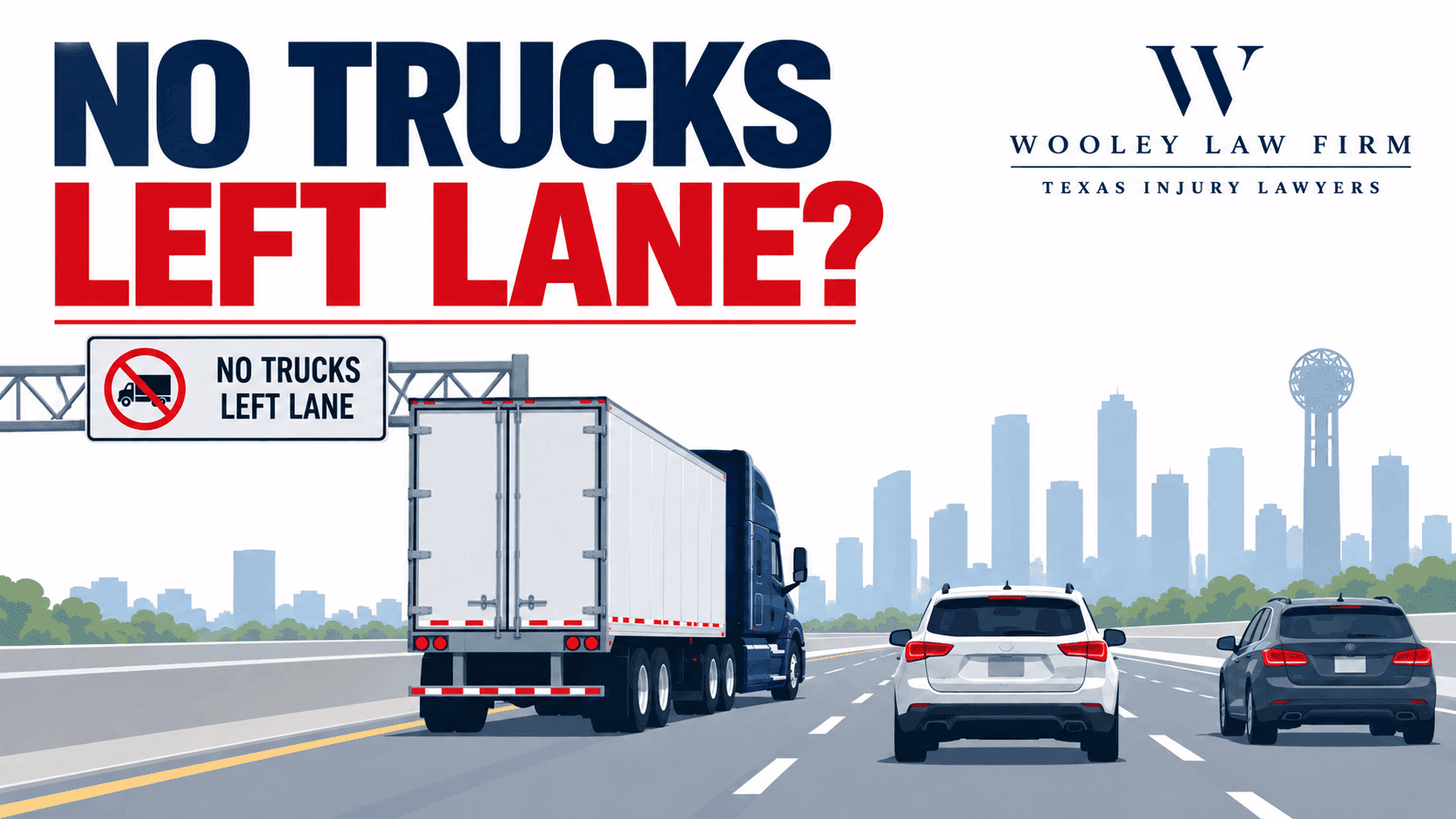
Texas does not have a blanket statewide law prohibiting every tractor-trailer from ever entering the left lane. However, Texas law allows truck traffic to be restricted to designated lanes on certain controlled-access highways. When a truck-specific restriction applies, drivers may see signs such as “NO TRUCKS LEFT LANE.”
Texas law also generally requires a vehicle moving more slowly than the normal speed of traffic to use the right-hand lane unless the driver is passing another vehicle or preparing for a left turn.
For someone injured in a Dallas 18-wheeler wreck, the truck's lane can therefore become an important part of the investigation.
Was the truck legally permitted to be there?
Was a NO TRUCKS LEFT LANE sign posted?
Was the truck passing another vehicle or simply remaining in the left lane?
Did the driver make an unsafe lane change to enter or leave that lane?
And did the truck's position contribute to the collision?
Those questions can matter when determining how a serious truck wreck occurred.
If you were injured in a collision involving a tractor-trailer, learn more about how The Wooley Law Firm handles Dallas 18-wheeler accident cases.
Texas Does Not Ban Every 18-Wheeler From Every Left Lane
One of the most important distinctions is between a general left lane and a truck-restricted left lane.
An 18-wheeler is not automatically violating Texas law merely because someone photographs it traveling in the far-left lane.
The roadway matters.
The signs matter.
The traffic conditions matter.
And the reason the truck entered the lane may matter.
Texas Transportation Code § 545.0651 allows the Texas Transportation Commission—and, in certain circumstances, municipalities—to restrict classes of vehicles to designated lanes on qualifying controlled-access highways.
That is the legal authority that can be used to create truck lane restrictions.
TxDOT specifically provides for signs stating:
NO TRUCKS LEFT LANE
When such a restriction applies, the issue is very different from a highway where no truck-specific lane restriction exists.
What Does a “NO TRUCKS LEFT LANE” Sign Mean?
A NO TRUCKS LEFT LANE sign is not merely a suggestion that truck drivers should stay to the right.
It identifies a truck lane restriction established for that portion of roadway.
TxDOT's Sign Guidelines and Applications Manual contains specific guidance for restricted truck lanes and provides examples of signs stating:
NO TRUCKS LEFT LANE
BEGIN NO TRUCKS LEFT LANE
END NO TRUCKS LEFT LANE
NO TRUCKS LEFT LANE NEXT XX MILES
If you were involved in a wreck with an 18-wheeler traveling in the left lane, one of the first questions should therefore be:
What signs were posted on that section of highway at the time of the collision?
That should be verified rather than assumed.
“Left Lane for Passing Only” Is Different From “No Trucks Left Lane”
These signs should not be confused.
A NO TRUCKS LEFT LANE sign specifically addresses trucks.
A LEFT LANE FOR PASSING ONLY sign regulates use of the left lane more generally.
Texas Transportation Code § 544.011 specifically addresses signs directing slower traffic away from the far-left lane and provides that the sign must read “left lane for passing only.”
Texas law also provides that a vehicle moving more slowly than the normal speed of traffic under the existing conditions generally must travel in the right-hand lane available unless the driver is passing another vehicle or preparing for a left turn.
So the legal analysis should not stop with:
“The truck was in the left lane.”
Instead, determine:
What restriction applied to that particular roadway, and what was the truck actually doing?
Can an 18-Wheeler Use the Left Lane to Pass Another Vehicle?
Potentially, depending on the roadway and the restrictions in effect.
On a highway without a truck-specific prohibition, the fact that a tractor-trailer entered the left lane to pass another vehicle does not automatically establish a traffic violation.
But that does not mean the maneuver was necessarily safe.
An 18-wheeler entering the left lane still has to make the lane change safely.
Texas Transportation Code § 545.060 generally requires a driver on a roadway divided into clearly marked lanes to remain within a single lane as nearly as practical and prohibits moving from that lane unless the movement can be made safely.
That can become especially important with an 18-wheeler.
A tractor-trailer may be approximately 70 feet long depending on its configuration. The driver must account for the tractor, trailer, surrounding traffic, blind spots, vehicles approaching from behind, and the amount of space necessary to complete the maneuver.
Our article about an 18-wheeler changing lanes and causing a multi-vehicle Dallas wreck explains why the truck's initial movement can matter even when another vehicle ultimately makes contact with you.
Why Left-Lane Truck Driving Can Become Dangerous
The legal question and the safety question are related, but they are not identical.
A truck can potentially be lawfully present in a lane and still be operated negligently.
Likewise, evidence that a truck was traveling in a restricted lane may become relevant to explaining how the collision developed.
Several problems can arise when a tractor-trailer occupies or moves into the left lane.
The Truck May Be Traveling Much Slower Than Surrounding Traffic
A significant difference in speed can cause vehicles approaching from behind to brake or change lanes.
The investigation should determine the actual speeds of the vehicles rather than relying on estimates after the wreck.
The Truck May Change Lanes Into a Vehicle Beside It
Large commercial trucks have substantial areas around the tractor and trailer that can be difficult for the driver to monitor.
But a blind spot does not eliminate the driver's obligation to determine whether a lane change can be made safely.
If the truck begins moving left while your vehicle is already beside the trailer, the result can be a sideswipe, rollover, barrier collision, or multi-vehicle wreck.
Our article about 18-wheeler blind-spot accidents in Dallas discusses this issue in greater detail.
Injured in an Accident?
Free consultation. Tell us what happened and learn what options may be available.
The Tractor May Clear Your Car but the Trailer Does Not
A truck driver may believe there is enough room to move over because the tractor has passed a passenger vehicle.
But the trailer may still be beside that vehicle.
If the driver moves left too early, the side or rear portion of the trailer can strike the car.
Read more about what evidence matters when the tractor clears a vehicle but the trailer hits it.
The Truck May Need to Move Back Across Several Lanes for an Exit
Another dangerous scenario occurs when an 18-wheeler travels in the left lanes and then approaches an exit on the right.
A driver who waits too long may attempt to cross several lanes in a short distance.
That can place vehicles beside the tractor and trailer at risk.
If this happens, GPS data, dash-camera footage, navigation information, and electronic records may help determine why the truck suddenly moved across traffic.
Our related article explains what can happen when an 18-wheeler cuts across multiple lanes to reach a Dallas highway exit.
What If the 18-Wheeler Was in a Prohibited Left Lane When the Wreck Happened?
That fact could be important, but it does not automatically resolve the entire personal-injury case.
A truck wreck investigation should determine both whether a rule was violated and how that conduct relates to the collision.
Consider a hypothetical example.
An 18-wheeler is traveling in a left lane subject to a posted truck restriction. The driver realizes the truck should not be there and suddenly moves right. A passenger car is already traveling beside the trailer. The trailer strikes the car and pushes it toward a concrete barrier.
The investigation might consider:
whether a truck restriction applied;
where the restriction began and ended;
whether signs were visible;
how long the truck had occupied the restricted lane;
why the driver entered that lane;
whether the driver attempted to leave it suddenly;
whether the truck driver checked the mirrors;
whether the driver signaled;
where the passenger vehicle was positioned;
whether onboard cameras recorded the car;
how quickly the truck moved laterally; and
whether the trailer had sufficient clearance.
The lane violation could be relevant evidence, but the complete collision sequence still matters.
A Traffic Ticket Is Not the Only Evidence
Do not assume the issue disappears because the police officer did not ticket the truck driver for being in the wrong lane.
The civil investigation can include evidence beyond the crash report.
Important evidence may include:
Dash-Camera Video
Your dash camera—or video from another vehicle—may show the truck's lane position before the wreck.
Video can sometimes establish where the truck entered the roadway, how long it remained in a particular lane, whether it was passing traffic, and how the collision occurred.
Photographs and Video of Highway Signs
Photos showing the roadway near the collision can be especially important when a truck-lane restriction is disputed.
The precise location matters because restrictions may begin and end at designated points.
Truck GPS and Telematics Data
Commercial vehicles frequently generate electronic information showing location, speed, route, and vehicle movement.
That information may help establish which highway segment the truck was traveling on when the collision occurred.
Electronic Logging and Dispatch Records
Dispatch and trip information may help establish the truck's route and destination.
Onboard Cameras
Many commercial trucks have forward-facing cameras. Some have additional side-facing or digital-mirror camera systems.
Those recordings may show traffic conditions, lane markings, highway signs, and vehicles beside the tractor-trailer.
Witnesses
Another motorist may have observed the truck traveling in the restricted lane before the collision.
Police and Government Records
The investigating agency, TxDOT, or another governmental entity may possess records relevant to the roadway, signage, construction configuration, or traffic control in effect at the time.
What If the Trucking Company Says the 18-Wheeler Was Allowed in the Lane?
Verify it.
Do not assume the trucking company's interpretation is correct—but do not assume the opposite either.
The actual roadway restriction should be identified.
Questions may include:
What highway was involved?
In what direction was the truck traveling?
Where exactly did the wreck occur?
How many lanes existed?
Was the truck in the far-left lane or another lane?
Was there a truck restriction?
Where did the restricted area begin?
Where did it end?
Were there temporary construction restrictions?
What did the signs say?
Was the truck passing?
Was the truck changing lanes when the wreck occurred?
The answers should come from evidence.
Construction Zones Can Have Additional Truck Lane Restrictions
Construction can change the normal lane configuration.
Texas Transportation Code § 545.0653 also provides authority for commercial motor vehicles to be restricted to a specific lane in certain construction or maintenance work zones when the required safety determination has been made.
That means a truck driver familiar with a highway cannot simply assume the normal lane arrangement still applies.
Temporary signs and traffic-control devices may change where commercial trucks are supposed to travel.
This can become important after an 18-wheeler lane-change wreck in a Dallas construction zone.
Why the Exact Location of a Dallas Truck Wreck Matters
In an ordinary rear-end collision, knowing that the crash happened “on I-635” may initially seem sufficient.
A disputed truck-lane case can require much greater precision.
The investigation may need to establish:
Which direction? Which entrance or exit? Which mile marker? Which interchange? Which lane? Before or after which sign?
A difference of several hundred yards could potentially affect which traffic-control signs governed the truck.
That is one reason photographs, dash-camera footage, GPS coordinates, crash-report diagrams, 911 records, electronic truck data, and roadway video can become valuable.
For example, our guide to I-635/LBJ Freeway 18-wheeler wrecks in Dallas discusses the evidence that may be available after a collision on that corridor.
Can the Trucking Company Also Be Responsible?
Depending on the facts, the investigation may extend beyond the individual driver.
A trucking company may possess evidence concerning:
driver training;
company lane-use policies;
dispatch instructions;
GPS tracking;
onboard camera footage;
telematics;
safety policies;
driver qualification records; and
communications with the driver.
The legal responsibility of the trucking company depends on the facts and applicable Texas law.
But in a serious truck wreck, the investigation should generally identify the companies and people involved rather than assuming the driver is the only relevant party.
What Should I Do If an 18-Wheeler Hit Me While It Was in the Left Lane?
If possible, preserve evidence showing exactly where the wreck happened.
Photographs of the roadway can be particularly useful.
Try to preserve:
dash-camera footage;
photographs of the truck;
tractor and trailer license plates;
USDOT numbers and company markings;
photographs of lane-use signs;
photographs of lane markings;
the crash location;
witness contact information;
police-report information; and
photographs of vehicle damage.
Do not put yourself in danger by walking along an interstate to photograph a sign.
Other methods may later be available to document the roadway safely.
A preservation letter can also request that the trucking company retain potentially important electronic and physical evidence before it is overwritten, repaired, or lost.
Frequently Asked Questions About 18-Wheelers in the Left Lane in Texas
Is it illegal for an 18-wheeler to drive in the left lane in Texas?
Not automatically. Texas does not impose a blanket prohibition covering every 18-wheeler on every highway. Truck-specific lane restrictions can apply to particular stretches of qualifying highways, and posted signs are important in determining whether the truck was permitted in the lane.
What does “NO TRUCKS LEFT LANE” mean in Texas?
It identifies a portion of roadway where an established lane restriction prohibits the covered trucks from using the left lane. The exact location and scope of the restriction should be verified.
Can a semi-truck use the left lane to pass in Texas?
It may be able to do so on a roadway where no applicable truck-specific restriction prohibits it. The driver must still comply with applicable traffic laws and make any lane change safely.
Does “LEFT LANE FOR PASSING ONLY” apply to 18-wheelers?
A general left-lane passing restriction is different from a truck-specific NO TRUCKS LEFT LANE restriction. The applicable signage and circumstances should be examined to determine what rules governed the particular roadway.
What if an 18-wheeler caused a wreck while driving in a restricted lane?
Evidence that the truck was traveling in a prohibited lane may become relevant to the investigation. But the complete circumstances still matter, including how the collision occurred and whether the truck's lane position or movement contributed to it.
How can I prove the truck was in the wrong lane?
Potential evidence includes dash-camera video, roadway photographs, witnesses, police records, GPS and telematics information, onboard truck cameras, electronic data, and photographs or official records showing the traffic-control signs in effect at the collision location.
Talk to a Dallas Truck Wreck Lawyer About an 18-Wheeler Lane Violation
If you were injured by an 18-wheeler traveling in or moving out of the left lane, determining whether the truck was legally permitted to be there may be only one part of the investigation.
The evidence should establish:
Where was the truck?
What signs applied?
Why was the truck in that lane?
How long had it been there?
Was the driver passing?
Was the driver changing lanes?
Where was your vehicle?
And did the truck's lane position or movement contribute to the collision?
The Wooley Law Firm represents people seriously injured in 18-wheeler, tractor-trailer, and commercial-truck wrecks in Dallas and throughout North Texas.
Call (214) 699-6524 for a free consultation. You don't pay unless we win.
Disclaimer
This article is for general informational purposes only and is not legal advice. Reading it does not create an attorney-client relationship. Texas traffic laws and truck-lane restrictions may vary based on the roadway, location, signage, vehicle, construction conditions, and other circumstances. Every case is different.
Topics
Share This Article

Andrew J. Wooley
Personal Injury Attorney
Andrew J. Wooley is a dedicated personal injury attorney based in Dallas, Texas. He focuses on helping accident victims recover fair compensation for their injuries. With a commitment to personalized service, Andrew works directly with each client to understand their unique situation and fight for their rights.