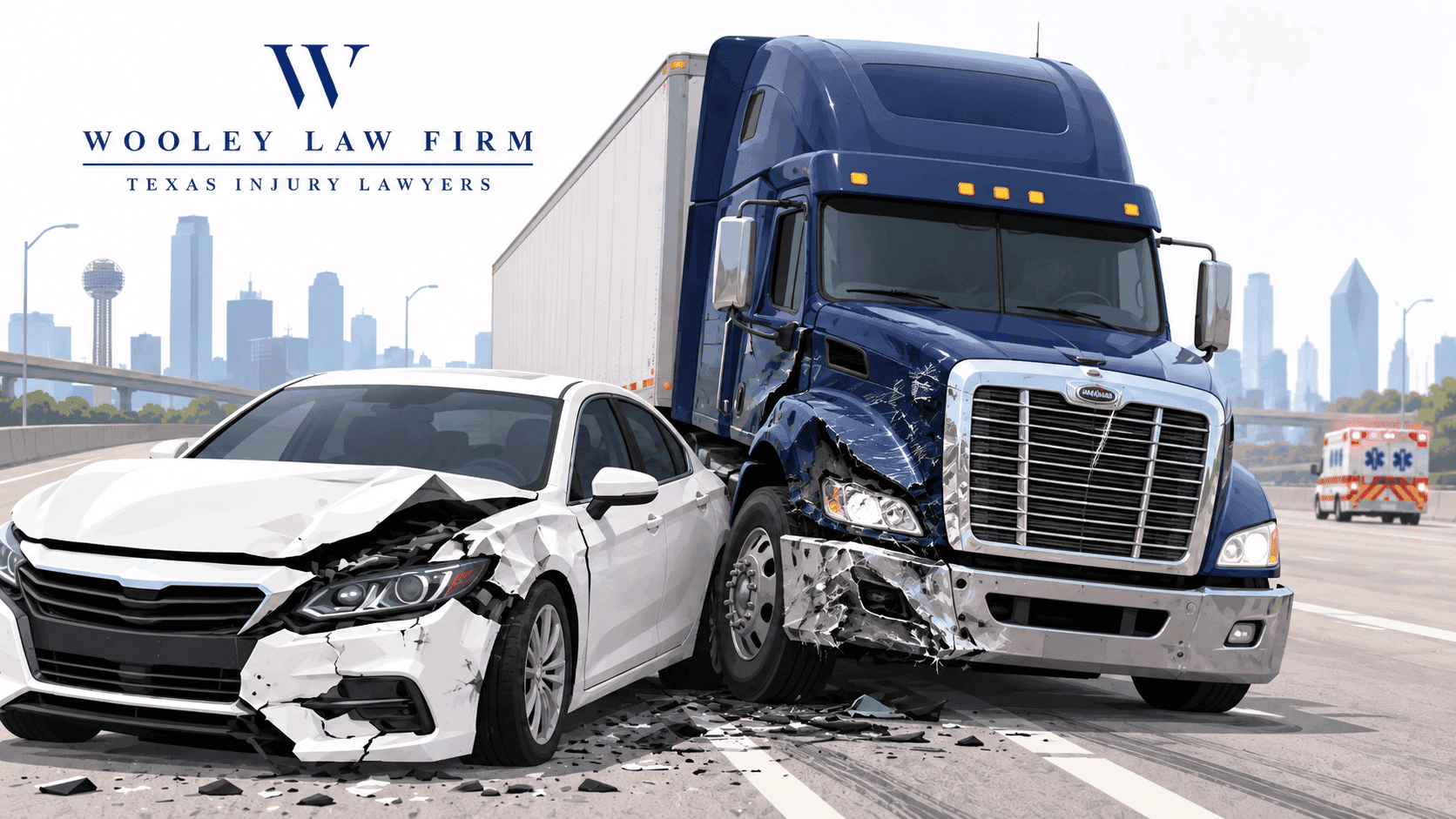
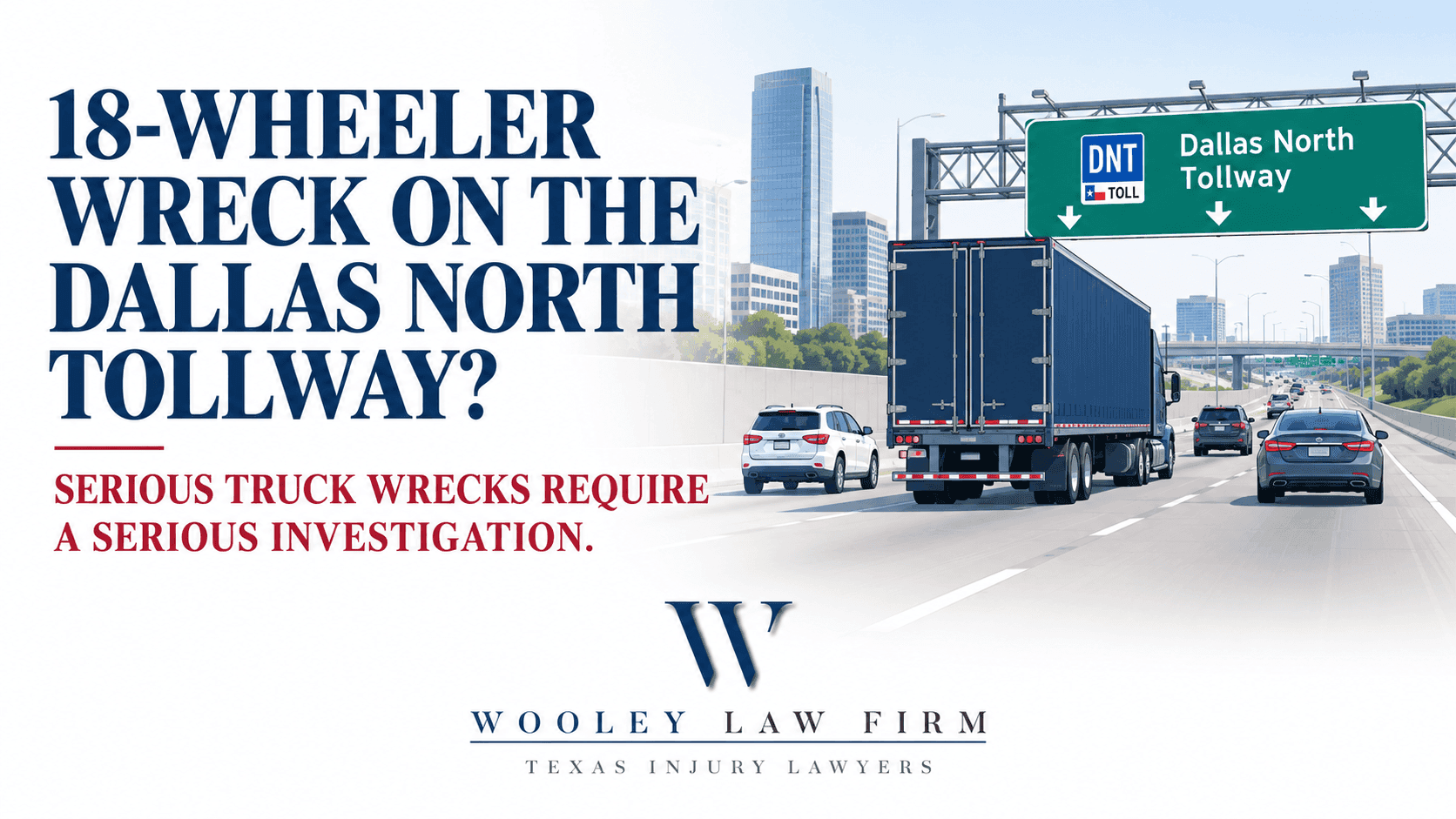
A serious 18-wheeler wreck on the Dallas North Tollway can happen in seconds.
Traffic may be moving at highway speed before suddenly slowing near an exit, interchange, construction area, or congested stretch of roadway. A tractor-trailer may change lanes into a passenger vehicle, fail to stop for slowing traffic, force another driver into a concrete barrier, or trigger a multi-vehicle collision without ever making direct contact with every vehicle involved.
When a commercial truck is involved, determining what happened may require much more than reading the police crash report.
Important evidence may exist inside the truck's electronic systems, onboard cameras, GPS records, driver logs, dispatch communications, maintenance files, and trucking-company records.
If you were seriously injured in a commercial-truck collision in Dallas, The Wooley Law Firm's Dallas 18-wheeler accident lawyer page explains how these cases may differ from an ordinary car accident claim.
Where Does the Dallas North Tollway Run?
According to the North Texas Tollway Authority, the Dallas North Tollway is approximately 33 miles long and connects downtown Dallas with Prosper.
The Tollway passes through or alongside:
Dallas;
Highland Park;
University Park;
Addison;
Farmers Branch;
Plano;
Frisco; and
Prosper.
That means a Dallas North Tollway truck wreck can occur in Dallas County or farther north in Collin or Denton County.
Major connections and heavily traveled areas along or near the DNT include:
downtown Dallas;
Mockingbird Lane;
Northwest Highway;
Royal Lane;
Forest Lane;
I-635/LBJ Freeway;
Belt Line Road;
President George Bush Turnpike;
Legacy Drive;
Sam Rayburn Tollway/SH 121;
Gaylord Parkway;
Eldorado Parkway; and
US 380.
The Dallas North Tollway also connects drivers with some of North Texas's busiest employment, shopping, entertainment, and residential areas.
Traffic conditions can change quickly as drivers enter, exit, merge, or move across lanes to position themselves for upcoming interchanges.
Can 18-Wheelers and Commercial Trucks Travel on the Dallas North Tollway?
Commercial vehicles can use NTTA toll roads subject to applicable laws, vehicle restrictions, and tolling requirements. NTTA specifically publishes toll rates for vehicles with more than two axles through its toll-road trip planning information.
You may therefore encounter a variety of commercial vehicles on the Dallas North Tollway, including:
tractor-trailers;
box trucks;
delivery trucks;
flatbed trucks;
construction vehicles;
commercial pickups pulling trailers;
moving trucks; and
other multi-axle commercial vehicles.
When one of these vehicles causes a serious wreck, the investigation may need to identify not only the driver but also the business operating the vehicle and other companies connected to it.
Why Dallas North Tollway Truck Wrecks Can Become Serious
The combination of highway speeds, closely spaced vehicles, concrete barriers, entrance ramps, exits, and sudden congestion can make a truck collision particularly dangerous.
A passenger vehicle may have little room to escape when a tractor-trailer begins entering its lane.
Likewise, when Tollway traffic slows suddenly, a commercial driver who is following too closely or not watching the road may not have enough distance to stop safely.
Common Dallas North Tollway truck-wreck scenarios may include:
rear-end collisions;
unsafe lane changes;
sideswipe wrecks;
trucks forcing vehicles into barriers;
multi-vehicle collisions;
jackknife crashes;
rollovers;
tire failures;
brake-related collisions;
distracted-driving wrecks; and
fatigue-related crashes.
Each type of collision may produce different physical and electronic evidence.
Rear-Ended by an 18-Wheeler on the Dallas North Tollway
One of the most dangerous situations occurs when traffic slows but the commercial truck approaching from behind does not.
A truck driver may later say:
“Traffic stopped suddenly.”
That explanation should be tested against the evidence.
The investigation may examine:
how fast the tractor-trailer was traveling;
how closely the driver was following;
when slowing traffic became visible;
when the driver released the accelerator;
when braking began;
whether the driver was distracted;
whether a forward-collision warning activated;
whether automatic emergency braking activated; and
whether the braking system was operating properly.
Our detailed guide for people rear-ended by an 18-wheeler in Dallas explains the truck data, video, braking records, maintenance evidence, and driver information that may become important after one of these collisions.
What If the Truck Driver Says You Stopped Too Quickly?
A commercial driver cannot necessarily avoid responsibility simply by claiming that the vehicle ahead stopped suddenly.
Highway traffic can slow rapidly.
That is one reason drivers must maintain an appropriate following distance and keep a proper lookout.
The investigation should determine how long traffic had been slowing or stopped and whether the truck driver had enough warning to respond.
Evidence may include:
forward-facing camera footage;
dash-camera video;
eyewitness testimony;
electronic speed data;
GPS information;
brake application information;
automatic emergency braking records;
collision-warning data; and
data from other vehicles involved in the wreck.
A driver's description of the collision should be compared with the objective evidence rather than automatically accepted.
Unsafe 18-Wheeler Lane Changes on the Dallas North Tollway
Lane-change wrecks can be especially dangerous on the Tollway.
A tractor-trailer is much longer than a passenger vehicle. The driver must account for both the tractor and the entire trailer before moving into another lane.
One recurring collision scenario occurs when the front of the tractor passes a passenger vehicle but the trailer has not.
The truck driver begins moving over.
The tractor clears the passenger vehicle.
The trailer does not.
The trailer may strike the side of the car and push it:
toward a concrete barrier;
into another traffic lane;
into another vehicle;
under the side of the trailer; or
off the roadway.
These collisions may be particularly dangerous where concrete barriers leave a driver with limited space for evasive action.
Our article about 18-wheelers causing multi-vehicle wrecks while changing lanes explains why the first unsafe movement by the truck may matter even when another passenger vehicle ultimately strikes you.
Injured in an Accident?
Free consultation. Tell us what happened and learn what options may be available.
What If the 18-Wheeler Never Actually Hit Your Vehicle?
Physical contact is not always required for a truck driver's conduct to cause a wreck.
Suppose an 18-wheeler begins entering your lane on the Dallas North Tollway.
To avoid being sideswiped or pushed beneath the trailer, you steer away.
You then:
strike the concrete barrier;
collide with another vehicle;
spin out;
lose control; or
become involved in a chain-reaction crash.
The truck may continue driving.
In that situation, proving what happened may depend heavily on:
your dash-camera video;
video from other vehicles;
witnesses;
NTTA or nearby camera evidence, if available;
the truck's onboard cameras;
GPS and telematics;
physical vehicle damage; and
electronic truck records.
The investigation should reconstruct the entire sequence rather than focusing only on which vehicles physically touched one another.
An 18-Wheeler Can Trigger a Multi-Vehicle Tollway Wreck
A serious commercial-truck collision may involve several vehicles.
For example, a tractor-trailer changes lanes toward a car.
The car swerves.
That vehicle strikes another car.
A third vehicle rear-ends one of them.
The truck may have caused the emergency even though it never made contact with the vehicle where the most severe impact occurred.
Our article discussing who may be responsible after a Dallas 18-wheeler causes a multi-vehicle lane-change wreck explains why investigators should identify the event that started the collision sequence rather than looking only at the final impact.
The Truck's Electronic Data May Show What Happened
Modern commercial trucks can contain extensive electronic information.
Depending on the tractor and systems installed, potentially important evidence may include:
vehicle speed;
engine RPM;
throttle position;
brake application;
hard-braking events;
GPS location;
telematics;
electronic logging-device information;
collision warnings;
lane-departure alerts;
automatic emergency braking data;
cruise-control status;
fault codes; and
onboard camera footage.
This information may help establish what the truck was doing seconds before impact.
It can be particularly important when the driver claims:
another vehicle cut the truck off;
traffic stopped without warning;
the brakes failed;
the passenger car was in a blind spot; or
there was nothing the driver could have done.
Automatic Emergency Braking Data Can Be Important
Many newer commercial vehicles contain forward-collision warning and automatic emergency braking technology.
These systems may create evidence showing whether the tractor-trailer electronically detected traffic ahead.
Depending on the system, investigators may be able to determine:
when a collision threat was detected;
whether the driver received a warning;
whether the driver applied the brakes;
when braking occurred;
whether automatic braking activated;
how fast the truck was traveling; and
whether the system reported a fault.
Our article explaining automatic emergency braking evidence after an 18-wheeler wreck discusses why this information can be especially important after a rear-end collision.
Driver Distraction on the Dallas North Tollway
A commercial driver traveling at highway speed can cover a substantial distance while looking away from the roadway.
Potential distractions may include:
cellphone use;
texting;
dispatch messages;
GPS navigation;
an electronic logging device;
food or drinks;
paperwork;
in-cab controls; or
reaching for an object.
After a serious truck wreck, cellphone evidence, driver-facing camera footage, dispatch communications, telematics, and forward-facing video may help determine where the driver was looking immediately before impact.
Driver Fatigue May Also Need to Be Investigated
Some commercial drivers may have been traveling for many hours before entering the Dallas-Fort Worth area.
Fatigue can affect reaction time, judgment, lane control, and hazard recognition.
Federal hours-of-service rules apply to many interstate commercial drivers. The Federal Motor Carrier Safety Administration provides information about those requirements.
But the investigation should not stop at asking whether the electronic log appears compliant.
Other evidence can include:
dispatch records;
GPS history;
fuel receipts;
toll records;
loading records;
delivery times;
cellphone records; and
communications with the motor carrier.
Together, these records may help establish what the driver had actually been doing before the collision.
What If the Truck's Brakes Failed?
A commercial driver or trucking company may claim that a mechanical problem caused the collision.
If so, maintenance becomes an important part of the investigation.
Investigators may need to determine:
who maintained the tractor;
who maintained the trailer;
when the brakes were last inspected;
whether previous defects were reported;
whether repairs were recommended;
whether repairs were completed;
whether the driver noticed a problem before the wreck; and
whether electronic fault codes existed.
A brake-failure explanation can potentially raise questions about the trucking company, tractor owner, trailer owner, maintenance provider, or repair facility.
Who May Be Responsible for a Dallas North Tollway Truck Wreck?
The answer depends on the facts.
Potentially responsible parties may include:
the truck driver;
the driver's employer;
the motor carrier;
the tractor owner;
the trailer owner;
a leasing company;
a maintenance or repair company;
a cargo-loading company;
a manufacturer; or
another driver involved in causing the crash.
The name printed on the tractor does not necessarily identify everyone involved.
A driver may own the tractor but operate under another company's authority.
A leasing company may own the equipment.
A different business may own the trailer.
Another company may have performed the maintenance.
Our guide explaining who else may potentially be responsible besides the trucking company discusses why serious truck cases sometimes require investigating an entire network of businesses.
The Tractor and Trailer May Belong to Different Companies
An 18-wheeler is not always owned as one unit.
The tractor may belong to one company.
The trailer may belong to another.
The driver may work for a third company.
A motor carrier may operate the shipment.
A separate repair company may maintain the equipment.
That matters because different businesses may possess different records and may have had different responsibilities.
Our article about truck owner and leasing-company liability after a Dallas truck wreck explains how registration, leases, USDOT records, maintenance documents, and insurance information can help identify the companies connected to the tractor and trailer.
Evidence That Should Be Considered After a Dallas North Tollway Truck Wreck
Important evidence may include:
police crash reports;
scene photographs;
vehicle photographs;
dash-camera video;
witness statements;
onboard truck cameras;
electronic truck data;
GPS and telematics;
electronic logging-device records;
cellphone information;
dispatch communications;
driver qualification records;
training records;
maintenance files;
tractor inspection records;
trailer inspection records;
brake records;
tire records;
collision-warning data;
automatic emergency braking information;
bills of lading;
cargo records;
tow-yard records; and
the tractor and trailer themselves.
Some evidence may exist only for a limited period.
A truck may be repaired and placed back into service.
Camera footage may be overwritten.
Electronic systems may continue recording new information.
Damaged components may be replaced.
That is why preservation can become important early in a serious commercial-truck claim.
Serious Injuries After a Dallas North Tollway Truck Collision
An 18-wheeler collision can cause significant injuries even when the occupants of a passenger vehicle initially believe they are fortunate to have walked away.
Potential injuries may include:
traumatic brain injuries;
concussions;
cervical disc injuries;
lumbar disc injuries;
spinal-cord injuries;
fractures;
shoulder injuries;
knee injuries;
nerve injuries;
internal injuries;
crush injuries;
amputations;
scarring;
permanent impairment; and
wrongful death.
Some injuries may require surgery, injections, rehabilitation, specialist treatment, or long-term medical care.
What Should You Do After an 18-Wheeler Wreck on the Dallas North Tollway?
Your immediate health and safety should come first.
When circumstances permit:
Call 911.
Seek appropriate medical care.
Photograph the vehicles and scene if it is safe.
Photograph the tractor, trailer, license plates, and identifying information.
Obtain the truck's USDOT number if visible.
Preserve original dash-camera footage.
Obtain witness names and contact information.
Keep medical, towing, storage, rental, and other expense records.
Avoid guessing about facts you do not know.
Consider speaking with an attorney before providing a detailed recorded statement to the commercial insurer.
Address preservation of truck and trucking-company evidence promptly.
Frequently Asked Questions About Dallas North Tollway Truck Wrecks
Can I sue after an 18-wheeler wreck on the Dallas North Tollway?
Potentially. Whether you have a claim depends on how the collision happened, who caused it, your injuries and damages, and the available evidence.
What if the truck driver says I cut in front of the truck?
That allegation should be compared with forward-facing video, electronic speed and braking information, dash-camera footage, witnesses, lane positions, and other evidence.
Can the truck's black box prove how fast it was traveling?
Potentially. Depending on the tractor and its electronic systems, investigators may be able to obtain information concerning speed, braking, throttle use, hard-braking events, fault codes, and other operational information.
What if the tractor and trailer belong to different companies?
That is not unusual in commercial trucking. Registration, lease documents, USDOT information, insurance records, maintenance files, and bills of lading may help identify the companies involved.
What if the 18-wheeler forced me into a barrier but never hit me?
Lack of physical contact does not necessarily mean the truck could not have caused the wreck. Video, witnesses, electronic records, and physical evidence may help establish the sequence.
Does NTTA have cameras that recorded my Dallas North Tollway wreck?
There may be roadway, traffic-management, private surveillance, dash-camera, or other video depending on the location and circumstances. Whether particular footage exists or was retained should be investigated promptly rather than assumed.
Injured in an 18-Wheeler Wreck on the Dallas North Tollway?
A serious Dallas North Tollway truck wreck should be investigated beyond the police report.
The truck may contain electronic evidence.
The motor carrier may have camera footage.
Dispatch records may show what the driver was doing.
Maintenance documents may identify mechanical problems.
Ownership and leasing records may reveal additional companies.
And the tractor and trailer may be repaired or returned to service before all of that evidence is examined.
The Wooley Law Firm represents people injured in serious 18-wheeler and commercial-truck wrecks in Dallas, North Texas, and throughout Texas.
Learn more about how we handle Dallas 18-wheeler wreck cases, or call The Wooley Law Firm at (214) 699-6524 for a free consultation. You don't pay unless we win.
Disclaimer: This article is for general informational purposes only and is not legal advice. Reading it does not create an attorney-client relationship. Every case is different.
Topics
Share This Article

Andrew J. Wooley
Personal Injury Attorney
Andrew J. Wooley is a dedicated personal injury attorney based in Dallas, Texas. He focuses on helping accident victims recover fair compensation for their injuries. With a commitment to personalized service, Andrew works directly with each client to understand their unique situation and fight for their rights.