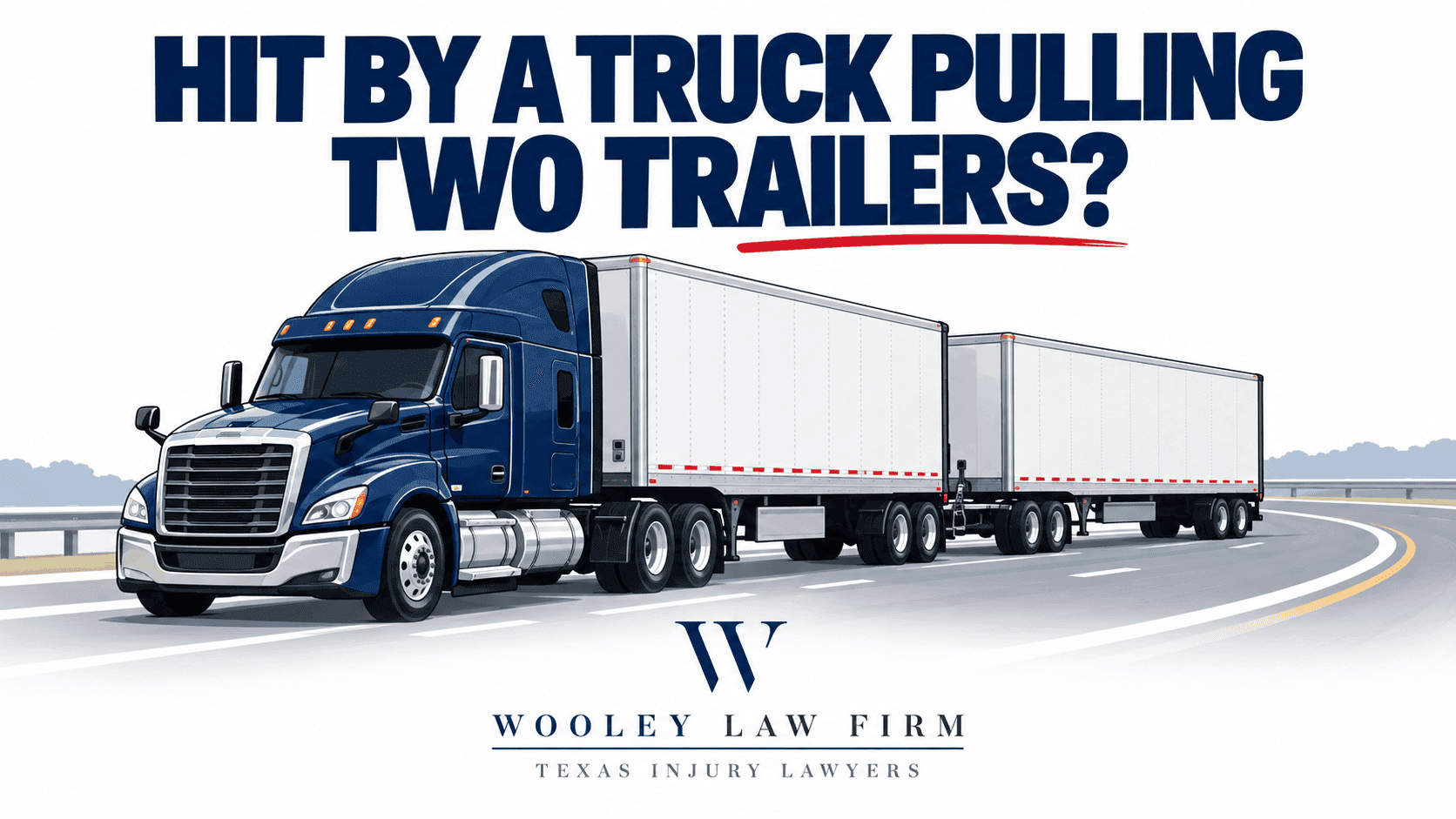
Yes, a tractor can legally pull two trailers in Texas. These combinations are commonly called doubles or twin trailers. But the fact that doubles are permitted does not mean every combination, driver, load, or route is legal—or that the driver can operate it as though it were a truck pulling one trailer.
A tractor pulling three trailers, commonly called triples, presents a different legal question. Texas law generally limits a coupled combination to three vehicles. A tractor plus two trailers is three vehicles; a tractor plus three trailers is four. Ordinary freight triples are therefore not authorized under that general Texas rule. Other states have different rules, so a truck that was legal on one portion of an interstate trip may need to be reconfigured before entering Texas. Department of Public Safety
If a double-trailer truck caused a wreck in Dallas–Fort Worth, the investigation should examine both the rules governing the combination and how each trailer moved before the collision.
What Does a Double-Trailer Truck Look Like?
A typical double consists of a powered tractor, a first trailer, and a second trailer. Depending on the equipment, a converter dolly may connect the rear trailer to the first. The dolly has its own wheels and coupling components.
Those added connections matter. In a wreck involving one trailer, investigators may need to inspect the tractor-to-trailer connection. With doubles, they must also examine the connection between the trailers, the dolly if one was used, and the air and electrical lines serving the rear unit.
What Are the Texas Rules for Pulling Two Trailers?
Texas permits a truck-tractor to pull two trailers, but the configuration must satisfy applicable size, weight, equipment, licensing, and route rules.
Trailer Length
Under Texas Transportation Code § 621.204, a semitrailer or trailer in a truck-tractor, semitrailer, and trailer combination generally may not be longer than 28½ feet, excluding the towing device. That is a limit for each trailing unit in the covered combination. Texas DPS summarizes the rule in its commercial-vehicle length guidance. Department of Public Safety
A driver cannot assume that attaching a second full-length freight trailer behind the first creates a lawful double.
Overall Length and Route
The length rules require more care than a single statewide number. Texas Transportation Code § 621.205 addresses vehicle combinations, while federal rules govern conventional twin-trailer combinations on the National Network and reasonable access routes. The Federal Highway Administration explains that states generally cannot impose an overall length limit on qualifying tractor-and-two-trailer combinations on those routes. Route and equipment details matter when applying the rules to a particular trip. Department of Public Safety
A legal double on a designated highway does not have blanket permission to take any street, ramp, or access route. An investigation should establish where the truck was traveling and whether restrictions applied there.
Driver Endorsement
A commercial driver operating double or triple trailers generally needs the T endorsement on the driver’s CDL. The federal endorsement requirement involves an additional knowledge test. csa.fmcsa.dot.gov
The endorsement is one qualification to check; it is not proof that the driver handled a particular combination safely. Additional federal training and certification rules apply to certain longer combination vehicles above 80,000 pounds. They do not apply to every ordinary set of doubles simply because it has two trailers. csa.fmcsa.dot.gov
Inspection and Equipment
Before operating a commercial vehicle, the driver must be satisfied that specified equipment is in good working order. The federal pre-trip inspection rule includes service brakes and trailer brake connections, lights, tires, mirrors, and coupling devices. A double has more of those components to check across the combination. csa.fmcsa.dot.gov
Whether a violation contributed to a wreck depends on the evidence. A missing endorsement, an equipment defect, or an unauthorized route should be investigated, but none automatically explains how the collision occurred.
Injured in an Accident?
Free consultation. Tell us what happened and learn what options may be available.
Why Can Doubles Be More Dangerous to Operate?
The second trailer changes the way the vehicle responds to steering, braking, and road conditions. FMCSA’s commercial driver manual warns that doubles and triples are less stable than other commercial vehicles and require special care with turns, speed, following distance, and inspections. fmcsa.dot.gov
The Rear Trailer Can Swing More Sharply
A quick steering movement at the tractor can produce a greater movement toward the rear of a multi-trailer combination. This is often called rearward amplification or the crack-the-whip effect. FMCSA warns that the last trailer is particularly vulnerable to rollover during an abrupt maneuver. fmcsa.dot.gov
A sudden lane change made to reach an exit on I-635, for example, should be evaluated by tracking both trailers. The tractor may clear a passenger car while the rear trailer moves into its lane. Our article, “The Tractor Cleared My Car, but the 18-Wheeler’s Trailer Hit Me,” explains why the driver must account for the entire combination.
Turns and Ramps Require Planning
The trailers do not necessarily follow the precise path of the tractor. The driver needs enough room for the combination’s turning path and must take ramps and curves at a speed appropriate for the vehicle and conditions. FMCSA cautions that a speed manageable for a single-trailer truck may be too fast for doubles. fmcsa.dot.gov
Stopping and Lane Changes Require More Space
Doubles occupy more roadway and cannot be turned or stopped suddenly without added risk. The driver must look ahead, leave adequate following distance, and ensure the rear trailer has cleared traffic before completing a lane change. Rain, slippery pavement, and congestion can further affect the room needed to maneuver. fmcsa.dot.gov
If a double caused a chain-reaction collision, the last vehicle struck may not reveal what started the wreck. Learn more about how a truck lane change can cause a multi-vehicle crash in Dallas.
There Are More Connections to Inspect
The coupling between trailers and the rear trailer’s brake and light connections are critical. An investigation may need to determine whether the dolly was properly connected, whether air reached the rear trailer, whether its brakes worked, and whether its lights were visible. FMCSA’s doubles-and-triples guidance specifically emphasizes careful coupling, uncoupling, and inspection. fmcsa.dot.gov
What Must a Driver Consider Before and During a Trip?
A driver pulling doubles should consider more than whether the tractor can physically move the load. Questions include:
Is the combination legal for the route? The driver and carrier should account for applicable trailer lengths, weights, and route restrictions.
Is the driver qualified? The CDL, T endorsement, and any applicable additional training should be verified.
Are both trailers properly connected? Couplings, the dolly if present, and air and electrical lines need inspection.
Do the rear trailer’s brakes and lights work? A problem at the back of the combination may be difficult for another motorist to detect until it is too late.
How are the trailers loaded? Weight distribution and the order of loaded trailers affect handling. FMCSA’s driver manual advises placing the more heavily loaded trailer first for safer handling. fmcsa.dot.gov
Is there enough room to turn, merge, and stop? The driver must account for the full length and movement of both trailers, especially in traffic, construction zones, and bad weather.
These questions also matter to the motor carrier planning the trip. Dispatch instructions, equipment assignments, training, inspections, and maintenance records may help show what the carrier knew and what it required of the driver.
Can a Tractor Pull Three Trailers in Texas?
Generally, not as an ordinary freight combination. Texas Transportation Code § 621.205 describes combinations of not more than three vehicles. A tractor pulling three separate trailers totals four vehicles. The fact that a CDL has a combined “double/triple” endorsement does not make triples legal in every state. Department of Public Safety
Some other states allow triples on specified routes. Their permission does not carry over automatically to Texas. If a witness reports seeing a tractor with three trailers after a Texas wreck, the configuration should be documented carefully; what appeared to be a trailer might instead have been another kind of towed or mounted equipment. The precise vehicles and any claimed special authority would need to be examined.
What Evidence Matters After a Double-Trailer Wreck?
A Dallas truck accident lawyer investigating a double-trailer collision may seek:
Photographs and identification numbers for the tractor, first trailer, second trailer, and dolly
Each trailer’s ownership and maintenance records
Coupling, brake, light, tire, and inspection evidence
Cargo records and the weight loaded into each trailer
The driver’s CDL and endorsements
Dispatch instructions and the route assigned
Dashcam, nearby video, GPS, and available electronic truck data
Witness accounts identifying which trailer struck a vehicle or entered a lane
The tractor and two trailers may be owned or leased by different businesses. Our guide to truck owner and leasing company liability explains why the name on the cab may not identify everyone involved.
Frequently Asked Questions
Are double-trailer trucks illegal in Dallas?
No. Doubles can be operated legally in Texas, including on qualifying Dallas-area routes, when the combination, driver, and operation meet applicable requirements. Legality depends on the specific truck, trailers, load, and route.
Does a T endorsement permit a driver to pull three trailers in Texas?
No. The endorsement addresses driver qualification. It does not override Texas limits on vehicle combinations. Department of Public Safety
What if the first trailer cleared my car but the second one hit it?
The driver must account for the movement of the entire combination. Photographs, video, vehicle damage, lane markings, and witness statements may help establish the rear trailer’s path and whether the maneuver was safe.
Hurt by a Truck Pulling Two Trailers in Dallas–Fort Worth?
A double-trailer wreck may require investigators to reconstruct the movement of two trailers and examine additional couplings, brakes, owners, and records. The Wooley Law Firm represents people injured in serious truck wrecks throughout Dallas–Fort Worth.
Call (214) 699-6524 for a free consultation. You don’t pay unless we win.
This article is for general informational purposes only and is not legal advice. Reading it does not create an attorney-client relationship. Every case is different.
Topics
Share This Article

Andrew J. Wooley
Personal Injury Attorney
Andrew J. Wooley is a dedicated personal injury attorney based in Dallas, Texas. He focuses on helping accident victims recover fair compensation for their injuries. With a commitment to personalized service, Andrew works directly with each client to understand their unique situation and fight for their rights.