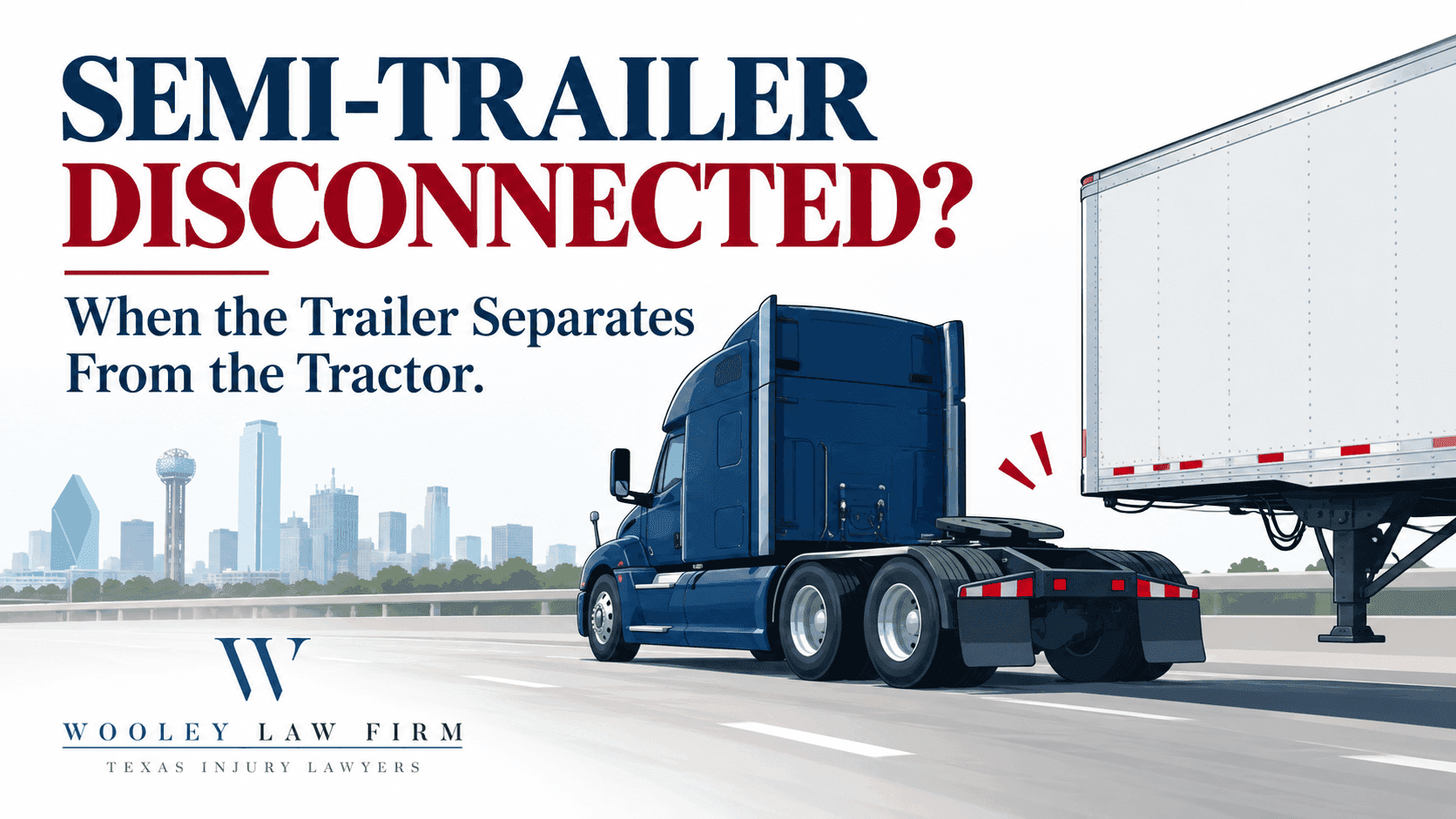
A semi-truck trailer is not supposed to separate from the tractor while an 18-wheeler is traveling down the highway.
But when the connection between the tractor and trailer fails, the consequences can be catastrophic.
A detached trailer may continue moving through traffic without a driver controlling it. It can cross lanes, strike passenger vehicles, hit a concrete barrier, overturn, or create a sudden obstruction that causes a multi-vehicle collision.
If you were injured in a semi-truck trailer detached accident in Dallas, determining who is responsible requires more than asking who was driving the tractor.
The investigation should determine why the trailer separated in the first place.
Was the fifth wheel properly locked around the kingpin? Did the driver inspect the connection? Was the fifth wheel worn or defective? Was the kingpin damaged? Did someone improperly couple the tractor and trailer? Were previous problems ignored? Who owned and maintained the trailer?
Depending on the evidence, responsibility may involve the truck driver, motor carrier, tractor owner, trailer owner, leasing company, maintenance contractor, or potentially another company involved with the equipment.
How Does a Semi-Truck Trailer Connect to the Tractor?
Understanding a trailer-separation accident starts with understanding how the two pieces of an 18-wheeler connect.
The front of a semi-trailer does not simply rest on the back of the tractor.
Instead, two important components work together:
The fifth wheel is the large coupling assembly mounted behind the tractor's cab.
The kingpin extends downward from the underside of the front portion of the semi-trailer.
When the tractor backs underneath the trailer, the kingpin enters the fifth wheel. The fifth wheel's locking mechanism is supposed to secure the kingpin and prevent the tractor and trailer from separating during operation.
Federal regulations specifically address these assemblies. Under 49 C.F.R. § 393.70, a fifth-wheel assembly must have a locking mechanism designed to prevent separation of the upper and lower halves unless a positive manual release is activated.
That connection is critical.
If the fifth wheel does not properly capture and lock around the kingpin—or if part of the coupling system fails—the trailer can potentially separate from the tractor.
What Can Cause a Trailer to Detach From an 18-Wheeler?
There is no single explanation for every detached-trailer accident.
A proper investigation may need to consider several possibilities.
Improper Coupling
One of the first questions is whether the tractor and trailer were properly connected before the driver left.
A driver may back underneath a trailer but fail to achieve a complete connection between the fifth wheel and kingpin.
For example, investigators may examine whether:
The kingpin properly entered the fifth wheel;
The locking jaws completely engaged;
The trailer was sitting at the correct height during coupling;
The fifth wheel was visually inspected;
The driver performed an appropriate physical check of the connection;
The driver checked the release handle and locking mechanism; and
The driver verified that the trailer was actually secured before entering traffic.
A trailer that appears connected is not necessarily properly locked.
That is one reason coupling procedures and inspections can become central issues after a trailer breaks loose.
Fifth-Wheel Failure
The fifth wheel deserves close examination after any unexplained tractor-trailer separation.
Investigators may look for:
Worn locking jaws;
A damaged locking mechanism;
Excessive play;
Cracks;
Bent components;
Improper adjustment;
Damaged mounting hardware;
Loose or missing bolts;
Improper repairs;
Inadequate lubrication;
Corrosion;
A malfunctioning release mechanism; or
Other evidence of wear or mechanical failure.
Federal regulations require the lower half of the fifth wheel to be properly secured to the tractor's frame and require the locking mechanism to prevent separation unless positively released.
If the fifth wheel itself failed, the next question becomes:
Why did it fail, and who was responsible for inspecting and maintaining it?
That can turn what initially appears to be driver error into a much broader maintenance investigation.
Kingpin Failure
The kingpin is just as important as the fifth wheel.
Because the kingpin is attached to the trailer, an investigation into kingpin failure may lead directly to the trailer's ownership, inspection, and maintenance history.
Evidence may reveal:
Excessive wear;
Cracking;
Deformation;
Damage from previous use;
Improper installation;
Problems with the trailer's upper coupling assembly; or
A condition that should have been discovered during an inspection.
An investigator should not simply photograph the tractor's fifth wheel and conclude the inspection.
The underside of the trailer and kingpin assembly should also be preserved and examined.
Did the Driver Inspect the Coupling Before Driving?
Federal regulations make pre-trip equipment inspection particularly important.
Under 49 C.F.R. § 392.7, a commercial motor vehicle should not be driven unless the driver is satisfied that specified equipment is in good working order. The regulation specifically includes:
Coupling devices; and
Service brakes, including trailer brake connections.
Federal regulations also require a driver, before operating a commercial motor vehicle, to be satisfied that the vehicle is in safe operating condition. See 49 C.F.R. § 396.13.
Those requirements can become important after a Dallas accident involving a detached trailer.
The investigation may ask:
What exactly did the driver inspect before pulling away?
It may also examine the driver's training and the motor carrier's coupling procedures.
Federal commercial-driver road-test requirements specifically include coupling and uncoupling combination units when the assigned equipment includes combination vehicles.
Why the Air Lines Matter After a Trailer Separation
The physical coupling is only part of the tractor-trailer connection.
The tractor and trailer also have connections for the trailer's braking system.
In a typical air-brake system, investigators may need to examine the air connections, hoses, couplers, and related components.
The condition of these connections can help answer important questions about what happened before and during the separation.
For example:
Were the air lines properly connected?
Was there pre-existing damage?
Were hoses or connectors worn?
Did the lines separate as a consequence of the trailer breaking loose?
Was there evidence of an existing trailer-brake problem?
What happened to the trailer's brakes when separation occurred?
Federal regulations expressly identify trailer brake connections among the equipment a driver must be satisfied is in good working order before operating the commercial vehicle.
The condition of the air lines can therefore become both a mechanical issue and an important piece of physical evidence.
Injured in an Accident?
Free consultation. Tell us what happened and learn what options may be available.
Who Is Responsible When a Semi-Truck Trailer Detaches in Dallas?
There may be more than one potentially responsible person or company.
The answer depends on why the trailer separated and which party had responsibility for the failed equipment or procedure.
The Truck Driver
The driver's actions should be investigated when the evidence suggests improper coupling or an inadequate pre-trip inspection.
Relevant questions may include:
Who connected the tractor to the trailer?
Did the driver visually inspect the fifth wheel?
Did the driver verify the kingpin was locked?
Was a coupling check performed?
Did the driver notice anything unusual?
Had the driver experienced coupling problems earlier?
Was the driver properly trained to couple and uncouple trailers?
Did the driver report any defect before the trip?
Driver responsibility should be determined from the evidence rather than assumed merely because the driver was operating the tractor.
The Motor Carrier or Trucking Company
The motor carrier may possess critical information concerning the tractor, driver, maintenance program, and trip. Federal regulations require motor carriers to systematically inspect, repair, and maintain commercial vehicles subject to their control and to keep required maintenance records. See 49 C.F.R. § 396.3.
Depending on the circumstances, an investigation may examine the carrier's:
Inspection procedures;
Preventive-maintenance program;
Driver training;
Coupling and uncoupling policies;
Prior defect reports;
Repair history;
Driver qualification records; and
Response to previously reported fifth-wheel problems.
The Wooley Law Firm's guide to evidence after an 18-wheeler accident explains other trucking records that may become important after a serious commercial-vehicle collision.
The Trailer Owner May Be Different From the Trucking Company
This is especially important in a detached-trailer case.
The company whose name appears on the tractor may not own the trailer.
A commercial trucking arrangement could involve:
A driver employed by one company;
A motor carrier operating the load;
An owner-operator who owns the tractor;
A separate company that owns the trailer;
A trailer leasing company;
A maintenance company servicing the trailer; and
A shipper or logistics company involved with the freight.
If a defective kingpin or trailer-side coupling component caused the separation, determining who owned, controlled, inspected, and maintained that trailer can be critical. Our detailed guide explains when the company that owns or leases an 18-wheeler may be responsible after a Dallas truck wreck. Ownership alone does not automatically establish negligence. But ownership and lease records can help identify who had responsibility for inspecting, maintaining, and repairing the equipment that failed.
Could a Trailer Leasing Company Be Responsible?
Potentially, depending on the facts.
Many trailers used in interstate commerce are leased rather than owned by the motor carrier hauling them.
An investigation may need to determine:
Who owned the trailer;
Who leased it;
What the lease required;
Who was responsible for preventive maintenance;
Who performed inspections;
Who repaired the kingpin and upper coupling assembly;
Whether the owner knew of previous problems; and
Whether responsibility for particular maintenance had been assigned by contract.
A lease agreement can therefore become important evidence.
It may help identify responsibilities, but the investigation should not necessarily stop with the contract. Actual maintenance records, inspection documents, repair invoices, communications, and physical evidence should also be reviewed.
Could a Maintenance or Repair Company Be Responsible?
Sometimes neither the driver nor trucking company performed the relevant repairs.
Commercial carriers and equipment owners frequently use outside:
Trailer repair facilities;
Fleet-maintenance companies;
Mobile mechanics;
Truck dealerships;
Welding shops; or
Specialized trailer-service companies.
Suppose a repair facility recently serviced the fifth wheel or repaired the trailer's kingpin assembly.
If that work was performed improperly and contributed to the separation, the repair company's work may need to be investigated.
This is why a serious detached-trailer case should include the complete repair history, not merely the trucking company's internal maintenance file.
What Maintenance Records Matter After a Detached-Trailer Accident?
Maintenance records may reveal whether the separation was truly unexpected.
Important records can include:
Fifth-wheel inspection records;
Fifth-wheel repair and replacement history;
Kingpin inspection records;
Trailer repair records;
Preventive-maintenance schedules;
Driver vehicle inspection reports;
Driver defect reports;
Annual inspection records;
Roadside inspection reports;
Work orders;
Repair invoices;
Mechanic notes;
Parts invoices;
Warranty claims;
Prior coupling complaints;
Out-of-service records; and
Communications concerning mechanical problems.
Under 49 C.F.R. § 396.3, covered motor carriers must maintain specified inspection, repair, and maintenance records for vehicles under their control.
Those records should be compared against the actual physical condition of the tractor and trailer.
A maintenance file may say one thing.
The damaged fifth wheel, kingpin, mounting assembly, or other physical evidence may say something very different.
Preserve the Fifth Wheel and Kingpin Before They Are Repaired
This can be one of the most important issues in the entire case.
After a serious truck wreck, the tractor and trailer may be repaired and returned to service.
If the case involves an alleged coupling failure, investigators may need access to the equipment before the critical components are removed, repaired, adjusted, or replaced.
Potentially important physical evidence includes:
The complete fifth-wheel assembly;
Fifth-wheel locking jaws;
Release handle and linkage;
Fifth-wheel mounting hardware;
Kingpin;
Upper coupling plate;
Air lines and connectors;
Trailer landing gear;
Damaged or fractured components; and
Parts removed during post-crash repairs.
High-resolution photographs, measurements, inspection findings, removed parts, and expert testing may all become important.
The goal is to determine whether the trailer detached because of driver error, improper coupling, mechanical failure, inadequate maintenance, defective equipment, or some combination of causes.
Other Evidence That Should Be Preserved
A detached-trailer investigation should extend beyond the coupling itself.
Important evidence may include:
Dash-camera video;
Forward- and driver-facing truck cameras;
Nearby surveillance video;
Traffic-camera footage;
Photographs from the scene;
Police body-camera video;
Witness statements;
911 calls;
Electronic Control Module data;
GPS and telematics;
Electronic logging records;
Dispatch communications;
Bills of lading;
Tractor and trailer registration;
Equipment leases;
Driver training records;
Driver qualification records;
Inspection reports;
Maintenance records;
Repair invoices; and
Post-collision inspection and repair records.
Our article about 18-wheeler black-box data after a Dallas-Fort Worth truck wreck explains how electronic truck information can help reconstruct what happened immediately before a collision.
What If the Trucking Company and Trailer Owner Blame Each Other?
That is precisely why these cases require investigation beyond the name printed on the tractor.
The motor carrier may argue:
“We didn't own the trailer.”
The trailer owner may respond:
“The trucking company was responsible for inspecting it.”
A maintenance contractor may contend:
“We never worked on the failed component.”
And the driver may say:
“The fifth wheel showed that it was locked.”
Those positions do not answer the question.
The evidence does.
Contracts, maintenance files, inspection reports, repair invoices, photographs, physical inspections, driver testimony, mechanic testimony, and expert analysis may help establish who controlled the equipment and what actually caused the separation.
For a broader discussion of these issues, see our guide to who else may be responsible besides the trucking company after a Dallas 18-wheeler wreck.
What Injuries Can a Detached Semi-Truck Trailer Cause?
A runaway or detached trailer can create an extremely violent collision.
Depending on the impact, occupants of passenger vehicles may suffer:
Traumatic brain injuries;
Spinal cord injuries;
Neck and back injuries;
Multiple fractures;
Crush injuries;
Internal organ injuries;
Amputations;
Burns;
Facial injuries;
Scarring and disfigurement; or
Fatal injuries.
Our guide to life-changing injuries after a Dallas-Fort Worth truck wreck discusses the serious medical and financial consequences these crashes can create.
How a Dallas Truck Wreck Lawyer Can Investigate a Detached-Trailer Accident
A detached trailer raises a question that should be answered before responsibility is assigned:
Why did a piece of equipment specifically designed to remain connected to the tractor come loose?
An investigation may include:
Identifying the tractor, trailer, driver, motor carrier, and equipment owners;
Determining who coupled the tractor and trailer;
Preserving the tractor and trailer for inspection;
Examining the fifth wheel and kingpin;
Documenting the condition of the air and brake connections;
Obtaining maintenance and inspection records;
Reviewing driver training and coupling procedures;
Obtaining tractor and trailer lease agreements;
Identifying outside maintenance companies;
Preserving onboard video and electronic truck data;
Reviewing prior repairs and reported defects; and
Consulting qualified trucking, mechanical, or reconstruction experts when appropriate.
If you were seriously injured when a semi-truck trailer detached in Dallas, a Dallas 18-wheeler accident lawyer can investigate the entire chain of responsibility instead of stopping with the truck driver's insurance information.
Frequently Asked Questions About Detached Semi-Truck Trailers
What keeps a semi-truck trailer attached to the tractor?
The trailer's kingpin connects with the tractor's fifth-wheel assembly. The fifth wheel contains a locking mechanism designed to secure the connection and prevent separation during normal operation.
Can a semi-trailer come loose if the fifth wheel is not properly locked?
Potentially. Improper coupling is one issue investigators may examine after a trailer separation. Mechanical failure, component wear, improper maintenance, or other defects may also contribute.
Is the truck driver automatically responsible if the trailer detaches?
No. The driver's coupling and inspection procedures should be investigated, but the separation may also involve defective or poorly maintained equipment. Responsibility should be based on what caused the failure.
Can the trailer owner be responsible even if another company was pulling it?
Potentially. The investigation should determine who owned, controlled, inspected, maintained, and repaired the trailer and the failed components. Ownership by itself does not automatically establish liability.
What records should be obtained after a fifth-wheel or kingpin failure?
Important evidence can include inspection reports, preventive-maintenance files, repair invoices, driver defect reports, annual inspections, trailer leases, driver training records, prior coupling complaints, and post-crash repair records.
Should the tractor and trailer be inspected before they are repaired?
When mechanical failure is suspected, preserving the relevant equipment before repair can be extremely important. Repairs, adjustments, or replacement of damaged components may alter evidence concerning how the separation occurred.
Injured by a Detached Semi-Truck Trailer in Dallas?
A trailer separating from an 18-wheeler should trigger a detailed investigation into the fifth wheel, kingpin, coupling procedure, air and brake connections, driver inspection, maintenance history, and ownership of both the tractor and trailer. Do not assume the company whose name appears on the tractor is the only business that should be investigated. The Wooley Law Firm represents people seriously injured in 18-wheeler and commercial-truck accidents throughout Dallas-Fort Worth and Texas.
If you or a family member was injured after a trailer detached from a semi-truck, call (214) 699-6524 for a free consultation. You don't pay unless we win. You can also contact The Wooley Law Firm online.
Disclaimer
This article is for general informational purposes only and is not legal advice. Reading it does not create an attorney-client relationship. Every truck wreck depends on its specific facts, parties, equipment, contracts, and applicable law.
Topics
Share This Article

Andrew J. Wooley
Personal Injury Attorney
Andrew J. Wooley is a dedicated personal injury attorney based in Dallas, Texas. He focuses on helping accident victims recover fair compensation for their injuries. With a commitment to personalized service, Andrew works directly with each client to understand their unique situation and fight for their rights.