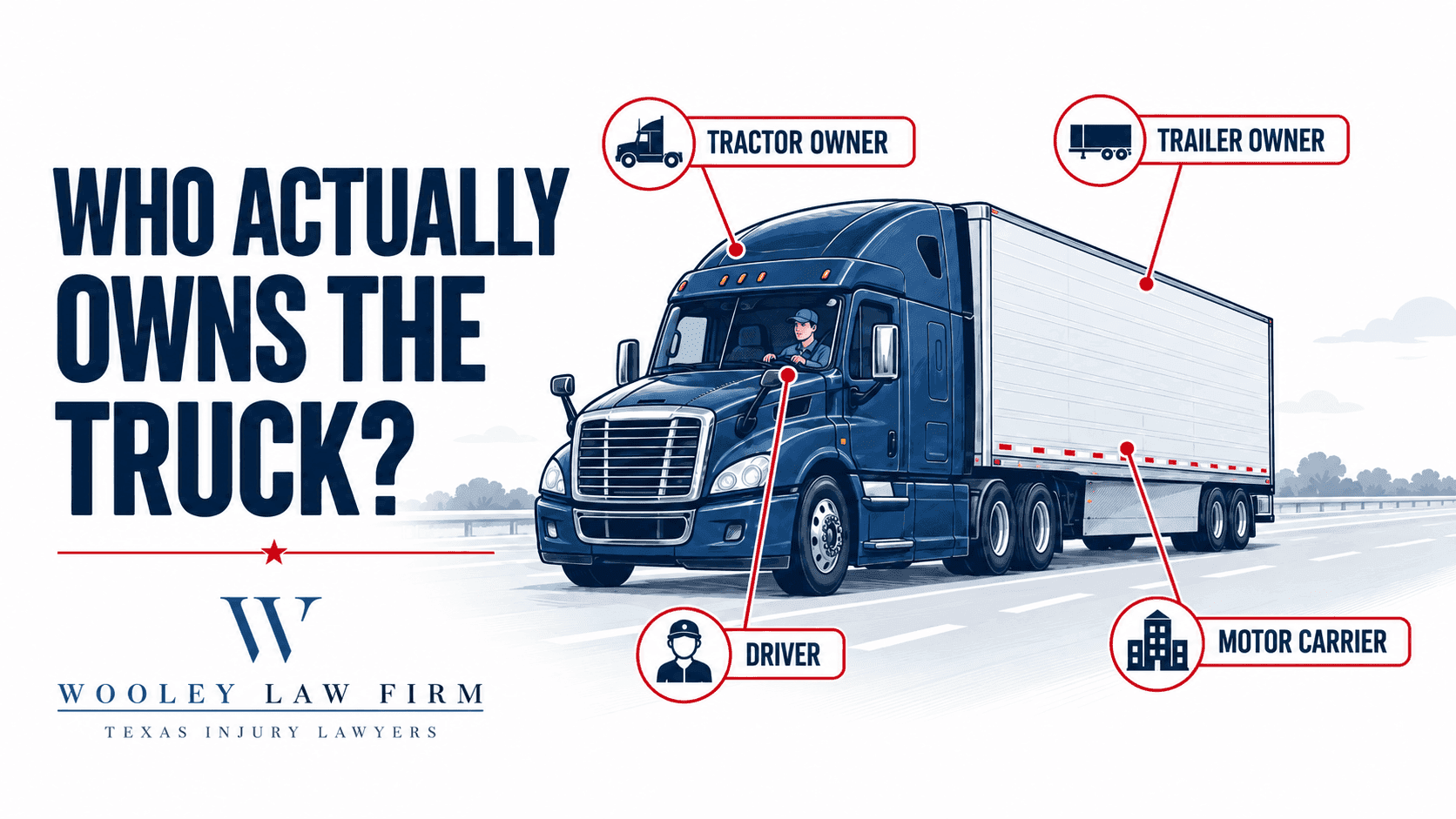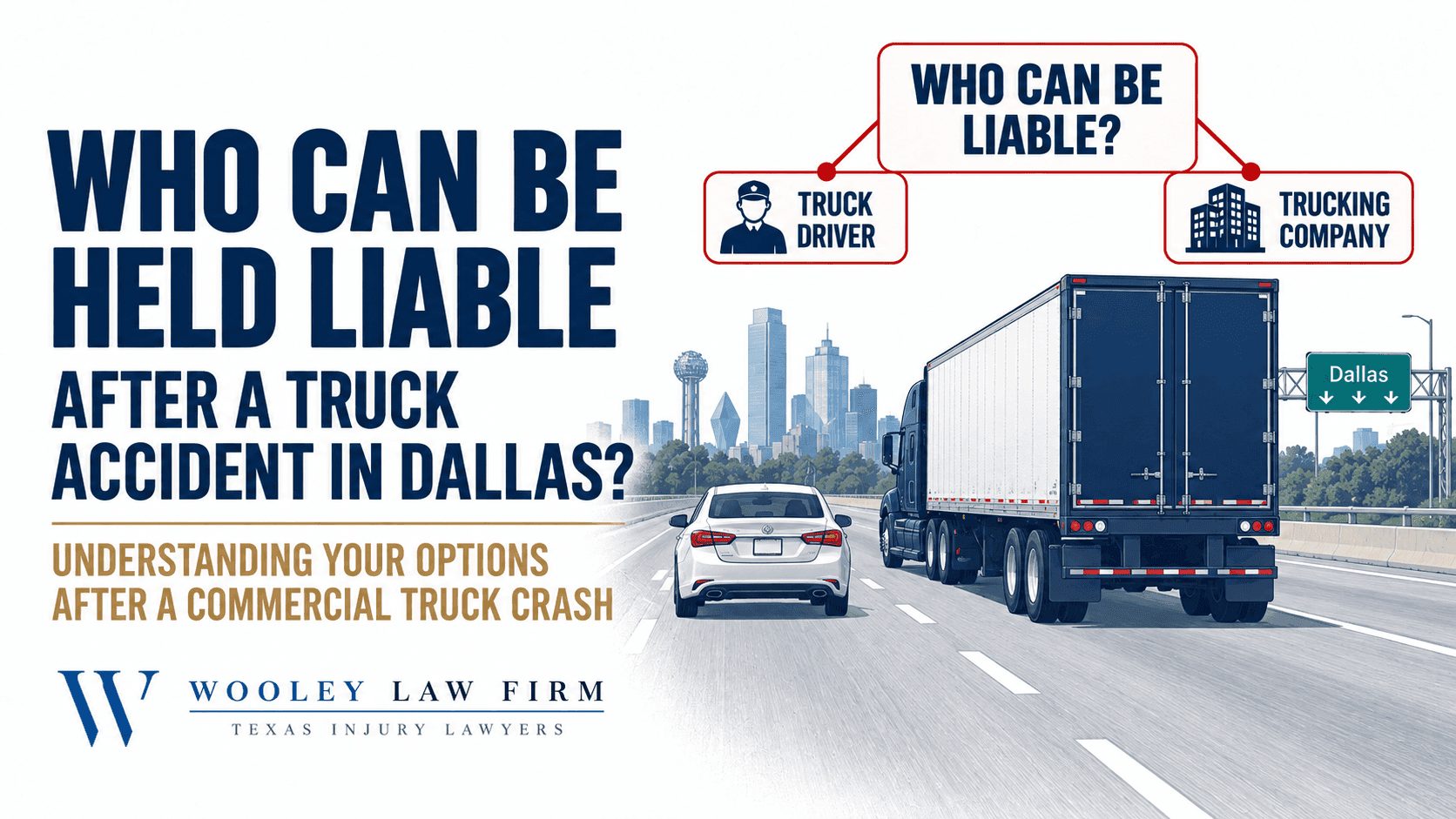
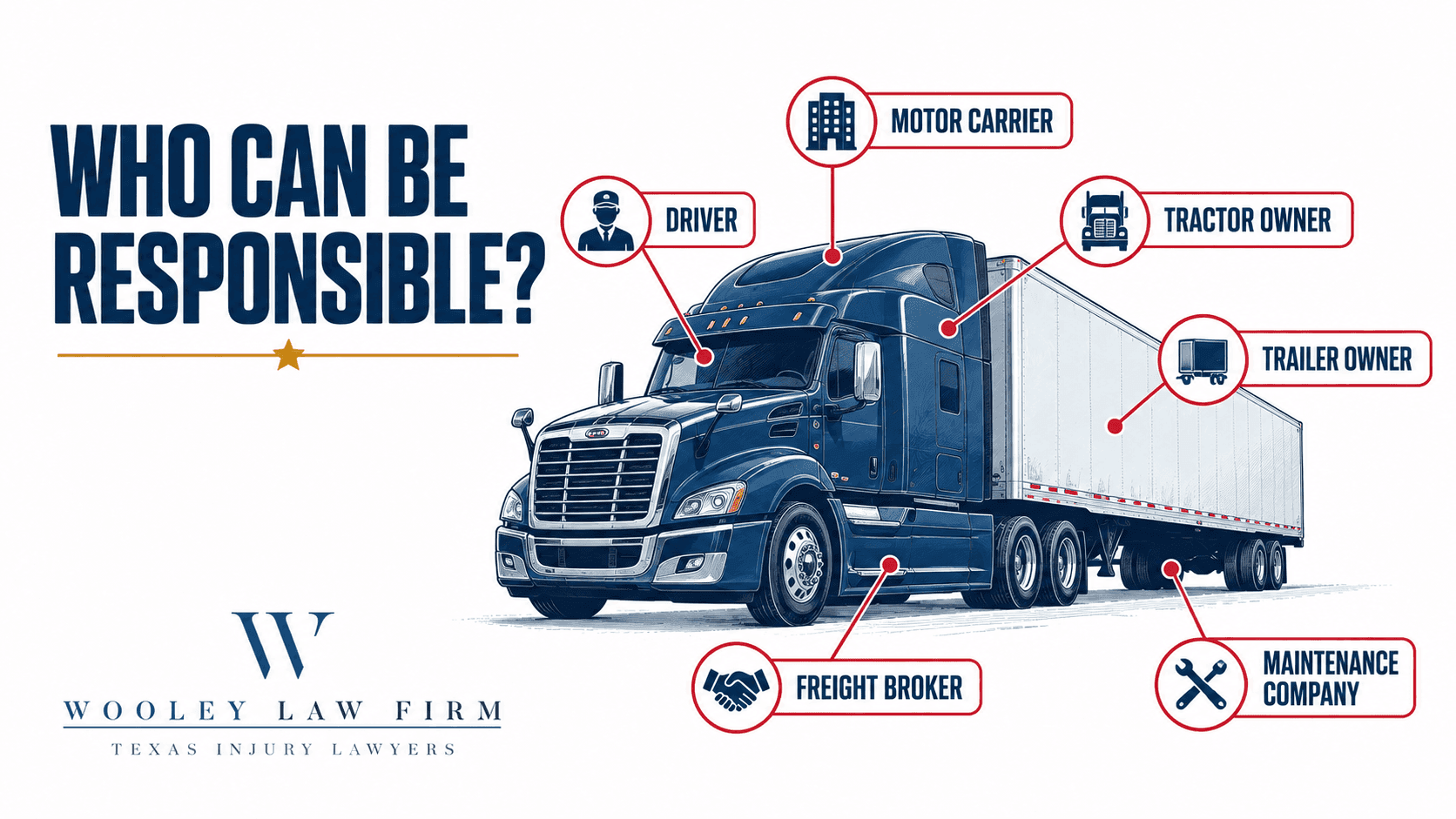
After a serious 18-wheeler wreck in Dallas, many injured people assume there are only two possible defendants:
the truck driver and the trucking company.
Sometimes that is true.
But many commercial truck wrecks involve a much larger chain of people and companies.
The driver may work for one company.
A different company may be the authorized motor carrier.
The tractor may belong to an owner-operator or leasing company.
Another company may own the trailer.
A freight broker may have selected the carrier.
A warehouse or loading company may have loaded the cargo.
A separate repair shop may have worked on the brakes.
And if a defective truck component contributed to the wreck, a manufacturer or supplier may also need to be investigated.
That is why an important question after a serious Dallas truck accident is not simply:
“What trucking company name was printed on the cab?”
The better question is:
“Who was involved in putting this truck, this driver, this trailer, and this load on the road?”
A thorough Dallas truck-wreck investigation may need to identify the entire chain of businesses involved before determining who may be legally responsible.
If you were seriously injured in a commercial-truck collision, our Dallas 18-wheeler accident lawyer page explains how The Wooley Law Firm investigates serious truck wrecks throughout Dallas and North Texas.
Who Can Be Sued After a Dallas Truck Accident?
Depending on the facts, potentially responsible parties may include:
The truck driver;
The driver's employer;
The motor carrier;
The tractor owner;
The trailer owner;
An equipment leasing company;
A freight broker;
A shipper;
A loading or warehouse company;
A maintenance or repair company;
A truck, trailer, tire, brake, or component manufacturer;
Another commercial business involved in the transportation; or
Another negligent motorist.
Not every company connected to a shipment is automatically liable.
The evidence must establish what each company did, what responsibilities it had, and whether its conduct contributed to the collision.
That is one reason evidence after an 18-wheeler wreck can be much more extensive than the evidence involved in an ordinary passenger-vehicle crash.
The Truck Driver
The truck driver is often the most obvious potential defendant.
A commercial driver may cause or contribute to a collision by:
Speeding;
Following too closely;
Failing to control speed;
Driving while distracted;
Texting or using a cellphone;
Driving while fatigued;
Falling asleep;
Making an unsafe lane change;
Failing to keep a proper lookout;
Running a red light;
Making an unsafe turn;
Failing to yield;
Driving while impaired; or
Failing to properly inspect the tractor or trailer.
But identifying driver negligence is often only the first step.
A serious truck-wreck investigation should also determine who the driver was working for, whose authority the driver was operating under, who dispatched the load, and who controlled the transportation.
The Motor Carrier or Trucking Company
The motor carrier may be responsible for the driver's conduct under Texas law when the requirements for vicarious liability are satisfied.
The carrier's own conduct may also deserve investigation depending on the circumstances.
Potential issues can include:
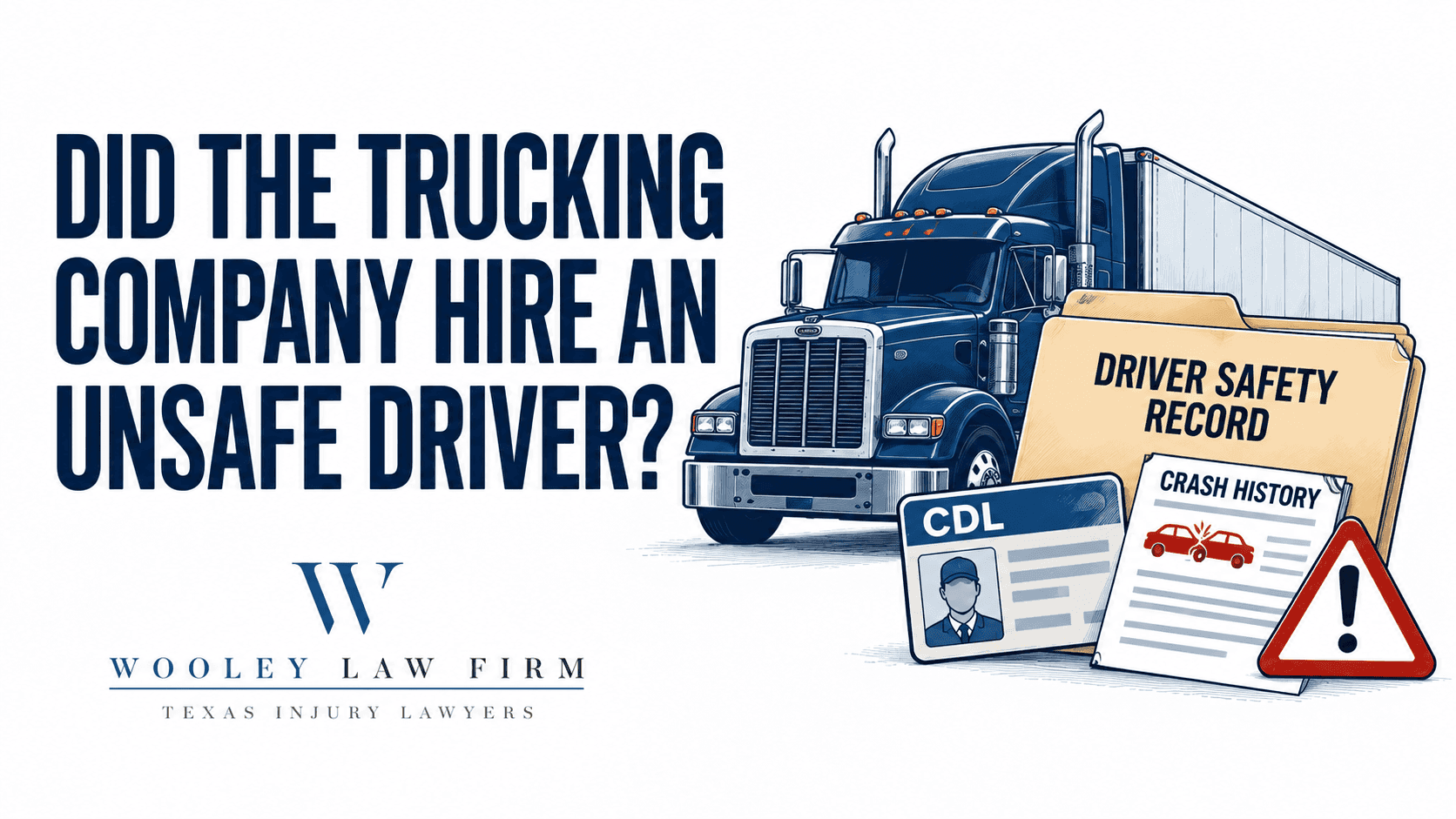
Hiring an unsafe driver;
Keeping an unsafe driver after warning signs appeared;
Inadequate training;
Safety-policy violations;
Maintenance failures;
Allowing an unsafe vehicle to remain in service;
Improper dispatch practices; or
Other corporate conduct that contributed to the wreck.
Our related guide explains whether you can sue the trucking company after a Dallas 18-wheeler wreck.
The Driver's Employer May Not Be the Name Printed on the Truck
Commercial trucking relationships can be complicated.
The driver may be:
A company employee;
An owner-operator;
An independent contractor;
An employee of another company;
Driving equipment leased to a carrier; or
Operating through a separate LLC.
A carrier may respond after a wreck by saying:
“The driver doesn't work for us.”
That statement should not necessarily end the investigation.
Important records can include:
Employment files;
Contractor agreements;
Tractor leases;
Dispatch records;
Payroll records;
Settlement statements;
Bills of lading;
Insurance documents;
FMCSA records; and
Communications concerning the driver's assignment.
These documents may help establish the actual relationships involved in the transportation.
The Tractor Owner
The company operating the truck may not own the tractor.
The tractor might belong to:
The driver;
An owner-operator's LLC;
A truck leasing company;
Another motor carrier; or
A separate equipment company.
Ownership by itself does not automatically establish liability.
But the tractor owner may become important if it had responsibility for maintenance, repairs, inspection, or another condition that contributed to the wreck.
For example, if a tractor had serious brake problems that were repeatedly reported to its owner and never repaired, ownership and maintenance responsibility could become highly relevant.
This is why identifying the tractor by its VIN, license plate, unit number, registration, and lease documents can matter just as much as identifying the driver.
The Trailer Owner
The tractor and trailer may have completely different owners.
That is common in commercial transportation.
A carrier may pull a trailer owned by:
A trailer leasing company;
A shipper;
Another trucking company;
A distribution company; or
Another equipment owner.
The trailer owner may become particularly important when the wreck involves:
Trailer brakes;
Trailer tires;
Lighting;
Reflective markings;
Suspension;
Coupling equipment;
Structural failure;
Trailer doors; or
Other trailer-specific defects.
This is one reason photographs taken after a Dallas 18-wheeler accident should capture both the tractor and trailer, including license plates, unit numbers, USDOT information, company markings, and visible damage.
An Equipment Leasing Company
A tractor or trailer may be owned by a company whose business is leasing commercial equipment.
A leasing company is not necessarily liable merely because it owns the equipment.
Federal law can protect qualifying vehicle-leasing businesses from liability based solely on vehicle ownership when the lessor itself was not negligent.
But the lessor's own conduct can present a different issue.
For example, an investigation may examine whether the leasing company:
Performed maintenance;
Made negligent repairs;
Knew about a serious defect;
Failed to address a reported problem; or
Otherwise contributed to an unsafe equipment condition.
The lease itself may help establish which company was responsible for maintenance, inspections, possession, and operation of the equipment.
A Freight Broker
A freight broker generally acts as an intermediary between a shipper that needs cargo transported and a motor carrier that will perform the transportation.
The broker usually does not physically operate the truck.
But a freight broker should not automatically be ignored in every serious truck-wreck investigation.
Depending on the facts and applicable law, an investigation may examine:
Which broker arranged the shipment;
Which carrier the broker selected;
What information was available about that carrier;
The carrier's safety history;
Whether there were warning signs before selection; and
What the broker knew or reasonably should have known.
This can become particularly important when evidence suggests an unsafe motor carrier was selected to transport the load.
A freight broker is not automatically liable merely because it arranged transportation. The particular legal theory and evidence still matter.
Injured in an Accident?
Free consultation. Tell us what happened and learn what options may be available.
A Shipper
The shipper is typically the business whose goods are being transported.
A shipper is not automatically responsible simply because its product was inside the trailer.
But the shipper may need to be investigated when its own conduct contributed to the collision.
Depending on the circumstances, that might involve issues concerning:
Loading;
Securement;
Weight;
Hazardous materials;
Special handling requirements; or
Other conduct connected to the shipment.
The key is determining what the shipper actually did, rather than naming the company merely because it owned the cargo.
A Warehouse or Cargo-Loading Company
Improperly loaded cargo can make an 18-wheeler difficult or impossible to control safely.
Cargo can:
Shift during turns;
Move during emergency braking;
Make the trailer unstable;
Overload an axle;
Alter the truck's center of gravity;
Cause a rollover;
Cause cargo to fall onto the roadway; or
Contribute to a jackknife.
Sometimes the truck driver loads the trailer.
Sometimes the motor carrier controls loading.
Other times, a shipper, warehouse, distribution center, or third-party loading company performs the work before the driver arrives.
If cargo movement contributed to the wreck, investigators may need to determine:
Who actually loaded and secured the shipment?
Important evidence can include:
Bills of lading;
Loading diagrams;
Cargo photographs;
Weight tickets;
Scale records;
Seal records;
Warehouse video;
Loading procedures; and
Testimony from employees who loaded the trailer.
A Maintenance or Repair Company
Many trucking companies outsource maintenance.
A truck involved in a Dallas collision may have recently been serviced by:
A dealership;
A commercial repair facility;
A mobile mechanic;
A tire company;
A brake specialist; or
Another maintenance contractor.
If a mechanical failure contributed to the wreck, those repair records should be examined.
For example, suppose a repair company serviced the truck's brakes shortly before a serious rear-end collision.
The investigation may need to determine:
What work was requested;
What inspections were performed;
What defects were found;
What repairs were recommended;
What repairs were actually completed;
Whether the mechanic warned anyone about unsafe conditions; and
Whether defective work contributed to the wreck.
A rear-end collision may also involve evidence about driver reaction time, braking, electronic systems, and traffic conditions. Our guide for people rear-ended by an 18-wheeler in Dallas discusses these issues in greater detail.
What If the Trucking Company Blames the Repair Shop?
Truck cases involving mechanical failures can quickly become finger-pointing contests.
The motor carrier may say:
“We hired a repair company to fix it.”
The repair company may respond:
“The carrier declined the recommended repairs.”
The tractor owner may claim:
“Maintenance was the carrier's responsibility under the lease.”
That is why repair invoices, inspection reports, emails, driver complaints, maintenance histories, and contracts can become critical.
The question is not simply who touched the truck last.
The investigation should determine what each company knew and whether its conduct actually contributed to the unsafe condition.
The Truck or Component Manufacturer
Sometimes the problem is not maintenance.
The truck or one of its components may have been defective.
Depending on the evidence, a product-liability investigation might involve a manufacturer or seller of:
Braking components;
Tires;
Steering components;
Coupling equipment;
Trailer components;
Wheels;
Safety systems;
Lighting;
Suspension components; or
Other defective equipment.
A product claim is very different from an ordinary driver-negligence claim.
It may require preserving the failed component, inspecting the vehicle, obtaining design and manufacturing information, reviewing recalls or technical information, and consulting qualified experts.
The damaged part should not simply be discarded or replaced without documentation if a defect may have contributed to the crash.
Another Driver or Company Vehicle
Not every multi-vehicle truck wreck is caused entirely by the 18-wheeler.
Another vehicle may start the sequence.
For example:
A passenger car makes an unsafe lane change.
The truck swerves to avoid it.
The tractor-trailer enters another lane and strikes your vehicle.
Or another commercial vehicle may force the truck into your lane.
In a chain-reaction collision, investigators need to reconstruct the entire sequence rather than assume the vehicle that physically struck you was the only responsible party.
Our guide to who may be responsible when an 18-wheeler causes a chain-reaction crash in Dallas explains why the final impact may not reveal what actually started the wreck.
Unsafe lane changes can create similar issues. An 18-wheeler that changes lanes and triggers a multi-vehicle wreck may cause injuries even when the truck never physically contacts every vehicle involved.
Why Freight Documents Matter
Commercial trucking generates paperwork.
Those documents can help reveal the companies involved behind the scenes.
Important records may include:
Bills of Lading
A bill of lading can help identify the shipper, carrier, cargo, origin, destination, and other information about the shipment.
Rate Confirmations
Rate confirmations may help identify a freight broker, motor carrier, compensation arrangement, and shipment instructions.
Dispatch Records
Dispatch communications may reveal who assigned the load and who was directing the driver.
Equipment Leases
Leases can establish relationships among tractor owners, trailer owners, owner-operators, and motor carriers.
Maintenance Agreements
These may establish which business was responsible for maintaining the tractor or trailer.
Loading Documents
Loading and warehouse records may identify who actually loaded and secured the cargo.
A serious trucking case often begins to look very different once these documents are collected.
The Truck's Electronic Evidence Can Help Identify Responsibility
Commercial trucks can generate substantial electronic evidence.
Depending on the equipment installed, investigators may look for:
ECM or engine data;
Event data;
Electronic logging-device records;
GPS history;
Telematics;
Forward-facing cameras;
Driver-facing cameras;
Side cameras;
Digital mirrors;
Collision-warning events;
Automatic emergency-braking information;
Lane-departure warnings;
Hard-braking events; and
Dispatch-system communications.
Our detailed article about 18-wheeler black-box data after a Dallas-Fort Worth truck wreck explains how ECM, EDR, ELD, GPS, telematics, and onboard camera information can help establish what happened before a collision.
Evidence May Be Spread Across Several Different Companies
This is one of the biggest reasons identifying all potential parties early matters.
The motor carrier may have:
Driver logs;
Dispatch information;
Safety policies; and
Driver qualification materials.
The tractor owner may have:
Lease records;
Maintenance records; and
Repair history.
The trailer owner may have:
Trailer inspection records;
Tire history; and
Brake-maintenance records.
A broker may have:
Carrier-selection records;
Rate confirmations; and
Communications with the carrier.
A shipper or warehouse may have:
Loading records;
Surveillance video;
Cargo photographs; and
Weight information.
A repair shop may have:
Inspection reports;
Invoices;
Technician notes; and
Recommendations.
That is why our broader guide to evidence that can help prove an 18-wheeler wreck case emphasizes identifying which business possesses each category of evidence before important information is lost.
Why the Name Printed on the Cab Is Not Enough
Imagine a tractor-trailer involved in a wreck on I-35E.
The tractor displays ABC Trucking.
But further investigation reveals:
Driver Smith owns the tractor through Smith Transport LLC;
ABC Trucking is the motor carrier;
XYZ Leasing owns the trailer;
Freight Broker Corp. arranged the shipment;
Distribution Center Inc. loaded the trailer; and
Repair Company LLC serviced the brakes three days before the crash.
The name ABC Trucking on the cab tells only one part of the story.
This is why serious truck-wreck investigations should follow:
the driver, the tractor, the trailer, the load, the maintenance, the dispatch, and the money.
Multiple Defendants May Mean Multiple Insurance Policies
Identifying all potentially responsible businesses can also affect the insurance investigation.
Different policies may potentially cover:
The motor carrier;
Driver;
Owner-operator;
Tractor owner;
Trailer owner;
Maintenance company;
Loading company;
Broker; or
Another responsible company.
That does not mean every policy applies or that every business should be sued.
But after a catastrophic collision involving surgery, permanent impairment, lost earning capacity, or wrongful death, identifying the responsible parties and applicable insurance coverage can be extremely important.
Our guide to damages after a Dallas 18-wheeler wreck explains medical expenses, lost income, future medical needs, impairment, pain and suffering, and other damages that may become important in a serious truck accident claim.
Do Not Name Every Company Just Because It Appears in the Records
A strong truck-accident case is not about suing as many companies as possible.
It is about identifying the companies that the evidence and law actually connect to the wreck.
A company may appear on a bill of lading but have had nothing to do with the unsafe conduct.
A trailer lessor may merely own equipment without having committed negligence.
A broker may have selected a competent carrier and done nothing wrong.
A manufacturer should not be blamed for a component failure caused by poor maintenance.
The investigation should determine:
What role did the company have?
What duty, if any, applied?
What did the company do or fail to do?
Did that conduct contribute to the wreck or injuries?
What evidence proves the relationship?
That approach helps distinguish legitimate claims from companies that simply happened to be somewhere in the transportation paperwork.
Frequently Asked Questions About Multiple Defendants in Dallas Truck Wrecks
Can I sue more than one company after an 18-wheeler accident?
Potentially. A serious commercial-truck wreck may involve several companies whose conduct contributed to the collision. Liability depends on the evidence and applicable law.
Is the trucking company always responsible for the truck driver's negligence?
Not automatically. The driver's relationship with the carrier and whether the driver was acting within the course and scope of employment can matter, along with other applicable Texas law.
Can I sue the company that owns the trailer?
Possibly. Trailer ownership alone does not automatically create liability, but the owner's maintenance responsibilities or independent negligence may become relevant.
Can a freight broker be sued after a truck accident?
Potentially, depending on the applicable law and evidence. A broker is not automatically liable merely because it arranged the shipment. The investigation may focus on the carrier-selection process and what the broker knew or should have known when selecting the motor carrier.
Can the company that loaded the trailer be responsible?
Potentially. If negligent loading, overloading, improper weight distribution, or inadequate cargo securement contributed to the collision, the company responsible for loading may need to be investigated.
Can a repair shop be sued after an 18-wheeler wreck?
Potentially, if negligent inspection or repair contributed to a mechanical failure that caused the collision.
Can I sue the truck manufacturer?
A manufacturer or seller may become relevant when evidence supports a defective-product theory. These cases often require expert analysis and preservation of the truck or failed component.
How do you determine all of the companies involved?
The investigation may include the crash report, FMCSA records, vehicle registrations, leases, bills of lading, rate confirmations, dispatch messages, insurance policies, maintenance records, loading documents, corporate records, electronic truck data, and discovery from the parties.
Injured in a Dallas 18-Wheeler Wreck?
A serious truck wreck should not be investigated as though it were simply a larger car accident.
The truck driver may be only one piece of a much larger commercial transportation operation.
At The Wooley Law Firm, we investigate the relationships among the:
Driver;
Motor carrier;
Employer;
Tractor owner;
Trailer owner;
Leasing company;
Freight broker;
Shipper;
Loading company;
Maintenance provider; and
Other businesses involved in the transportation.
We also investigate electronic data, dispatch records, driver files, maintenance history, cargo documents, insurance coverage, and other evidence that may reveal why the wreck happened and which parties may be legally responsible.
Learn more about how we handle serious commercial-vehicle cases on our Dallas 18-wheeler accident lawyer page.
If you or a family member was seriously injured in an 18-wheeler, tractor-trailer, semi-truck, or commercial-vehicle collision in Dallas or the Dallas-Fort Worth area, call (214) 699-6524 for a free consultation.
You don't pay unless we win.
Disclaimer
This article is for general informational purposes only and is not legal advice. Reading it does not create an attorney-client relationship. Every case depends on its specific facts, parties, contracts, evidence, and applicable law.
Topics
Share This Article

Andrew J. Wooley
Personal Injury Attorney
Andrew J. Wooley is a dedicated personal injury attorney based in Dallas, Texas. He focuses on helping accident victims recover fair compensation for their injuries. With a commitment to personalized service, Andrew works directly with each client to understand their unique situation and fight for their rights.