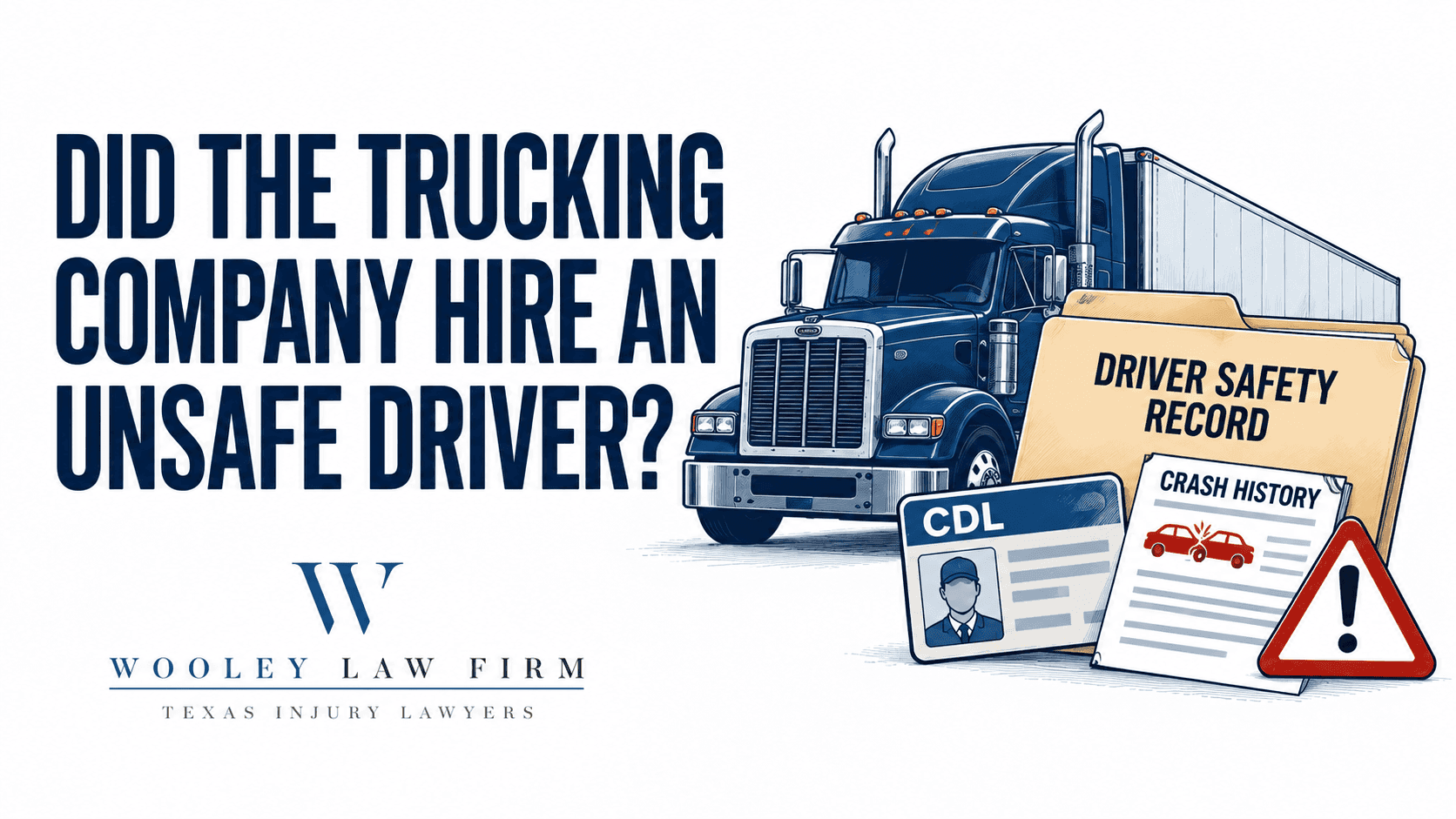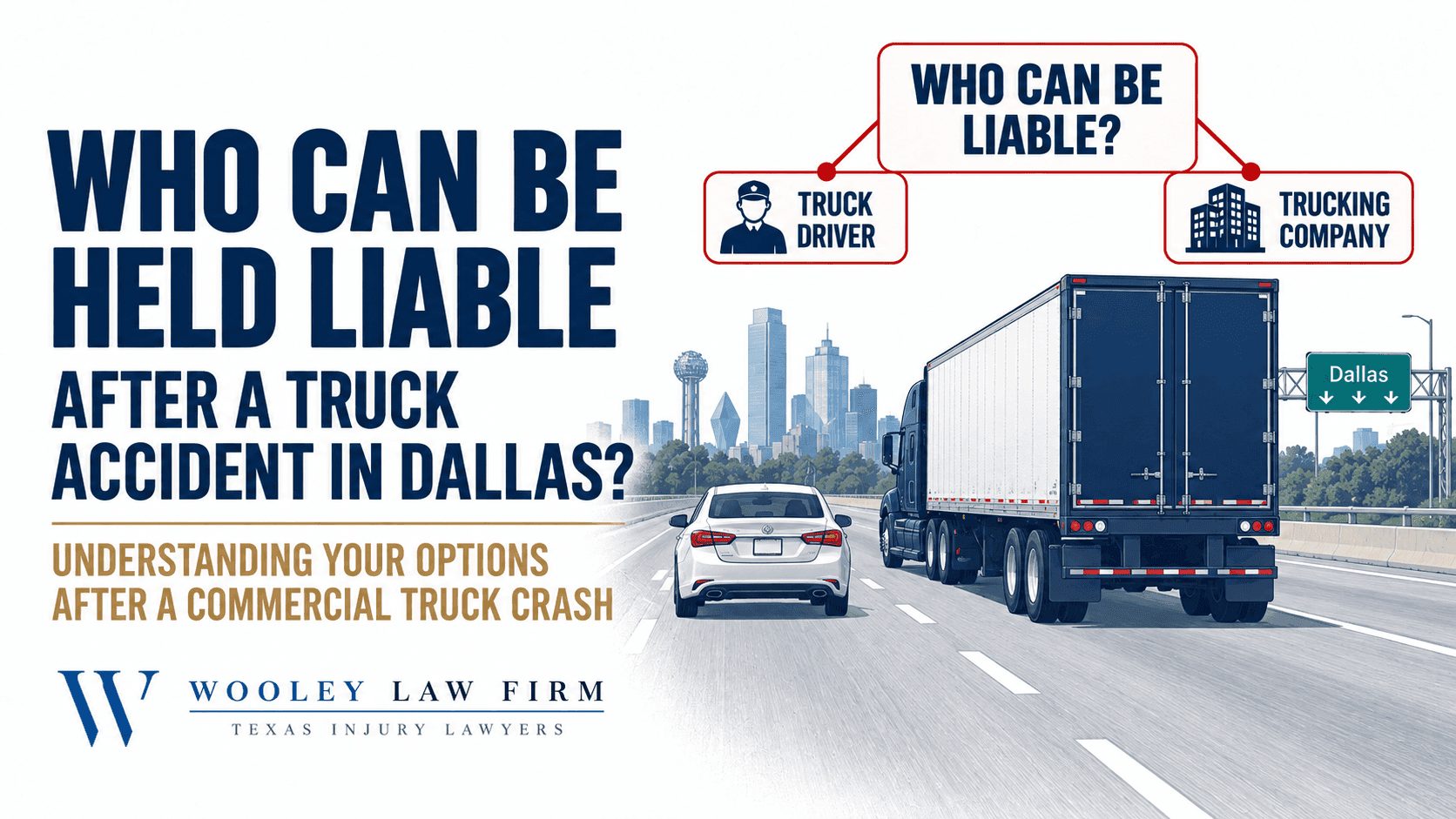
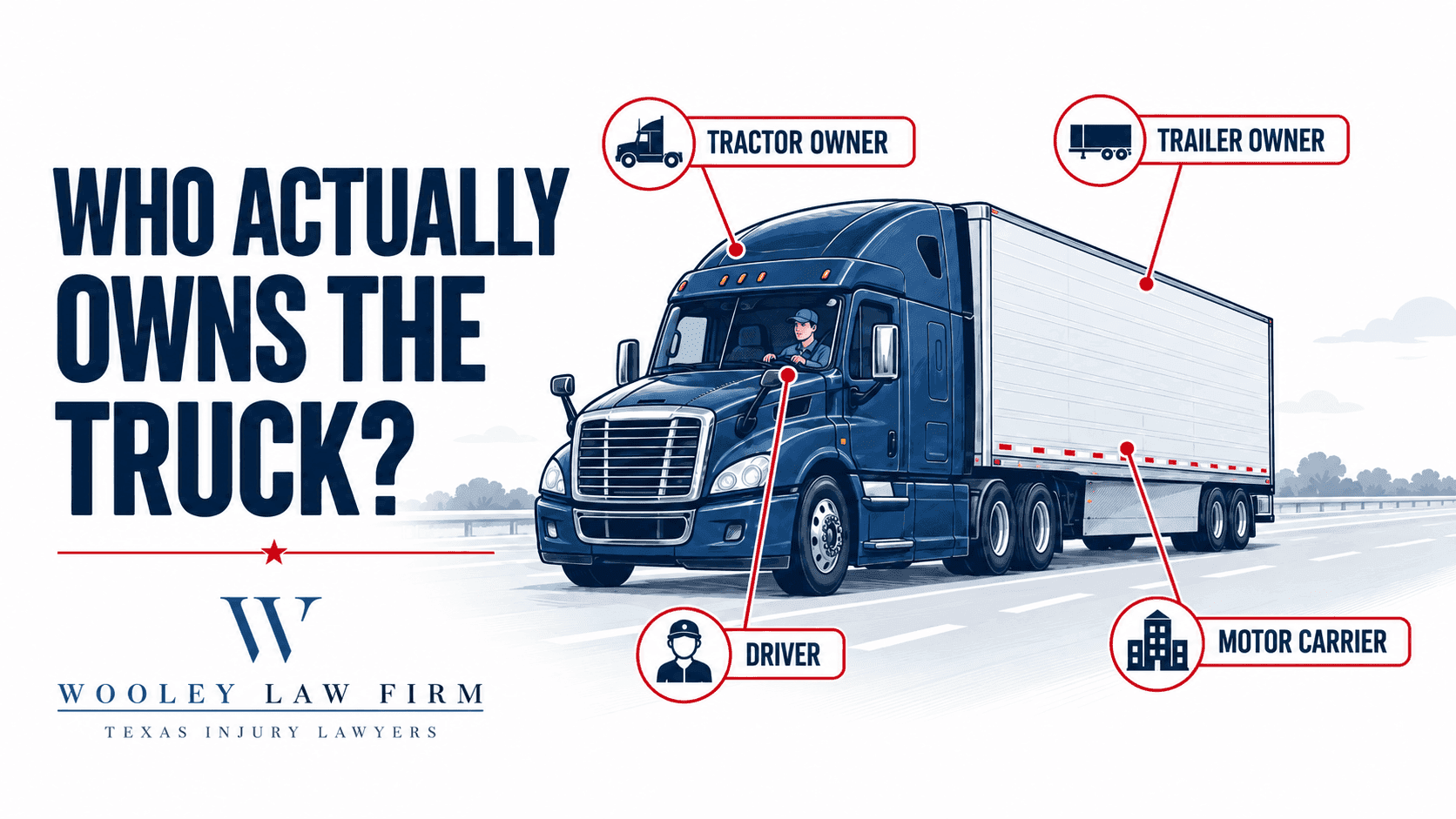
After a serious 18-wheeler wreck in Dallas, identifying the truck driver is often only the beginning.
The company name printed on the tractor may not own the tractor.
A different company may own the trailer.
The driver may own the tractor but operate it for another motor carrier.
A leasing company may own the equipment.
Another company may employ or contract with the driver.
And a shipper, broker, or logistics company may have arranged the load.
That raises an important question after a Dallas truck wreck:
Can you sue the company that owns or leases the 18-wheeler?
Potentially, but ownership alone does not automatically make every tractor owner, trailer owner, or leasing company liable for a collision. The answer depends on the company's role, the leasing arrangement, who controlled the trucking operation, who was responsible for maintenance, and whether that company's own negligence contributed to the wreck.
This is one reason a serious 18-wheeler accident requires more investigation than simply reading the company name on the side of the truck. Our Dallas 18-wheeler accident lawyer page explains more about how The Wooley Law Firm investigates commercial truck crashes involving multiple companies.
The Truck Driver, Tractor Owner, Trailer Owner, and Motor Carrier May All Be Different
People often refer to the entire vehicle as “the truck,” but an 18-wheeler usually consists of at least two major pieces of equipment:
The tractor; and
The trailer.
Those pieces do not necessarily have the same owner.
For example, a Dallas truck wreck could involve:
A driver who owns the tractor;
A trucking company operating under federal motor-carrier authority;
A separate company that owns the trailer;
A leasing company that leased the trailer to the motor carrier;
A shipper whose cargo was inside the trailer;
A maintenance contractor responsible for repairs; and
A logistics company that arranged the shipment.
Each company may have a different legal relationship to the truck and the delivery.
That means the first question should not simply be:
“Whose name was on the truck?”
A more useful investigation asks:
Who owned the tractor? Who owned the trailer? Who leased them? Who employed or controlled the driver? Who maintained the equipment? And who was responsible for the transportation operation?
Our broader article on whether you can sue the trucking company after a Dallas 18-wheeler wreck explains why liability may extend beyond the individual driver.
Why the Name on the Truck May Not Tell You Who Owns It
A tractor may display the name and USDOT information of the motor carrier operating it even when that company does not own the tractor.
Commercial carriers frequently use equipment owned by:
Owner-operators;
Equipment leasing companies;
Related corporate entities; or
Other businesses.
Likewise, the semi-trailer may bear markings from a leasing company or trailer pool rather than the motor carrier operating it.
This can become particularly important after a sideswipe or lane-change collision.
A photograph may show one company name on the trailer and another on the tractor.
That does not necessarily mean either company employed the driver.
It does mean those entities need to be identified and their relationships investigated.
If your vehicle was struck alongside a tractor-trailer, our guide for people sideswiped by an 18-wheeler in Dallas-Fort Worth explains why identifying the tractor, trailer, driver, and motor carrier can be particularly important in a lane-change wreck.
What Is a Motor Carrier?
The motor carrier is generally the company authorized to transport property or passengers in commercial interstate transportation.
It may operate tractors it owns.
But it can also operate equipment it leases from someone else.
Federal leasing regulations recognize that motor carriers may use equipment they do not own. In covered leasing arrangements, federal regulations require the lease to address possession, control, and responsibility for the equipment during the lease.
That is important because the owner listed on the title is not necessarily the same company responsible for operating the truck during the trip.
After a serious Dallas truck wreck, motor-carrier records may help determine:
Whose operating authority was being used;
Which carrier was responsible for the transportation;
Who dispatched the driver;
Which company controlled the trip;
Who carried the required insurance;
Who was responsible for safety compliance; and
What lease governed the equipment.
What If the Truck Driver Owns the Tractor?
Owner-operators are common in commercial trucking.
A driver may own the tractor personally or through an LLC and then lease that tractor to a motor carrier.
For example:
Driver owns Tractor A;
Driver leases Tractor A to Motor Carrier B;
Motor Carrier B dispatches the driver;
Trailer C is owned by Leasing Company D;
Cargo belongs to Shipper E.
If a wreck occurs on I-35E in Dallas, several businesses may appear in the investigation even though only one driver was physically behind the wheel.
The fact that the driver owns the tractor does not automatically mean the motor carrier disappears from the case.
The lease, dispatch records, operating authority, insurance filings, bills of lading, and actual transportation relationship may all help identify which companies were involved.
This is also why a serious truck case should look beyond the police report. Our article on evidence that can help prove an 18-wheeler wreck case discusses many of the records that can help identify the responsible companies and reconstruct the collision.
What If a Leasing Company Owns the Tractor?
Truck leasing companies frequently own tractors used by motor carriers.
But there is an important legal distinction between owning equipment and being negligent.
Federal law commonly known as the Graves Amendment generally limits liability against businesses engaged in renting or leasing motor vehicles when the claim is based only on their ownership of the vehicle and there was no negligence or criminal wrongdoing by the owner or affiliate.
In other words, an equipment leasing company is not necessarily liable just because its name appears on the vehicle title.
But that does not mean a leasing company can never be responsible.
The investigation should determine whether the leasing company had its own duties and whether its own conduct contributed to the wreck.
Potential issues could include:
Negligent maintenance;
Defective repairs;
Failure to address known mechanical problems;
Providing unsafe equipment; or
Other independent negligent conduct.
The facts matter.
What If a Different Company Owns the Trailer?
This is extremely common.
A motor carrier may pull a trailer owned by:
A trailer leasing company;
Another motor carrier;
A shipper;
A dedicated fleet owner; or
A separate affiliated company.
The trailer owner may become important when the collision involves a condition related to the trailer itself.
Examples include:
Defective trailer brakes;
Worn or damaged tires;
Lighting problems;
Faulty reflective tape;
Defective underride equipment;
Coupling problems;
Door or structural failures;
Suspension defects; or
Other maintenance issues.
Suppose an 18-wheeler jackknifes on I-635 because of a trailer-brake problem.
The truck driver may be investigated.
The motor carrier may be investigated.
But the trailer owner and any company responsible for maintaining the trailer may also need to be identified.
Our detailed article about jackknife 18-wheeler accidents in Dallas explains how driver conduct, braking, maintenance, tires, cargo, and trailer problems can combine to cause these serious wrecks.
Injured in an Accident?
Free consultation. Tell us what happened and learn what options may be available.
Leasing Agreements Can Be Important Evidence
A truck or trailer lease can help explain who was responsible for the equipment during the trip.
Depending on the arrangement, a lease may identify:
The equipment owner;
The motor carrier using the equipment;
The duration of the lease;
Maintenance responsibilities;
Inspection responsibilities;
Insurance obligations;
Compensation arrangements;
Who had possession of the equipment; and
Which party assumed operational responsibilities.
For certain federally regulated equipment leases, the regulations require the authorized carrier's lease to provide that the carrier has exclusive possession, control, and use of the equipment during the lease and assumes responsibility for its operation.
But federal regulations also make clear that those lease provisions do not automatically decide whether a particular driver is an employee or independent contractor.
The actual legal relationships can therefore be more complicated than simply reading one paragraph of a lease.
Who Maintained the Tractor?
Maintenance responsibility is a major question in equipment-ownership cases.
The title owner may not perform the maintenance.
A motor carrier may maintain leased tractors itself.
An owner-operator may be contractually required to perform maintenance.
A leasing company may provide maintenance as part of a full-service lease.
Another repair company may have performed the actual work.
After a wreck involving mechanical failure, an investigation may need to determine:
Who performed the last inspection;
Who serviced the brakes;
Who changed the tires;
Whether defects were reported;
Whether repairs were recommended;
Whether those repairs were completed;
Who had authority to take the truck out of service; and
Whether anyone continued operating the truck despite a known problem.
Maintenance and repair records can become just as important as the driver's actions in determining why a truck wreck occurred.
Who Maintained the Trailer?
The same questions apply separately to the trailer.
This distinction is easy to overlook.
A driver may conduct pre-trip inspections, but the underlying responsibility for repairs or long-term maintenance may belong to another entity.
Important trailer records can include:
Inspection reports;
Preventive-maintenance records;
Brake-service records;
Tire records;
Repair invoices;
Roadside-service records;
Driver defect reports; and
Lease documents.
The tractor's maintenance file will not necessarily contain the trailer's complete history.
That is why identifying the trailer by its license plate, unit number, VIN, and owner can be extremely important after a Dallas truck wreck.
What If the Trailer Owner Says, “We Only Leased the Trailer”?
That statement may or may not end the inquiry.
A company that merely leased equipment and committed no independent wrongdoing may have substantial defenses under federal law.
But the investigation should still determine:
Whether the company actually owned the trailer;
What type of lease existed;
Who was responsible for maintenance;
Whether the owner performed repairs;
Whether it knew about safety defects;
Whether defects were reported before the wreck; and
Whether the owner's own conduct contributed to the collision.
A lawyer should examine those facts before assuming the trailer owner either is or is not a proper defendant.
What If the Tractor or Trailer Was Repaired After the Wreck?
This can become an important evidence issue.
Commercial equipment is valuable, and trucking companies often want to return damaged tractors and trailers to service.
But repairs can change or destroy physical evidence.
That can include evidence relating to:
Collision damage;
Tire condition;
Brake condition;
Lights;
Reflective markings;
Trailer components;
Coupling systems;
Electronic sensors; and
Other damaged parts.
Before significant repairs occur, the involved companies may need to be asked to preserve the tractor, trailer, damaged components, photographs, repair estimates, invoices, and inspection records.
Our guide to evidence that can help prove an 18-wheeler wreck case explains why the tractor, trailer, electronic systems, maintenance records, dispatch communications, and other trucking evidence should be identified early.
Truck electronic information can be important as well. Our article about 18-wheeler black-box data after a Dallas-Fort Worth truck wreck explains what ECM, EDR, ELD, GPS, telematics, and onboard camera systems may reveal.
What Records Can Identify the Tractor Owner and Trailer Owner?
A truck-wreck investigation may use several sources to identify ownership and leasing relationships.
Potential records include:
Crash Report
The police report may identify the driver, carrier, vehicle owner, VIN, license plate, and commercial-motor-vehicle information.
But it should not always be treated as the final word.
Vehicle Registration
Registration records can help establish the titled or registered owner of the tractor and trailer.
Lease Agreements
Equipment leases may show which company owned the vehicle and which company possessed or operated it during the collision.
FMCSA Records
Federal motor-carrier information can help identify the carrier's USDOT number, operating authority, and other public information.
Bills of Lading
Shipping documents may identify the motor carrier, shipper, consignee, broker, or companies involved with the shipment.
Dispatch Records
Dispatch records may show which company controlled the driver's assignment and transportation.
Insurance Records
Commercial insurance policies can help identify the motor carrier, equipment, insured entities, and potentially available coverage.
Maintenance Records
Maintenance records may reveal which company actually exercised responsibility over the tractor or trailer.
Why the USDOT Number Can Be More Important Than the Logo
Commercial trucks often display a USDOT number.
That number may help identify the motor carrier responsible for the commercial operation even when the tractor belongs to an owner-operator or leasing company.
A photograph taken after a crash should ideally capture:
USDOT number;
Company name;
Tractor license plate;
Trailer license plate;
Tractor unit number;
Trailer unit number;
Visible VIN information if safely accessible; and
Damage to both vehicles.
This information can become especially important when the truck driver leaves before all ownership information is understood.
Our guide explaining what an 18-wheeler driver must do after a truck wreck in Dallas also discusses the importance of identifying the driver, tractor, trailer, carrier, and other potentially responsible companies following a collision.
What If the Driver Claims to Be an Independent Contractor?
Commercial trucking companies frequently work with owner-operators and independent contractors.
A motor carrier may respond to a claim by saying:
“That driver doesn't work for us. He owns his own truck.”
That should not automatically end the investigation.
Questions may remain about:
Whose motor-carrier authority was being used;
Who dispatched the load;
Who controlled the transportation;
Whether the tractor was under lease;
Who insured the operation;
Who selected the driver;
Who imposed delivery requirements; and
Who was responsible for the equipment.
Federal leasing rules can also matter when an authorized carrier operates equipment owned by someone else.
The real relationship should be established from documents and evidence, not simply a label such as “independent contractor.”
What If the Trucking Company and Equipment Owner Blame Each Other?
This happens.
The motor carrier may say:
“The owner was responsible for maintaining the tractor.”
The owner may say:
“The trucking company controlled the vehicle.”
The trailer lessor may say:
“The carrier was responsible once it took possession.”
A maintenance provider may say:
“We were never told about that defect.”
When several companies are involved, each may have an incentive to shift responsibility to another party.
That makes the underlying records particularly important.
A Dallas truck-wreck investigation may need to compare:
Leases;
Contracts;
Inspection records;
Maintenance agreements;
Driver reports;
Emails;
Dispatch messages;
Repair invoices; and
Deposition testimony.
The goal is to determine what each company was actually responsible for and what role, if any, its conduct played in causing the collision.
A Truck Wreck May Involve Multiple Insurance Policies
Multiple companies can also mean multiple insurance issues.
Depending on the circumstances, coverage may involve policies issued to:
The motor carrier;
The tractor owner;
The trailer owner;
An owner-operator;
A leasing company;
A maintenance provider; or
Another responsible business.
That does not mean every policy necessarily applies.
But identifying all companies involved can be important when investigating insurance coverage after a catastrophic truck wreck.
This becomes particularly significant when the injured person has undergone surgery, sustained permanent impairment, cannot return to work, or requires substantial future medical care.
Our article on truck accident damages after a Dallas 18-wheeler wreck discusses medical expenses, lost income, future damages, pain and suffering, impairment, and other issues that can affect a serious truck injury claim.
Do I Sue the Truck Driver, the Trucking Company, the Owner, or the Leasing Company?
Sometimes the answer may be more than one.
A serious truck-wreck case may potentially involve:
The truck driver;
The driver's employer;
The motor carrier;
The tractor owner;
The trailer owner;
A leasing company;
A maintenance provider;
A cargo-loading company;
A shipper;
A broker or logistics company; or
Another business whose conduct contributed to the collision.
But every company should not simply be named because it appears somewhere in the paperwork.
The evidence should establish each company's role and a legal basis for liability.
Our broader guide explains when you may be able to sue the trucking company after a Dallas 18-wheeler wreck.
Why Early Investigation Matters
Commercial tractors and trailers do not necessarily remain in one location after a wreck.
They may be:
Repaired;
Returned to service;
Transported to another state;
Sold;
Returned to a leasing company;
Assigned to another driver; or
Separated from one another.
Electronic data may also be overwritten.
Documents can be spread among several companies.
That is why a preservation investigation should identify both the tractor and the trailer, not simply the trucking company's name.
Potential evidence to preserve may include:
Tractor;
Trailer;
Electronic control module data;
Telematics;
Dash-camera footage;
Driver-facing video;
GPS records;
ELD records;
Lease agreements;
Maintenance records;
Repair records;
Inspection files;
Dispatch messages;
Bills of lading;
Insurance policies; and
Post-crash photographs.
For more on preserving these materials, read our guide to evidence that can help prove an 18-wheeler wreck claim.
Frequently Asked Questions About Truck Owners and Leasing Companies
Can I sue the owner of an 18-wheeler after a Dallas truck wreck?
Possibly, but vehicle ownership alone does not automatically establish liability. The owner's role, negligence, maintenance responsibilities, relationship with the driver or carrier, and applicable federal law must be examined.
Can I sue the company that leased the truck to the trucking company?
Potentially, depending on the facts. Federal law can protect some businesses engaged in leasing motor vehicles from claims based solely on ownership if the lessor was not independently negligent. A lessor's own negligent maintenance or other conduct may present a different issue.
What if the truck driver owns the tractor?
The driver may be an owner-operator working under another motor carrier's authority. The lease, dispatch arrangement, insurance, operating authority, and other records should be investigated.
What if a different company owns the trailer?
That is common. The trailer owner may become relevant if trailer maintenance, brakes, tires, lighting, coupling equipment, or another trailer-related condition contributed to the wreck.
Does the logo on the truck prove who owns it?
No. A truck can display a motor carrier's name while the tractor is owned by an owner-operator or equipment lessor.
How do I find out who owns the tractor and trailer?
Crash reports, license-plate records, VIN information, registration records, lease agreements, FMCSA information, insurance records, and litigation discovery can help identify the relevant companies.
Can the tractor and trailer have different insurance?
Potentially. Trucking operations can involve multiple companies and policies. Coverage depends on the particular policy terms and relationships involved.
Injured in a Dallas 18-Wheeler Wreck Involving Leased or Separately Owned Equipment?
If you were seriously injured in a Dallas truck wreck, do not assume the company name visible on the truck identifies everyone responsible.
The Wooley Law Firm investigates the entire trucking operation, including:
The driver;
The motor carrier;
Tractor ownership;
Trailer ownership;
Equipment leases;
Employment and contractor relationships;
Maintenance responsibilities;
Dispatch records;
Shipping documents;
Electronic truck data; and
Available insurance coverage.
Learn more about how we investigate serious commercial-vehicle cases on our Dallas 18-wheeler accident lawyer page.
If you or a family member was seriously injured in an 18-wheeler, tractor-trailer, semi-truck, or other commercial-vehicle wreck in Dallas or the Dallas-Fort Worth area, call (214) 699-6524 for a free consultation.
You don't pay unless we win.
Disclaimer
This article is for general informational purposes only and is not legal advice. Reading it does not create an attorney-client relationship. Every truck wreck depends on its specific facts, contracts, parties, and applicable law.
Topics
Share This Article

Andrew J. Wooley
Personal Injury Attorney
Andrew J. Wooley is a dedicated personal injury attorney based in Dallas, Texas. He focuses on helping accident victims recover fair compensation for their injuries. With a commitment to personalized service, Andrew works directly with each client to understand their unique situation and fight for their rights.