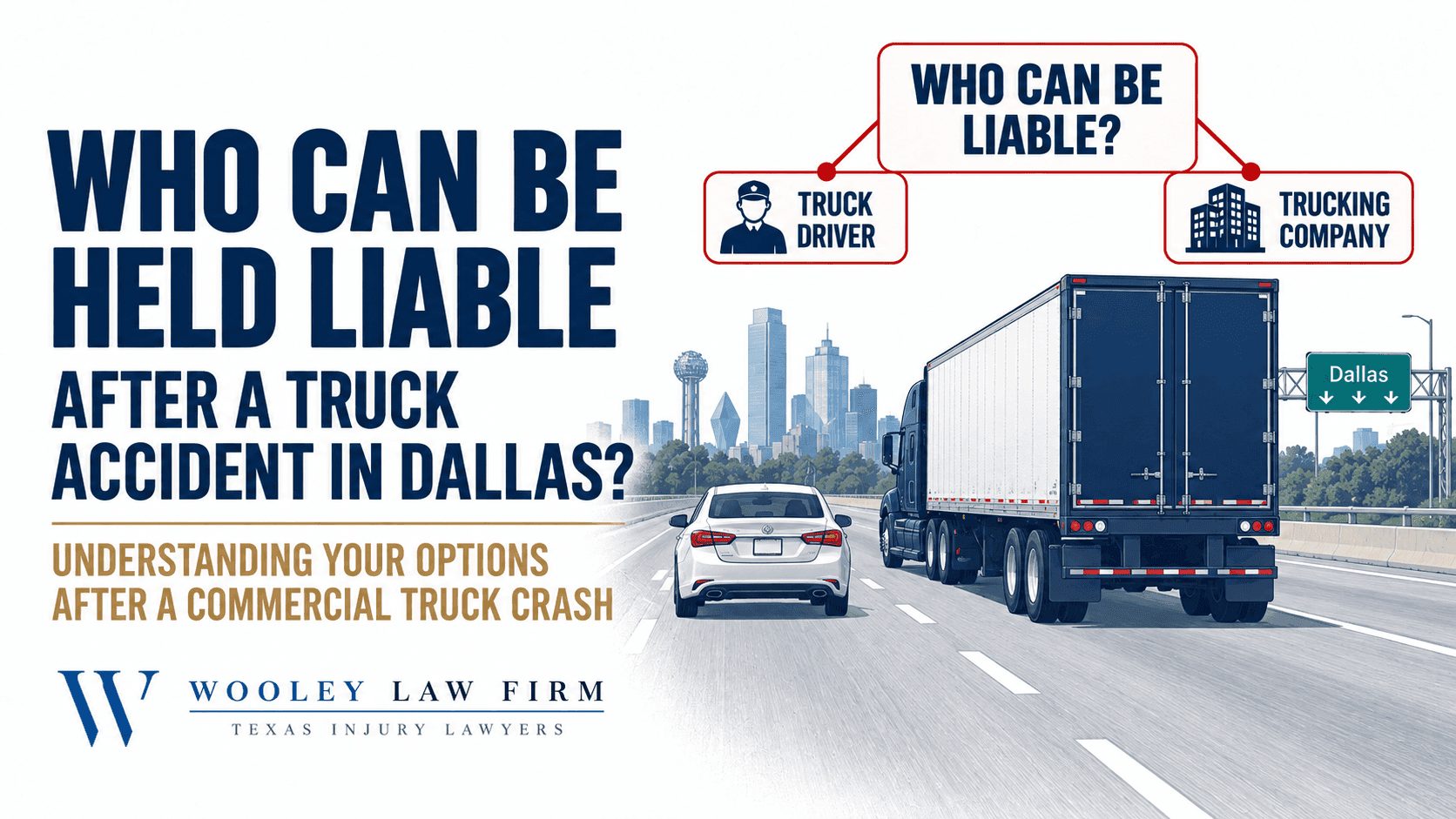
After being hit by an 18-wheeler, many injured people assume they have to choose between suing the truck driver or the trucking company.
That is not necessarily true.
Depending on the facts, a person injured in a Dallas truck wreck may have claims involving both the commercial truck driver and the trucking company responsible for the driver or vehicle. The driver may be responsible for negligent driving, such as speeding, following too closely, making an unsafe lane change, driving while distracted, or operating while fatigued.
The trucking company may also be legally responsible for the driver's conduct under Texas law. In some cases, the company's own negligent decisions or failures may have contributed to the collision.
If you were seriously injured in a commercial-truck collision, our Dallas truck accident lawyer page explains more about how The Wooley Law Firm investigates 18-wheeler crashes throughout Dallas and North Texas.
Can You Sue Both the Truck Driver and the Trucking Company in Texas?
Potentially, yes.
A Dallas truck-accident lawsuit may name the individual driver as a defendant and may also include the driver's employer or another company legally responsible for the commercial vehicle.
Consider a common scenario.
An 18-wheeler driver is making deliveries for a trucking company on I-35E in Dallas. The driver becomes distracted, fails to notice stopped traffic, and rear-ends a passenger vehicle.
The driver's conduct may support a negligence claim against the driver.
But the investigation should not necessarily stop there.
If the driver was an employee performing his or her job when the collision occurred, the trucking company may also be responsible for the driver's negligence under a doctrine commonly called respondeat superior or vicarious liability.
We discuss the broader issue of corporate liability in our guide, Can I Sue the Trucking Company After a Dallas 18-Wheeler Wreck?
What Is Respondeat Superior After a Texas Truck Wreck?
“Respondeat superior” is a legal doctrine that can make an employer responsible for negligent conduct committed by an employee acting within the course and scope of employment.
In practical terms, the issue is often not simply:
Did the truck driver cause the wreck?
The investigation may also need to determine:
Was the driver working for the trucking company and performing job duties when the wreck happened?
If an employee truck driver negligently changes lanes while transporting freight for the employer, for example, the trucking company may potentially face liability for that employee's negligence.
This is one reason determining the driver's employment relationship and purpose of the trip can become important after a serious commercial-truck collision.
Why the Truck Driver's Employment Status Matters
One of the first things a truck-wreck investigation should determine is:
Who was the driver actually working for?
That answer is not always obvious from the name painted on the tractor.
Commercial trucking arrangements can involve multiple businesses, including:
A motor carrier;
A driver;
An owner-operator;
A tractor owner;
A trailer owner;
A leasing company;
A shipper;
A freight broker;
A logistics company; and
A company receiving the delivery.
A truck driver may be described as an “employee,” “independent contractor,” “owner-operator,” or “leased driver.”
But the label used by a trucking company does not necessarily answer every legal question.
The contracts, payment records, dispatch instructions, operating authority, leasing documents, company policies, driver records, and degree of control exercised over the work may all be relevant to understanding the relationships among the people and companies involved.
That is why a Dallas 18-wheeler accident should be investigated beyond the police report.
What Does “Course and Scope of Employment” Mean?
Even when someone is an employee, another question is whether the driver was acting within the course and scope of employment when the wreck occurred.
For example, evidence may show the driver was:
Delivering cargo;
Traveling between scheduled stops;
Driving to a warehouse or distribution center;
Returning a trailer;
Following dispatch instructions;
Picking up a load;
Transporting freight for the company; or
Performing another assigned work duty.
Those facts may support an argument that the driver was furthering the employer's business when the collision occurred.
The analysis can become more complicated if the driver had departed from company business for a personal reason.
That is why evidence such as dispatch messages, GPS information, bills of lading, electronic logs, trip records, and delivery instructions can become important.
The Trucking Company's Own Negligence May Also Need to Be Investigated
Vicarious liability focuses on whether a company can be responsible for an employee's negligent conduct.
But sometimes the trucking company's own conduct deserves investigation.
Depending on the facts, that could involve issues such as:
Negligent vehicle maintenance;
Allowing an unsafe truck to remain in service;
Unsafe dispatch decisions;
Ignoring known mechanical problems;
Entrusting a commercial vehicle to an unsafe driver;
Failing to address known driver-safety problems; or
Other company conduct that independently contributed to the wreck.
For example, suppose an 18-wheeler rear-ends stopped traffic on I-635 and the trucking company claims the truck's brakes failed.
The investigation should not end with the words “brake failure.”
It should determine why the brakes failed, when the truck was last inspected, what maintenance was performed, whether problems were previously reported, and who was responsible for keeping the tractor and trailer safe.
Our article on brake failure after a rear-end 18-wheeler accident in Dallas explains why maintenance records, inspection reports, brake adjustments, and repair history can become important evidence.
Texas Law Can Affect Which Claims Are Tried Against a Trucking Company
Texas has special procedural rules for lawsuits involving commercial motor vehicles.
Under Chapter 72 of the Texas Civil Practice and Remedies Code, when certain conditions are satisfied, an employer defendant may stipulate that the driver was its employee and was acting within the scope of employment at the time of the collision.
That stipulation can affect how certain ordinary-negligence claims against the employer are handled during litigation.
Other claims based on a company's independent conduct may present different issues.
The exact claims available and how they are handled depend on the facts of the particular wreck.
For an injured person, however, the practical point is much simpler:
The investigation should examine both what the truck driver did and what the trucking company did.
Injured in an Accident?
Free consultation. Tell us what happened and learn what options may be available.
Why You Should Not Assume the Name on the Truck Identifies Everyone Responsible
A common mistake after a commercial-truck wreck is assuming that the business name printed on the tractor tells you everyone who may be involved.
It may not.
The tractor could be owned by one company.
The trailer could belong to another company.
The driver could own the tractor but operate under another motor carrier's authority.
A separate company could have leased the trailer.
Someone else may have loaded the cargo.
Another company may have performed maintenance or repairs.
A broker or logistics company may have been involved in arranging the shipment.
That means identifying the correct parties may require reviewing:
The crash report;
USDOT and motor-carrier information;
Tractor registration;
Trailer registration;
Leasing agreements;
Driver employment records;
Dispatch records;
Bills of lading;
Cargo documents;
Insurance policies;
Driver qualification records; and
Corporate records.
A serious Dallas truck accident should be investigated based on the actual business relationships and evidence—not simply the logo printed on the door of the tractor.
What Evidence Can Show the Relationship Between the Driver and Trucking Company?
Determining who employed, controlled, dispatched, or contracted with a truck driver frequently requires documents and electronic evidence.
Driver Qualification Records
Driver qualification materials may help identify the relationship between the driver and motor carrier and what information the carrier had concerning the driver.
Dispatch Records
Dispatch communications may show:
Who gave the driver instructions;
Where the driver was supposed to go;
What load the driver was carrying;
Delivery deadlines;
Pickup instructions; and
What the driver was doing immediately before the wreck.
Electronic Logging Device Records
ELD information may help establish driving time, duty status, routes, and the driver's activities surrounding the crash.
GPS and Telematics Data
Commercial vehicles may contain GPS and fleet-management information showing where the tractor traveled before the collision.
Bills of Lading and Delivery Documents
Shipping records may identify the motor carrier, shipper, receiver, cargo, destination, and other companies participating in the transportation.
Employment and Contractor Agreements
Contracts can provide evidence concerning the driver's relationship with a motor carrier or other company, although the investigation should not necessarily end with the terminology used in the contract.
Trucking Evidence Can Be Critical After a Dallas 18-Wheeler Wreck
One major difference between an ordinary passenger-vehicle crash and an 18-wheeler wreck is the amount of evidence that may exist.
The trucking company or other businesses may possess:
Forward-facing camera footage;
Driver-facing camera footage;
Electronic control module data;
GPS information;
Dispatch communications;
Electronic logs;
Driver qualification records;
Maintenance files;
Inspection reports;
Cargo records;
Post-crash photographs;
Repair records; and
Other telematics information.
Newer trucks may even have camera-monitor or digital-mirror systems. Our guide to digital mirrors on 18-wheelers and evidence after a Dallas truck wreck explains how this technology may become relevant when a driver claims that another vehicle was in a blind spot.
Some electronic information may eventually be overwritten or lost in the ordinary course of business.
The tractor or trailer can also be repaired or returned to service.
For that reason, preserving evidence can become an important early part of investigating a serious truck wreck.
What If the Truck Driver Says He Is an Independent Contractor?
That issue should be investigated rather than simply accepted at face value.
Commercial trucking frequently involves:
Owner-operators;
Leased tractors;
Leased trailers;
Motor carriers;
Independent contractors;
Freight brokers; and
Logistics companies.
A trucking company may tell an injured person:
“He doesn't work for us. He's an independent contractor.”
That statement does not necessarily answer every potential liability question.
The investigation may need to determine:
Who hired the driver;
Who dispatched the load;
Who paid the driver;
Who owned the tractor;
Who owned the trailer;
Whose USDOT or operating authority was being used;
Who selected the route;
Who controlled the delivery;
Who maintained the equipment; and
What agreements governed the transportation.
In other words, follow the driver, the truck, the trailer, the load, and the companies involved in the trip.
What If the Truck Driver Blames You for the Dallas Wreck?
Truck drivers and trucking companies sometimes dispute how the collision occurred.
They may claim that the passenger vehicle:
Stopped suddenly;
Changed lanes unexpectedly;
Entered the truck's blind spot;
Cut in front of the truck;
Was speeding; or
Somehow caused the collision.
Those assertions should be compared against the available evidence.
For example, electronic truck data may show speed and braking.
Onboard cameras may show traffic conditions.
GPS information may establish the truck's movements.
Witnesses and traffic-camera footage may help establish the collision sequence.
If the defense is that your vehicle suddenly stopped in front of the tractor-trailer, our article The Truck Driver Says I Stopped Suddenly—Who Is at Fault? discusses the evidence that can help determine what actually occurred.
What If an Unsafe Lane Change Caused the Wreck?
Unsafe lane changes present another common situation where both driver and company evidence can matter.
A driver may fail to:
Check mirrors;
Monitor traffic beside the trailer;
Account for blind spots;
Signal adequately;
Confirm the adjacent lane is clear; or
Monitor the trailer as it crosses into another lane.
When an 18-wheeler moves into another lane and triggers impacts involving several vehicles, determining responsibility requires reconstructing the entire sequence.
Our article about an 18-wheeler changing lanes and causing a multi-vehicle wreck in Dallas explains how truck cameras, electronic data, witnesses, digital mirrors, and vehicle damage may help determine what started the collision.
What If the 18-Wheeler Caused a Chain-Reaction Crash?
The vehicle that physically hit you is not necessarily the vehicle that started a multi-car collision.
Suppose an 18-wheeler fails to stop for traffic on I-35E.
The truck strikes Vehicle A.
Vehicle A is pushed into Vehicle B.
Vehicle B then strikes your vehicle.
The insurance companies may initially focus on Vehicle B because it physically contacted your vehicle.
But the more important question may be:
What caused Vehicle B to hit you?
If the truck's initial impact started the entire sequence, the truck driver and potentially the trucking company may be central to the liability investigation.
Our guide to who may be responsible when an 18-wheeler causes a chain-reaction crash in Dallas discusses these multi-vehicle collisions in greater detail.
What If an 18-Wheeler Rear-Ended You?
Rear-end truck accidents present many of the same liability questions.
The driver may have:
Followed too closely;
Failed to control speed;
Been distracted;
Been fatigued;
Failed to watch traffic ahead; or
Waited too long to brake.
But the investigation may also reveal issues involving dispatch, maintenance, brakes, company policies, or other corporate conduct.
If your vehicle was struck from behind, our detailed guide to being rear-ended by an 18-wheeler in Dallas explains the evidence and liability issues that frequently arise after these crashes.
Do You Have to Choose Between Suing the Driver or the Trucking Company?
Not necessarily.
After a serious 18-wheeler wreck, the better question is:
Who does the evidence show may be legally responsible?
That may include the truck driver.
It may include the trucking company.
Depending on the circumstances, the investigation may also identify other businesses connected with the tractor, trailer, cargo, maintenance, or transportation.
The purpose of a truck-wreck investigation is to determine what happened, why it happened, and which people or companies may bear legal responsibility under Texas law.
Frequently Asked Questions About Suing a Truck Driver and Trucking Company
Can I sue both an 18-wheeler driver and the trucking company in Texas?
Potentially. If the driver was negligent and was acting within the course and scope of employment, the trucking company may potentially be responsible for the driver's negligence. Other claims may depend on the company's own conduct.
Is the trucking company automatically responsible whenever its driver causes a wreck?
No. Liability depends on the particular facts, including the driver's relationship with the company, what the driver was doing at the time of the wreck, how the collision occurred, and other applicable Texas law.
What if the truck driver owns the tractor?
Owning the tractor does not necessarily identify every responsible party. Owner-operators may operate in relationships involving motor carriers, trailer owners, brokers, shippers, or other businesses.
What if a different company owns the trailer?
That should be investigated. Tractor ownership, trailer ownership, maintenance responsibilities, leasing arrangements, insurance, and control over the transportation may involve different companies.
Can a trucking company be responsible for poor maintenance?
Potentially. A maintenance issue may require investigating the motor carrier, equipment owner, maintenance company, repair facility, and others responsible for inspecting or maintaining the tractor or trailer.
What if the trucking company says the driver was an independent contractor?
Do not assume that statement answers every liability question. The driver's relationship with the company, operating authority, contracts, dispatch arrangements, equipment ownership, and other circumstances may need to be investigated.
How soon should evidence from the truck be preserved?
Important truck evidence should be identified and preserved as early as reasonably possible. Video, telematics information, electronic logs, vehicle condition, and other evidence can change, be overwritten, or become more difficult to obtain over time.
Injured in a Dallas 18-Wheeler Wreck?
If you were seriously injured in a Dallas truck accident, determining who can be held responsible is one of the most important parts of investigating the case.
The Wooley Law Firm handles serious 18-wheeler and commercial-truck wrecks in Dallas and throughout the Dallas-Fort Worth area.
We investigate issues involving the truck driver, trucking company, tractor and trailer ownership, employment relationships, electronic truck data, dispatch records, maintenance records, insurance coverage, and other evidence that may explain why the collision occurred.
Learn more about how we handle these cases on our Dallas 18-wheeler accident lawyer page.
Call (214) 699-6524 for a free consultation.
You don't pay unless we win.
Disclaimer
This article is for general informational purposes only and is not legal advice. Reading it does not create an attorney-client relationship. Every case is different.
Topics
Share This Article

Andrew J. Wooley
Personal Injury Attorney
Andrew J. Wooley is a dedicated personal injury attorney based in Dallas, Texas. He focuses on helping accident victims recover fair compensation for their injuries. With a commitment to personalized service, Andrew works directly with each client to understand their unique situation and fight for their rights.