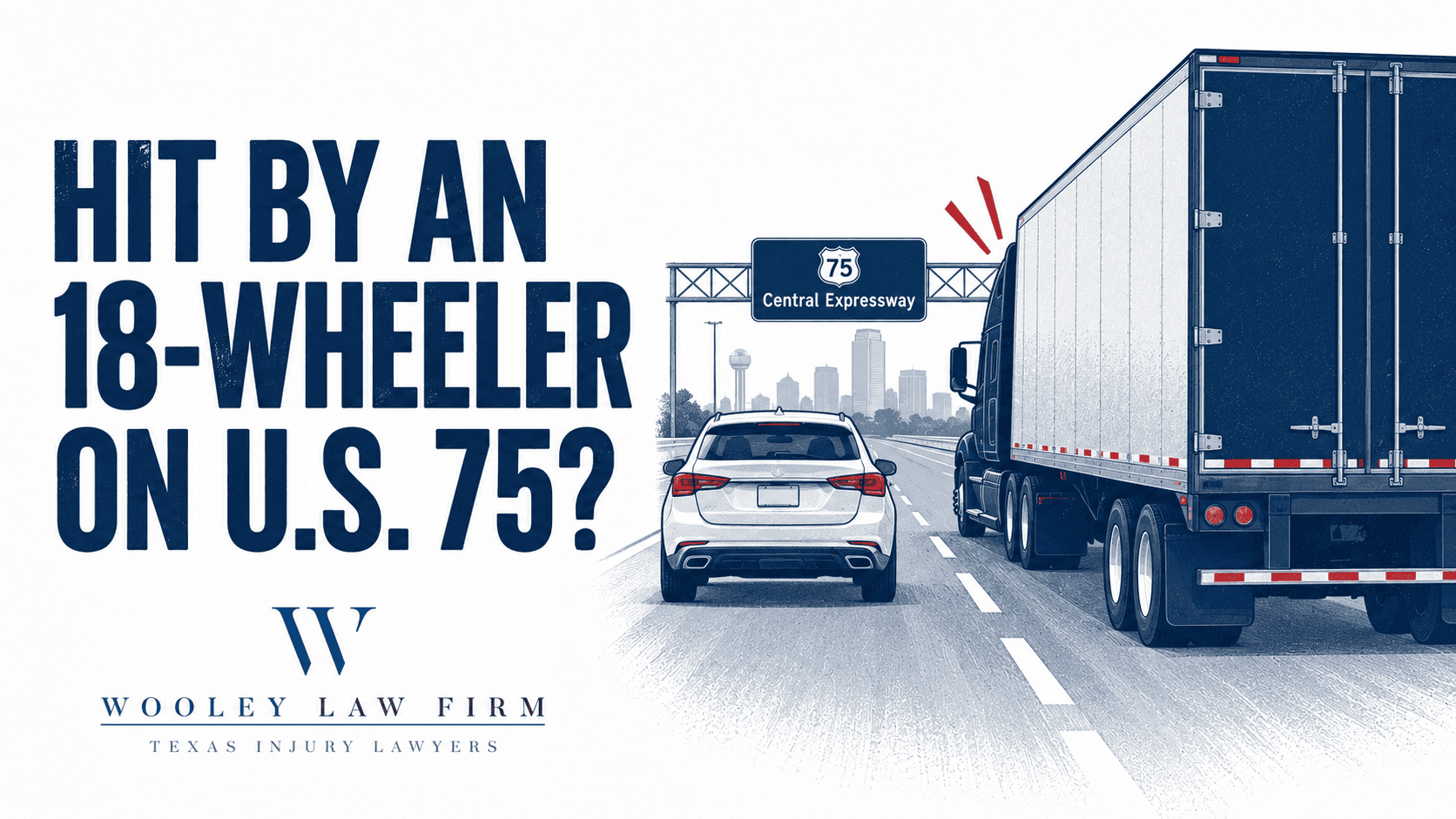
An 18-wheeler starts moving toward your lane on U.S. 75. You are beside the trailer. You sound the horn, but the truck keeps coming. Within seconds, you may be deciding whether to let the trailer strike your car, brake hard in highway traffic, or move toward a concrete barrier.
Afterward, the truck driver may say: “I never saw the car,” “The car was in my blind spot,” or “The passenger vehicle changed lanes into me.” Those statements should not automatically determine responsibility. Modern tractor-trailers may contain dash cameras, digital mirrors, GPS, telematics, lane-departure alerts, safety events, and electronic information that can provide a more objective account.
If you were injured in a commercial-truck collision on U.S. 75, our Dallas truck accident lawyer page explains how we investigate these cases.
Why U.S. 75 Lane-Change Wrecks Can Be Difficult to Prove
A rear-end wreck often leaves a straightforward impact pattern. A highway sideswipe can be more disputed. Both drivers may say they maintained their lane. Damage may be concentrated along the sides of the vehicles. The truck driver may not have directly seen the trailer contact. The passenger driver may be focused on avoiding the truck rather than identifying the precise instant it crossed the lane line.
That is why objective evidence matters so much in disputed lane-change cases.
The Truck Driver Must Clear the Entire Trailer
One of the most important questions is where the passenger vehicle was relative to the trailer when the truck began changing lanes. The tractor can move ahead of a car while the car remains beside the middle or rear of the trailer. If the driver moves over too early, the trailer can strike the vehicle even though the cab itself has already passed.
Read our detailed guide, The Tractor Cleared My Car, but the 18-Wheeler’s Trailer Hit Me.
The Rear Trailer Wheels Create an Additional Danger
A trailer sideswipe can become catastrophic if the passenger vehicle is pushed toward the trailer wheels. The driver may be trying to move away from the truck while also avoiding another vehicle, a concrete median, or traffic in the next lane. A seemingly simple lateral movement can rapidly become a rollover, underride, or multi-impact collision.
What Should a Commercial Driver Do Before Moving Over?
Monitor surrounding traffic continuously
Check flat and convex mirrors
Account for known blind areas
Signal before the maneuver
Recheck mirrors after signaling
Confirm adequate space for the entire tractor-trailer
Move gradually rather than abruptly
Continue monitoring until the trailer fully clears surrounding vehicles
Our guide to what truck drivers should do before changing lanes in Dallas explains these safety steps in more detail.
“You Were in My Blind Spot” Should Raise More Questions
If the truck driver says you were in a blind spot, the investigation should ask when the driver last saw you, whether the driver watched your vehicle approach, which mirrors were checked, whether the truck used side cameras or digital mirrors, whether a blind-spot alert activated, and whether the driver rechecked immediately before crossing the lane line.
Read our full discussion of 18-wheeler blind-spot accidents in Dallas.
Digital Mirrors Can Change a “Word Against Word” Case
Newer commercial trucks may use camera-monitor systems commonly called digital mirrors. Depending on the system, they may provide views beside the tractor, along the trailer, toward the rear, and around areas that are difficult to see with traditional mirrors. Some systems may also record or retain video.
Our article on digital mirrors and Dallas truck-wreck evidence explains why identifying the installed system can be important.
A Forward-Facing Truck Camera Can Still Be Useful
Even if the forward camera does not show the side of the trailer, it may establish whether the truck was maintaining its lane, approaching an exit, crossing lane markings, encountering construction, or responding to changing traffic. That video can be synchronized with side-camera footage, electronic data, witness accounts, and physical damage.
Your Dash Camera May Be Even More Important
A passenger-vehicle dash camera can sometimes show the truck’s tractor, turn signals, lateral movement, the trailer crossing the lane line, horn use, evasive maneuvers, and secondary impacts. The original recording should be saved promptly because many devices overwrite older footage during normal use.
What If the Truck Was Trying to Reach an Exit?
A truck driver approaching an exit should not create an emergency for surrounding traffic. If the driver is several lanes away, missing the exit and rerouting may be safer than crossing multiple occupied lanes. GPS and dispatch records may help establish the planned route, destination, missed turn, and timing of the maneuver.
Read our article about an 18-wheeler cutting across multiple lanes to reach a Dallas highway exit.
What If the Truck Never Actually Hits Your Car?
No-contact truck wrecks are often disputed. An 18-wheeler may move into your lane, causing you to steer or brake to avoid being struck. Your vehicle may hit a barrier or another vehicle while the truck continues without contact. The relevant question is not simply whether the vehicles touched; it is what created the emergency.
Our article about being forced off the road by an 18-wheeler in Dallas addresses these cases in detail.
What If Several Cars Crash While Avoiding the Truck?
An unsafe lane change can create a chain reaction several vehicles away. One car swerves, another brakes, a third rear-ends the second, and the first car strikes the median. The truck may keep driving. The complete event should be reconstructed from the first unsafe movement forward.
See our article on an 18-wheeler lane change causing a multi-vehicle Dallas wreck.
Damage Location Can Tell Part of the Story
Photographs should document the entire passenger vehicle and the entire tractor-trailer, not just one close-up. Scrape direction, paint transfer, trailer-wheel marks, broken lights, reflective tape, damaged panels, and the location of the first contact can become important. Physical damage should be interpreted together with video, lane markings, witness statements, and electronic data.
Preserve the Trailer Before It Is Repaired
A trailer can be repaired and returned to service quickly. Repairs may remove scrapes, paint transfer, bent components, damaged reflective tape, broken lights, tire marks, and other physical evidence. When the trailer is alleged to have struck the passenger vehicle, its condition can be just as important as the tractor’s.
Injured in an Accident?
Free consultation. Tell us what happened and learn what options may be available.
Electronic Truck Data Can Help Establish Timing
Depending on the vehicle and installed technology, electronic systems may record speed, throttle, brake activity, GPS movement, hard-braking events, lane-departure alerts, safety events, camera triggers, and other information. A sideswipe may not involve dramatic braking, but timing and lane-related alerts can still matter.
Dispatch Data May Explain Why the Truck Was There
Commercial trucks generally have an operational purpose: a pickup, delivery, terminal movement, trailer repositioning, or other assignment. Dispatch and trip documents may identify origin, destination, route, driver assignment, trailer assignment, scheduled delivery time, and the companies involved in the shipment.
Who Actually Owns the Tractor and Trailer?
Do not assume they have the same owner. A driver may own the tractor while operating under a motor carrier’s authority. A separate leasing company may own the trailer. Another business may have arranged the load. An outside contractor may maintain the equipment. Those relationships can affect what records exist and which parties need to be investigated.
The Trucking Company May Be Responsible
The driver’s conduct is only one part of the case. Depending on the evidence, the carrier’s hiring, training, supervision, safety monitoring, dispatching, maintenance practices, or response to prior safety events may also matter.
Our article Can I Sue the Trucking Company After a Dallas 18-Wheeler Wreck? explains these potential claims and evidence issues.
Important Evidence to Preserve
Forward-facing, driver-facing, side, and rear camera footage, if installed
Engine-control-module and event data
Electronic logging-device records and hours-of-service information
GPS, telematics, hard-braking, speed, and safety-alert data
Dispatch messages, trip assignments, bills of lading, and delivery records
Driver qualification, training, safety, and disciplinary records
Tractor and trailer inspection, maintenance, and repair records
Post-crash photographs, measurements, tow records, and witness information
The condition of the tractor, trailer, tires, brakes, lights, and other relevant components
Your vehicle and complete damage photographs
Digital-mirror and side-camera system information
Roadway photographs showing lane configuration and barriers
Witness contact information and dash-camera footage
Serious Injuries After U.S. 75 Sideswipe Wrecks
A highway-speed sideswipe can cause far more than cosmetic damage. A passenger vehicle can spin, roll, strike the median, hit another vehicle, leave the roadway, or become trapped near the trailer. Potential injuries include brain injuries, cervical and lumbar injuries, fractures, shoulder injuries, nerve damage, internal injuries, crush injuries, and permanent impairment.
What If the Police Do Not Cite the Truck Driver?
A traffic citation is one piece of evidence, not the entire civil investigation. Police may not have access at the scene to truck camera footage, digital-mirror video, black-box data, GPS information, dispatch records, training documents, maintenance records, or internal company safety information. The absence of a citation does not necessarily resolve civil responsibility.
What Should You Do After a U.S. 75 Truck Wreck?
Call police and seek medical care.
Photograph the tractor and trailer from several angles.
Photograph license plates, USDOT information, company markings, trailer numbers, and damage.
Take wide roadway photographs showing lanes, barriers, shoulders, and exits.
Identify witnesses and obtain contact information.
Save dash-camera footage immediately.
Preserve original phone photographs and videos.
Keep tow, repair, rental, wage, and medical documentation.
Avoid posting detailed statements about fault on social media.
Consider legal advice before detailed recorded statements or broad releases.
Address preservation of trucking-company evidence promptly.
Talk to a Dallas Truck Wreck Lawyer After a U.S. 75 Collision
When a trucking company says your car was in the blind spot, that should not end the investigation. The evidence may show when your vehicle became visible, how long it remained beside the truck, whether the tractor passed you, whether the trailer had cleared you, which mirrors the driver checked, whether digital-mirror footage exists, why the truck changed lanes, and what its electronic systems recorded.
The Wooley Law Firm represents people injured in 18-wheeler and commercial-vehicle collisions in Dallas, Richardson, and throughout North Texas.
Call (214) 699-6524 for a free consultation. You don’t pay unless we win.
Why a U.S. 75 Sideswipe Can Become a “He Said, She Said” Case
When two vehicles are traveling side by side, both drivers may insist they stayed within their lane. The truck driver may not feel the first contact with the trailer. The passenger driver may be focused on escaping the truck and may not see exactly which part of the trailer crossed first. Without independent evidence, each insurer may adopt its own driver’s version.
That is why a U.S. 75 sideswipe should be investigated for video, digital-mirror footage, lane-departure information, witness statements, paint transfer, scrape direction, roadway markings, and the timing of the vehicles’ movements before impact.
How Long Was the Passenger Vehicle Beside the Truck?
The length of time a car was next to the tractor-trailer can be important. A vehicle that had been visible behind the cab for several seconds before moving alongside the trailer may be different from a vehicle that rapidly accelerated into a narrowing gap after the truck began a lane change. Video and witness evidence can help establish that timeline.
The question should not be reduced to whether the vehicle was technically in a blind spot at the instant of impact. The better question is whether the commercial driver knew or should have known the vehicle was nearby and whether the driver maintained awareness before starting the maneuver.
Lane-Departure and Blind-Spot Technology
Some commercial vehicles use lane-departure warnings, blind-spot detection, or other driver-assistance systems. The capabilities differ by manufacturer and model. Some systems provide audible or visual warnings without storing a useful event record. Others may integrate with telematics or camera systems that create an alert history.
The actual equipment should be identified rather than assuming every new truck has the same features. Maintenance and diagnostic records may also show whether a system was functioning or had recently generated fault codes.
Why the Truck’s Route Can Explain an Abrupt Lane Change
A disputed lane change often makes more sense when the route is understood. The truck may have been approaching a delivery exit, moving toward a highway interchange, correcting a missed turn, or following GPS directions. Dispatch records and route history can explain why the driver suddenly moved across U.S. 75 lanes.
That information does not by itself establish fault. It provides context. If the truck was several lanes away from an exit and began an abrupt movement immediately before the collision, the route evidence can help explain motive and timing.
What to Do When the Trailer Owner Is Different From the Carrier
A separate trailer owner can mean a separate source of evidence. The trailer company may have lease records, inspection files, repair history, photographs, tracking data, or records showing when the trailer entered and left the carrier’s possession. If the trailer is repaired after the crash, those records can help establish what damage existed and when it was repaired.
The fact that a company owns the trailer does not automatically make it liable for a lane-change collision. Ownership is important because it helps identify who possessed the evidence and who may have had maintenance duties relevant to the alleged defect or condition.
How Repair Records Can Preserve a Sideswipe Story
Even when the trailer has already been repaired, repair documents may preserve useful evidence. Work orders can identify damaged panels, lights, rub rails, wheels, tires, or structural components. Photographs taken by the repair facility or insurer may show paint transfer or scrape marks that no longer exist. Invoices can establish when the repair occurred and who performed it.
The passenger vehicle’s repair documents can be equally useful. Panel replacement, wheel damage, alignment work, and paint-transfer photographs can help explain the direction and duration of contact.
Insurance Arguments in a No-Contact U.S. 75 Wreck
When the truck never physically touches the passenger vehicle, the carrier may argue that the truck had nothing to do with the crash. The injured driver may then need evidence showing the truck’s movement created the emergency: dash-camera footage, witness statements, nearby video, GPS, lane position, or digital-mirror recordings.
The passenger driver’s response also matters. A sudden swerve may be reasonable if a trailer is entering the lane, but the insurer may argue the driver overreacted or had another safe option. The analysis should be based on what a driver confronted with the situation could reasonably perceive in real time, not on a frame-by-frame review performed months later.
Why Richardson and Dallas Location Details Matter
U.S. 75 changes character as it moves through Dallas and Richardson. Entrance ramps, exit ramps, HOV or managed-lane features, nearby interchanges, concrete barriers, and traffic density can affect what room drivers have to maneuver. A collision near an exit may raise different questions from a mid-block freeway sideswipe in steady traffic.
Accurate location information also helps identify potential video sources, responding agencies, roadway configuration, and witnesses. Photographs or dash-camera footage showing signs, exits, overpasses, or landmarks can be useful if the exact crash point is disputed.
A Strong U.S. 75 Claim Connects the Physical Evidence to the Driver’s Decision
The most persuasive lane-change cases usually connect three things: where the vehicles were, what the truck driver could see, and why the driver moved. Damage and lane markings can show position. Cameras and digital mirrors can show visibility. GPS, route, and dispatch information can explain the timing of the maneuver. When those sources point in the same direction, the case becomes much less dependent on competing memories after the fact.
That same approach can also reveal when the passenger driver contributed to the event. A careful investigation should test both sides of the story. The goal is not to force the evidence into a preferred conclusion; it is to determine what happened and preserve the proof before vehicles are repaired, video is overwritten, or witnesses become harder to locate.
Frequently Asked Questions
What if the truck driver says I was in the blind spot?
That does not automatically establish fault. The driver’s observations, mirror checks, camera systems, lane position, and other evidence should be examined.
Can digital mirrors prove my car was beside the trailer?
Potentially, depending on the system installed and whether recordings were created and retained.
What if the tractor cleared me but the trailer hit me?
Trailer clearance is central because the driver must account for the entire combination vehicle.
What if I hit a barrier and never touched the truck?
A no-contact collision can still require investigation of whether the truck’s movement created the emergency.
Does it matter that the truck driver was not cited?
A citation is only one piece of evidence and does not necessarily determine civil responsibility.
Can the trailer have a different owner from the tractor?
Yes. Commercial trucking can involve separate tractor owners, trailer owners, carriers, leasing companies, and other businesses.
Disclaimer: This article is for general informational purposes only and is not legal advice. Reading it does not create an attorney-client relationship. Every case is different.
Topics
Share This Article

Andrew J. Wooley
Personal Injury Attorney
Andrew J. Wooley is a dedicated personal injury attorney based in Dallas, Texas. He focuses on helping accident victims recover fair compensation for their injuries. With a commitment to personalized service, Andrew works directly with each client to understand their unique situation and fight for their rights.