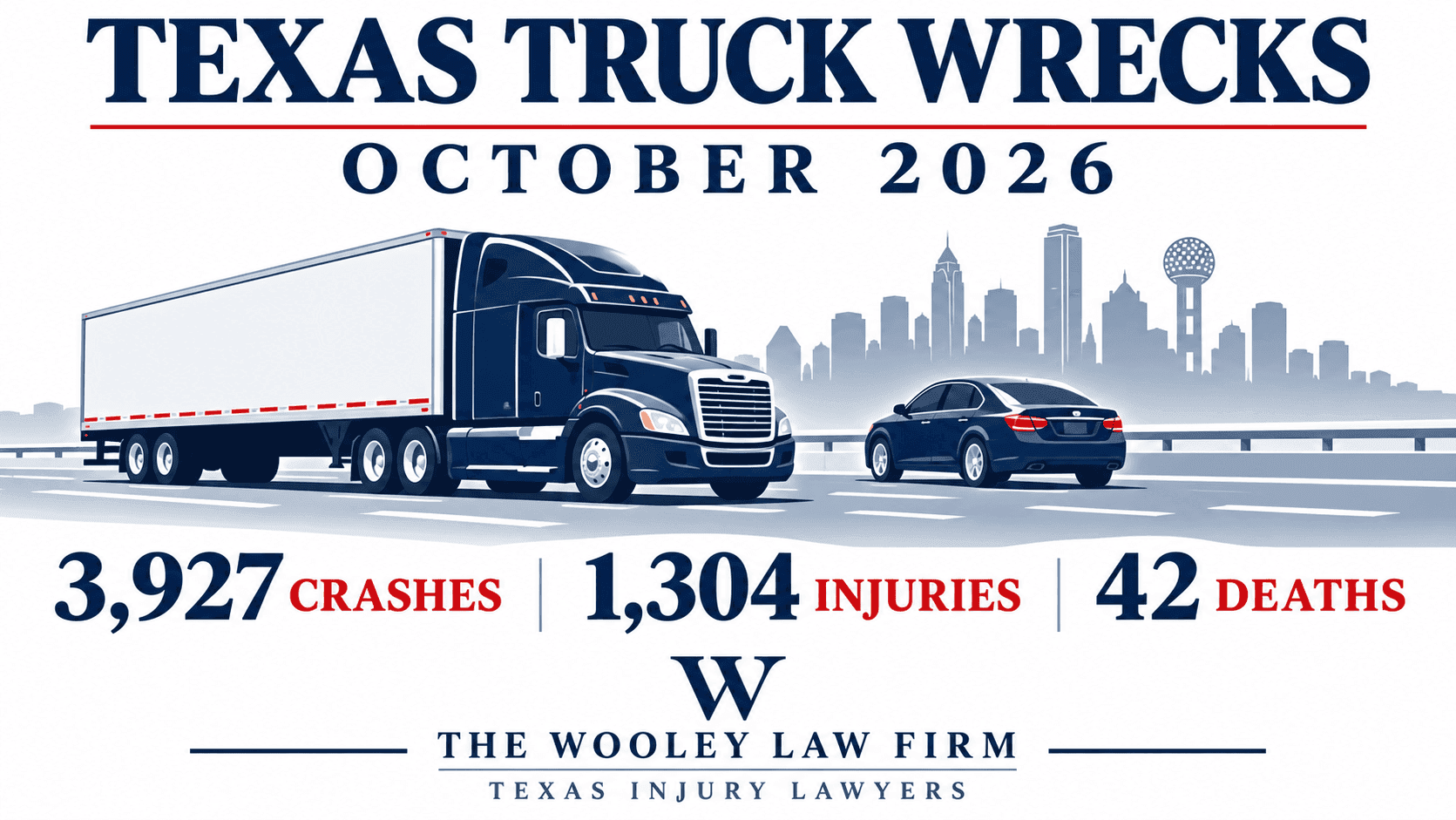
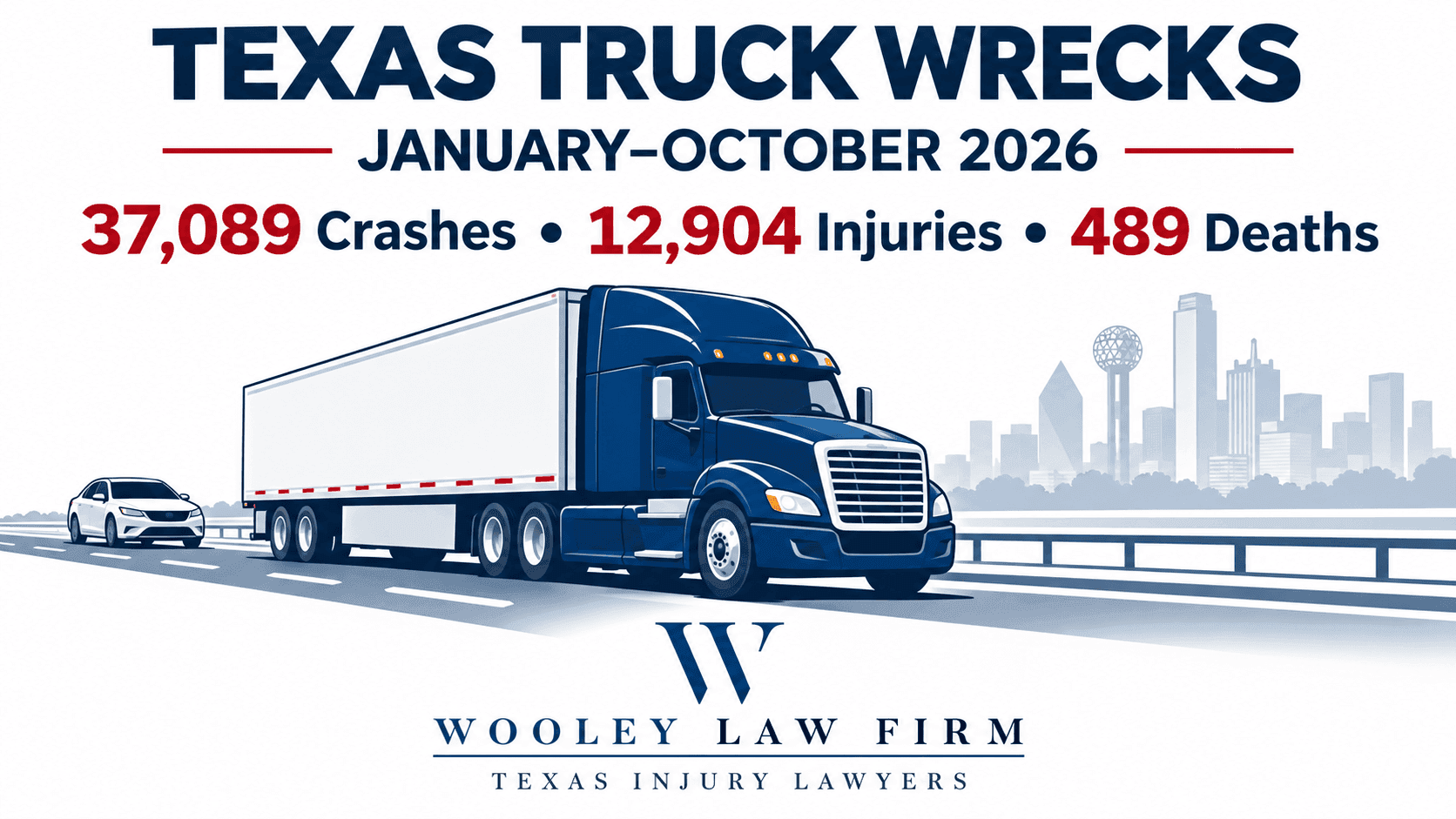
Texas recorded 37,089 crashes involving commercial motor vehicles between January 1 and October 31, 2026, resulting in 489 deaths and 12,904 reported injuries, according to our analysis of Texas Department of Transportation (TxDOT) crash records.
Among those injured, 1,350 suffered injuries classified as suspected serious injuries. The records also identify 442 fatal crashes across the state.
During the first ten months of 2026, Texas averaged approximately 122 commercial motor vehicle crashes every day.
In Dallas–Fort Worth, the numbers were particularly significant. Dallas County recorded 3,298 commercial vehicle crashes, resulting in 24 deaths and 1,259 injuries. Across Dallas, Tarrant, Denton, and Collin counties, the data identifies 6,842 crashes, 50 deaths, and 2,422 reported injuries.
These crashes involved a variety of commercial vehicles, including 18-wheelers, tractor-trailers, box trucks, commercial buses, and other qualifying vehicles.
One of the most notable findings was the frequency of sideswipe collisions. The records identify 9,672 same-direction sideswipe crashes involving commercial motor vehicles. Unsafe lane changes were also among the most frequently reported contributing factors.
For people injured in a Dallas 18-wheeler wreck, these statistics illustrate the scale of commercial vehicle collisions across Texas. However, an individual injury claim depends on the facts of the collision, the injuries involved, and the available evidence.
At The Wooley Law Firm, we represent individuals and families injured in serious commercial truck accidents. Our Dallas truck accident lawyer helps clients investigate collisions, identify trucking companies and responsible parties, preserve evidence, and evaluate available insurance coverage.
Texas Commercial Motor Vehicle Crash Statistics: January–October 2026
According to the TxDOT Commercial Motor Vehicle crash data obtained on November 17, 2026, the first ten months of the year included:
37,089 commercial motor vehicle-involved crashes
442 fatal crashes
489 traffic deaths
12,904 reported injuries
1,350 suspected serious injuries
8,924 crashes involving at least one reported injury
3,721 crashes occurring in construction zones
101,419 vehicle and other unit records associated with these collisions
The statistics cover 304 days, from January 1 through October 31, 2026.
During that period, Texas averaged approximately:
122 commercial vehicle crashes per day
42 reported injuries per day
4.4 suspected serious injuries per day
1.6 traffic deaths per day
That means Texas recorded approximately five crashes involving commercial motor vehicles every hour during the first ten months of 2026.
The suspected serious injury total is included within the overall injury count and should not be added to it.
These figures also include injuries and deaths involving occupants of passenger vehicles, commercial vehicles, and other road users. They do not represent injuries to truck drivers alone.
How Many Texas Truck Wrecks Occurred Each Month in 2026?
The January–October crash data shows that commercial vehicle collisions remained frequent throughout the year.
The monthly totals were:
January 2026: 3,510 crashes, 36 deaths, and 1,172 injuries.
February 2026: 3,472 crashes, 40 deaths, and 1,204 injuries.
March 2026: 3,865 crashes, 55 deaths, and 1,305 injuries.
April 2026: 3,836 crashes, 53 deaths, and 1,338 injuries.
May 2026: 3,566 crashes, 47 deaths, and 1,241 injuries.
June 2026: 3,690 crashes, 72 deaths, and 1,351 injuries.
July 2026: 3,558 crashes, 54 deaths, and 1,345 injuries.
August 2026: 3,829 crashes, 44 deaths, and 1,280 injuries.
September 2026: 3,831 crashes, 46 deaths, and 1,363 injuries.
October 2026: 3,932 crashes, 42 deaths, and 1,305 injuries.
Several findings stand out.
October Recorded the Most Commercial Vehicle Crashes
October recorded 3,932 commercial vehicle-involved crashes, the highest monthly total during the first ten months of 2026.
The second-highest monthly total occurred in March, with 3,865 crashes.
September recorded 3,831 crashes, followed by August with 3,829.
October recorded 101 more crashes than September, an increase of approximately 2.6%.
However, because October has 31 days and September has 30, the average number of crashes per day remained nearly unchanged.
September averaged approximately 127.7 commercial vehicle crashes per day, while October averaged approximately 126.8.
Monthly totals alone do not establish that October was the most dangerous month for commercial vehicle travel. Traffic volume, miles traveled, and other factors would be necessary to evaluate relative risk.
June Recorded the Most Deaths
June was the deadliest month in the January–October dataset, with 72 deaths in commercial vehicle-involved crashes.
Other months with substantial death totals included:
March — 55 deaths
July — 54 deaths
April — 53 deaths
May — 47 deaths
September — 46 deaths
June accounted for approximately 14.7% of the 489 traffic deaths recorded during the ten-month period.
The reasons for the higher June death toll cannot be determined from these monthly totals alone.
September Recorded the Most Reported Injuries
September recorded 1,363 injuries, the highest monthly injury total during the period.
June followed with 1,351 injuries, July with 1,345, and April with 1,338.
Although the number of crashes varied month to month, serious injuries remained a recurring concern throughout the year.
Did Texas Commercial Vehicle Crashes Increase During 2026?
The updated dataset shows that commercial motor vehicle crashes occurred at relatively consistent daily rates across the first three quarters of 2026.
The quarterly totals were:
First Quarter: January–March
10,847 commercial vehicle crashes
131 deaths
3,681 injuries
385 suspected serious injuries
Second Quarter: April–June
11,092 commercial vehicle crashes
172 deaths
3,930 injuries
403 suspected serious injuries
Third Quarter: July–September
11,218 commercial vehicle crashes
144 deaths
3,988 injuries
416 suspected serious injuries
The third quarter recorded the most crashes and reported injuries among the three complete quarters.
The second quarter, however, recorded the most deaths.
Compared with the first quarter, third-quarter crashes increased approximately 3.4%, while reported injuries increased approximately 8.3%.
The number of suspected serious injuries increased approximately 8.1%.
Because the quarters contain different numbers of days, these figures should not be interpreted as proving a corresponding increase in risk per commercial vehicle trip.
The newly updated dataset also differs from previously published year-to-date totals because additional reports and corrections may have been processed.
Our September 2026 year-to-date Texas truck wreck analysis examined 32,983 crashes through September using an earlier export.
The current November export identifies 33,157 crashes for January through September and 3,932 additional crashes in October.
That brings the updated ten-month total to 37,089.
These are updated 2026 crash totals, not a year-over-year comparison with 2025. Determining whether Texas experienced more commercial vehicle crashes than during January–October 2025 would require a comparable 2025 dataset.
Dallas–Fort Worth Recorded 6,842 Commercial Vehicle Crashes Through October
Commercial motor vehicle crashes affected communities throughout North Texas.
Dallas, Tarrant, Denton, and Collin counties accounted for a combined 6,842 reported commercial vehicle crashes during the first ten months of 2026.
Those collisions resulted in 50 deaths and 2,422 reported injuries, including 209 suspected serious injuries.
Together, the four counties accounted for approximately 18.4% of the commercial vehicle crashes reported statewide.
Dallas County — 3,298 Commercial Vehicle Crashes
Dallas County recorded:
3,298 CMV-involved crashes
24 traffic deaths
1,259 reported injuries
108 suspected serious injuries
Dallas County had the second-highest commercial motor vehicle crash total among Texas counties, behind Harris County.
During the first ten months of 2026, Dallas County averaged approximately 10.8 commercial vehicle crashes per day.
Commercial trucks regularly travel throughout Dallas County on major transportation routes, including I-20, I-30, I-35E, I-45, I-635, and U.S. Highway 75.
A serious commercial vehicle accident may involve driver negligence, unsafe lane changes, rear-end collisions, disputed insurance coverage, or other issues that require further investigation.
Tarrant County — 1,972 Commercial Vehicle Crashes
Tarrant County recorded:
1,972 CMV-involved crashes
20 traffic deaths
687 reported injuries
49 suspected serious injuries
Tarrant County includes Fort Worth, Arlington, and other communities served by major commercial transportation corridors.
Interstate 20, Interstate 30, Interstate 35W, Interstate 820, and U.S. Highway 287 are important trucking routes in the county.
A commercial truck wreck in Tarrant County may require examining driver records, electronic vehicle data, trucking company safety practices, and maintenance information.
Denton County — 929 Commercial Vehicle Crashes
Denton County recorded:
929 CMV-involved crashes
3 traffic deaths
252 reported injuries
24 suspected serious injuries
Denton County includes portions of I-35, I-35E, I-35W, and U.S. Highway 380.
These roads carry regional passenger traffic and commercial vehicles traveling throughout North Texas.
Collin County — 643 Commercial Vehicle Crashes
Collin County recorded:
643 CMV-involved crashes
3 traffic deaths
194 reported injuries
28 suspected serious injuries
Commercial vehicle crashes in Collin County affected roadways serving Plano, McKinney, Frisco, Richardson, and other surrounding communities.
Major roads include U.S. Highway 75, U.S. Highway 380, State Highway 121, and the Dallas North Tollway.
The county statistics describe where collisions occurred. They do not establish which driver or trucking company caused a particular accident.
Dallas Recorded Nearly 2,000 Commercial Vehicle Crashes
Within Dallas city limits, the January–October 2026 records identify:
1,979 commercial vehicle crashes
16 traffic deaths
814 reported injuries
Dallas recorded approximately 6.5 commercial vehicle crashes per day.
Among Texas cities, Dallas had the third-highest commercial vehicle crash total during this period, behind Houston and San Antonio.
Some of the most heavily represented Dallas roadway designations in the CMV crash data were:
Interstate 35E — 262 crashes
Interstate 30 — 247 crashes
Interstate 20 — 222 crashes
Interstate 635 — 128 crashes
Loop 12 — 74 crashes
Interstate 45 — 71 crashes
U.S. Highway 75 — 45 crashes
Dallas North Tollway — 34 crashes
These counts reflect the roadway designations recorded in the collision data and may not include every nearby frontage-road or interchange collision.
Why Are Dallas Truck Wrecks More Complicated Than Ordinary Car Accidents?
A collision involving an 18-wheeler can involve several businesses, multiple insurance policies, and substantial electronic evidence.
For example, the truck driver may work for a motor carrier that operates a tractor owned by another company.
The trailer may be leased from a different business.
Depending on the circumstances, investigators may need to determine:
Who employed or contracted with the truck driver
Which company operated the truck
Who owned the tractor and trailer
Whether the truck was properly maintained
Whether the driver complied with applicable safety regulations
Whether the truck's electronic systems recorded relevant information
Which insurance policies may apply
These issues can become particularly important when the injured person requires surgery, faces a permanent disability, or cannot return to work.
Injured in an Accident?
Free consultation. Tell us what happened and learn what options may be available.
Which Texas Cities Had the Most Commercial Vehicle Crashes?
The commercial motor vehicle crash data identifies the following leading city totals from January through October 2026:
Houston — 3,043 crashes
San Antonio — 2,299 crashes
Dallas — 1,979 crashes
Fort Worth — 1,273 crashes
El Paso — 806 crashes
Laredo — 795 crashes
Austin — 322 crashes
Beaumont — 278 crashes
Denton — 271 crashes
Amarillo — 265 crashes
Other Texas cities with substantial commercial vehicle crash totals included:
Pasadena — 265 crashes
Irving — 242 crashes
Waco — 213 crashes
Lubbock — 207 crashes
Arlington — 200 crashes
Odessa — 200 crashes
Corpus Christi — 200 crashes
La Porte — 190 crashes
Mesquite — 186 crashes
Plano — 176 crashes
Lewisville — 174 crashes
The dataset also identifies 11,825 commercial vehicle crashes occurring outside incorporated city limits.
That represents approximately 31.9% of statewide commercial vehicle crashes.
Although Houston, San Antonio, and Dallas recorded the highest city totals, those rankings do not establish which city has the greatest crash risk per mile traveled.
Which Texas Highways Had the Most Commercial Vehicle Wrecks in 2026?
Major interstate highways accounted for thousands of commercial motor vehicle crashes during the first ten months of 2026.
The most frequently recorded roadway designations included:
Interstate 10 — 2,341 crashes
Interstate 35 — 1,958 crashes
Interstate 20 — 1,819 crashes
Interstate 30 — 1,046 crashes
Interstate 45 — 1,041 crashes
Interstate 35E — 742 crashes
U.S. Highway 59 — 533 crashes
Interstate 35W — 467 crashes
U.S. Highway 287 — 382 crashes
Interstate 69 — 363 crashes
Other notable statewide totals included:
I-610 — 362 crashes
U.S. Highway 290 — 306 crashes
Interstate 635 — 276 crashes
U.S. Highway 75 — 246 crashes
Interstate 820 — 138 crashes
State Highway 121 — 119 crashes
State Highway 114 — 115 crashes
U.S. Highway 380 — 111 crashes
These are statewide counts associated with the reported roadway names. They are not limited to Dallas–Fort Worth.
The dataset records I-35, I-35E, and I-35W separately.
I-35E and I-20 Were Leading DFW Commercial Vehicle Crash Corridors
Looking specifically at Dallas, Tarrant, Denton, and Collin counties, several major highways accounted for hundreds of commercial vehicle wrecks.
Interstate 35E — 610 DFW Crashes
Interstate 35E recorded 610 commercial vehicle crashes within the four-county area.
Of those, 262 occurred within Dallas city limits.
I-35E is a major commercial transportation route connecting Dallas, Lewisville, Denton, and surrounding communities.
A serious 18-wheeler collision on I-35E may require investigating the truck driver's speed, lane position, driver attention, braking, and available electronic evidence.
Interstate 20 — 572 DFW Crashes
Interstate 20 recorded 572 commercial vehicle crashes within the four-county region.
Of those, 222 occurred within Dallas city limits.
I-20 carries significant commercial traffic across southern Dallas County and Tarrant County.
An 18-wheeler rear-end collision, sideswipe, or multi-vehicle accident on I-20 may require reconstructing the sequence of impacts and preserving vehicle data.
Interstate 30 — 416 DFW Crashes
Interstate 30 recorded 416 commercial vehicle crashes within the four-county area.
Within Dallas city limits, 247 crashes were assigned to I-30.
Interstate 30 connects Dallas, Grand Prairie, Arlington, and Fort Worth.
Commercial vehicle collisions can involve congested traffic, merging vehicles, multiple impacts, and disputes over which driver caused the wreck.
Interstate 35W — 406 DFW Crashes
Interstate 35W recorded 406 commercial vehicle crashes within the four-county region.
This highway serves Fort Worth and communities north and south of the city.
When an 18-wheeler is involved in a serious collision, examining driver records, truck maintenance, and the circumstances leading to impact may become important.
Interstate 635 — 276 DFW Crashes
Interstate 635 recorded 276 commercial vehicle crashes within the four-county area.
Of those, 128 occurred within Dallas city limits.
I-635 is a heavily traveled highway serving Dallas and surrounding communities.
When traffic suddenly slows, an 18-wheeler driver may need substantial stopping distance to avoid a collision.
Our article about being rear-ended by an 18-wheeler while stopped in Dallas traffic explains evidence that can become important in these cases.
Sideswipes Were the Most Frequently Reported Commercial Vehicle Collision Type
One of the most notable findings in the January–October data was the frequency of sideswipe collisions.
The records identify 9,672 same-direction sideswipe crashes involving commercial motor vehicles.
That represents approximately 26.1% of all recorded CMV-involved crashes.
Other leading collision configurations included:
Single-vehicle, straight-travel crashes — 6,262
Same-direction rear-end collisions — 4,454
Same-direction collisions involving one moving and one stopped vehicle — 2,624
Angle collisions involving vehicles traveling straight — 1,863
Same-direction collisions involving a straight-moving vehicle and a right-turning vehicle — 1,424
Same-direction collisions involving a straight-moving vehicle and a left-turning vehicle — 1,198
These are recorded collision configurations. They do not, by themselves, identify which driver was negligent.
Why Are Sideswipe Accidents With 18-Wheelers Dangerous?
An 18-wheeler consists of a tractor and one or more trailers, creating a much longer vehicle than an ordinary passenger car.
A driver changing lanes must account for the position of other vehicles and the movement of the trailer.
A passenger car may be struck along its side when a commercial truck changes lanes, merges, turns, or otherwise moves into an occupied lane.
In some crashes, a vehicle may be pushed toward another lane, roadside barrier, or shoulder.
Determining how a sideswipe occurred may require:
Dashcam footage
Photographs of vehicle damage
Witness statements
Truck and trailer measurements
Lane markings
Electronic vehicle records
Nearby surveillance recordings
The crash report may describe the vehicles' positions without resolving every dispute about how the collision occurred.
When a commercial truck leaves the scene, identifying the correct trucking company and insurance carrier may also become a challenge.
Our article, Hit by an 18-Wheeler That Fled the Scene?, explains how evidence such as a trailer license plate, company markings, and video may assist in identifying a fleeing truck.
What Were the Most Frequently Reported Contributing Factors?
The January–October TxDOT data also identifies contributing factors associated with crashes involving commercial motor vehicles.
After separating multiple factors recorded for a single crash and counting each factor once per crash, the most frequently reported specific factors included:
Unsafe lane changes — 6,242 crashes
Failure to control speed — 6,022 crashes
Driver inattention — 5,492 crashes
Failure to maintain a single lane — 3,836 crashes
Backing without safety — 1,762 crashes
Unsafe speed — 1,508 crashes
Faulty evasive action — 1,400 crashes
Unsafe turns — 1,360 crashes
Failure to yield at a stop sign — 1,112 crashes
Following too closely — 1,074 crashes
A nonspecific category of "other" appeared in 5,256 crashes.
The dataset also identified fatigue or falling asleep as a contributing factor in 710 crashes.
These factors may relate to any driver involved in a CMV crash, not necessarily the commercial truck driver. Multiple factors may appear in the same collision, and officer-reported factors are not conclusive findings of civil liability.
Unsafe Lane Changes
Unsafe lane changes appeared in 6,242 commercial vehicle-involved crashes.
When an 18-wheeler changes lanes, a driver may need to account for vehicles traveling beside the tractor and along the length of the trailer.
Questions after a lane-change collision may include whether the truck driver checked mirrors, maintained a proper lookout, and moved into an occupied lane.
Investigators may also need to consider whether another motorist changed lanes or otherwise contributed to the collision.
Failure to Control Speed
Failure to control speed appeared in 6,022 CMV-involved crashes.
A driver may be traveling below the posted speed limit but still fail to adjust speed appropriately for traffic or roadway conditions.
In a rear-end collision involving an 18-wheeler, investigators may need to determine how fast the vehicle was traveling, when braking began, and whether the driver had sufficient time and distance to respond.
Driver Inattention
Driver inattention appeared in 5,492 commercial vehicle-involved crashes.
Driver distraction can involve cellphone use, navigation systems, in-cab activity, or other circumstances that divert attention from the roadway.
However, an inattention finding does not establish that the driver was using a phone.
The underlying evidence must establish what occurred.
Driver Fatigue
Fatigue or falling asleep appeared as a contributing factor in 710 commercial vehicle-involved crashes.
Some commercial drivers are subject to federal hours-of-service requirements intended to address the risks associated with prolonged driving.
Those requirements are administered by the Federal Motor Carrier Safety Administration.
When fatigue is suspected, an investigation may involve electronic logging device data, dispatch records, trip information, and other evidence.
A fatigue designation in a crash report does not automatically establish a federal regulatory violation.
More Than 3,700 Commercial Vehicle Crashes Occurred in Construction Zones
The January–October data identifies 3,721 commercial vehicle-involved crashes flagged as occurring in construction zones.
That represents approximately 10% of all recorded commercial vehicle crashes during the ten-month period.
Construction zones may involve:
Reduced speed limits
Temporary lane closures
Narrowed lanes
Concrete barriers
Changed traffic patterns
Stopped or slowing traffic
Reduced shoulder space
Construction vehicles entering or leaving the roadway
Commercial truck drivers must respond appropriately to traffic and road conditions.
However, a construction-zone crash does not automatically mean the truck driver or construction contractor was negligent.
Investigators may need to review traffic-control plans, warning signs, lane markings, photographs, surveillance footage, and vehicle movement before impact.
Which Types of Commercial Vehicles Were Involved in Texas Crashes?
The TxDOT commercial vehicle data includes more than traditional tractor-trailers.
Among vehicle records specifically flagged as commercial motor vehicles, the most frequently recorded types included:
Tractor/semitrailer combinations — 15,176 vehicle records
Truck tractors without trailers (bobtails) — 4,902
Single-unit trucks with three or more axles — 4,376
Truck-trailer configurations — 4,106
Single-unit trucks with two axles and six tires — 3,903
Buses with capacity exceeding 15 people — 3,396
Light trucks — 1,092
These are counts of commercial vehicle records, not unique collisions. Some crashes involved more than one commercial vehicle.
Why Does the Commercial Vehicle Type Matter?
A tractor-trailer collision may involve different evidence and safety considerations than a box truck accident or a commercial bus crash.
For example, an investigation involving a tractor-trailer may require determining the ownership of both the tractor and trailer.
A box truck collision may involve a business operating its own delivery fleet or a vehicle leased from another company.
Different vehicles and operations may be subject to different regulations and insurance requirements.
An attorney must determine which laws and duties apply to the particular collision.
What Makes a Dallas 18-Wheeler Wreck Different From a Car Accident?
Commercial truck accidents can involve evidence and business relationships that are not present in ordinary passenger vehicle collisions.
Depending on the circumstances, an investigation may require examining:
Driver qualification records
Driver training information
Hours-of-service records
Electronic logging device information
Engine control module data
Truck-mounted camera footage
Inspection and maintenance records
Dispatch communications
Cargo loading information
Tractor and trailer ownership
Leasing agreements
Insurance policies
These records may be important when liability is disputed or an injured person's losses are substantial.
Preserving Trucking Company Evidence
Some commercial vehicles contain electronic systems that record information relevant to a collision.
Depending on the equipment, available information may include vehicle speed, braking activity, or other operational data.
Other systems may contain video footage, GPS history, or driver activity information.
Data retention varies among systems and companies. Some information may be overwritten or lost through routine operations.
Preserving relevant evidence early can therefore be important.
Identifying All Potentially Responsible Parties
A truck driver may not be the only person whose conduct is relevant to a collision.
Depending on the facts, potentially responsible parties may include the driver, motor carrier, maintenance company, cargo-loading company, or another negligent motorist.
Liability cannot be determined solely from ownership or a business relationship.
The investigation must establish the applicable legal duties and whether negligent conduct contributed to the collision.
Finding Available Insurance Coverage
The insurance listed on the Texas crash report may not identify every potentially applicable policy.
Commercial vehicle operations may involve several companies and insurance arrangements.
In some circumstances, excess or umbrella coverage may also be relevant.
Our article, Finding Insurance After a Dallas 18-Wheeler Wreck, explains why identifying the truck's insurer can require additional investigation.
What Compensation May Be Available After a Texas Truck Wreck?
Serious commercial truck accidents can cause substantial medical expenses, lost income, and long-term physical limitations.
Depending on the facts and applicable Texas law, an injured person may seek damages for:
Legally recoverable past medical expenses
Future medical care
Lost earnings
Reduced earning capacity
Physical pain
Mental anguish
Physical impairment
Disfigurement
Other legally recoverable losses
When a collision results in death, eligible family members may have claims under Texas wrongful death law.
The existence and value of a claim depend on the individual circumstances, available evidence, applicable law, and insurance coverage.
Frequently Asked Questions About Texas Truck Wrecks in 2026
How many 18-wheeler and commercial vehicle crashes occurred in Texas through October 2026?
The TxDOT records identify 37,089 crashes involving commercial motor vehicles from January 1 through October 31, 2026.
This includes qualifying trucks, buses, and other commercial vehicles. It is not a count limited to 18-wheelers.
How many people died in commercial vehicle crashes in Texas during 2026?
Through October 31, the data identifies 489 deaths in 442 fatal commercial vehicle-involved crashes.
How many people were injured?
The records identify 12,904 reported injuries, including 1,350 suspected serious injuries.
Which Texas county recorded the most commercial vehicle crashes?
Harris County recorded 5,771 crashes, followed by Dallas County with 3,298.
How many commercial vehicle crashes occurred in Dallas?
Dallas city limits recorded 1,979 commercial vehicle-involved crashes from January through October 2026.
Dallas County recorded 3,298.
Which Texas highway recorded the most commercial vehicle crashes?
Interstate 10 had the highest total among the recorded roadway designations, with 2,341 commercial vehicle crashes statewide.
Which Dallas highway had the most commercial vehicle wrecks?
Within Dallas city limits, Interstate 35E recorded 262 commercial vehicle crashes, followed by I-30 with 247 and I-20 with 222.
What was the most frequently reported collision type?
Same-direction sideswipes were the most frequently reported collision configuration, accounting for 9,672 commercial vehicle-involved crashes.
Does the involvement of an 18-wheeler mean the truck driver was at fault?
No. Commercial vehicle involvement does not establish negligence.
The collision must be investigated to determine whether the truck driver, another motorist, a trucking company, or another party caused or contributed to the accident.
Talk to a Dallas Truck Wreck Lawyer
The first ten months of 2026 brought 37,089 commercial motor vehicle crashes, 12,904 injuries, and 489 deaths across Texas.
In Dallas County alone, 3,298 commercial vehicle crashes were reported, including collisions involving tractor-trailers, delivery trucks, commercial buses, and other qualifying vehicles.
These statistics represent real people and families dealing with the consequences of serious traffic accidents.
A commercial truck collision can leave an injured person facing hospitalization, surgery, ongoing medical treatment, lost income, and disputes with multiple insurance companies.
The Wooley Law Firm represents people injured in serious 18-wheeler wrecks, commercial truck accidents, and other motor vehicle collisions throughout Dallas–Fort Worth and Texas.
Attorney Andrew J. Wooley has more than a decade of experience representing injured Texans. His professional recognitions include selection to Super Lawyers Rising Stars, membership in the Million Dollar Advocates Forum, and recognition by The National Trial Lawyers.
Our firm investigates serious commercial vehicle wrecks, identifies potentially responsible parties, seeks preservation of evidence, and evaluates insurance coverage.
If you were injured in a Dallas 18-wheeler accident or lost a family member in a commercial truck collision, we can review the circumstances and explain your options.
Call The Wooley Law Firm at (214) 699-6524 for a free consultation or contact us online. You don't pay unless we win.
Sources and Data Methodology
Primary source: Texas Department of Transportation Crash Records Information System (CRIS), commercial motor vehicle crash export supplied to The Wooley Law Firm.
The dataset covers crashes occurring from January 1 through October 31, 2026, with reports received and processed through November 17, 2026.
The export reports 37,089 crashes involving 101,419 units and 108,236 persons.
Each unique crash ID was counted once for the statewide, county, city, highway, injury, and fatality totals.
Commercial vehicle type counts were calculated from vehicle records flagged as commercial motor vehicles. These are vehicle counts and should not be added together as unique crash totals.
Crash contributing factors were separated and counted once per distinct crash and factor. Multiple factors may appear in one collision, and the factors may relate to any involved driver.
Roadway figures use the primary street or highway designation recorded in the crash data. Similar route numbers with different roadway prefixes are treated separately.
The newly supplied November 17 export contains 33,157 unique crash IDs for January–September 2026, compared with 32,983 in our previously published September year-to-date report. That difference reflects changes between the available exports; the specific additions or corrections have not been independently reconciled.
The October portion of this updated export identifies 3,932 CMV crashes, compared with 3,927 in the earlier October-specific export. This report consistently uses the newer November 17 data.
Additional source: TxDOT Crash Data Analysis and Statistics.
The statistics describe commercial vehicle involvement and do not establish that truck drivers caused every collision. Crash records may be updated or corrected as additional information becomes available.
This report is The Wooley Law Firm's analysis of the supplied TxDOT data, not an official statistical conclusion issued by TxDOT.
Disclaimer: This article is provided for general informational purposes only and does not constitute legal advice. Reading this article does not create an attorney-client relationship. Every case depends on its own facts and applicable law. Past results do not guarantee a similar outcome.
Topics
Share This Article

Andrew J. Wooley
Personal Injury Attorney
Andrew J. Wooley is a dedicated personal injury attorney based in Dallas, Texas. He focuses on helping accident victims recover fair compensation for their injuries. With a commitment to personalized service, Andrew works directly with each client to understand their unique situation and fight for their rights.