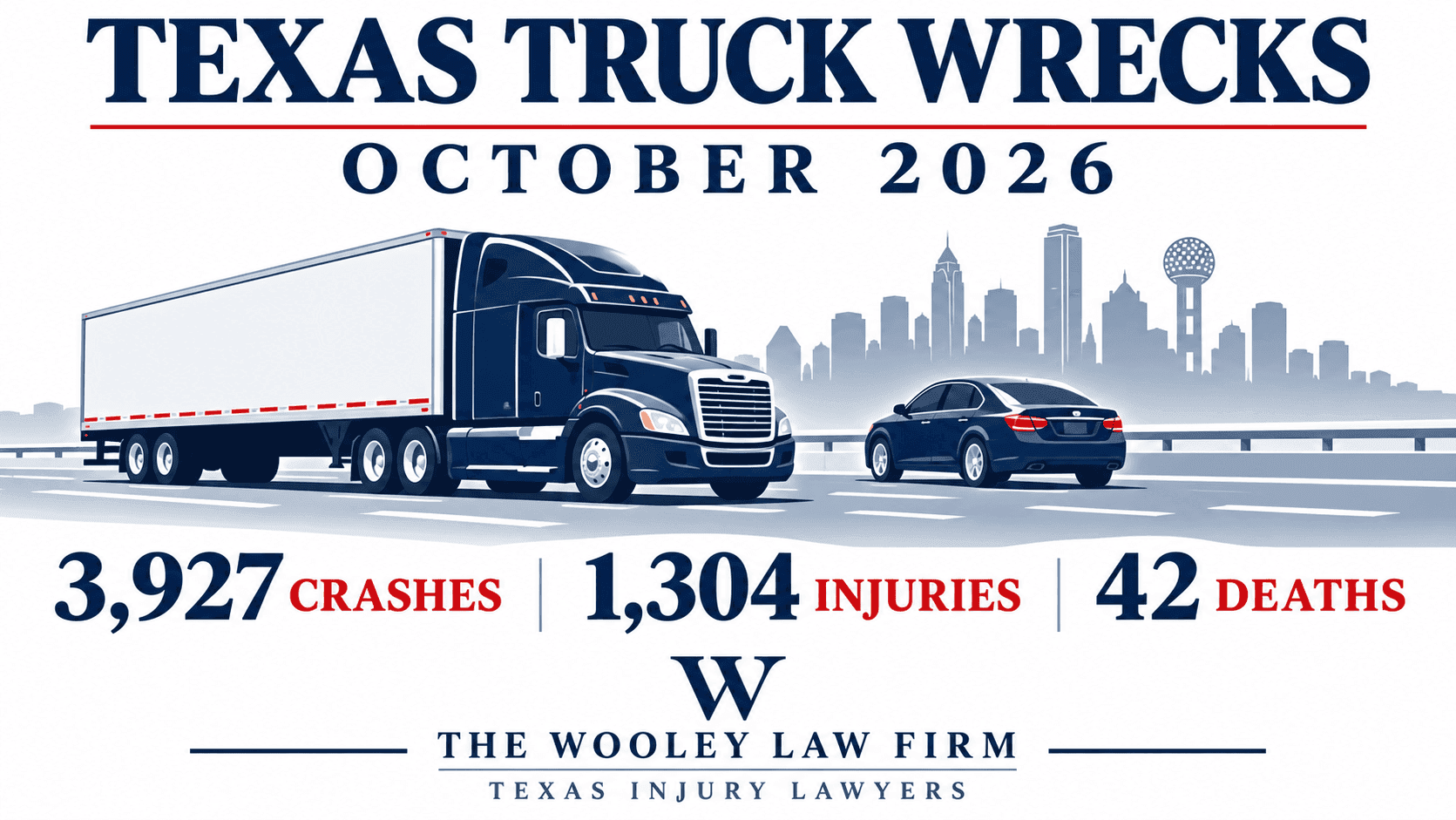
Texas recorded 3,927 crashes involving commercial motor vehicles during October 2026, resulting in 42 deaths and 1,304 reported injuries, according to crash records from the Texas Department of Transportation (TxDOT).
Among those injuries, 146 were classified as suspected serious injuries.
In Dallas–Fort Worth, commercial vehicle crashes continued to affect motorists traveling on major highways, including Interstate 20, Interstate 30, Interstate 35E, Interstate 35W, and Interstate 635.
Dallas County recorded 372 commercial motor vehicle crashes during October, resulting in five deaths and 151 reported injuries. Within Dallas city limits, 227 commercial vehicle crashes were reported.
Across Dallas, Tarrant, Denton, and Collin counties, the data identifies 753 commercial vehicle-involved collisions during October.
Compared with the detailed records used in our September 2026 Texas truck wreck statistics, October recorded approximately 4.7% more commercial motor vehicle crashes statewide.
Behind these statistics are people facing medical expenses, missed work, serious injuries, and uncertainty about who is responsible for their losses.
At The Wooley Law Firm, our Dallas truck accident lawyer helps people injured in collisions involving 18-wheelers, tractor-trailers, box trucks, delivery vehicles, and other commercial motor vehicles throughout Dallas–Fort Worth and Texas.
October 2026 Texas Commercial Motor Vehicle Crash Statistics
The October 2026 TxDOT crash records identify:
3,927 crashes involving commercial motor vehicles
39 fatal crashes
42 traffic deaths
1,304 reported injuries
146 suspected serious injuries
902 crashes involving at least one reported injury
374 crashes flagged as occurring in construction zones
10,723 vehicle and other unit records associated with these collisions
During October's 31 days, Texas averaged approximately:
127 commercial vehicle crashes per day
42 reported injuries per day
4.7 suspected serious injuries per day
1.4 traffic deaths per day
That means an average of approximately five crashes involving commercial motor vehicles occurred every hour in Texas during October 2026.
The suspected serious injury count is included in the overall injury total and should not be added again.
Likewise, these figures describe crashes involving commercial motor vehicles. They do not establish that a commercial driver was responsible for every collision or that all injured people were occupants of commercial vehicles.
What Types of Commercial Vehicles Were Involved in October Texas Crashes?
The term commercial motor vehicle encompasses more than traditional 18-wheelers.
The October dataset includes qualifying tractor-trailers, truck tractors without trailers, single-unit trucks, buses, and other commercial vehicles.
Among the units specifically flagged as commercial motor vehicles, the data identifies:
1,614 tractor/semitrailer units
530 truck tractors operating without a trailer (bobtails)
467 single-unit trucks with three or more axles
426 vehicles classified as truck trailers
398 single-unit trucks with two axles and six tires
376 buses with capacity exceeding 15 people
148 buses with capacity for 9–15 people
100 light trucks
17 tractor/double-trailer configurations
3 tractor/triple-trailer configurations
Additional commercial vehicle records used other or unknown classifications.
These figures count vehicle records, not unique crashes. A single crash may involve multiple commercial vehicles, so the vehicle totals should not be added together and represented as separate wrecks.
Why Does the Type of Commercial Vehicle Matter?
A serious accident involving a tractor-trailer may raise different questions from a collision involving a delivery van or commercial bus.
For example, investigators may need to determine:
Who owned the commercial vehicle?
Which company operated the vehicle?
Was the driver working at the time?
Was the tractor or trailer leased?
Did federal or state commercial vehicle regulations apply?
Was the truck properly inspected and maintained?
Did the driver have the required qualifications?
Was the vehicle properly loaded?
What insurance policies potentially cover the collision?
A commercial vehicle's classification can affect the safety rules, records, and insurance arrangements relevant to an investigation.
However, the presence of a commercial vehicle does not automatically establish negligence or liability.
How Did October Texas Truck Wrecks Compare With September 2026?
October recorded more commercial motor vehicle-involved crashes than September.
Our September truck-specific report analyzed 3,749 identifiable CMV-involved crashes in the detailed TxDOT export.
The October export identifies 3,927.
That represents an increase of 178 crashes, or approximately 4.7%.
The detailed month-to-month figures show:
CMV crashes: Increased from 3,749 to 3,927, up 4.7%.
Traffic deaths: Increased from 41 to 42.
Reported injuries: Decreased from 1,343 to 1,304, down approximately 2.9%.
Suspected serious injuries: Remained at 146.
Fatal crashes: Increased from 38 to 39.
Construction-zone crashes: Increased from 364 to 374.
October had 31 days, compared with September's 30 days.
After accounting for that difference, the average number of commercial motor vehicle crashes per day increased from approximately 125 in September to 127 in October, an increase of approximately 1.4%.
Although October recorded more commercial vehicle collisions, it recorded slightly fewer reported injuries than September.
These figures do not establish why commercial vehicle crashes increased. Changes in traffic volume, trucking activity, weather, roadway conditions, and other factors may influence monthly totals.
Data comparison note: Our broader September statewide crash-statistics article used a different CMV query total of 3,659. This truck-specific comparison uses the 3,749 identifiable crash records reported in our separate September commercial vehicle article. The two September baselines should not be mixed without reconciling the underlying exports.
Dallas and DFW Commercial Vehicle Crashes in October 2026
Commercial vehicle collisions affected all four major counties in the Dallas–Fort Worth region.
The October records identify:
Dallas County — 372 CMV Crashes
Dallas County recorded:
372 commercial vehicle crashes
5 traffic deaths
151 reported injuries
12 suspected serious injuries
During September, Dallas County recorded 344 commercial vehicle crashes in the truck-specific analysis.
October's total represents an increase of 28 crashes, or approximately 8.1%.
The number of reported injuries remained at 151, while traffic deaths increased from three to five.
Dallas County had the second-highest county total statewide in October, behind Harris County.
Tarrant County — 201 CMV Crashes
Tarrant County recorded:
201 commercial vehicle crashes
2 traffic deaths
75 reported injuries
7 suspected serious injuries
Tarrant County recorded 217 crashes in September.
October's total represents a decrease of approximately 7.4%.
Although the total number of commercial vehicle crashes declined, reported deaths increased from one to two.
Denton County — 112 CMV Crashes
Denton County recorded:
112 commercial vehicle crashes
25 reported injuries
7 suspected serious injuries
No reported traffic deaths in the CMV dataset
Denton County recorded 103 commercial vehicle crashes in September.
That represents an increase of approximately 8.7%.
Denton County includes major commercial transportation routes such as I-35, I-35E, I-35W, and U.S. Highway 380.
Collin County — 68 CMV Crashes
Collin County recorded:
68 commercial vehicle crashes
13 reported injuries
1 suspected serious injury
No reported traffic deaths in the CMV dataset
Collin County recorded 59 commercial vehicle crashes during September.
That represents an increase of approximately 15.3%.
Four Major DFW Counties Recorded 753 Commercial Vehicle Crashes
Together, Dallas, Tarrant, Denton, and Collin counties recorded:
753 commercial vehicle crashes
7 traffic deaths
264 reported injuries
27 suspected serious injuries
The four counties recorded 723 crashes during September.
October's total represents an increase of 30 crashes, or approximately 4.1%.
The combined county figures include crashes inside and outside city limits. They should not be added to separate city totals because those geographic categories overlap.
Dallas Recorded 227 Commercial Vehicle Crashes in October
Within Dallas city limits, the October records identify:
227 commercial vehicle crashes
108 reported injuries
8 suspected serious injuries
5 traffic deaths
Dallas recorded 197 commercial vehicle crashes during September.
That represents an increase of 30 collisions, or approximately 15.2%.
The October data shows that several major Dallas highways accounted for substantial numbers of these commercial vehicle wrecks.
Within Dallas city limits, the leading recorded roads included:
Interstate 20 — 31 CMV crashes
Interstate 35E — 25 CMV crashes
Interstate 30 — 23 CMV crashes
Interstate 635 — 16 CMV crashes
Loop 12 — 7 CMV crashes
Interstate 45 — 5 CMV crashes
Dallas North Tollway — 5 CMV crashes
These figures are based on the primary roadway designation recorded in the crash data.
They do not necessarily include every collision on a frontage road, entrance ramp, exit ramp, or nearby intersection associated with the same highway corridor.
Why Do Dallas Truck Wrecks Require a Detailed Investigation?
Dallas serves as a major commercial transportation hub.
Large trucks frequently travel through the city on I-20, I-30, I-35E, I-45, I-635, and other major roadways.
When an 18-wheeler collides with a passenger vehicle, investigators may need to examine whether the truck driver maintained a proper lookout, followed traffic laws, and responded appropriately to changing road conditions.
Potential evidence may include:
Truck-mounted camera footage
Electronic vehicle data
Driver logs
Dispatch communications
Truck and trailer inspection records
Maintenance records
Witness statements
Traffic surveillance video
Photographs of the collision scene
Depending on the circumstances, a commercial truck wreck may involve the driver, motor carrier, tractor owner, trailer owner, or other business.
The investigation must establish what each party did and whether that conduct contributed to the collision.
Which Texas Cities Had the Most Commercial Vehicle Crashes in October?
Houston recorded the most CMV-involved crashes within city limits during October, followed by San Antonio and Dallas.
The leading reported city totals included:
Houston — 321 CMV crashes
San Antonio — 249
Dallas — 227
Fort Worth — 124
Laredo — 80
El Paso — 77
Denton — 48
Waco — 36
Pasadena — 35
Amarillo — 31
Other Texas cities with reported commercial vehicle wrecks included:
Mesquite — 29 crashes
Irving — 28
Lubbock — 28
Austin — 28
Conroe — 23
Beaumont — 23
Odessa — 22
Arlington — 20
Lewisville — 20
Plano — 19
Grand Prairie — 16
Rockwall — 16
Carrollton — 15
Garland — 15
Weatherford — 14
The dataset also identifies 1,215 commercial vehicle crashes outside incorporated city limits.
These figures are counts of reported collisions, not measures of risk adjusted for traffic volume, miles traveled, or the number of commercial vehicles using a roadway.
Which Texas Highways Had the Most Commercial Vehicle Wrecks in October?
Several major interstate highways accounted for substantial numbers of commercial vehicle-involved collisions during October.
Based on the crash export's primary roadway field, the leading highways included:
Interstate 10 — 240 CMV crashes
Interstate 35 — 219
Interstate 20 — 218
Interstate 30 — 113
Interstate 45 — 99
Interstate 35E — 77
U.S. Highway 59 — 48
Interstate 35W — 41
U.S. Highway 287 — 35
Interstate 610 — 35
Other significant roadway totals included:
Interstate 410 — 35 crashes
Interstate 635 — 29
U.S. Highway 90 — 28
State Highway 6 — 28
U.S. Highway 290 — 27
Interstate 69 — 26
U.S. Highway 281 — 25
U.S. Highway 380 — 22
U.S. Highway 75 — 22
These are statewide totals for the roadway designations, not totals limited to Dallas–Fort Worth.
Interstate 35, I-35E, and I-35W are reported separately.
Injured in an Accident?
Free consultation. Tell us what happened and learn what options may be available.
I-20 Had the Most Commercial Vehicle Crashes Among Major DFW Highways
Among the major highways serving North Texas, Interstate 20 recorded particularly high commercial vehicle crash totals in October.
Interstate 20 — 218 CMV Crashes Statewide
Interstate 20 recorded 218 commercial motor vehicle-involved crashes during October.
Of those, 68 were recorded within Dallas, Tarrant, Denton, and Collin counties.
Within Dallas city limits, I-20 accounted for 31 commercial vehicle crashes.
The interstate connects communities throughout southern Dallas–Fort Worth and carries significant long-distance commercial trucking traffic.
A serious I-20 truck wreck may involve a rear-end impact, unsafe lane change, chain-reaction collision, or a truck's failure to respond to slowing traffic.
Investigating these crashes may require examining braking data, camera footage, roadway conditions, and the positions of the vehicles before impact.
Interstate 35E — 77 CMV Crashes Statewide
Interstate 35E recorded 77 commercial vehicle crashes statewide during October.
Of those, 64 occurred within the four major DFW counties analyzed.
Within Dallas city limits, 25 crashes were assigned to I-35E.
The highway is a major commercial route through Dallas and Denton County.
When a tractor-trailer is involved in a serious crash, relevant questions may include whether the driver was distracted, fatigued, speeding, or following another vehicle too closely.
Our guide to 18-wheeler wrecks on I-35E in Dallas discusses evidence that may help establish responsibility.
Interstate 30 — 113 CMV Crashes Statewide
Interstate 30 recorded 113 commercial vehicle crashes during October.
Forty-five of those occurred within Dallas, Tarrant, Denton, and Collin counties.
Within Dallas city limits, 23 were reported on I-30.
I-30 is a primary east-west route connecting Dallas, Arlington, and Fort Worth.
Accidents on this highway may involve congested traffic, merging vehicles, or multiple impacts.
When responsibility is disputed, investigators may need to reconstruct the sequence of collisions and examine the physical damage to each vehicle.
Interstate 635 — 29 CMV Crashes Statewide
Interstate 635 recorded 29 commercial vehicle crashes during October, all 29 appearing within the four-county DFW dataset.
Within Dallas city limits, 16 crashes were associated with I-635.
Interstate 635, also known as LBJ Freeway, serves heavily traveled areas of Dallas and surrounding communities.
A truck driver who encounters slowing traffic may need sufficient time and distance to respond safely.
When an 18-wheeler rear-ends a passenger vehicle, the investigation may focus on speed, following distance, driver attention, braking, and road conditions.
Learn more about being rear-ended by an 18-wheeler while stopped in Dallas traffic.
Interstate 35W — 41 CMV Crashes Statewide
Interstate 35W recorded 41 commercial vehicle crashes during October.
Thirty-five occurred within the four major DFW counties.
The highway serves Fort Worth and communities to the north and south.
Commercial vehicle accident investigations may involve driver records, vehicle inspections, and the trucking company's operations.
In some cases, records held by the company may be necessary to determine whether maintenance, training, or other operational issues contributed to the collision.
What Were the Most Common Contributing Factors in October Texas Commercial Vehicle Crashes?
The October TxDOT data includes officer-reported contributing factors associated with crashes involving commercial motor vehicles.
Counting each factor once per crash, the leading specific factors included:
Failure to control speed — 676 crashes
Unsafe lane changes — 662 crashes
Driver inattention — 604 crashes
Failure to drive in a single lane — 440 crashes
Backing without safety — 187 crashes
Unsafe speed — 157 crashes
Unsafe turning — 150 crashes
Faulty evasive action — 126 crashes
Following too closely — 104 crashes
Failure to yield at a stop sign — 98 crashes
A broad category labeled "other" also appeared in 560 crashes.
These factors can overlap because a single collision may have multiple contributing factors.
Importantly, the factors may relate to any driver involved in the crash, not necessarily the commercial vehicle driver. They are not final findings of legal liability.
Unsafe Lane Changes in Commercial Truck Wrecks
Unsafe lane changes appeared among the most frequently recorded contributing factors.
A tractor-trailer can occupy substantial roadway space, and its length and blind spots may make a lane-change collision particularly serious for occupants of nearby passenger vehicles.
When a commercial truck changes lanes, investigators may need to determine:
Whether the driver checked mirrors and blind spots
Whether the other vehicle was already occupying the lane
Whether the truck's trailer crossed into another lane
Whether the driver used appropriate signals
Whether another vehicle changed position
Whether dashcam footage captured the maneuver
In a disputed sideswipe collision, vehicle damage patterns and independent video may be especially important.
Failure to Control Speed
Failure to control speed appeared in 676 CMV-involved crashes.
This category is distinct from an allegation that a driver exceeded the posted speed limit.
A driver may travel below the speed limit but still fail to adjust speed appropriately for traffic, weather, roadway conditions, or a developing hazard.
In an 18-wheeler rear-end collision, an investigation may examine:
The truck's speed before impact
When the driver applied the brakes
Whether traffic had already slowed
Available stopping distance
Driver reaction time
Whether the truck was properly maintained
The sequence of impacts
An electronic vehicle system may contain useful information, but the exact data available depends on the truck and its equipment.
Driver Inattention
Driver inattention appeared in 604 commercial vehicle-involved crashes.
Potential distractions can include cellphone use, navigation systems, dispatch communications, or activities that divert attention from driving.
However, the presence of an inattention factor does not establish that a driver was using a cellphone.
Determining what caused the distraction may require examining the crash report, witness statements, video, and other lawfully obtainable records.
Failure to Maintain a Single Lane
Failure to drive in a single lane appeared in 440 CMV-involved crashes.
In a crash involving a tractor-trailer, investigators may examine whether the truck or trailer crossed lane markings, whether the driver lost control, or whether roadway conditions contributed to the vehicle's movement.
The underlying circumstances matter because a lane departure does not automatically establish which driver caused the collision.
More Than 1,000 October CMV Crashes Were Reported as Sideswipes
The October export also identifies the reported manner of collision.
The leading categories included:
Same-direction straight-travel sideswipes — 1,013 crashes
Single-vehicle straight-travel crashes — 681
Same-direction rear-end collisions — 454
Same-direction crashes involving a moving and stopped vehicle — 306
Angle collisions involving vehicles traveling straight — 159
Other collision configurations involved right turns, left turns, backing, and vehicles traveling in opposite directions.
The sideswipe category accounted for approximately 25.8% of all reported CMV-involved crashes.
The combination of unsafe lane changes and sideswipe collisions is particularly relevant when investigating commercial truck accidents.
However, these are separate data fields. The statistics do not establish that all reported sideswipes were caused by unsafe lane changes or by commercial vehicle drivers.
Why Are Truck Sideswipe Collisions Difficult to Investigate?
A truck sideswipe collision may occur when a tractor-trailer changes lanes, merges into traffic, turns, or travels too close to another vehicle.
In some cases, the drivers may disagree about which vehicle moved into the other's lane.
Evidence that can help resolve these disputes includes:
Forward-facing or side-facing camera footage
Photographs of damage along the vehicles
Lane markings
Witness observations
Truck and trailer measurements
Electronic vehicle data
Nearby surveillance recordings
When a commercial truck leaves the scene before its identity is confirmed, identifying the tractor, trailer, motor carrier, and insurance company may create additional challenges.
Construction Zones Were Involved in 374 October Commercial Vehicle Crashes
The October records identify 374 CMV-involved crashes flagged as occurring in construction zones.
Five deaths and 130 reported injuries were associated with these collisions.
The data also identifies 159 crashes in which the construction-zone-workers-present field was marked "Yes."
A construction-zone flag does not establish that roadwork caused the accident, that a contractor was negligent, or that a commercial driver violated a safety regulation.
Nevertheless, construction areas can create circumstances that require additional investigation.
Roadways may involve:
Narrowed travel lanes
Temporary lane markings
Closed shoulders
Reduced speed limits
Construction barriers
Sudden traffic backups
Changed entrance or exit patterns
When an 18-wheeler is involved in a construction-zone collision, relevant evidence may include traffic-control plans, lane-closure records, photographs, camera footage, and the truck driver's actions before impact.
Liability depends on the particular circumstances and applicable legal duties.
Why 18-Wheeler Crash Investigations Are Different From Ordinary Car Accidents
A commercial truck wreck can involve more parties, more records, and more complicated insurance questions than an ordinary two-car collision.
An 18-wheeler may consist of a tractor owned by one company and a trailer owned by another.
The motor carrier may operate the vehicle under a leasing arrangement.
The truck driver may be an employee or independent contractor, although that classification alone does not resolve liability.
A separate business may have performed maintenance or loaded the trailer.
When investigating a serious commercial vehicle wreck, an attorney may need to identify the relationships among these businesses and determine whether any negligent conduct contributed to the accident.
Electronic Evidence Can Be Important
Depending on the truck's equipment, available electronic evidence may include:
Engine control module data
Event recorder information
GPS and telematics records
Forward-facing dashcam footage
Driver-facing camera footage
Electronic logging device records
Dispatch communications
Different systems record different types of information.
For example, an electronic logging device generally tracks hours-of-service information. It should not be confused with an event recorder that may contain speed or braking information.
Some data may be overwritten or become unavailable through normal business operations.
Preserving relevant evidence promptly can therefore be important.
Trucking Company Records May Reveal Additional Information
A serious truck wreck investigation may also involve requesting:
Driver qualification records
Driver training documentation
Vehicle inspection reports
Maintenance and repair records
Dispatch instructions
Trip information
Cargo documents
Leasing agreements
Insurance policies
The relevance of these records depends on how the collision occurred.
Not every accident requires every category of evidence, and obtaining records does not necessarily establish wrongdoing.
The Insurance Listed on the Crash Report May Not Be the Only Coverage
Commercial vehicle insurance can be more complicated than personal auto insurance.
An injured person may initially receive insurance information for the truck driver or motor carrier.
However, that information may not identify every potentially applicable policy.
Depending on the business relationships and policy terms, additional coverage questions may involve:
The motor carrier's liability insurance
The tractor owner's insurance
A trailer owner's insurance
Excess or umbrella policies
Other coverage that may apply to the particular operation
Determining whether a policy applies requires examining the coverage language and the underlying facts.
A commercial truck's involvement does not automatically mean every business associated with the vehicle is liable or that all its policies provide coverage.
Our article, The Trucking Company's Insurance Keeps Saying “We're Investigating”—What Can I Do?, explains why insurers may investigate fault and insurance coverage separately.
Who May Be Responsible for a Dallas 18-Wheeler Wreck?
Depending on the evidence, potentially responsible parties may include:
The commercial truck driver
The trucking company or motor carrier
Another negligent motorist
A company responsible for vehicle maintenance
A business responsible for loading or securing cargo
Another party whose conduct contributed to the collision
The fact that a party owned or leased the truck does not automatically establish liability.
The investigation must identify the applicable legal duties, the conduct involved, and how that conduct contributed to the collision and injuries.
In some cases, several parties may share responsibility.
An attorney may also need to address allegations that the injured motorist contributed to the collision.
What Compensation May Be Available After a Texas Truck Wreck?
A serious commercial vehicle collision may cause financial losses and long-term physical consequences.
Depending on the facts and applicable Texas law, an injured person may seek compensation for:
Legally recoverable past medical expenses
Future medical care
Lost income
Reduced earning capacity
Physical pain
Mental anguish
Physical impairment
Disfigurement
Other legally recoverable damages
When a commercial vehicle collision results in death, eligible family members may have claims under Texas wrongful death law.
The existence and value of a claim depend on the evidence, applicable law, and individual circumstances.
What Should You Do After Being Hit by an 18-Wheeler in Dallas?
If you or a family member is injured in a commercial vehicle collision, the following steps may help preserve important evidence and protect your interests.
1. Obtain Medical Care
Seek appropriate medical evaluation and accurately describe your symptoms.
Some injuries require ongoing treatment, additional diagnostic testing, or specialist evaluations.
2. Obtain the Police Crash Report
The report may identify the involved drivers, vehicles, contributing factors, and insurance information.
However, the crash report may not resolve every question about fault or insurance coverage.
3. Preserve Photographs and Video
Save photographs of the collision scene, vehicle damage, lane markings, and surrounding roadway conditions.
Preserve original dashcam footage and identify possible surveillance cameras.
4. Identify the Trucking Company
If available, preserve photographs of the:
Company name
USDOT number
Tractor license plate
Trailer license plate
Truck number
Trailer number
Other identifying markings
The trailer owner and motor carrier may be different businesses.
5. Document Your Financial Losses
Keep medical bills, receipts, employment records, and documentation of missed work.
6. Be Careful About Insurance Releases
Before signing a settlement release, understand what claims are being resolved and whether additional treatment or insurance issues remain outstanding.
7. Consider Speaking With a Dallas Truck Wreck Lawyer
An attorney can evaluate the collision, identify potentially responsible parties, seek preservation of relevant evidence, and review available insurance coverage.
Frequently Asked Questions About October 2026 Texas Truck Wrecks
How many commercial vehicle crashes happened in Texas during October 2026?
Texas recorded 3,927 crashes involving commercial motor vehicles during October 2026, according to the supplied TxDOT crash records.
How many people died in October commercial vehicle crashes?
The October records identify 42 traffic deaths in 39 fatal crashes involving commercial motor vehicles.
How many people were injured?
The crashes resulted in 1,304 reported injuries, including 146 suspected serious injuries.
How many commercial truck wrecks occurred in Dallas County?
Dallas County recorded 372 CMV-involved crashes, resulting in five deaths and 151 injuries.
How many commercial vehicle wrecks occurred in Dallas city limits?
Dallas recorded 227 CMV-involved crashes, with 108 reported injuries and five deaths.
Did Texas truck wrecks increase compared with September 2026?
Yes. The October detailed records identify 3,927 crashes, compared with 3,749 identifiable crashes in the September truck-specific report, an increase of approximately 4.7%.
Which highway had the most commercial vehicle crashes in Dallas?
Within Dallas city limits, I-20 had the highest October count among the recorded roadways, with 31 commercial motor vehicle-involved crashes.
What was the most common reported contributing factor?
Among the specific officer-reported factors, failure to control speed appeared in 676 CMV-involved crashes, followed by unsafe lane changes in 662 and driver inattention in 604.
These counts may overlap and are not findings that the commercial driver caused each collision.
Can I pursue a claim if the trucking company denies responsibility?
Potentially. An insurer's denial does not necessarily determine who was legally responsible.
An attorney may investigate available evidence, identify responsible parties, and evaluate whether the facts support a claim.
Talk to a Dallas Truck Wreck Lawyer About Your October 2026 Accident
October 2026 brought thousands of commercial vehicle collisions throughout Texas.
The data identifies 3,927 CMV-involved crashes, 1,304 injuries, and 42 deaths statewide.
In Dallas County alone, 372 commercial vehicle crashes were reported.
For individuals and families affected by these collisions, the consequences may include hospital treatment, surgery, long-term rehabilitation, lost income, and disputes with insurance companies.
The Wooley Law Firm represents people seriously injured in 18-wheeler wrecks, tractor-trailer accidents, and other commercial vehicle collisions throughout Dallas–Fort Worth and Texas.
Attorney Andrew J. Wooley has more than a decade of experience representing injured Texans. His professional recognitions include selection to Super Lawyers Rising Stars, membership in the Million Dollar Advocates Forum, and recognition by The National Trial Lawyers.
Our firm investigates collisions, identifies potentially responsible parties, seeks preservation of evidence, and evaluates available insurance coverage.
If you were injured in a Dallas truck wreck, or lost a family member in a commercial vehicle accident, we can review the circumstances and explain your legal options.
Call The Wooley Law Firm at (214) 699-6524 for a free consultation or contact us online. You don't pay unless we win.
Sources and Data Methodology
Primary source: Texas Department of Transportation Crash Records Information System (CRIS) commercial motor vehicle crash export supplied by The Wooley Law Firm.
The query covers crashes occurring October 1–31, 2026, with records received and processed through November 17, 2026.
The supplied file contains 3,927 unique crash IDs and 10,723 vehicle/unit rows.
Each crash ID was counted once for crash totals, injuries, suspected serious injuries, deaths, county totals, city totals, and roadway totals.
Commercial vehicle types were counted from rows flagged as commercial motor vehicles. These are vehicle counts, not counts of unique crashes.
Contributing factors were counted once per distinct crash and factor. A single crash can have multiple factors. Those factors may relate to any involved driver and are not conclusive findings of civil liability.
Monthly comparisons use the identifiable September crash records from our September 2026 truck wreck report. The September dataset was processed as of October 21, 2026, while the October dataset was processed as of November 17, 2026.
Because the datasets were obtained on different dates, additional reporting or corrections may affect comparisons.
Government source: TxDOT Crash Data Analysis and Statistics.
The article is The Wooley Law Firm's analysis of the supplied crash data, not a statistical conclusion issued by TxDOT. Reported crash circumstances, contributing factors, and counts may change as additional information becomes available.
Disclaimer: This article is for general informational purposes only and does not constitute legal advice. Reading it does not create an attorney-client relationship. Every case depends on its own facts and applicable law. Past results do not guarantee a similar outcome.
Topics
Share This Article

Andrew J. Wooley
Personal Injury Attorney
Andrew J. Wooley is a dedicated personal injury attorney based in Dallas, Texas. He focuses on helping accident victims recover fair compensation for their injuries. With a commitment to personalized service, Andrew works directly with each client to understand their unique situation and fight for their rights.