You reported the truck wreck. You provided the crash report, photographs, and claim information. Meanwhile, medical bills are arriving, you are missing work, and the adjuster keeps giving the same answer:
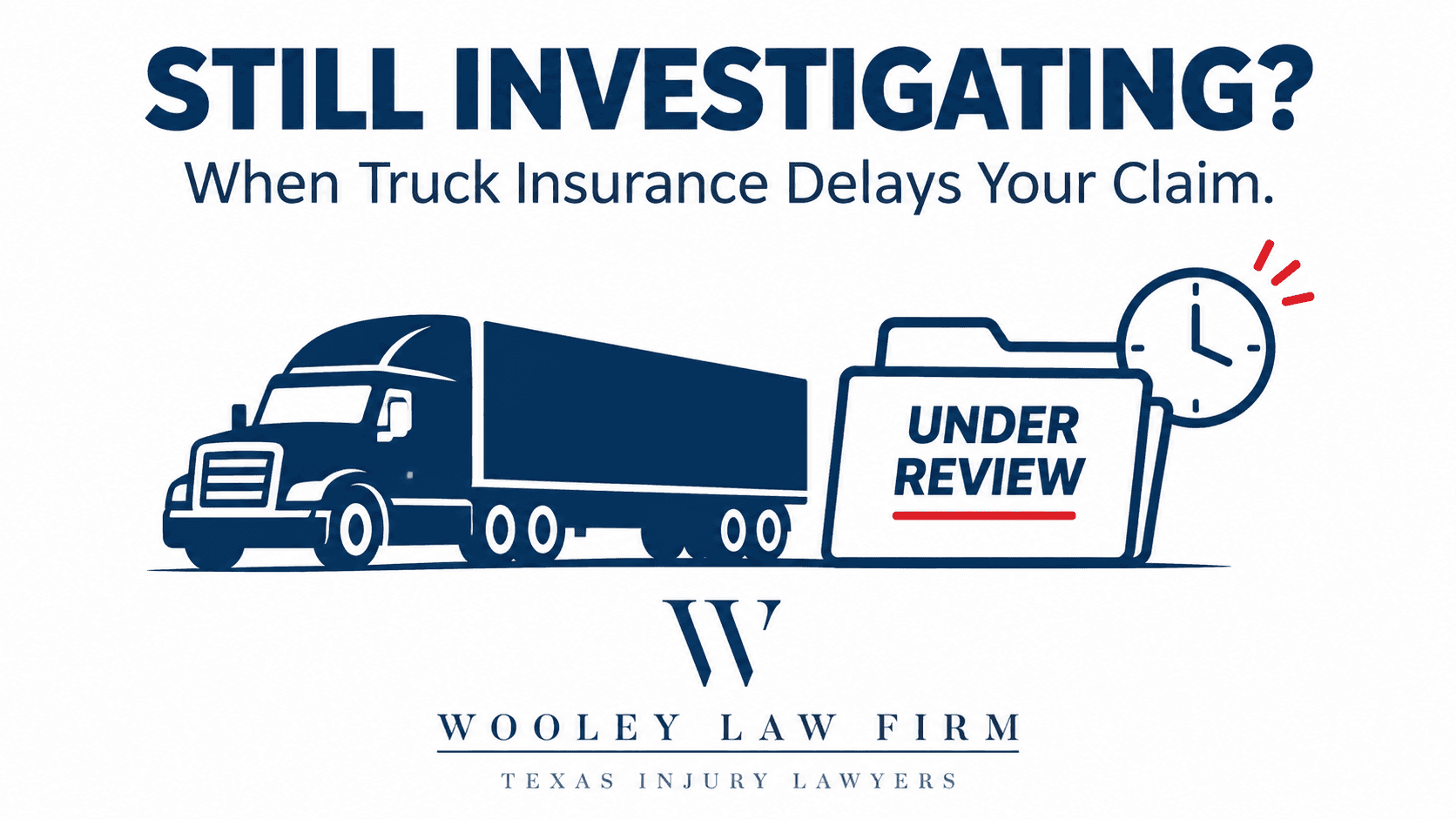
“We’re still investigating.”
A trucking insurer may need time to investigate a collision. But an open claim does not protect your filing deadline, preserve evidence, or tell you what issue is preventing a decision.
If the trucking company’s insurance keeps delaying your claim, ask what is being investigated, what information remains outstanding, and when the adjuster expects to provide a meaningful update. Preserve your evidence and have an attorney evaluate whether further negotiation or litigation is appropriate.
The next steps also depend on whose policy is involved. A claim against the trucking company’s insurer is legally different from a claim for benefits under your own policy.
At The Wooley Law Firm, our Dallas truck wreck lawyer helps injured people investigate unresolved commercial-truck claims and determine how to move forward.
What Does “We’re Investigating” Actually Mean?
The phrase can describe several different issues.
Investigating Fault
The insurer may be determining how the collision happened and whether its insured bears responsibility.
Questions may include:
Did the truck make an unsafe lane change?
Was the driver following too closely?
Were several vehicles involved?
Do the drivers give conflicting accounts?
Is video, witness testimony, or vehicle data available?
Was the driver working for the trucking company at the time?
A crash report can provide important information, but it may not resolve every dispute. Video, physical evidence, and other records may support or contradict the initial accounts.
Investigating Coverage
Coverage concerns whether a particular insurance policy applies to the collision.
The insurer may be reviewing the policy period, insured parties, vehicle information, endorsements, exclusions, or the truck’s use at the time.
Who caused the wreck and which policy covers it are separate questions. An insurer can investigate both simultaneously.
Our guide to finding insurance after a Dallas 18-wheeler wreck explains why the insurer listed on the crash report may be only a starting point.
Evaluating Injuries and Losses
The insurer may also be assessing medical treatment, lost income, vehicle damage, and future needs.
Ask whether it is still disputing fault, evaluating damages, or doing both. A request for additional medical records does not necessarily mean liability has been accepted.
Likewise, acceptance of responsibility does not establish that the insurer agrees with every claimed expense or the amount needed to resolve the case.
Does Texas Give the Trucking Insurer 15 Days to Accept Liability?
Do not assume that the deadlines for your own insurance claim apply to the other driver’s insurer.
The Texas Department of Insurance explains that the prompt-payment deadlines described in its auto insurance guidance do not apply when another driver’s insurer is paying the claim. Texas Insurance Code Chapter 542’s prompt-payment provisions concern qualifying first-party claims.
That distinction matters:
Third-party claim: You seek compensation from the truck driver or trucking company, with its liability insurer handling the claim.
First-party claim: You seek benefits under a policy that covers you, such as applicable collision, PIP, medical payments, or UM/UIM coverage.
For applicable first-party claims, acknowledgment, investigation, decision, and payment requirements can matter. The particular coverage, statutory exceptions, and claim circumstances require review.
UM/UIM claims also involve special issues concerning liability, damages, and entitlement to benefits. They should not be treated as identical to a routine vehicle-repair claim.
The Texas Department of Insurance’s auto insurance guide explains the general distinction between claims under your own policy and claims against another driver’s insurer.
What Information Should I Request From the Adjuster?
Move beyond asking, “Is there an update?”
Ask specific questions:
Who is handling the claim? Confirm the insurer’s legal name, claim number, adjuster’s contact information, and the insured person or company involved.
What remains under investigation? Ask whether the unresolved issue concerns fault, coverage, damages, or a combination.
What information is missing? Request a specific list rather than a general statement that the file is incomplete.
Who is expected to provide it? Clarify whether the insurer is waiting on you, its insured, a witness, law enforcement, or another source.
What has the insurer received? Ask it to confirm receipt of records and evidence already submitted.
Has any position been reached? Ask whether liability or coverage has been accepted, denied, or remains undecided.
When will the next update occur? Request a reasonable follow-up date and a written explanation of the current status.
You can request relevant coverage information, including potentially applicable policies and limits. However, a request does not mean you are automatically entitled to the insurer’s entire file or every policy document before suit. An attorney can assess available ways to obtain needed information.
If the driver has not responded to the insurer, ask what additional steps are being taken and whether other evidence can be evaluated. An unanswered call to the driver does not itself resolve your claim.
Injured in an Accident?
Free consultation. Tell us what happened and learn what options may be available.
How Should I Document Insurance Communications?
Keep a simple chronological record of:
The date and method of contact.
The adjuster’s name.
What you provided.
What the adjuster said remained outstanding.
Any promised action or follow-up date.
Whether that action occurred.
Save original emails, letters, attachments, delivery confirmations, and claim-portal messages.
After a phone conversation, send a short factual recap confirming what you understood and identifying any next steps. Invite the adjuster to correct inaccuracies.
The purpose is to create an accurate history of the claim. Avoid guessing about motives or overstating what the adjuster promised.
If the same document is requested repeatedly, resend it when appropriate and identify the earlier submission date. A clear record helps your attorney distinguish missing information from a claim that is not progressing.
Should I Give a Recorded Statement or Sign a Medical Authorization?
Understand the request before agreeing.
A statement about the crash, injuries, or prior medical history can become evidence. A broad medical authorization may allow access to records beyond the treatment you intended to discuss.
For a third-party claim, consider consulting an attorney before providing a recorded statement or signing an unrestricted authorization. Ask what information is needed and why.
Your own policy may impose notice and cooperation obligations, including appropriate information or examination requirements. Do not ignore your insurer’s requests based on advice intended for dealings with the trucking company’s insurer.
An attorney can review the policy, the request, and its scope so you can respond appropriately.
What Evidence Should Be Preserved While the Insurer Investigates?
Do not assume the insurer’s investigation protects evidence for you.
Keep original photographs, dashcam footage, witness information, repair records, medical records, and proof of missed work.
Depending on the collision, relevant commercial-truck evidence may include:
Truck and trailer inspections.
Available dashcam footage and electronic vehicle data.
Electronic logging and hours-of-service records.
Dispatch communications and trip information.
Maintenance and repair records.
Driver qualification or training records.
Ownership, lease, and employment documents.
The appropriate requests depend on what happened. Not every truck has every type of recording or data, and a preservation letter does not guarantee that evidence has been retained.
Our guide to Texas crash reports after a Dallas–Fort Worth wreck explains why the report is one part of the investigation.
When May Litigation Become Necessary?
A lawsuit may be appropriate when the evidence supports a claim but negotiations cannot resolve it.
Reasons to evaluate filing include:
A significant fault dispute.
Repeated requests producing no meaningful clarification.
Evidence that requires formal discovery.
Disagreement about injuries or damages.
An approaching filing deadline.
The need to identify and pursue responsible parties.
For an ordinary third-party injury claim, the lawsuit generally targets the allegedly responsible driver, trucking company, or other defendants supported by the facts. It is not automatically a lawsuit against their insurer.
Through litigation, attorneys can seek relevant documents, take depositions, and request appropriate court assistance with discovery disputes. Filing does not guarantee immediate payment, favorable coverage, or a particular result.
You do not need to wait for a formal denial before asking whether suit is appropriate.
Can I Sue the Trucking Insurer for Bad Faith Because It Is Delaying?
An injured third-party claimant generally does not have the same bad-faith remedies as an insured making a claim against their own insurer.
Texas Insurance Code Section 541.060(b) expressly limits third-party claims under that unfair-settlement-practices provision. Delay alone does not give you a general right to sue the trucking insurer directly for bad faith.
Your own-policy claim requires a separate analysis of the insurer’s obligations and any available remedies.
Our insurance coverage practice page discusses assistance with coverage disputes. If an investigation becomes a denial, our article about insurance denials after a Dallas wreck explains why the stated reason matters.
Will a Complaint to the Texas Department of Insurance Resolve the Delay?
A complaint may be useful for some insurance-handling problems, especially disputes involving your own insurer. But it is not a substitute for proving fault or protecting a legal deadline.
TDI explains that it cannot determine who caused an accident and generally cannot resolve another driver’s insurer’s refusal to accept liability.
Review TDI’s explanation of the complaint process and its limits. An attorney can help determine whether a complaint addresses the actual problem or whether the claim requires litigation or another approach.
Does an Open Investigation Extend My Filing Deadline?
Generally, no. “We’re investigating” is not an extension agreement.
Many Texas personal injury lawsuits are subject to the two-year limitations period in Texas Civil Practice and Remedies Code Section 16.003. Exceptions, different claims, and notice requirements can affect the analysis.
Ordinary negotiations, continued treatment, or an open insurance file generally do not stop the clock. Properly filing suit and timely pursuing service also require attention.
Have an attorney evaluate the actual deadline rather than relying on the adjuster to warn you.
Frequently Asked Questions
How Long Can Truck Insurance Keep Investigating a Texas Claim?
There is no universal number of days that requires the trucking insurer to accept a third-party injury claim. Ask what remains unresolved and have the evidence and deadlines independently reviewed.
Does Opening a Claim Mean Coverage Was Accepted?
No. Assigning a claim number or adjuster does not necessarily establish coverage, fault, or agreement on damages.
Can My Own Insurance Help While the Trucking Claim Is Pending?
Potentially. Applicable collision coverage may help with vehicle damage, while PIP or medical payments coverage may help with certain expenses. UM/UIM requires its own coverage and entitlement analysis. Review policy duties and any required consent before settling with another party.
Do I Have to Finish Medical Treatment Before Hiring a Lawyer?
No. An attorney can investigate responsibility, preserve evidence, and evaluate coverage while care continues. Settlement timing can be considered separately from whether legal work should begin.
Talk With a Dallas Truck Wreck Lawyer About an Unresolved Claim
If every call ends with “we’re investigating,” you deserve a clearer understanding of what remains disputed and what steps are available.
The Wooley Law Firm can review the insurer’s communications, investigate fault and coverage, preserve available evidence, and evaluate whether negotiation or litigation is appropriate.
Call (214) 699-6524 or contact The Wooley Law Firm for a free consultation. Have your crash date, claim number, adjuster correspondence, and available records ready.
This article provides general information and is not legal advice. Reading it or requesting a consultation does not by itself create an attorney-client relationship. Every claim depends on its facts, policy terms, and applicable law.
Topics
Share This Article

Andrew J. Wooley
Personal Injury Attorney
Andrew J. Wooley is a dedicated personal injury attorney based in Dallas, Texas. He focuses on helping accident victims recover fair compensation for their injuries. With a commitment to personalized service, Andrew works directly with each client to understand their unique situation and fight for their rights.