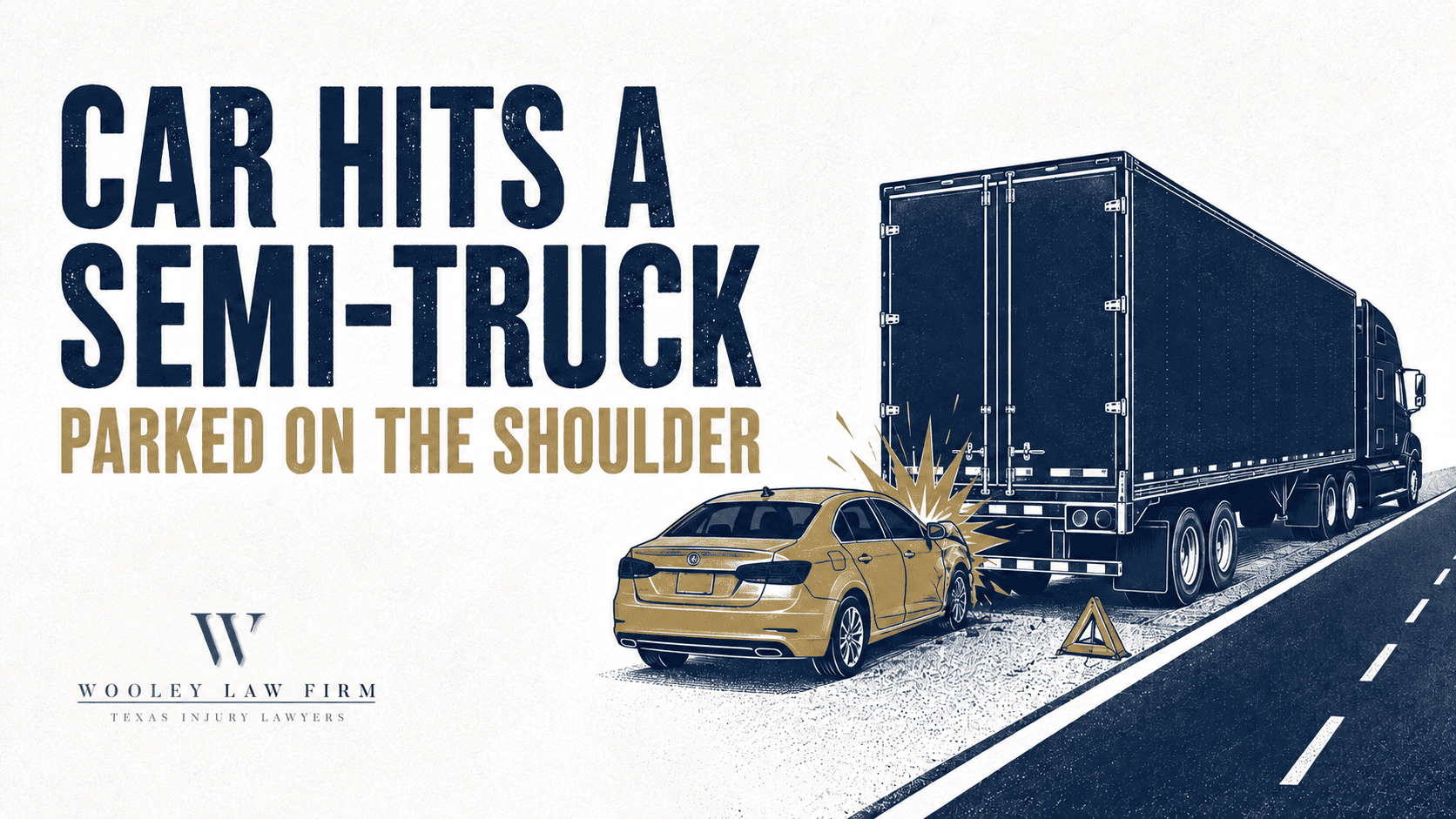
When a car or SUV crashes into the back of a semi-truck parked on the shoulder of a Texas highway, many people immediately assume the passenger-vehicle driver must be entirely at fault.
That is not always true.
A commercial truck stopped beside a high-speed interstate can create a serious danger, particularly at night, around sunrise, during bad weather, or in an area with limited visibility. Truck drivers and trucking companies must follow safety rules designed to warn approaching motorists and reduce the risk of a catastrophic rear-end or underride collision.
Liability may depend on why the truck stopped, where it was positioned, whether its lights were working, whether reflective warning triangles were placed, and whether the truck could have been moved to a safer location.
A proper investigation should examine the conduct of both drivers—not simply assume that the motorist who struck the trailer is automatically responsible.
The Wooley Law Firm represents people injured in serious commercial-vehicle crashes throughout North Texas. Learn more about how we investigate these cases on our Dallas truck accident lawyer page.
Is the Rear Driver Always at Fault?
No. A rear-end collision does not automatically make the rear driver legally responsible for every resulting injury.
Passenger-vehicle drivers have a duty to:
Maintain a proper lookout;
Control their speed;
Stay within their lane;
Avoid distracted driving;
Adjust to weather and visibility conditions; and
React reasonably to hazards on the road.
However, truck drivers and motor carriers also have legal responsibilities.
A truck driver may have contributed to the collision by:
Parking unnecessarily on the highway shoulder;
Stopping where the trailer was difficult to see;
Allowing part of the truck or trailer to extend into a travel lane;
Failing to activate hazard lights;
Failing to place reflective warning triangles;
Operating with defective taillights or marker lights;
Failing to maintain reflective tape;
Stopping near a curve, hill, ramp, or other visual obstruction; or
Remaining on the shoulder longer than reasonably necessary.
Texas law allows responsibility to be divided among multiple people and companies. The passenger-vehicle driver may bear some responsibility while the truck driver, trucking company, maintenance contractor, or another party may also share fault.
For additional information about fault and evidence after a stopped-truck collision, read our guide to safety rules for 18-wheelers stopped on the highway shoulder.
Federal Rules for Semi-Trucks Stopped on the Shoulder
Commercial truck drivers are subject to safety requirements that generally do not apply to ordinary passenger vehicles.
When a commercial motor vehicle is stopped on the traveled portion or shoulder of a highway for a reason other than a necessary traffic stop, the driver is generally required to activate the truck’s hazard warning flashers immediately.
The driver must also place required warning devices, typically reflective triangles, as soon as possible and generally within 10 minutes.
On a divided highway or one-way roadway, warning devices are generally placed behind the truck in the direction of approaching traffic. Their exact placement may need to be adjusted when the truck is stopped near a curve, hill, or other obstruction.
These rules exist because a stationary tractor-trailer may be difficult to recognize at highway speeds. A motorist may see the trailer but mistakenly believe it is moving with traffic until there is too little time to stop.
A failure to follow federal safety regulations can become important evidence in a Texas truck-accident claim.
Why Reflective Warning Triangles Matter
Reflective warning triangles provide motorists with advance notice that a commercial vehicle is stopped ahead.
Without warning triangles, an approaching driver may have only the truck’s rear lights or reflective tape to identify the danger. At highway speed, that may not provide enough time to slow down or safely change lanes.
Investigators should determine:
Whether the truck carried the required warning devices;
Whether the driver placed the triangles;
How long the truck had been stopped;
Where each triangle was positioned;
Whether the triangles were visible to approaching traffic;
Whether the truck was near a hill, curve, bridge, or entrance ramp; and
Whether weather or lighting conditions required additional precautions.
Placing a warning triangle only a few feet behind a trailer may not provide meaningful advance warning. Investigators should document the precise location of each device before it is moved.
If no warning devices were placed, the trucking company may argue that the truck had only recently stopped. Electronic logs, dispatch messages, GPS records, witness statements, and roadside video may help establish the actual timeline.
Were the Hazard Lights Working?
A truck driver should generally activate the vehicle’s hazard flashers immediately after stopping on the highway shoulder.
Investigators should not rely only on the driver’s statement that the flashers were operating. The truck’s electrical system, bulbs, wiring, switches, and post-collision condition should be independently examined.
Evidence may show that:
The hazard lights were never activated;
One or more rear lights were defective;
An electrical problem prevented the flashers from working;
The lights were covered by dirt or road debris;
The driver knew about an existing lighting problem; or
The trucking company failed to correct a previously reported defect.
Maintenance records, inspection reports, driver vehicle inspection reports, repair invoices, photographs, and electronic fault codes may help establish whether the lighting system was properly maintained.
A failure involving lights, wiring, brakes, tires, or another truck component may also support a claim against the motor carrier or maintenance provider. Our article about truck maintenance and mechanical failures discusses how tire, brake, and maintenance problems can contribute to major commercial-vehicle accidents.
Was the Truck Completely Outside the Travel Lane?
A police report may state that a semi-truck was “on the shoulder,” but that description does not necessarily mean the entire tractor-trailer was outside the traffic lane.
Highway shoulders vary in width. A narrow shoulder may not provide enough space for the full width of a commercial truck. The tractor may be off the roadway while part of the trailer extends across the fog line.
Investigators should examine:
The width of the shoulder;
The width of the truck and trailer;
The position of the passenger vehicle before impact;
Tire marks and scrape marks;
Debris locations;
Fluid trails;
The angle of impact;
Damage to the trailer;
Damage to the passenger vehicle; and
Photographs taken before the vehicles were moved.
A three-dimensional scan, accident reconstruction, dash-camera recording, traffic-camera footage, or witness video may help determine whether the trailer was partially blocking the outside lane.
Even a small encroachment into a travel lane can become critical when motorists are traveling at interstate speed.
Why Was the Semi-Truck Stopped?
The reason the truck stopped may substantially affect liability.
A true mechanical emergency may require an immediate stop. However, a commercial driver should not use an interstate shoulder as a routine parking place when a safer location is reasonably available.
Possible reasons for stopping include:
Tire failure;
Brake problems;
Engine trouble;
Electrical failure;
Overheating;
Cargo movement;
A fuel issue;
Driver fatigue;
A missed exit;
A navigation problem;
A personal break;
A telephone call;
A company instruction; or
A preventable maintenance problem.
Investigators should determine whether the driver could have continued to a nearby exit, truck stop, parking lot, frontage road, or other location away from moving traffic.
Dispatch communications, electronic logging device data, GPS records, telematics, engine-control-module information, cellphone records, and roadside-assistance records may reveal why the truck stopped and how long it remained there.
Could Poor Truck Maintenance Have Caused the Stop?
A breakdown is not always an unavoidable event.
A truck may become disabled because a trucking company failed to properly inspect, repair, or maintain it. A preventable mechanical failure can expose the motor carrier or a maintenance provider to liability.
Potential maintenance issues include:
Worn or damaged tires;
Improper tire pressure;
Defective brakes;
Electrical-system problems;
Engine defects;
Overdue preventive maintenance;
Unresolved dashboard warnings;
Inadequate pre-trip inspections;
Previously reported defects;
Defective trailer lighting; or
Poor roadside repairs.
Maintenance records may show that the company knew about a dangerous condition before the truck became disabled.
Investigators should compare repair invoices, inspection reports, driver complaints, fault codes, maintenance schedules, and post-collision repairs. A company should not be allowed to repair the truck and destroy evidence before an independent inspection takes place.
Injured in an Accident?
Free consultation. Tell us what happened and learn what options may be available.
Can the Truck Driver Be Liable?
A commercial driver may be liable when the driver’s actions or omissions contributed to the collision.
Examples may include:
Stopping in an unsafe location;
Parking unnecessarily on the shoulder;
Failing to activate hazard lights;
Failing to place warning triangles;
Placing warning devices incorrectly;
Allowing the trailer to extend into a travel lane;
Failing to inspect the truck’s lights;
Continuing to operate after discovering a mechanical defect;
Failing to move the truck after the emergency passed;
Sleeping in a truck parked in a dangerous location; or
Choosing a shoulder stop when a safer location was nearby.
The driver’s training, experience, driving history, physical condition, hours-of-service records, and communications with dispatch may all be relevant.
Can the Trucking Company Be Liable?
The trucking company may be responsible for the driver’s negligence when the driver was acting within the course and scope of employment.
Depending on the evidence, the trucking company may also face claims based on its own conduct.
Negligent hiring
A motor carrier may be responsible for hiring a driver who lacked the qualifications, experience, judgment, or safety history required to operate a commercial vehicle safely.
Inadequate training
A trucking company should train drivers on roadside emergencies, warning-device placement, hazard-light use, vehicle inspections, and safe stopping procedures.
Negligent supervision
A carrier may be liable when it ignores prior safety violations, failed inspections, preventable crashes, driver complaints, or repeated failures to follow roadside procedures.
Negligent maintenance
If a mechanical problem forced the truck onto the shoulder, the company’s inspection and maintenance practices should be investigated.
Failure to provide emergency equipment
Commercial vehicles should carry required emergency warning equipment. If the driver did not have usable warning triangles, the company may bear responsibility for failing to equip or inspect the truck.
Unsafe company policies
A trucking company may create dangerous conditions by pressuring drivers to continue operating unsafe equipment, delaying repairs, discouraging roadside assistance, or rewarding drivers for placing speed and delivery schedules ahead of safety.
Truck cases frequently involve corporate records and digital information that are not available in an ordinary passenger-vehicle claim. Our overview of Dallas-Fort Worth truck accident cases explains why these claims are different and why immediate investigation matters.
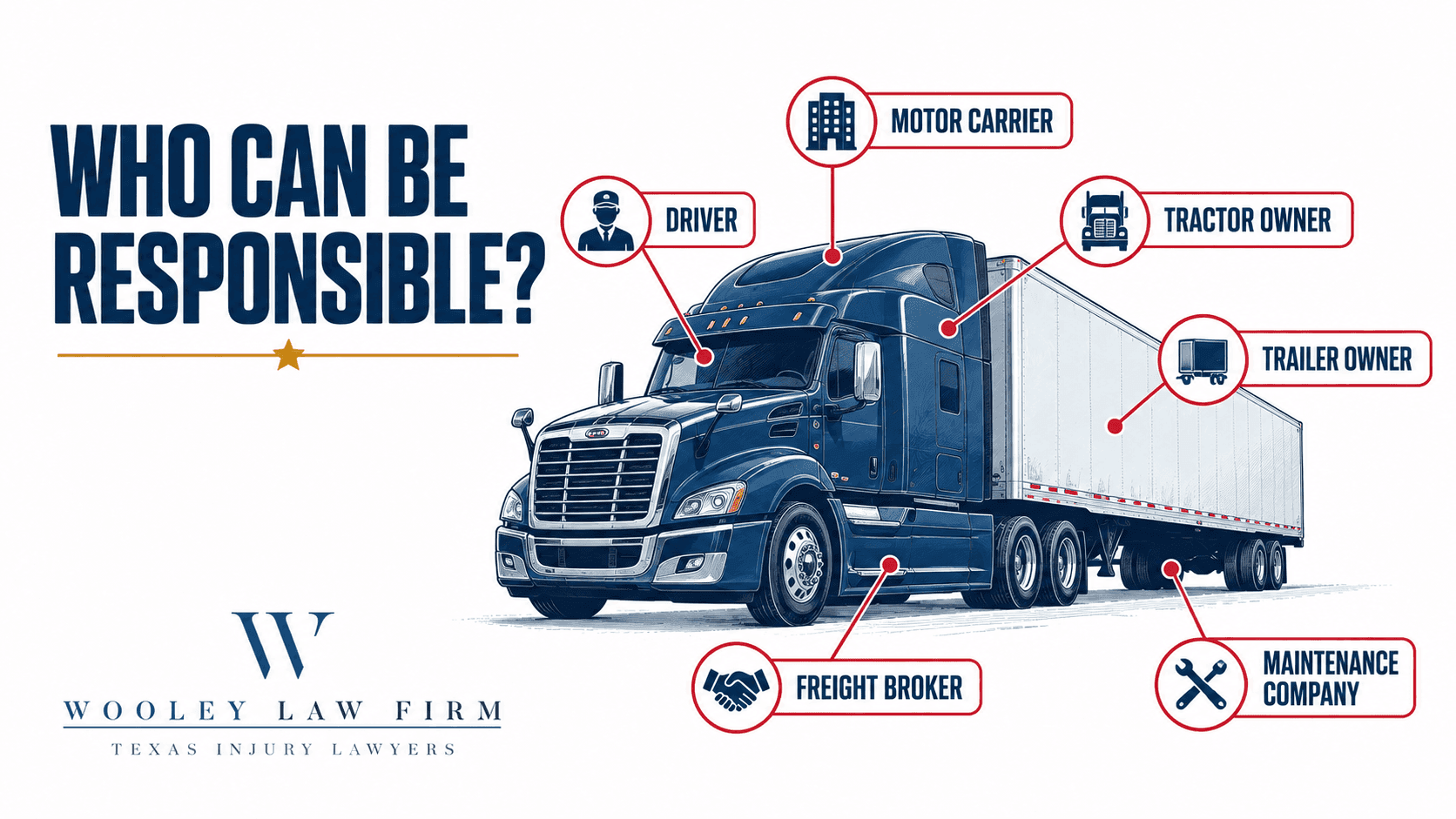
Other Parties That May Be Liable
Commercial truck cases frequently involve more than one company.
Potentially responsible parties may include:
The motor carrier;
The tractor owner;
The trailer owner;
A leasing company;
A maintenance contractor;
A tire company;
A roadside-repair provider;
A freight broker;
A shipper;
A cargo-loading company;
A parts manufacturer; or
Another company controlling the driver’s work.
The company name displayed on the truck may not identify every business involved. Insurance records, registration documents, leasing agreements, bills of lading, dispatch records, and federal motor-carrier filings may reveal additional parties.
Identifying all responsible companies can be essential because each may possess different evidence and insurance coverage.
Why Early-Morning and Nighttime Shoulder Collisions Are So Dangerous
A stopped semi-truck may be especially difficult to see in darkness, at dawn, during rain, or in heavy road spray.
Visibility problems may be made worse by:
Defective rear lights;
Dirty or damaged lights;
Missing reflective tape;
Poorly maintained reflective tape;
Disabled hazard flashers;
Lack of warning triangles;
Fog or rain;
Highway glare;
Curves or hills;
Construction zones;
Narrow shoulders; or
A dark-colored trailer blending into the roadway.
At highway speeds, a driver may travel a significant distance in only a few seconds. Warning devices are intended to give motorists time to identify the hazard and move safely away from the shoulder.
Underride Collisions and Catastrophic Injuries
A rear impact with a semi-trailer can cause an underride collision. This happens when part of a passenger vehicle travels underneath the trailer.
Because the trailer may enter the passenger compartment, these collisions can cause severe or fatal injuries even when the passenger vehicle has airbags and seat belts.
Common injuries may include:
Traumatic brain injuries;
Skull fractures;
Facial fractures;
Spinal-cord injuries;
Paralysis;
Neck injuries;
Back injuries;
Chest trauma;
Rib fractures;
Internal bleeding;
Organ damage;
Arm and leg fractures;
Amputations;
Burns;
Scarring;
Disfigurement; and
Fatal injuries.
Some injuries are not immediately obvious. A person may initially feel only soreness or confusion but later experience severe headaches, dizziness, numbness, weakness, breathing problems, abdominal pain, or worsening neck and back pain.
Prompt medical evaluation is important after any high-speed collision involving a commercial vehicle.
People facing permanent physical limitations, extensive medical care, or an inability to return to work can learn more in our article about life-changing injuries after a Dallas-Fort Worth truck wreck.
Evidence That Should Be Preserved
Trucking companies and their insurers may begin investigating immediately after a serious wreck. Important electronic and physical evidence can be lost, overwritten, repaired, or destroyed.
A preservation demand may seek evidence including:
The tractor;
The trailer;
Reflective warning triangles;
Electronic control module data;
Telematics;
GPS history;
Dash-camera footage;
Driver-facing camera footage;
Electronic logging device data;
Dispatch records;
Text messages and electronic communications;
Driver call logs;
Roadside-assistance records;
Maintenance files;
Repair invoices;
Tire records;
Brake records;
Lighting-system records;
Pre-trip inspection reports;
Post-trip inspection reports;
Driver vehicle inspection reports;
Driver qualification records;
Training materials;
Company roadside-emergency policies;
Drug and alcohol testing information;
Internal safety reports;
Photographs taken by the trucking company;
Insurance investigation materials; and
Any preventability review performed by the motor carrier.
The truck should be inspected before repairs alter its condition. Warning triangles, bulbs, reflective tape, electrical components, tires, and mechanical parts may become important physical evidence.
For a more detailed discussion of the records that may determine fault, read what evidence matters most in a Texas 18-wheeler case.
Black Box, GPS, and Telematics Data
Electronic data may help answer important questions such as:
When did the truck stop?
How long was it on the shoulder?
Did the truck experience a mechanical fault?
Was the truck moving immediately before impact?
Did the driver report the breakdown to dispatch?
Was another location available nearby?
Had the truck experienced similar problems before?
The engine control module, electronic logging device, GPS system, and motor carrier’s telematics platform may each contain different information.
Learn more about preserving and analyzing 18-wheeler black box data after a DFW truck wreck.
Video Evidence Can Disappear Quickly
Highway collisions may be captured by:
TxDOT traffic cameras;
Tollway cameras;
Nearby businesses;
Gas stations;
Warehouses;
Hotels;
Construction cameras;
Dash cameras;
Other commercial trucks;
Law-enforcement body cameras;
Emergency vehicles; or
Witness cellphones.
Video may show:
How long the truck had been stopped;
Whether the hazard lights were operating;
Whether warning triangles were placed;
Whether the trailer extended into the traffic lane;
Whether the truck had recently broken down;
How other vehicles reacted;
Traffic and weather conditions; and
The movement of the passenger vehicle before impact.
Many camera systems automatically overwrite footage within days or weeks. Early investigation is often necessary to preserve it.
What Compensation May Be Available?
A person injured in a Texas semi-truck accident may be able to seek compensation for losses including:
Ambulance expenses;
Emergency-room treatment;
Hospital bills;
Surgery;
Rehabilitation;
Physical therapy;
Future medical care;
Lost wages;
Loss of earning capacity;
Physical pain;
Mental anguish;
Physical impairment;
Disfigurement; and
Property damage.
When a collision results in death, eligible family members may have wrongful-death claims. The estate may also have a survival claim for damages the person experienced before death.
The value of a truck-accident claim depends on the injuries, available evidence, insurance coverage, future medical needs, lost income, and the percentage of responsibility assigned to each party.
Our guide addressing what a Dallas 18-wheeler accident case may be worth explains the different categories of economic and non-economic damages that may be available.
What Should You Do After Hitting a Semi-Truck Parked on the Shoulder?
After emergency needs are addressed, helpful steps may include:
Seek prompt medical treatment.
Photograph the truck, trailer, shoulder, lane markings, lights, warning triangles, and surrounding roadway.
Preserve dash-camera footage.
Obtain witness names and contact information.
Save damaged personal property.
Request the police crash report.
Write down everything you remember.
Avoid giving a recorded statement to the trucking company’s insurer without legal advice.
Do not sign a settlement release prematurely.
Preserve cellphone data, photographs, and location information.
Contact a Texas truck-accident attorney before critical evidence disappears.
An insurance adjuster may contact an injured motorist quickly and suggest that the case is simple because the passenger vehicle hit the trailer from behind. That conclusion should not be accepted before the truck driver’s actions, the trailer’s position, the warning devices, and the trucking company’s records are investigated.
A Rear Impact Does Not End the Liability Investigation
A collision with the back of a semi-trailer should not be dismissed as an automatic-fault rear-end accident.
A complete investigation should determine:
Why the truck was stopped;
Whether the stop was necessary;
Whether a safer location was available;
How long the truck remained on the shoulder;
Whether the hazard lights were activated;
Whether reflective triangles were properly placed;
Whether the trailer was entirely outside the travel lane;
Whether the rear lighting and reflective tape were visible;
Whether poor maintenance caused the breakdown;
Whether the driver followed federal safety rules;
Whether the trucking company properly trained and supervised the driver; and
Whether another company contributed to the dangerous condition.
The passenger-vehicle driver’s conduct should also be evaluated, but a trucking company should not avoid responsibility merely because its trailer was struck from behind.
Contact a Dallas-Fort Worth Semi-Truck Accident Lawyer
Claims involving semi-trucks parked on highway shoulders can require immediate investigation. The truck, trailer, warning devices, electronic data, maintenance records, dispatch communications, and available video should be preserved before they are lost or altered.
The Wooley Law Firm represents people and families affected by serious 18-wheeler and commercial-truck accidents throughout Dallas-Fort Worth and across Texas. We investigate the actions of the driver, motor carrier, maintenance companies, equipment owners, and every other party that may have contributed to the collision.
If you were injured after striking a semi-truck stopped on a Texas highway shoulder, you may have the right to seek justice and pursue compensation for medical expenses, pain and suffering, lost wages, mental anguish, impairment, and other damages.
Call (214) 699-6524 for a free consultation. You don’t pay unless we win.
Frequently Asked Questions
Is the driver who hits the back of a parked semi-truck always at fault?
No. Liability depends on the circumstances. The truck driver or trucking company may share responsibility if the trailer extended into a traffic lane, required warning triangles were not placed, hazard lights were not operating, the truck was stopped unnecessarily, or poor maintenance caused the breakdown.
How long does a truck driver have to place warning triangles?
Federal regulations generally require a commercial driver to place warning devices as soon as possible and within 10 minutes after stopping on the roadway or shoulder, except during a necessary traffic stop.
Are hazard lights enough when a semi-truck is parked on the shoulder?
Not necessarily. Hazard flashers are generally required immediately, but the driver may also be required to place reflective warning devices. The precise requirements depend on the circumstances surrounding the stop.
What if the semi-truck was partially inside the traffic lane?
The position of the trailer may become critical evidence. Photographs, measurements, tire marks, debris, video, and accident reconstruction can help establish whether part of the truck was blocking the lane.
Can the trucking company be liable for a mechanical breakdown?
Potentially. The company or a maintenance provider may be responsible if poor inspection, deferred maintenance, defective repairs, worn tires, electrical problems, or another preventable condition caused the truck to become disabled.
What evidence can show how long the truck was parked?
GPS data, telematics, electronic logs, engine data, dispatch messages, roadside-assistance records, dash cameras, traffic cameras, witness statements, and the driver’s phone records may help establish the timeline.
Should I speak with the trucking company’s insurance adjuster?
You should be cautious before providing a recorded statement or signing documents. The trucking company’s insurer may try to obtain admissions that can later be used to place all responsibility on you.
Disclaimer
This article is provided for general informational purposes only and is not legal advice. Every collision involves different facts, evidence, parties, and legal issues. Reading this article does not create an attorney-client relationship. Consult a qualified Texas attorney regarding your specific circumstances.
Topics
Share This Article

Andrew J. Wooley
Personal Injury Attorney
Andrew J. Wooley is a dedicated personal injury attorney based in Dallas, Texas. He focuses on helping accident victims recover fair compensation for their injuries. With a commitment to personalized service, Andrew works directly with each client to understand their unique situation and fight for their rights.