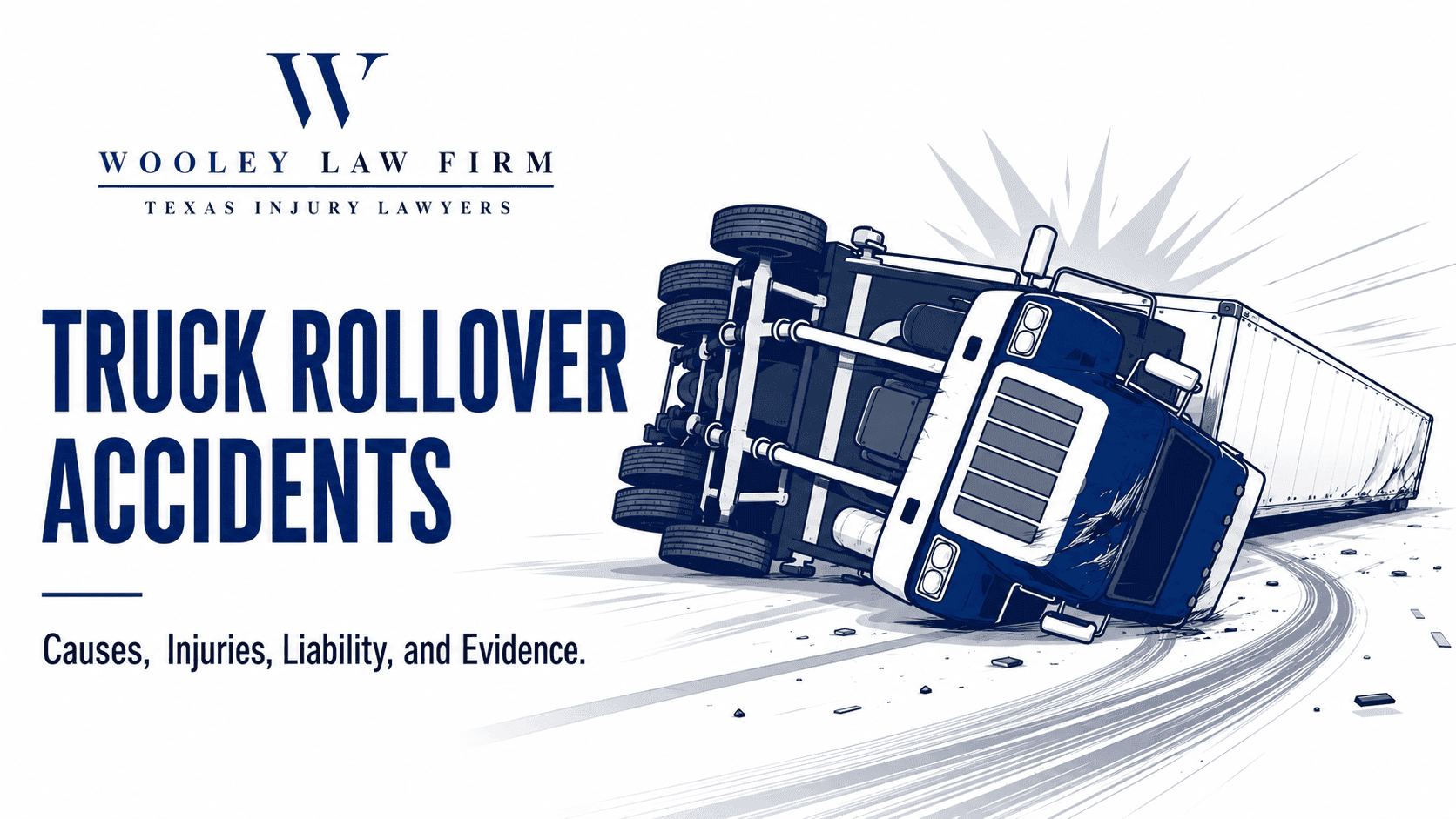
A truck rollover accident can turn a busy Dallas highway into a catastrophic crash scene within seconds. When an 18-wheeler rolls onto its side or roof, the truck may crush nearby vehicles, block multiple lanes, spill cargo, release hazardous materials, or trigger a chain-reaction collision.
These crashes are rarely simple. A rollover may result from excessive speed, unsafe steering, driver fatigue, improper cargo loading, defective tires, poor maintenance, or a trucking company’s failure to properly train and supervise its driver.
If you were injured in a truck rollover accident in Dallas or elsewhere in North Texas, a prompt investigation may be critical. Trucking companies and their insurers often begin protecting themselves immediately after a serious wreck. Important electronic data, video footage, maintenance records, and physical evidence can disappear if they are not preserved.
The Wooley Law Firm represents people injured in serious 18-wheeler and commercial vehicle accidents throughout Dallas and North Texas.
What Is a Truck Rollover Accident?
A truck rollover accident occurs when a commercial vehicle tips onto its side or overturns completely.
Rollovers can involve:
18-wheelers;
Tractor-trailers;
Tanker trucks;
Dump trucks;
Delivery trucks;
Garbage trucks;
Concrete trucks;
Flatbed trucks;
Box trucks; and
Other commercial vehicles.
Some rollovers involve only the truck. Others involve several passenger vehicles struck before, during, or after the truck overturns.
A trailer may slide across the roadway, strike multiple vehicles, or fall onto a nearby car. Cargo may break loose and create additional hazards for approaching motorists.
Why Are 18-Wheeler Rollover Accidents So Dangerous?
Commercial trucks are much larger and heavier than passenger vehicles. Their high center of gravity can also make them vulnerable to instability during sudden turns, lane changes, or emergency maneuvers.
When an 18-wheeler rolls over, it may:
Crush a smaller vehicle;
Trap occupants inside a car;
Push vehicles into concrete barriers;
Sweep across several traffic lanes;
Cause underride collisions;
Spill heavy or hazardous cargo;
Start a fire;
Block visibility for approaching drivers;
Trigger a multi-vehicle pileup; or
Cause fatal injuries.
A motorist traveling beside a tractor-trailer may have little or no time to avoid the truck once it begins to tip.
What Causes Truck Rollover Accidents?
A rollover investigation should examine the driver, trucking company, truck, trailer, cargo, roadway, and surrounding circumstances. Many rollovers involve several contributing causes.
Excessive Speed
Speed is one of the most common factors in truck rollover accidents.
A truck may roll when the driver enters a curve, exit ramp, intersection, or construction zone too quickly. Even when the driver is below the posted speed limit, the speed may still be unsafe for the truck’s size, load, road conditions, or turning radius.
Truck drivers must reduce speed when approaching:
Curves;
Exit ramps;
Intersections;
Construction zones;
Congested traffic;
Wet pavement;
Steep grades; and
Areas with limited visibility.
Speed data from the truck’s electronic systems may help determine how fast the driver was traveling before the rollover.
Unsafe Turns
Commercial vehicles require more room to turn than passenger cars. A driver who turns too sharply or too quickly may cause the trailer to become unstable.
A rollover may occur when the driver:
Enters a curve too fast;
Makes an abrupt right or left turn;
Cuts the steering wheel sharply;
Fails to account for the trailer’s weight;
Turns while braking aggressively; or
Misjudges the roadway or lane width.
Tankers and other vehicles carrying liquid cargo may be especially vulnerable because the liquid can shift and surge during turns.
Sudden Steering and Overcorrection
A truck driver may lose control after making a sudden steering maneuver to avoid stopped traffic, road debris, another vehicle, or a missed exit.
Overcorrection may cause the tractor and trailer to sway, rotate, or tip.
Abrupt steering is particularly dangerous when combined with:
Excessive speed;
Improperly loaded cargo;
Worn tires;
Wet roads;
Driver distraction; or
Inexperienced operation.
Dashcam footage, roadway markings, witness statements, and electronic data may help reconstruct the driver’s movements.
Driver Fatigue
Fatigue can slow reaction time, impair judgment, and make it difficult for a driver to maintain control.
A tired truck driver may fail to notice:
Slowing traffic;
A sharp curve;
A lane ending;
Construction barriers;
A vehicle entering the truck’s lane; or
Changing weather and road conditions.
Electronic logging device records, dispatch messages, fuel receipts, trip documents, and delivery schedules may reveal whether the driver had enough rest or was operating beyond allowable hours.
Distracted Driving
A distracted commercial driver may drift from a lane, miss a curve warning, or react too late to traffic ahead.
Potential distractions include:
Texting;
Phone calls;
GPS devices;
Dispatch systems;
Eating;
Paperwork;
Adjusting controls; and
Reaching for objects inside the cab.
When the driver looks up and realizes danger is close, a sudden steering or braking maneuver may cause the truck to roll.
Improperly Loaded Cargo
Cargo loading plays a major role in truck stability.
A trailer may be more likely to roll when cargo is:
Unevenly distributed;
Loaded too high;
Concentrated on one side;
Not properly secured;
Overweight;
Allowed to shift; or
Loaded without accounting for axle limits.
A high or uneven center of gravity can make the truck unstable during turns or lane changes.
Cargo records, weight tickets, bills of lading, loading diagrams, photographs, and securement records may help determine whether improper loading contributed to the rollover.
Injured in an Accident?
Free consultation. Tell us what happened and learn what options may be available.
Unsecured or Shifting Cargo
Cargo that moves during transport can suddenly change the trailer’s balance.
Examples include:
Machinery;
Lumber;
Steel coils;
Construction materials;
Pallets;
Vehicles;
Livestock; and
Liquid cargo.
A cargo-loading company, shipper, warehouse, contractor, or trucking company may be responsible when unsafe loading or securement contributes to the crash.
Tire Blowouts and Tire Defects
A blown tire can cause a commercial driver to lose control, especially at highway speed.
Tire-related rollover causes may include:
Worn tread;
Underinflation;
Overinflation;
Improper tire matching;
Overloaded axles;
Defective tires;
Damage from road hazards; or
Failure to replace unsafe tires.
The truck and damaged tire should be preserved for inspection when tire failure may have caused the wreck.
Brake Failure or Poor Brake Maintenance
Defective or poorly maintained brakes can make it difficult for a driver to slow safely before a curve, traffic backup, or exit ramp.
Brake problems may include:
Worn components;
Improper adjustment;
Uneven braking;
Contaminated brake surfaces;
Air-brake system defects;
Delayed repairs; or
Inadequate inspections.
A maintenance company or motor carrier may be liable when negligent repair or inspection practices contribute to a rollover.
Inadequate Driver Training
Truck drivers must understand how commercial vehicles respond to speed, braking, steering, cargo movement, curves, and emergency maneuvers.
A driver may be unprepared to handle a rollover risk if the trucking company failed to provide adequate training.
Relevant evidence may include:
The driver’s application;
Commercial driver’s license history;
Training records;
Road-test documents;
Safety manuals;
Prior violations;
Previous crashes; and
Disciplinary records.
Weather and Road Conditions
Rain, ice, strong winds, construction zones, uneven pavement, and roadway defects can contribute to a rollover.
Poor weather does not necessarily excuse unsafe driving. Commercial drivers are expected to reduce speed and adjust their operation to existing conditions.
A driver may still be negligent for:
Traveling too fast in rain;
Following too closely;
Making an abrupt lane change;
Failing to stop when conditions become unsafe; or
Ignoring warning signs.
Common Injuries in Truck Rollover Accidents
Truck rollovers can cause severe and permanent injuries, especially when a trailer falls onto a passenger vehicle or the crash involves several impacts.
Common injuries include:
Traumatic brain injuries;
Concussions;
Skull fractures;
Facial injuries;
Neck injuries;
Herniated discs;
Back injuries;
Spinal cord injuries;
Paralysis;
Broken ribs;
Collarbone fractures;
Shoulder injuries;
Arm and wrist fractures;
Pelvic fractures;
Hip injuries;
Knee injuries;
Leg and ankle fractures;
Internal bleeding;
Organ damage;
Crush injuries;
Burns;
Amputations;
Emotional trauma; and
Wrongful death.
Some symptoms may not be obvious at the scene. Pain, dizziness, numbness, tingling, headaches, confusion, weakness, and limited movement may develop or worsen later.
Victims should seek medical care and report all symptoms to their providers.
Who May Be Responsible for a Dallas Truck Rollover?
Truck accident cases often involve multiple companies and insurance policies.
Potentially responsible parties may include:
The Truck Driver
The driver may be liable for speeding, distracted driving, unsafe steering, fatigue, improper braking, following too closely, or failing to inspect the truck.
The Trucking Company
A motor carrier may be responsible for the driver’s conduct and for its own negligent practices, including:
Negligent hiring;
Inadequate training;
Negligent supervision;
Retaining an unsafe driver;
Pressuring drivers to meet unsafe schedules;
Failing to monitor driver hours;
Inadequate maintenance;
Ignoring safety violations; and
Allowing an unsafe truck to remain in service.
The Trailer Owner
The tractor and trailer may be owned by different companies. A trailer owner may be liable for defects, poor maintenance, or unsafe equipment.
A Cargo-Loading Company or Shipper
A company that improperly loaded or secured cargo may be responsible when the load caused or contributed to the rollover.
A Maintenance or Repair Company
A third-party repair company may be liable for negligent brake work, tire replacement, inspections, or other repairs.
A Truck or Component Manufacturer
A manufacturer may be responsible when a defective tire, brake component, steering system, coupling device, suspension part, or stability system contributed to the wreck.
A Freight Broker or Logistics Company
Depending on the facts, a broker or logistics company may become relevant when it negligently selected an unsafe carrier or exercised control over transportation operations.
What Evidence Is Important After a Truck Rollover?
Commercial trucking evidence should be preserved as quickly as possible.
Important evidence may include:
Electronic control module data;
Event data recorder information;
Engine and braking data;
Electronic logging device records;
GPS and telematics records;
Forward-facing camera footage;
Driver-facing camera footage;
Cellphone records;
Dispatch communications;
Driver qualification files;
Training records;
Hours-of-service logs;
Drug and alcohol testing records;
Maintenance and repair records;
Tire inspection records;
Brake inspection records;
Pre-trip and post-trip inspection reports;
Cargo manifests;
Bills of lading;
Weight tickets;
Loading records;
Securement documents;
Crash-scene photographs;
Skid marks and roadway measurements;
Police reports;
911 recordings;
Nearby surveillance video;
Witness statements; and
The tractor, trailer, tires, brakes, and damaged components.
Some data may be overwritten. Video may be deleted. The truck may be repaired, salvaged, or returned to service.
A lawyer can send evidence-preservation notices demanding that the trucking company and other involved businesses retain relevant materials.
What Should You Do After a Truck Rollover Accident?
Your health and safety should come first.
When possible:
Call 911.
Request emergency medical assistance.
Photograph the truck, trailer, cargo, vehicles, roadway, debris, and surrounding area.
Record the truck number, trailer number, license plate, company name, and USDOT number.
Obtain witness names and contact information.
Preserve dashcam footage.
Seek medical care.
Follow treatment recommendations.
Keep records of medical expenses, lost wages, mileage, and other losses.
Avoid giving a recorded statement to the trucking company’s insurer before receiving legal advice.
Contact a Dallas truck rollover accident lawyer promptly.
The company name printed on the truck may not identify every responsible party. The tractor, trailer, cargo, maintenance, and driver may all involve different businesses.
What Compensation May Be Available?
A person injured because of another party’s negligence may be entitled to recover damages caused by the crash.
Potential damages may include:
Ambulance expenses;
Emergency room care;
Hospital bills;
Surgery;
Rehabilitation;
Physical therapy;
Prescription medications;
Past medical expenses;
Future medical expenses;
Lost wages;
Reduced earning capacity;
Physical pain;
Mental anguish;
Physical impairment;
Disfigurement;
Property damage; and
Other accident-related losses.
When a rollover causes a death, eligible family members may have wrongful-death claims. The estate may also have a survival claim.
The value of a truck accident case depends on the evidence, injuries, medical treatment, long-term effects, available insurance, and the conduct of the responsible parties.
How a Dallas Truck Rollover Accident Lawyer Can Help
A serious truck rollover case requires more than obtaining the crash report and submitting medical bills.
A Dallas truck wreck lawyer can:
Investigate the crash scene;
Identify all involved companies;
Preserve electronic and physical evidence;
Obtain driver logs and qualification records;
Review maintenance and inspection files;
Analyze cargo-loading documents;
Investigate the driver’s training and safety history;
Locate witnesses and video footage;
Work with accident-reconstruction experts;
Identify available insurance coverage;
Document past and future damages;
File suit when necessary; and
Prepare the case for trial.
Contact a Dallas Truck Rollover Accident Lawyer
A truck rollover can leave victims facing surgery, lost income, permanent limitations, and overwhelming medical expenses. The trucking company may already have investigators and insurance representatives working to limit its exposure.
Injured victims deserve their own investigation.
The Wooley Law Firm represents people injured in 18-wheeler rollovers, tractor-trailer wrecks, and other serious commercial vehicle accidents in Dallas and throughout North Texas.
Call The Wooley Law Firm at 214-699-6524 or contact us through our website for a free consultation.
You do not pay attorney’s fees unless we recover compensation for you.
Frequently Asked Questions About Truck Rollover Accidents
What causes an 18-wheeler to roll over?
Common causes include excessive speed, sharp turns, sudden steering, driver fatigue, distraction, improper cargo loading, shifting cargo, tire failure, brake defects, and inadequate driver training.
Is the truck driver always responsible?
No. The driver, trucking company, cargo-loading company, maintenance contractor, trailer owner, manufacturer, broker, or another party may share responsibility.
Can a truck roll over without hitting another vehicle first?
Yes. A truck may roll because of speed, cargo movement, tire failure, steering, braking, road conditions, or mechanical defects. The overturned truck may then strike other vehicles or block the roadway.
What happens when cargo spills during a rollover?
Spilled cargo may cause secondary collisions, fires, road closures, or hazardous-material exposure. Cargo records and loading documents may be important in determining responsibility.
How quickly should I contact a lawyer?
As soon as reasonably possible. Trucking evidence may be lost, overwritten, repaired, or destroyed long before the deadline to file a lawsuit.
Should I talk to the trucking company’s insurer?
Use caution. The adjuster represents the insurance company. A recorded statement may later be used to dispute fault or minimize your injuries.
How long do I have to file a Texas truck accident lawsuit?
Texas generally has a two-year limitations period for personal-injury and wrongful-death claims, but exceptions and shorter notice requirements may apply. Victims should seek legal advice promptly.
This article provides general information and is not legal advice. Reading it does not create an attorney-client relationship.
Topics
Share This Article

Andrew J. Wooley
Personal Injury Attorney
Andrew J. Wooley is a dedicated personal injury attorney based in Dallas, Texas. He focuses on helping accident victims recover fair compensation for their injuries. With a commitment to personalized service, Andrew works directly with each client to understand their unique situation and fight for their rights.