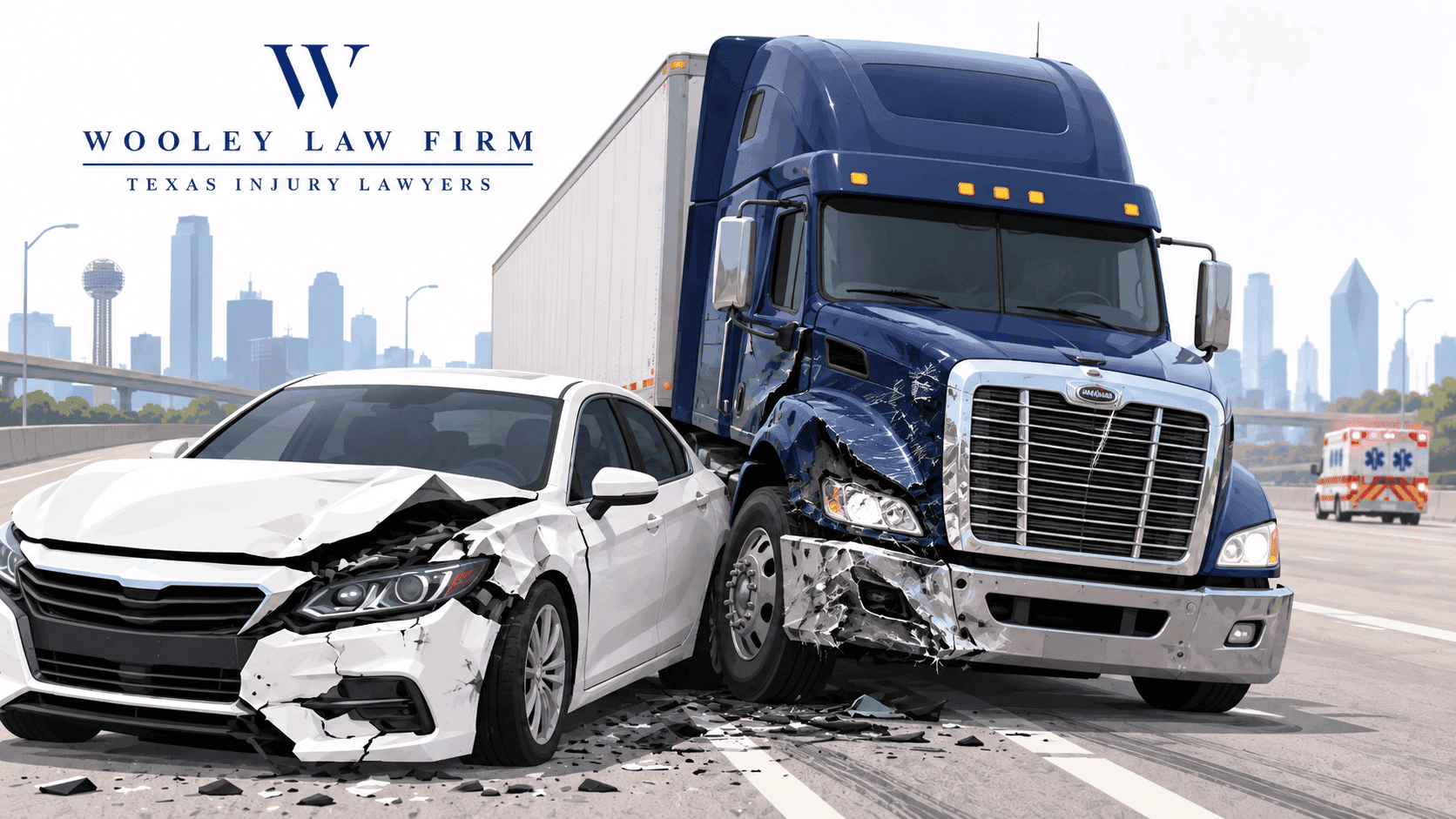
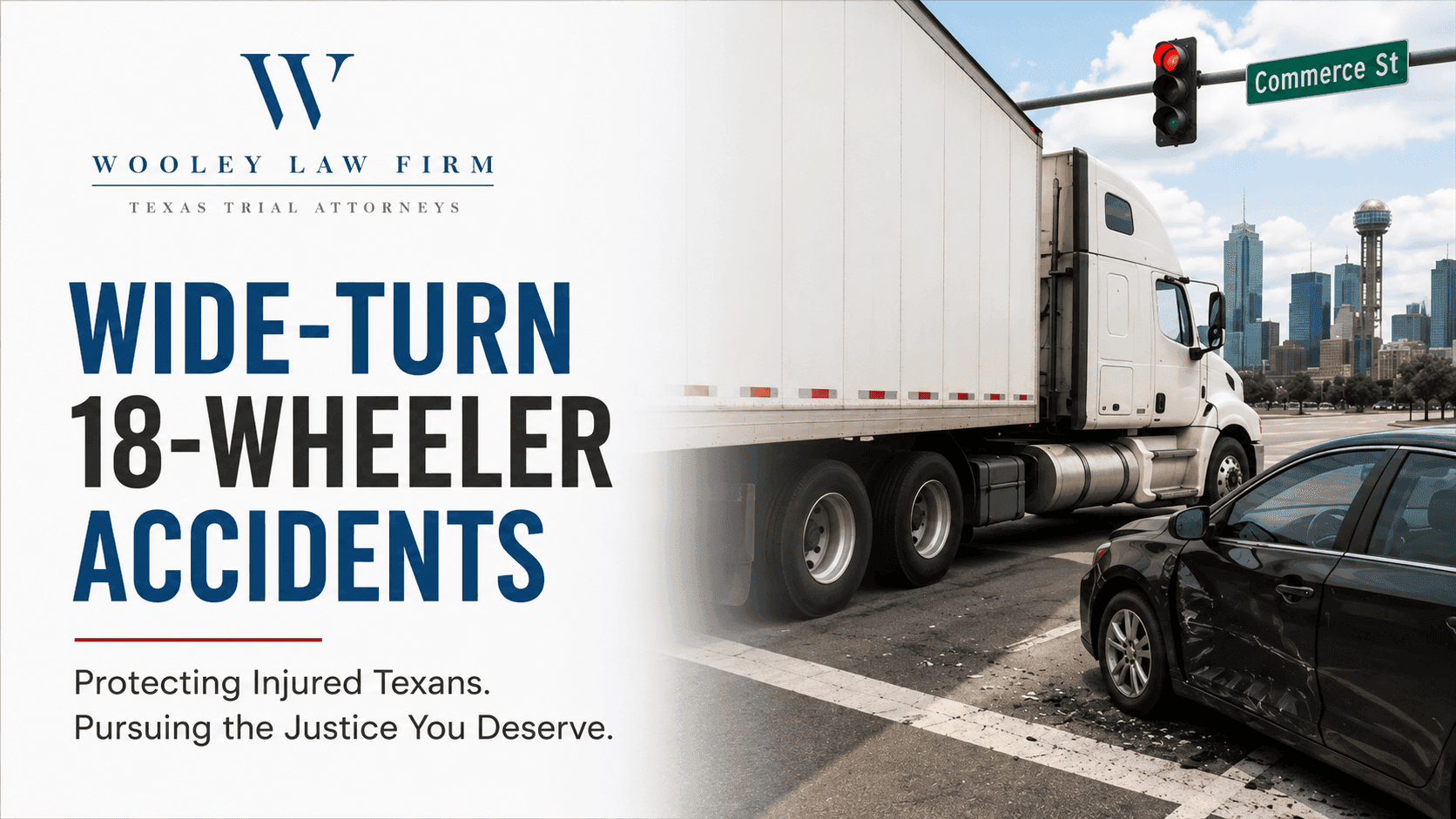
A wide-turn 18-wheeler accident can happen in seconds. One moment you are driving through a Dallas-Fort Worth intersection, service road, one-way street, commercial driveway, or warehouse area. The next moment, a tractor-trailer swings across your lane, the trailer tracks into your vehicle, or the truck driver turns from the wrong position and crushes the side of your car.
These crashes are especially dangerous because tractor-trailers do not turn like passenger vehicles. When a truck driver misjudges a turn, fails to check mirrors, turns from the wrong lane, ignores route restrictions, blocks traffic, or forces a turn that cannot be made safely, the result can be catastrophic.
If you were injured in a wide-turn 18-wheeler accident in Dallas, Fort Worth, Arlington, Irving, Plano, Garland, Lewisville, Denton, McKinney, Frisco, Grand Prairie, Saginaw, Wise County, or anywhere in North Texas, the issue is not simply whether the truck driver “needed more room.” The real question is whether the driver and trucking company followed the safety rules, training requirements, route-planning rules, and turning procedures designed to prevent these wrecks.
The Wooley Law Firm helps injured Texans investigate serious truck wrecks, preserve evidence, and hold negligent truck drivers and trucking companies accountable.
What Is a Wide-Turn 18-Wheeler Accident?
A wide-turn 18-wheeler accident happens when a commercial truck swings outside the normal path of travel while making a turn and collides with another vehicle, pedestrian, cyclist, train, or object.
Because a tractor-trailer is an articulated vehicle, the trailer does not follow the exact same path as the tractor. When the truck turns, the trailer’s rear wheels often track inside the tractor’s path. This is commonly called “off-tracking.” A trained commercial driver must account for off-tracking before and during a turn.
Common wide-turn truck accidents include:
An 18-wheeler making a right turn from the left lane and trapping a vehicle between the trailer and curb
A tractor-trailer making a left turn from the right lane and crossing into another vehicle’s lane
A truck swinging into an adjacent lane without making sure the lane is clear
A trailer striking the side of a passenger vehicle during a turn
A commercial vehicle attempting an unsafe U-turn
A truck entering or exiting a parking lot, gas station, warehouse, construction site, or driveway without enough clearance
A truck turning onto a road marked with “No Trucks” or other truck-route restrictions
A tractor-trailer blocking lanes, intersections, or railroad tracks while trying to complete a turn
A fully loaded tractor-trailer can weigh up to 80,000 pounds. When that much weight moves across a passenger vehicle, even at lower speeds, it can cause life-changing injuries or death.
Why Wide-Turn Truck Wrecks Are So Dangerous in DFW
Dallas-Fort Worth is one of the busiest commercial trucking regions in Texas. 18-wheelers travel through major highways, industrial corridors, warehouses, distribution centers, rail yards, construction zones, and crowded city streets every day.
Wide-turn accidents are especially dangerous because many local roads were not designed for constant tractor-trailer traffic. Truck drivers may be trying to navigate tight intersections, downtown streets, one-way roads, narrow lanes, construction zones, service roads, industrial areas, warehouse entrances, gas stations, residential streets, school zones, roads with “No Trucks” restrictions, and railroad crossings.
A safe commercial driver must plan the turn before entering it. That means choosing the proper lane, reducing speed, signaling early, checking mirrors, accounting for the trailer’s path, watching for vehicles beside the truck, and refusing to force a turn when it cannot be completed safely.
Texas News Stories Show How Dangerous Turning 18-Wheelers Can Be
Wide-turn and turn-path 18-wheeler wrecks are not theoretical. Texas news reports and court filings show how dangerous tractor-trailers can be when a driver attempts a left turn, turns from the wrong lane, blocks traffic, misjudges the trailer’s path, or creates an unavoidable conflict point.
In Laredo, Texas, the Laredo Morning Times reported that a Webb County jury awarded more than $20 million after a Marten Transport commercial truck driver made an improper left turn from the far-right lane at an industrial intersection. According to the report, the truck driver signaled right before turning left, and the injured driver had no opportunity to avoid the collision. Dashcam footage, eyewitness testimony, and the police report supported the injured driver’s claim that he was not speeding and could not avoid the crash. Laredo Morning Times — Webb County jury awards $20 million in Laredo crash involving Marten Transport truck.
In Houston, Texas, ABC13 reported a deadly crash involving a Honda Accord and an 18-wheeler on Highway 6. Investigators said the 18-wheeler was exiting a parking lot and making a left turn across the main lanes when the crash occurred. SkyEye footage showed the passenger car pinned under the 18-wheeler, and the Honda driver was pronounced dead at the scene. ABC13 — Houston police investigating deadly Highway 6 crash that left car pinned under 18-wheeler.
In Wise County near Paradise, the Wise County Messenger reported a serious crash involving an 18-wheeler and a pickup at North Farm Road 51 and Texas 114. According to the report, initial information indicated that the pickup was struck broadside by the semi-truck at an intersection described as notorious for accidents, and one person was flown to a Fort Worth hospital with serious injuries. Although the report does not specifically describe a wide turn, it is a North Texas example of how tractor-trailers can cause devastating intersection crashes when a commercial vehicle enters or crosses a traffic path. Wise County Messenger — 1 seriously injured after 18-wheeler, truck collide at FM 51 and SH 114.
In Saginaw, Texas, FOX 4 reported that a train collided with the trailer of an 18-wheeler at North Saginaw Boulevard and Hicks Field Road. No injuries were reported, but images showed cargo spilled across the tracks. While this was a train-truck collision rather than a passenger-vehicle wide-turn crash, it is a DFW example of how a tractor-trailer can create a serious hazard when the trailer is positioned across an intersection or crossing. FOX 4 — Train collides with 18-wheeler in Saginaw.
These examples matter because wide-turn truck cases often turn on the same evidence: lane position, turn path, signal use, mirror checks, dash camera footage, surveillance video, trailer off-tracking, blind spots, route choice, driver training, company supervision, and whether the turn could be completed safely.
Texas Turning Laws That Apply to 18-Wheeler Drivers
Texas law applies to commercial truck drivers just like it applies to other motorists. A CDL does not give a truck driver permission to turn from the wrong lane, cut across traffic, or force other drivers out of their lane.
Under Texas Transportation Code § 545.101, a driver making a right turn at an intersection must make both the approach and turn as closely as practicable to the right-hand curb or edge of the roadway. A driver turning left must approach in the extreme left-hand lane lawfully available and turn into a lane lawfully available for traffic moving in that direction. Texas Transportation Code § 545.101 — Turning at Intersection.
Under Texas Transportation Code § 545.103, a driver may not turn, enter a private road or driveway, move from a direct course, or move right or left on a roadway unless that movement can be made safely. Texas Transportation Code § 545.103 — Safely Turning.
Under Texas Transportation Code § 545.104, a driver intending to turn right or left must signal continuously for at least the last 100 feet before the turn. Texas Transportation Code § 545.104 — Signaling Turns; Use of Turn Signals.
These rules matter because trucking companies may argue that the driver “had no choice” but to swing wide. But a need for extra space does not erase the duty to turn safely, signal properly, use the correct lane, watch for traffic, and avoid moving into another vehicle’s lane when it is not safe.
Injured in an Accident?
Free consultation. Tell us what happened and learn what options may be available.
Federal Trucking Rules and Training Requirements for Safe Turns
Federal trucking regulations also matter in wide-turn accident cases. Under 49 C.F.R. Part 392, motor carriers, officers, agents, representatives, and employees involved in managing, maintaining, operating, driving, hiring, supervising, training, assigning, or dispatching commercial motor vehicle drivers must be instructed in and comply with federal rules governing the driving of commercial motor vehicles. 49 C.F.R. Part 392 — Driving of Commercial Motor Vehicles.
Federal Entry-Level Driver Training rules under 49 C.F.R. Part 380, Subpart F establish training requirements for covered entry-level drivers seeking a CDL, CDL upgrade, or certain endorsements. 49 C.F.R. Part 380, Subpart F — Entry-Level Driver Training Requirements.
For Class A CDL training, the federal curriculum requires instruction on basic combination-vehicle control, including executing sharp left and right turns, centering the vehicle, maneuvering in restricted areas, and entering and exiting interstate or controlled-access highways. 49 C.F.R. Part 380, Appendix A — Class A CDL Training Curriculum.
The behind-the-wheel public-road curriculum also requires driver-trainees to demonstrate proficiency in left and right turns, lane changes, curves, entering and exiting highways, controlled stopping, signaling intentions, visually searching for hazards, and managing speed and space. 49 C.F.R. Part 380, Appendix A — Behind-the-Wheel Public Road Training.
Federal training rules also require instruction on visual search, communication, and trip planning, including turn signals, four-way flashers, headlights, eye contact techniques, the safest route, vehicle size and weight limitations, restricted routes, and the limits of GPS or routing software. 49 C.F.R. Part 380, Appendix A — Trip Planning.
In plain English, a properly trained truck driver should know how to set up a turn, use the correct lane, signal early, check mirrors, watch for vehicles beside the tractor and trailer, account for trailer off-tracking, avoid squeezing cars between the trailer and curb, avoid swinging into occupied lanes, stop if the turn cannot be made safely, and plan routes that avoid roads too narrow or restricted for 18-wheelers.
When a truck driver fails to do these things, the issue may be more than simple driver error. It may be negligent training, negligent supervision, negligent hiring, unsafe dispatching, or a trucking company safety failure.
Common Causes of Unsafe Wide Turns
Wide-turn truck wrecks are usually preventable. Common causes include:
Turning From the Wrong Lane
A truck driver may attempt a right turn from the left lane or a left turn from the right lane. This can cause the trailer to sweep across a lane where a passenger vehicle has the right to continue forward.
Failing to Check Mirrors
A commercial driver must monitor mirrors before and during a turn. If the driver fails to watch the trailer’s path, a vehicle beside the truck may be sideswiped, trapped, or crushed.
Misjudging Trailer Off-Tracking
The trailer follows a tighter path than the tractor. An inexperienced, distracted, or careless driver may steer the tractor through a turn while the trailer cuts across another lane, curb, or vehicle.
Improper Signaling
If the driver signals late, signals the wrong direction, or fails to signal continuously, nearby drivers may have no warning before the truck crosses their lane.
Driving on Restricted or Unsafe Roads
Many DFW cities have truck routes, restricted streets, and “No Trucks” areas. A driver who ignores signs, blindly follows GPS, or takes a shortcut through a narrow road can create an unsafe turn situation.
Poor Training or Company Safety Practices
New or poorly trained drivers may not understand how much space an 18-wheeler needs. A trucking company may also fail to supervise unsafe drivers, discipline prior violations, assign safe routes, or enforce safety policies.
Why Trucking Companies May Be Responsible
A wide-turn crash may look like a split-second driver mistake, but many serious truck wrecks are caused by deeper company failures.
A trucking company may be responsible for negligent hiring, training, supervision, retention, entrustment, unsafe route planning, failure to enforce safety rules, failure to investigate prior complaints, failure to discipline unsafe driving, or pressuring drivers to meet unsafe delivery schedules.
A trucking company should not put an untrained or unsafe driver behind the wheel of an 80,000-pound commercial vehicle and then act surprised when that driver causes a serious crash.
Evidence That Should Be Preserved After a Wide-Turn 18-Wheeler Accident
Evidence can disappear quickly after a truck wreck. Surveillance video may be overwritten. The tractor or trailer may be repaired. Electronic data may be lost. Witnesses may become harder to find.
Important evidence may include:
Dash camera footage
Nearby business surveillance footage
Traffic camera footage
Police body camera footage
911 audio
Photos of the vehicles and roadway
Scene measurements
Skid marks, gouge marks, and debris fields
Tractor and trailer inspection records
ECM or event data recorder information
GPS and telematics data
Electronic logging device data
Dispatch records
Delivery documents
Driver qualification file
CDL and training records
Road test records
Company safety manuals
Prior crash history
Prior violations
Cell phone records
Route planning documents
Bills of lading
Maintenance records
Post-crash drug and alcohol testing records
In a serious Dallas-Fort Worth 18-wheeler wreck, a lawyer should send preservation letters quickly and investigate before the scene changes, video is deleted, and the trucking company controls the narrative.
Injuries Caused by Wide-Turn 18-Wheeler Accidents
Wide-turn truck crashes can cause severe injuries because the side of a passenger vehicle offers far less protection than the front or rear. Victims may suffer neck injuries, back injuries, herniated discs, spinal cord injuries, traumatic brain injuries, broken bones, internal bleeding, crush injuries, amputations, burns, psychological trauma, or wrongful death.
These injuries can lead to emergency medical care, surgery, physical therapy, injections, lost wages, loss of earning capacity, chronic pain, impairment, disfigurement, mental anguish, and a permanent change in quality of life.
What Compensation Can Be Recovered After a Wide-Turn Truck Wreck?
Every case is different, but injured victims may be able to pursue compensation for:
Past medical bills
Future medical treatment
Lost wages
Loss of earning capacity
Physical pain
Mental anguish
Physical impairment
Disfigurement
Property damage
Out-of-pocket expenses
Loss of household services
Wrongful death damages for surviving family members
Insurance companies often move quickly after a serious truck wreck. They may try to blame the injured driver, argue that the truck needed extra room, claim the passenger vehicle was in a blind spot, or suggest the crash was unavoidable. A thorough investigation can expose whether the truck driver actually followed the rules.
What to Do After a Wide-Turn 18-Wheeler Accident in Dallas-Fort Worth
After a wide-turn truck accident:
Call 911.
Get medical treatment immediately.
Take photos and video of the vehicles, intersection, road signs, skid marks, damage, and injuries.
Identify witnesses.
Do not give a recorded statement to the trucking company’s insurance carrier without legal advice.
Do not sign releases or settlement paperwork.
Preserve your damaged vehicle if possible.
Contact a Dallas-Fort Worth 18-wheeler wreck lawyer quickly so evidence can be preserved.
Talk to a Dallas-Fort Worth Wide-Turn 18-Wheeler Accident Lawyer
Wide-turn truck accidents are rarely simple. The trucking company may claim the driver had to swing wide, but that does not answer the real questions.
Was the turn legal? Was it safe? Was the truck in the proper lane? Did the driver signal? Did the driver check mirrors? Was the driver trained? Was the route appropriate? Did the trucking company follow federal safety rules? Did the company preserve the evidence?
The Wooley Law Firm represents injured crash victims and families in serious truck accident cases across Dallas-Fort Worth and throughout Texas. We investigate the driver, the trucking company, the route, the training, the vehicle, and the evidence needed to prove what happened.
If you were injured in a wide-turn 18-wheeler accident in Dallas, Fort Worth, Arlington, Irving, Plano, Garland, Lewisville, Denton, McKinney, Frisco, Grand Prairie, Saginaw, Wise County, or anywhere in North Texas, you may have the right to seek justice and pursue compensation for medical expenses, pain and suffering, lost wages, mental anguish, impairment, disfigurement, and other damages.
Contact The Wooley Law Firm today for a free consultation. You do not pay unless we win.
Frequently Asked Questions About Wide-Turn 18-Wheeler Accidents
What is a wide-turn 18-wheeler accident?
A wide-turn accident happens when a tractor-trailer swings outside its lane or turns across another lane while making a right turn, left turn, U-turn, driveway turn, or intersection maneuver.
Are truck drivers allowed to make wide turns in Texas?
Truck drivers may need extra room to turn, but they are still required to turn safely, signal properly, use the correct lane when required, and avoid moving into another lane unless it can be done safely.
What Texas laws apply to wide-turn truck crashes?
Important Texas laws may include Texas Transportation Code §§ 545.101, 545.103, and 545.104. These laws address turning at intersections, safe turning and lane movement, and required turn signals.
What federal regulations apply to truck driver training?
Federal Entry-Level Driver Training rules under 49 C.F.R. Part 380 require covered CDL drivers to complete training that includes basic vehicle control, left and right turns, lane changes, visual search, communication, speed and space management, and route planning.
Can the trucking company be responsible for a wide-turn crash?
Yes. The trucking company may be responsible for the driver’s negligence and may also be directly responsible for negligent hiring, training, supervision, retention, route planning, or failure to enforce safety policies.
What if the truck driver says I was in the blind spot?
Blind spots are a known danger in commercial trucking. A truck driver is trained to use mirrors, signals, speed control, lane positioning, and visual search techniques to avoid striking vehicles during turns. A blind spot does not automatically excuse a truck driver from responsibility.
What evidence is important in a wide-turn truck accident case?
Important evidence may include dash cam footage, surveillance video, photos, ECM data, GPS records, ELD records, driver qualification files, training records, dispatch records, inspection reports, route documents, and witness statements.
How soon should I contact a lawyer after a wide-turn 18-wheeler wreck?
You should contact a lawyer as soon as possible. Video can be overwritten, vehicles can be repaired, electronic data can be lost, and witnesses can become harder to locate.
Disclaimer
This article is for informational purposes only and is not legal advice. Reading this article does not create an attorney-client relationship. Every case is different, and you should speak with a qualified Texas personal injury lawyer about the specific facts of your case.
Topics
Share This Article

Andrew J. Wooley
Personal Injury Attorney
Andrew J. Wooley is a dedicated personal injury attorney based in Dallas, Texas. He focuses on helping accident victims recover fair compensation for their injuries. With a commitment to personalized service, Andrew works directly with each client to understand their unique situation and fight for their rights.