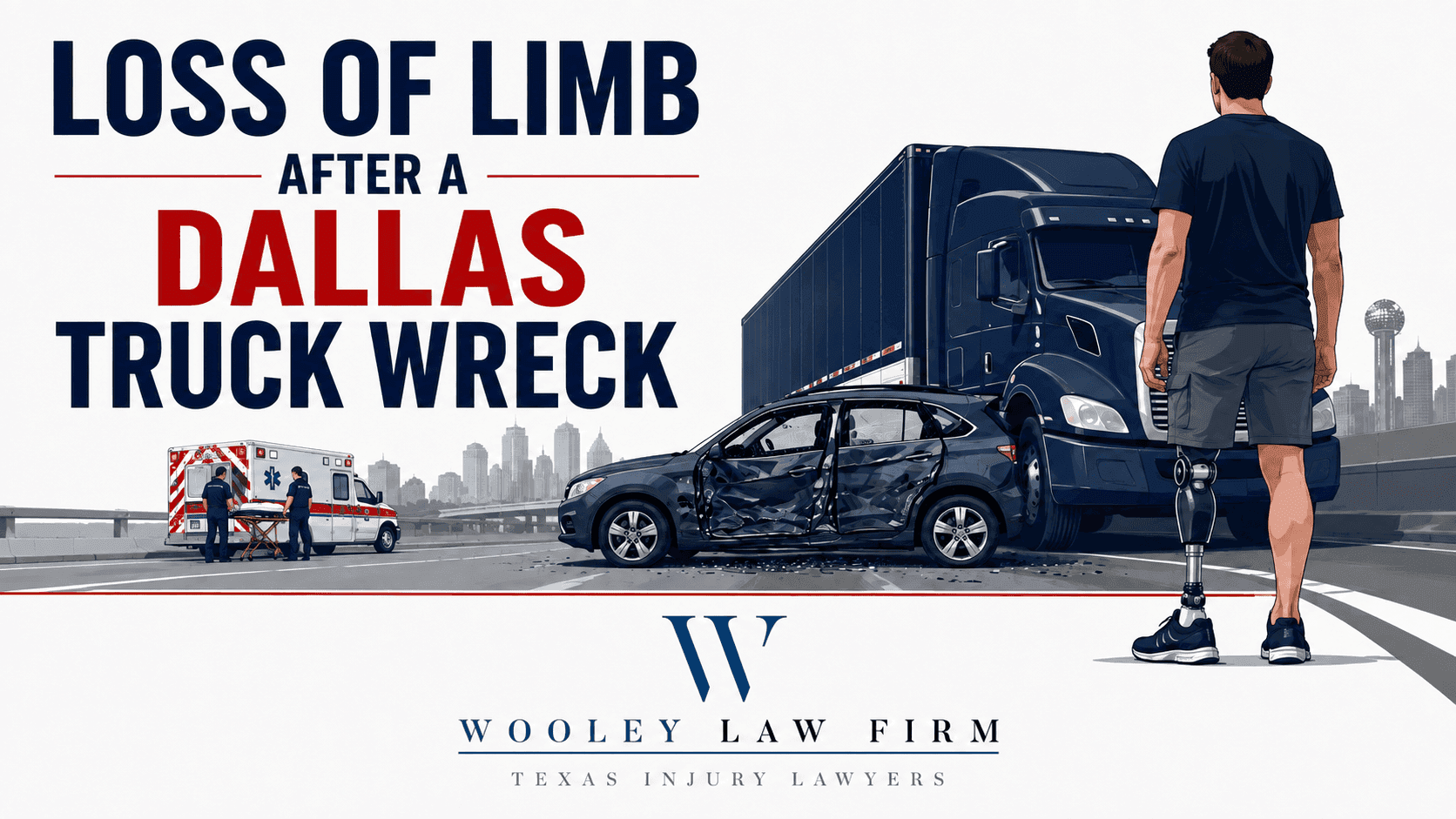
An 18-wheeler wreck can cause injuries so severe that doctors cannot save a victim’s arm, hand, leg, foot, finger, or toe. In other cases, a body part may be severed during the collision itself.
The loss of a limb is not simply a one-time medical event. An amputation can permanently affect a person’s mobility, independence, career, relationships, mental health, and ability to participate in everyday activities. The injured person may face multiple surgeries, rehabilitation, chronic pain, prosthetic replacements, home modifications, and substantial future medical expenses.
Traffic accidents are a recognized cause of traumatic limb loss. Amputation complications may include severe bleeding, shock, infection, phantom-limb pain, and difficulty adapting to a prosthesis.
If you or someone you love suffered an amputation or loss of a limb after an 18-wheeler, semi-truck, tractor-trailer, or commercial-vehicle wreck in Dallas-Fort Worth, your case may involve far more than the medical bills incurred immediately after the crash.
The Wooley Law Firm represents people seriously injured in wrecks involving:
18-wheelers and tractor-trailers
Semi-trucks
Flatbed trucks
Box trucks
Delivery trucks and vans
Dump trucks
Tanker trucks
Construction vehicles
Garbage and sanitation trucks
Buses and other commercial vehicles
Learn more about our representation of seriously injured truck-wreck victims on our Dallas 18-wheeler and truck accident lawyer page.
Call 214-699-6524 for a free consultation. You do not pay attorney’s fees unless we recover compensation for you.
What Is a Traumatic Amputation?
A traumatic amputation occurs when an accident severs or severely damages a body part.
The amputation may be:
Complete, meaning the body part is entirely separated
Partial, meaning some skin, muscle, blood vessels, nerves, or other tissue still connects the body part
Immediate, occurring during the wreck
Surgical, occurring later because doctors determine the limb cannot be saved
A limb may initially remain attached but sustain such severe damage that amputation becomes medically necessary.
Doctors may recommend surgical amputation when the injury causes:
Irreparable blood-vessel damage
Loss of blood flow
Extensive nerve destruction
Severe crushing of the bones and soft tissue
Uncontrollable bleeding
Dead or dying tissue
Serious infection
Compartment syndrome
Extensive burns
Repeated failed reconstruction procedures
Whether a partially amputated limb can be reattached depends on the location and severity of the injury, the condition of the tissue, the time before treatment, and other medical factors.
How 18-Wheeler Wrecks Cause Amputations
The size and weight of a commercial truck can expose occupants of smaller vehicles to extreme crushing, cutting, and shearing forces.
An amputation may occur when:
A tractor-trailer crushes the passenger compartment
A victim’s arm or leg becomes trapped in twisted metal
A trailer runs over a motorcyclist, bicyclist, or pedestrian
An occupant is ejected from the vehicle
A vehicle becomes trapped beneath an underride guard
A truck pins a vehicle against a barrier
A flatbed loses steel, lumber, machinery, or other cargo
A tanker or commercial vehicle catches fire
A jackknifed trailer sweeps across traffic lanes
A truck makes an unsafe wide turn and crushes a nearby vehicle
A rollover collapses the roof or side of a passenger vehicle
A tire, wheel, or truck component separates and strikes another vehicle
A victim suffers severe burns, infection, or vascular injuries after the crash
Truck collisions can also cause complex fractures and soft-tissue damage that initially appear treatable. After multiple surgeries, doctors may determine that the injured limb cannot be saved or that amputation offers the best chance of survival and future function.
Even a collision that appears to occur at a lower speed can cause serious injuries because of the truck’s size and weight. Read more about why a low-speed 18-wheeler wreck can still cause severe injuries.
Types of Amputations After a Truck Accident
The medical, functional, and financial consequences depend heavily on the body part lost and the level of the amputation.
Above-the-Knee Amputation
An above-the-knee amputation, also called a transfemoral amputation, removes the leg above the knee joint.
Because the victim loses the natural knee, walking with a prosthesis may require substantial strength, balance, coordination, and energy. Rehabilitation generally includes conditioning, balance work, strengthening, stretching, and learning to tolerate and use the prosthesis.
A person with an above-the-knee amputation may require:
A prosthetic knee and foot
Wheelchair use
Extensive gait training
Home modifications
An accessible vehicle
Replacement prostheses
Continued physical therapy
Assistance during portions of daily life
Below-the-Knee Amputation
A below-the-knee, or transtibial, amputation preserves the knee joint but removes part of the lower leg.
Preserving the knee may allow greater mobility than an above-the-knee amputation, but recovery can still involve chronic pain, skin breakdown, balance problems, falls, contractures, and difficulty using a prosthesis.
A victim may need several prosthetic fittings as swelling decreases and the residual limb changes shape.
Hip Disarticulation or Hemipelvectomy
Some catastrophic injuries require removal of the entire leg at the hip joint or removal of part of the pelvis.
These are extremely serious amputations that may substantially affect:
Sitting balance
Walking ability
Energy consumption
Transfers
Driving
Personal care
Employment
Independence
The victim may need a wheelchair for some or all mobility, even when a prosthesis is available.
Above-the-Elbow Amputation
An above-the-elbow amputation removes the arm above the elbow joint.
The loss of both the hand and natural elbow can make prosthetic control more complicated. Upper-limb prostheses may incorporate artificial hands, hooks, wrists, and elbow components, depending on the amputation level.
The injury may affect the ability to:
Dress
Bathe
Prepare food
Drive
Type
Write
Lift objects
Perform household work
Use tools
Return to a prior occupation
Below-the-Elbow Amputation
A below-the-elbow amputation preserves the elbow but removes the forearm, hand, or both.
Although retaining the elbow may improve function, losing a hand can still profoundly affect grip, fine-motor control, coordination, and the ability to perform two-handed activities.
Hand, Finger, Foot, or Toe Amputations
An injury does not have to involve the entire arm or leg to be life-changing.
Finger and hand amputations may affect:
Grip strength
Dexterity
Typing
Writing
Tool use
Personal care
Employment
Fingertips contain many nerves, and an amputation can result in sensitivity, functional problems, permanent deformity, or disability.
Foot and toe amputations may affect:
Balance
Gait
Standing tolerance
Climbing stairs
Running
Driving
Footwear
Employment involving prolonged standing
Immediate Medical Dangers After a Traumatic Amputation
A traumatic amputation is a medical emergency.
Immediate risks include:
Severe blood loss
Hemorrhagic shock
Damage to major arteries and veins
Infection
Contamination
Associated fractures
Crush injuries
Internal-organ damage
Nerve injuries
Burns
Tissue death
Early emergency and critical care can significantly affect the long-term outcome.
Treatment may involve:
Bleeding control
Blood transfusions
Emergency surgery
Cleaning and removal of contaminated tissue
Blood-vessel repair
Bone stabilization
Nerve repair
Antibiotics
Skin grafts
Reconstructive surgery
Revision of the residual limb
Pain management
Intensive-care monitoring
A victim may undergo multiple surgeries before doctors know the final level of amputation or whether additional tissue must be removed.
What Is a Residual Limb?
The portion of the arm or leg that remains after an amputation is commonly called the residual limb.
The residual limb must heal sufficiently before many patients can use a permanent prosthesis. Its shape, skin condition, strength, sensitivity, and range of motion can all affect prosthetic use.
Potential residual-limb complications include:
Wound-healing problems
Infection
Skin irritation
Pressure sores
Swelling
Scar sensitivity
Nerve pain
Neuromas
Bone overgrowth
Joint stiffness
Muscle weakness
Poor prosthetic fit
Residual-limb pain can substantially limit function and interfere with rehabilitation.
Phantom-Limb Sensations and Phantom-Limb Pain
After an amputation, a person may still feel as though the missing limb is present. This is known as a phantom sensation.
The person may feel that the missing limb is:
Tingling
Numb
Hot or cold
Itching
Moving
Bent into an unusual position
Becoming shorter
Still attached
When those sensations are painful, the condition is called phantom-limb pain. A victim may experience burning, stabbing, squeezing, cramping, shooting, or electrical pain in the missing body part.
Phantom-limb pain is real. It is not imagined merely because the affected body part is no longer present. NIH research continues to study how the brain maintains a representation of the missing limb after amputation.
Treatment may include:
Medication
Physical therapy
Desensitization
Mirror therapy
Nerve treatment
Psychological support
Prosthetic adjustments
Targeted muscle reinnervation
Other pain-management procedures
The appropriate treatment depends on the individual patient and should be determined by qualified medical providers.
Rehabilitation After Loss of a Limb
Rehabilitation may begin shortly after the victim becomes medically stable and may continue for months or years.
Rehabilitation is intended to help a person recover strength, relearn skills, and maximize independence after a serious injury or surgery.
A rehabilitation program may include:
Physical therapy
Occupational therapy
Strength training
Balance training
Range-of-motion exercises
Transfer training
Wheelchair training
Gait training
Residual-limb care
Prosthetic training
Pain management
Psychological counseling
Vocational rehabilitation
Driver rehabilitation
Home-safety training
Physical Therapy
Physical therapy may help the patient:
Maintain joint movement
Prevent contractures
Improve strength
Improve balance
Build endurance
Learn safe transfers
Walk with a prosthesis
Reduce fall risks
Occupational Therapy
Occupational therapy may help the patient adapt to daily tasks such as:
Dressing
Bathing
Grooming
Eating
Cooking
Writing
Using a phone or computer
Driving
Returning to work
Injured in an Accident?
Free consultation. Tell us what happened and learn what options may be available.
Psychological Support
Loss of a limb may cause grief, anger, depression, anxiety, post-traumatic stress, body-image concerns, and fear about the future.
Counseling may be an important part of recovery. The emotional consequences of an amputation should not be dismissed simply because the physical injury is visible.
Prosthetic Limbs After a Truck Wreck
A prosthesis is an artificial device intended to replace part or all of a missing limb.
Depending on the injury, a victim may use:
A prosthetic foot
A below-the-knee prosthesis
A computerized knee
A full-leg prosthesis
A passive cosmetic hand
A body-powered arm or hand
A myoelectric prosthesis
A prosthetic finger
A specialized activity or sports prosthesis
Prostheses can help some individuals walk, eat, dress, work, or perform other daily activities. Learning to use one takes time and may require physical or occupational therapy.
A prosthesis is not necessarily a permanent, one-time purchase. Future needs may include:
Initial fitting
Temporary prostheses
Permanent prostheses
Replacement sockets
Liners and sleeves
Batteries and chargers
Repairs
Adjustments
Replacement components
Specialized work or activity devices
Entire replacement prostheses
Changes in body weight, skin condition, residual-limb shape, activity level, technology, and wear may require future replacements or modifications.
A proper injury claim should consider the expected lifetime cost of prosthetic care—not merely the price of the first device.
Can Everyone Use a Prosthesis?
Not every person with an amputation can comfortably or effectively use a prosthesis.
Prosthetic use may be affected by:
The amputation level
Residual-limb condition
Pain
Skin breakdown
Strength
Balance
Other injuries
Cardiovascular health
Weight
Nerve damage
Vision problems
Cognitive injuries
The physical demands of walking
The person’s work and daily activities
Some victims may alternate between a prosthesis and wheelchair. Others may primarily use a wheelchair because prosthetic use is painful, exhausting, unsafe, or impractical.
The fact that a victim receives a prosthetic limb does not mean that life returns to normal.
Long-Term Complications After an Amputation
Amputation-related complications may continue long after the initial surgical wound heals.
Potential long-term problems include:
Phantom-limb pain
Residual-limb pain
Neuromas
Skin irritation
Pressure sores
Infection
Joint contractures
Arthritis
Back pain
Hip pain
Shoulder pain from crutch or wheelchair use
Falls
Reduced endurance
Changes in gait
Overuse injuries to the remaining limb
Prosthetic-fit problems
Sleep disruption
Depression
Anxiety
Post-traumatic stress
A person with lower-limb loss may place increased stress on the remaining leg, hips, back, and upper body.
A person with upper-limb loss may overuse the remaining arm and shoulder. One-handed lifting, typing, driving, and household activities may contribute to pain or repetitive-stress injuries.
How an Amputation Changes Daily Life
The loss of an arm or leg can affect nearly every part of a person’s life.
An injured person may have difficulty:
Getting out of bed
Walking
Climbing stairs
Driving
Bathing
Dressing
Cooking
Shopping
Cleaning
Caring for children
Exercising
Working
Traveling
Participating in hobbies
Maintaining personal relationships
Activities that once required little thought may take much longer or require assistance.
The victim may also need:
Accessible housing
Bathroom modifications
Ramps
Wider doorways
Hand controls for a vehicle
An accessible van
Wheelchair-accessible transportation
Adaptive tools
Household assistance
Personal attendant care
A serious amputation claim should document these real-world consequences rather than focusing exclusively on hospital bills.
The Effect on Employment and Earning Capacity
An amputation may prevent a victim from returning to the same occupation.
The impact can be especially severe for people whose work requires:
Standing
Walking
Climbing
Lifting
Carrying
Driving
Operating machinery
Using hand tools
Typing
Fine-motor coordination
Emergency response
Construction labor
Warehouse work
Commercial driving
Even when a person returns to work, the injury may cause:
Reduced hours
Lower productivity
Fewer overtime opportunities
A move to lighter-duty work
A lower-paying occupation
Loss of promotions
Early retirement
Periodic absences for treatment
Increased risk of future unemployment
The claim may include both past lost wages and future loss of earning capacity.
Loss of earning capacity concerns the reduction in the person’s ability to earn income over time. For a younger victim, that loss may extend across decades.
Future Medical and Life-Care Expenses
The cost of an amputation may continue throughout the victim’s lifetime.
Future needs may include:
Revision surgeries
Prosthetic replacement
Prosthetic repairs
Liners and sockets
Physical therapy
Occupational therapy
Pain management
Medication
Psychological counseling
Treatment for skin problems
Treatment for neuromas
Treatment for overuse injuries
Wheelchairs
Crutches or walkers
Accessible transportation
Home modifications
Attendant care
Vocational rehabilitation
Medical monitoring
A life-care planner may evaluate the care, equipment, services, and prosthetic replacements the victim is likely to need.
An economist may then calculate the long-term financial cost of those needs and the victim’s reduced earning capacity.
Compensation After a Truck Wreck Amputation
Depending on the facts and available evidence, a victim may be able to pursue compensation for:
Past medical expenses
Future medical expenses
Emergency surgery
Rehabilitation
Prostheses and replacement prostheses
Wheelchairs and mobility equipment
Lost wages
Loss of earning capacity
Physical pain and suffering
Phantom-limb pain
Mental anguish
Physical impairment
Disfigurement
Loss of enjoyment of life
Home modifications
Vehicle modifications
Attendant care
Out-of-pocket expenses
Property damage
Texas injury claims may include economic losses, such as medical expenses and reduced earnings, and noneconomic losses, such as pain, mental anguish, impairment, and disfigurement.
Read more about the potential categories of compensation in our guide to truck accident damages after a Dallas 18-wheeler wreck.
Physical Impairment and Disfigurement After Limb Loss
Amputation cases often involve significant claims for both physical impairment and disfigurement.
Physical Impairment
Physical impairment concerns the loss of the ability to participate in activities that were part of the victim’s life.
Examples may include the inability to:
Walk independently
Run or exercise
Play with children
Drive normally
Perform household work
Participate in sports
Travel without assistance
Return to a former occupation
Care for oneself independently
Disfigurement
Disfigurement may include:
Loss of the limb itself
Surgical scars
Skin grafts
Changes to the residual limb
Burns
Visible hardware
Changes in gait or posture
These losses are not automatically captured by medical bills. They require evidence showing how the injury changed the victim’s appearance, confidence, relationships, and daily life.
Who May Be Responsible for a Truck Wreck Causing an Amputation?
Serious truck-wreck cases may involve multiple responsible parties.
The Truck Driver
A commercial driver may cause a catastrophic collision by:
Speeding
Following too closely
Driving while fatigued
Texting or using a cellphone
Making an unsafe lane change
Failing to check blind spots
Running a red light
Driving while impaired
Making an unsafe wide turn
Failing to maintain a proper lookout
Driving too fast for traffic or weather conditions
Violating hours-of-service requirements
The Trucking Company
A motor carrier may be responsible for the conduct of its driver and for its own unsafe practices.
Company negligence may include:
Hiring an unqualified driver
Failing to properly train the driver
Inadequate supervision
Retaining a dangerous driver
Pressuring drivers to meet unsafe schedules
Failing to inspect or maintain the truck
Ignoring prior safety violations
Failing to enforce fatigue policies
Inadequate drug and alcohol testing
Unsafe dispatch or routing practices
Truck accident cases differ from ordinary car claims because commercial carriers may possess important electronic records, safety files, driver records, maintenance documents, and internal investigation materials.
The Cargo Loader or Shipper
Improperly loaded or unsecured cargo may fall from a trailer, shift the truck’s center of gravity, or contribute to a rollover or jackknife.
Flatbed loads involving steel, pipe, lumber, machinery, and construction materials can cause devastating crushing and amputation injuries.
A Maintenance Company
A repair or maintenance contractor may share responsibility when negligent work contributes to:
Brake failure
Tire separation
Steering problems
Trailer separation
Wheel detachment
Lighting failures
Mechanical breakdowns
A Truck or Parts Manufacturer
A defective truck component may contribute to the collision or increase the severity of an injury.
Potential defects may involve:
Brakes
Tires
Steering systems
Coupling devices
Underride guards
Door latches
Fuel systems
Safety equipment
Evidence That Should Be Preserved
The trucking company and its insurer may begin investigating immediately.
Important evidence may include:
Engine control module data
Electronic logging-device records
GPS and telematics data
Dash-camera footage
Driver-facing camera footage
Dispatch records
Cellphone records
Driver qualification files
Training materials
Hours-of-service logs
Drug and alcohol testing records
Maintenance records
Inspection reports
Cargo-loading records
Bills of lading
Weight tickets
Trucking-company policies
Post-crash investigation materials
Photographs and videos
Surveillance footage
Witness statements
Police body-camera footage
911 recordings
Physical vehicle evidence
Electronic information may be overwritten or lost unless prompt steps are taken to preserve it. The Wooley Law Firm’s truck-accident resources emphasize the importance of beginning the investigation before important evidence disappears.
Medical Evidence Needed in an Amputation Claim
A catastrophic injury claim may require more than the initial operative report.
Relevant medical evidence may include:
Ambulance records
Emergency-room records
Surgical reports
Trauma records
Imaging
Rehabilitation records
Prosthetic evaluations
Physical-therapy records
Occupational-therapy records
Pain-management records
Psychological-treatment records
Future-surgery recommendations
Prosthetic-replacement estimates
Functional-capacity evaluations
Life-care plans
Photographs may also document:
The initial injury
Surgeries
Wound healing
Skin grafts
Scarring
Prosthetic complications
The residual limb
Changes in mobility and function
The claim should explain both the medical injury and its continuing effect on the victim’s life.
How Insurance Companies Defend Amputation Claims
Even when an injury is visibly catastrophic, a trucking company’s insurer may still dispute the amount of compensation owed.
The insurer may attempt to:
Blame the injured person
Dispute how the collision occurred
Challenge the trucking company’s responsibility
Argue that the driver was an independent contractor
Minimize future medical needs
Underestimate prosthetic-replacement costs
Dispute the need for attendant care
Claim the victim can return to work
Minimize phantom-limb pain
Challenge psychological treatment
Downplay physical impairment
Offer a settlement before the long-term prognosis is known
A settlement should not be based solely on the first prosthesis or the bills incurred during the initial hospitalization.
Once a release is signed, the injured person generally cannot return for more money because a prosthesis wears out, the residual limb develops complications, or additional surgery becomes necessary.
What to Do After an Amputation Caused by a Truck Wreck
Focus on Emergency Medical Care
Follow the recommendations of trauma surgeons, orthopedic surgeons, rehabilitation physicians, therapists, and prosthetic specialists.
Report All Symptoms
Tell your medical providers about:
Residual-limb pain
Phantom-limb pain
Skin problems
Sleep difficulties
Depression or anxiety
Prosthetic discomfort
Balance problems
Falls
Pain in the remaining limbs
Difficulty performing daily activities
Preserve Records and Expenses
Keep copies of:
Medical bills
Prosthetic estimates
Therapy records
Prescription receipts
Travel expenses
Home-modification estimates
Vehicle-modification estimates
Employment records
Insurance communications
Document Daily Limitations
A journal may help record:
Pain
Prosthetic problems
Therapy
Missed work
Activities requiring assistance
Sleep disruption
Emotional struggles
Household limitations
Missed family activities
Avoid a Quick Settlement
Do not evaluate the claim before the prognosis, prosthetic needs, future care, and employment consequences are understood.
Contact a Truck Wreck Lawyer Promptly
Early legal involvement can help preserve truck data, identify responsible parties, investigate insurance coverage, and document the full impact of the injury.
How The Wooley Law Firm Handles Amputation Claims
An amputation case requires more than sending medical bills to an adjuster.
Depending on the facts, The Wooley Law Firm may:
Investigate the crash
Obtain the police report
Send evidence-preservation demands
Secure electronic truck data
Identify the truck driver and motor carrier
Investigate cargo-loading companies
Review driver qualification records
Examine hours-of-service information
Obtain maintenance and inspection records
Locate witnesses and video footage
Review medical and rehabilitation records
Document prosthetic needs
Calculate lost wages
Evaluate future loss of earning capacity
Work with qualified medical professionals
Consult prosthetic and rehabilitation experts
Retain a life-care planner when appropriate
Investigate available insurance coverage
File suit when necessary
Prepare the case for trial
The objective is to prove why the crash happened, identify every responsible party, and demonstrate how the amputation will affect the victim for the remainder of their life.
Dallas-Fort Worth Amputation Lawyer After an 18-Wheeler Wreck
The Wooley Law Firm represents seriously injured people throughout:
Dallas
Fort Worth
Arlington
Irving
Garland
Mesquite
Richardson
Plano
Frisco
McKinney
Allen
Denton
Lewisville
Carrollton
Grand Prairie
Grapevine
Mansfield
Keller
Southlake
North Texas
We also handle serious commercial-truck injury cases throughout Texas.
If you or a loved one suffered an amputation or loss of a limb after an 18-wheeler wreck, call 214-699-6524.
You can also learn more by visiting our Dallas truck accident lawyer page.
Your consultation is free and confidential. You do not pay attorney’s fees unless we obtain a recovery for you.
Frequently Asked Questions About Amputations After Truck Wrecks
Can an 18-wheeler wreck cause an amputation even when the limb is not severed at the scene?
Yes. A limb may suffer severe crush injuries, loss of circulation, infection, burns, nerve destruction, or tissue death. Doctors may later determine that surgical amputation is necessary.
What is the difference between a traumatic amputation and a surgical amputation?
A traumatic amputation occurs during the collision itself. A surgical amputation is performed by doctors when a damaged limb cannot be saved or when removal is medically necessary.
What is phantom-limb pain?
Phantom-limb pain is pain that appears to come from the missing body part. It may feel like burning, stabbing, tingling, squeezing, cramping, or electric shocks.
Is phantom-limb pain real?
Yes. Phantom-limb pain is a recognized medical condition. Although the limb is no longer physically present, the nervous system and brain may continue producing sensations associated with it.
Will a prosthetic limb restore normal function?
A prosthesis may improve function, but it does not necessarily restore the person to their pre-wreck condition. The outcome depends on the amputation level, other injuries, pain, strength, balance, prosthetic fit, and the person’s activities.
How often does a prosthesis need to be replaced?
Replacement timing varies based on the device, wear, activity level, residual-limb changes, body weight, and technological needs. A serious claim may need to account for multiple replacements over the person’s lifetime.
Can I recover the future cost of prosthetic limbs?
Future prosthetic expenses may be part of a claim when supported by medical, prosthetic, and economic evidence.
Can I recover compensation if I cannot return to my former job?
A victim may be able to pursue lost wages and loss of earning capacity when the amputation limits or eliminates the ability to work in the same position or occupation.
Can I recover compensation for scarring and the loss of the limb itself?
A Texas injury claim may include damages for physical impairment, pain, mental anguish, and disfigurement, depending on the evidence and circumstances.
Can family caregiving be included in the claim?
Necessary attendant care and assistance may be relevant even when family members initially provide that care without payment. The damages available depend on the evidence and applicable Texas law.
What if the insurance company offers to pay all current medical bills?
Current medical bills may represent only a small portion of the total loss. A serious amputation claim may also involve future surgeries, prosthetic replacements, rehabilitation, attendant care, lost earning capacity, impairment, pain, and disfigurement.
How long do I have to file an amputation claim in Texas?
Texas law imposes deadlines on personal-injury claims. Different or shorter notice requirements may apply when a government truck or public entity is involved.
Important truck data and video may disappear well before the filing deadline, so the investigation should begin promptly.
How much does it cost to hire The Wooley Law Firm?
The Wooley Law Firm handles personal-injury cases on a contingency-fee basis. You pay no upfront attorney’s fee and owe no attorney’s fee unless the firm obtains a recovery for you.
Speak With a Dallas-Fort Worth Truck Wreck Lawyer
Losing an arm, hand, leg, foot, finger, or toe can permanently change a person’s future.
The victim may be facing repeated surgeries, chronic pain, rehabilitation, prosthetic replacements, employment limitations, and a lifetime of medical and personal challenges. Meanwhile, the trucking company and its insurer may already be collecting evidence and building a defense.
You deserve someone protecting your interests.
Call The Wooley Law Firm at 214-699-6524 for a free consultation about an amputation caused by a Dallas-Fort Worth truck wreck.
You do not pay attorney’s fees unless we win.
Disclaimer:
This article is provided for general informational purposes only and does not constitute medical or legal advice. Seek immediate medical attention for any traumatic amputation, crush injury, severe bleeding, or other emergency condition. Reading this article or contacting The Wooley Law Firm does not create an attorney-client relationship. Every case is different, and past results do not guarantee a similar outcome. Legal deadlines may apply, so you should consult a qualified Texas attorney regarding your specific circumstances.
Topics
Share This Article

Andrew J. Wooley
Personal Injury Attorney
Andrew J. Wooley is a dedicated personal injury attorney based in Dallas, Texas. He focuses on helping accident victims recover fair compensation for their injuries. With a commitment to personalized service, Andrew works directly with each client to understand their unique situation and fight for their rights.