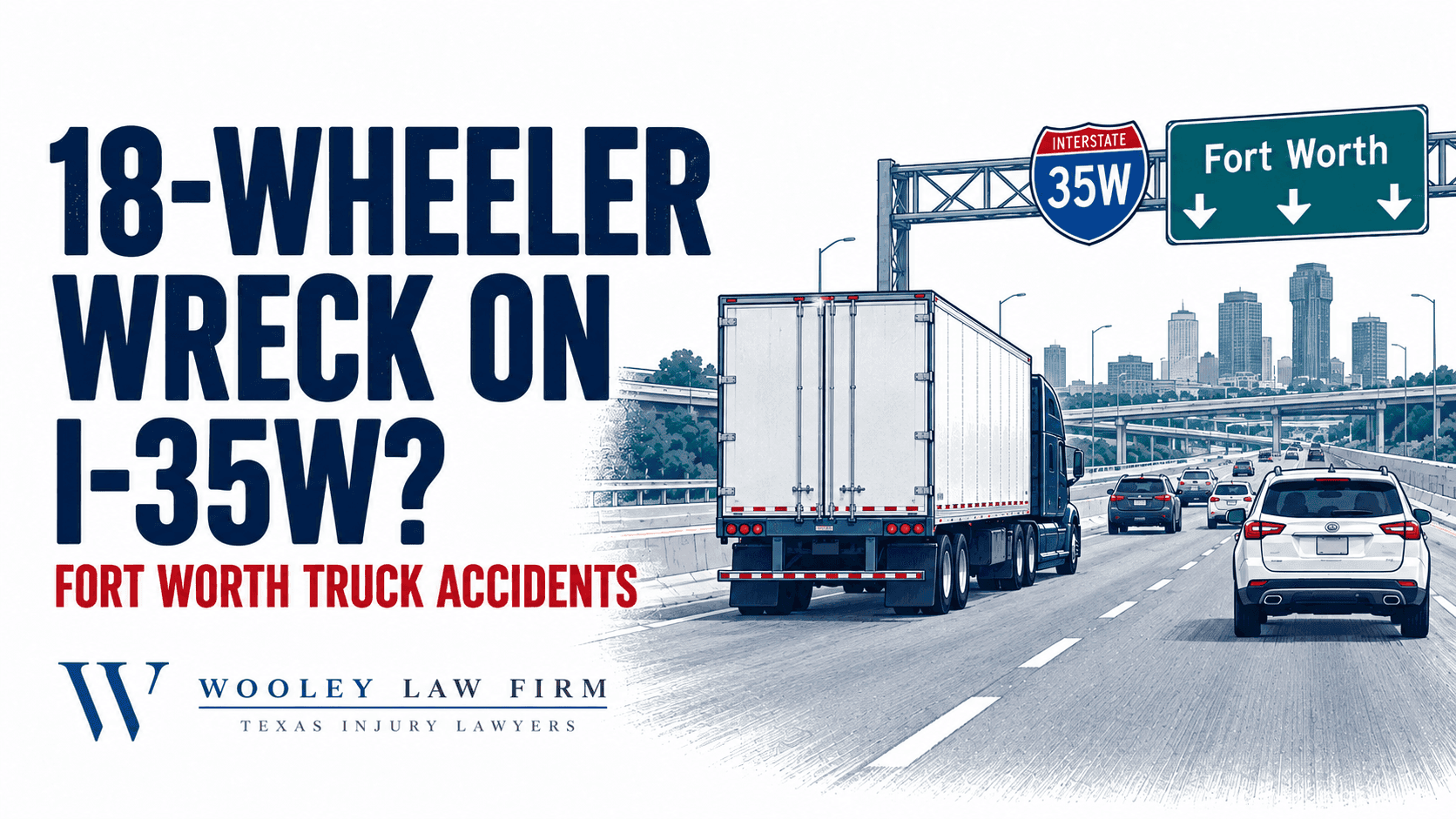
An 18-wheeler wreck on I-35W in Fort Worth is rarely just an ordinary car accident involving a larger vehicle.
A serious tractor-trailer collision can require an investigation into the truck driver, trucking company, tractor owner, trailer owner, maintenance history, driver logs, onboard cameras, electronic truck data, dispatch records, cargo information, and potentially several layers of commercial insurance.
I-35W is one of the most important truck and commuter corridors in North Texas. According to the Texas Department of Transportation, I-35W runs through Fort Worth, Haslet, and Burleson and serves as a major national trade corridor. TxDOT reports that the highway carries more than 165,000 vehicles per day near downtown Fort Worth, with trucks accounting for approximately 11% of daily traffic along the corridor.
That mixture of tractor-trailers, commuters, construction traffic, delivery vehicles, buses, and passenger cars can create dangerous situations when traffic suddenly slows near major interchanges, exits, entrance ramps, construction areas, or recurring congestion.
If you were seriously injured in a commercial-truck collision, our Fort Worth 18-wheeler accident lawyer page explains how The Wooley Law Firm investigates serious truck wrecks in Fort Worth and throughout North Texas. Fort Worth 18-wheeler accident lawyer
Why I-35W Is an Important Truck Corridor Through Fort Worth
I-35W is a major north-south route through Tarrant County.
Drivers traveling through Fort Worth may encounter heavy truck traffic around:
I-20
downtown Fort Worth
I-30
Rosedale Street
I-820
US-81/US-287
Western Center Boulevard
North Tarrant Parkway
Golden Triangle Boulevard
Alliance Boulevard
Eagle Parkway
South of Fort Worth, I-35W continues toward Everman, Burleson, and Johnson County.
TxDOT traffic-count data illustrates just how heavily traveled this corridor can be. Its 2020 counts showed approximately 168,654 vehicles per day near Hattie Street, 164,620 near Felix Street, and 148,767 just north of I-820.
High traffic volume alone does not establish why a particular collision happened. But it helps explain why I-35W truck drivers regularly encounter merging traffic, sudden slowdowns, closely spaced vehicles, and complicated interchange movements.
An I-35W Truck Wreck Requires a Different Investigation
A passenger-car collision may involve a relatively limited group of evidence.
A commercial truck collision can involve an entire corporate and electronic record.
After a serious I-35W 18-wheeler wreck, questions may include:
Who employed or controlled the driver?
Which company was operating under motor-carrier authority?
Who owned the tractor?
Who owned the trailer?
Was either vehicle leased?
Who inspected and maintained the tractor?
Who maintained the trailer?
Who dispatched the driver?
What cargo was being transported?
Who loaded the trailer?
What camera systems were installed?
What electronic data exists?
Was the driver fatigued or distracted?
Were there mechanical problems?
What insurance policies potentially apply?
The trucking company's name printed on the tractor does not necessarily tell you who owned every piece of equipment or which companies may have relevant evidence.
Our article about suing the trucking company after a Dallas-Fort Worth 18-wheeler wreck explains why the corporate relationship behind a commercial truck may matter. Can I sue the trucking company after an 18-wheeler wreck?
Rear-End 18-Wheeler Wrecks in I-35W Traffic
One dangerous I-35W collision scenario occurs when traffic ahead slows or stops but an approaching tractor-trailer does not reduce its speed soon enough.
An 18-wheeler may encounter stopped traffic because of:
rush-hour congestion;
an earlier collision;
construction;
lane closures;
merging traffic;
an emergency vehicle;
congestion near I-30, I-20, or I-820;
backups near entrance and exit ramps; or
vehicles slowing for a complicated interchange.
The investigation should determine when the slowdown became visible and what the truck driver did in response.
Relevant questions may include:
How fast was the truck traveling?
What following distance existed?
When did brake lights ahead become visible?
When did the driver release the accelerator?
When were the brakes applied?
Was the driver looking at the roadway?
Did a forward-collision warning activate?
Did automatic emergency braking engage?
Were the tractor and trailer brakes working properly?
Our detailed guide about being rear-ended by an 18-wheeler discusses the electronic, video, braking, maintenance, and driver evidence that may become important after this type of collision. Rear-ended by an 18-wheeler
“Traffic Stopped Suddenly” Should Be Tested Against the Evidence
After a rear-end truck wreck, a driver or trucking company may claim that traffic stopped so quickly that the collision could not have been avoided.
That explanation should be tested against objective evidence.
Highway congestion can develop quickly on I-35W, but the investigation should still determine what the driver could see, how closely the truck was following, how fast it was traveling, and when braking began.
Forward-facing camera footage may show brake lights or stopped traffic well before impact.
Electronic data may show that the truck maintained highway speed until shortly before the wreck.
GPS and telematics records may establish the truck's movement.
Witnesses may have seen the tractor-trailer approaching without slowing.
Collision-warning technology may indicate when the truck electronically detected traffic ahead.
The goal is to compare the driver's account with the physical and electronic evidence.
The Truck's Electronic Data May Show What Happened Before the Wreck
People commonly refer to commercial-truck electronic evidence as the truck's “black box,” but potentially relevant data may exist in several different systems.
Depending on the tractor and technology installed, evidence may include:
engine-control-module data;
event information;
vehicle speed;
engine RPM;
throttle position;
brake application;
hard-braking events;
GPS information;
telematics;
electronic logging-device records;
collision-warning events;
lane-departure alerts;
automatic emergency braking information;
fault codes; and
camera-triggered safety events.
This information can become extremely important when the driver's description of the collision is disputed.
Automatic Emergency Braking May Be Important in an I-35W Rear-End Wreck
Many newer commercial trucks have collision-avoidance technology designed to identify hazards ahead.
Depending on the system, investigators may be able to determine whether the truck detected slowing traffic, issued a forward-collision warning, or automatically applied the brakes.
If a driver claims there was no time to react, electronic records showing that the truck detected traffic earlier may require further investigation.
Our article about automatic emergency braking data after a truck wreck explains how this technology may help establish what the truck detected before impact. Automatic emergency braking data in a truck wreck
Injured in an Accident?
Free consultation. Tell us what happened and learn what options may be available.
What If the Truck Driver Says the Brakes Failed?
A claim that “the brakes failed” does not necessarily end the investigation.
It may expand it.
Commercial tractors and trailers contain braking components that require inspection and maintenance. The tractor and trailer may also have different owners and different maintenance histories.
Important questions can include:
When were the brakes last inspected?
Were defects previously reported?
Were repairs recommended?
Were those repairs actually performed?
Who performed the maintenance?
Were tractor and trailer brakes properly adjusted?
Were there prior brake-related violations?
Did the driver identify a problem during a pre-trip inspection?
What does the truck's electronic data show about brake application?
Our article on brake failure after a rear-end 18-wheeler wreck discusses the records and inspections that may help determine why a commercial vehicle failed to stop. 18-wheeler brake failure investigation
Unsafe Lane Changes on I-35W
I-35W truck wrecks are not limited to rear-end collisions.
Lane-change crashes can occur when tractor-trailers move between lanes in heavy traffic near interchanges, entrance ramps, exits, or merging areas.
An 18-wheeler driver must account for the entire tractor and trailer before changing lanes.
A common scenario occurs when the tractor has passed a passenger car but the trailer has not.
The driver sees open pavement beside the cab and begins moving over. The trailer then crosses into the occupied lane and strikes the passenger vehicle.
The impact can:
push the car into another lane;
force it against a concrete barrier;
spin the vehicle;
push it beneath the trailer;
force it off the roadway; or
trigger a multi-vehicle collision.
Our article The Tractor Cleared My Car, but the 18-Wheeler's Trailer Hit Me explains why trailer clearance, mirrors, cameras, and vehicle damage may become important evidence in these cases. The tractor cleared my car, but the trailer hit me
What If an 18-Wheeler Forces You Off I-35W Without Hitting Your Vehicle?
A commercial truck does not necessarily have to physically strike your vehicle to cause a wreck.
A tractor-trailer may begin entering your lane and force you to take evasive action.
You may:
steer onto the shoulder;
strike a concrete barrier;
collide with another vehicle;
lose control; or
leave the roadway.
The truck may even continue traveling without stopping.
In a no-contact collision, dash-camera footage, nearby vehicle video, traffic cameras, witnesses, truck cameras, GPS information, and physical roadway evidence may become particularly important.
Driver Fatigue Can Be an Issue on Long-Haul Truck Routes
I-35 is a major interstate freight route, and some commercial drivers traveling through Fort Worth may have been driving for hours before reaching I-35W.
Fatigue can affect:
reaction time;
judgment;
speed control;
lane position;
hazard recognition; and
decision-making.
An investigation into fatigue may go beyond simply looking at the driver's electronic log.
Relevant evidence can include:
electronic logging-device records;
GPS movement;
dispatch messages;
fuel receipts;
toll records;
delivery schedules;
loading and unloading delays;
prior stops;
the driver's work schedule; and
communications with the motor carrier.
The question is not merely whether a log appears technically compliant. The investigation should determine what the driver had actually been doing before the collision and whether fatigue contributed to the wreck.
Evidence That Should Be Considered for Preservation After an I-35W Truck Wreck
Commercial-truck evidence can change quickly after a wreck.
Potentially important evidence may include:
forward-facing camera footage;
driver-facing camera footage;
side and rear camera footage;
engine and event data;
electronic logging-device records;
GPS history;
telematics;
collision-warning information;
automatic emergency braking data;
dispatch communications;
driver qualification records;
training records;
safety records;
tractor inspection records;
trailer inspection records;
maintenance and repair files;
brake records;
tire records;
bills of lading;
cargo records;
post-crash photographs;
dash-camera footage;
traffic-camera footage;
witness statements;
tow-yard information; and
the tractor and trailer themselves.
Commercial equipment may be repaired and returned to service.
A damaged tire can be replaced. A trailer can be repaired. Electronic information can potentially be overwritten. Camera systems can continue recording.
That makes identifying and preserving important evidence an early part of a serious truck-wreck investigation.
Who May Be Responsible for an I-35W 18-Wheeler Wreck?
There is no universal list of defendants in every truck case.
Depending on the evidence, potentially responsible parties may include:
the truck driver;
the motor carrier;
the driver's employer;
the tractor owner;
the trailer owner;
a leasing company;
a maintenance contractor;
a repair facility;
a cargo-loading company;
a manufacturer; or
another negligent driver.
The purpose of the investigation is not to name every company associated with the shipment. It is to determine what each person or company actually did and whether that conduct contributed to the collision.
Serious Injuries After an I-35W Tractor-Trailer Collision
Because of the size difference between an 18-wheeler and a passenger vehicle, serious truck wrecks can result in substantial injuries.
These may include:
traumatic brain injuries;
concussions;
cervical spine injuries;
lumbar spine injuries;
spinal-cord injuries;
fractures;
shoulder injuries;
knee injuries;
crush injuries;
internal injuries;
nerve damage;
amputations;
burns;
scarring and disfigurement;
permanent impairment; and
wrongful death.
Some injuries are immediately apparent.
Others may require imaging, specialist evaluation, surgery, rehabilitation, or time before their full effect becomes clear.
What Should You Do After an I-35W 18-Wheeler Wreck?
After a serious truck collision, your health and immediate safety come first.
When circumstances permit:
Call 911 and report the collision.
Seek appropriate medical care.
Photograph the tractor and trailer if it is safe to do so.
Photograph license plates and USDOT information.
Take photographs of the vehicle damage.
Photograph the roadway, lane markings, debris, and vehicle positions.
Obtain witness names and contact information.
Preserve original dash-camera footage.
Keep tow, storage, repair, rental, medical, and expense records.
Avoid guessing about facts you do not know when discussing the wreck.
Consider legal advice before providing a detailed recorded statement to the trucking insurer.
Address preservation of commercial-truck evidence promptly.
Identifying the Correct Motor Carrier After an I-35W Truck Wreck
The company name on the side of the cab is an important starting point, but it may not tell the entire story.
For example:
an owner-operator may own the tractor;
another company may operate under the displayed USDOT authority;
a leasing company may own the trailer;
a separate company may maintain the equipment;
a shipper may own the cargo;
another company may have loaded the trailer.
Registration documents, USDOT information, lease agreements, bills of lading, dispatch records, insurance information, and federal carrier records can help establish how the transportation operation was structured.
Different companies may also possess different evidence.
The motor carrier may have driver logs and dispatch communications.
The tractor owner may have maintenance records.
The trailer owner may have repair and inspection records.
Identifying those relationships early can be an important part of investigating a serious Fort Worth truck collision.
Insurance Coverage After a Serious I-35W Truck Accident
Commercial truck cases may involve more than one insurance policy.
Depending on how the truck operation is structured, potentially relevant coverage can include:
commercial automobile liability;
motor-carrier coverage;
owner-operator coverage;
trailer coverage;
excess coverage; or
umbrella coverage.
The injured person's own insurance may also matter, including personal injury protection, MedPay, uninsured or underinsured motorist coverage, or health insurance.
Which policies apply depends on the facts and policy language.
Reconstructing an I-35W 18-Wheeler Collision
When liability is disputed or injuries are severe, a truck-wreck investigation may require reconstructing the seconds before impact.
That can involve combining:
roadway photographs;
vehicle damage;
skid or tire marks;
electronic truck data;
GPS information;
camera footage;
dash-camera video;
witness statements;
measurements;
roadway geometry; and
braking information.
Reconstruction can help answer practical questions such as:
How fast was the truck traveling?
When did braking begin?
Where were the vehicles positioned?
Did the truck change lanes?
Could the driver see stopped traffic?
Does the physical evidence match the driver's account?
The amount of reconstruction work needed should depend on the facts and seriousness of the collision.
Talk to a Fort Worth Truck Wreck Lawyer After an I-35W Collision
A serious I-35W truck wreck can involve important evidence that will never appear in the police report.
The tractor may contain electronic data.
The trucking company may possess camera footage.
Dispatch records may reveal where the driver had been and where the load was going.
Maintenance records may document prior mechanical problems.
The tractor and trailer may belong to different companies.
And several insurance policies may potentially need to be evaluated.
The Wooley Law Firm represents people seriously injured in tractor-trailer and commercial-vehicle wrecks in Fort Worth, Tarrant County, Dallas-Fort Worth, and throughout Texas.
We investigate the collision, commercial vehicles, electronic systems, driver, motor carrier, ownership relationships, maintenance history, and available insurance coverage.
Call The Wooley Law Firm at (214) 699-6524 for a free consultation. You don't pay unless we win.
Frequently Asked Questions About I-35W Truck Wrecks
Can I sue a trucking company after an I-35W wreck?
Potentially. Liability depends on the facts, including the driver's relationship with the carrier and whether actions by the company or its driver contributed to the collision.
What if the tractor and trailer have different owners?
Both ownership relationships may need to be investigated. The tractor owner, trailer owner, and motor carrier can have different responsibilities, records, insurance, and maintenance information.
Can the truck's black box show how fast it was going?
Depending on the tractor and systems installed, electronic information may provide evidence concerning vehicle speed, braking, throttle position, hard-braking events, GPS location, warnings, and other operational information.
What if the 18-wheeler changed lanes but never hit my vehicle?
Physical contact is not necessarily required for the truck's movement to be relevant. If the truck entered your lane and forced you to take evasive action that resulted in a collision, video, witnesses, electronic information, and physical evidence may help establish what occurred.
What if the trucking company says traffic stopped suddenly?
That explanation should be compared with the available evidence, including forward-facing video, vehicle speed, following distance, braking information, collision-warning data, witnesses, traffic conditions, and physical crash evidence.
Does it matter whether the wreck occurred near I-20, I-30, I-820, or Alliance?
The location can matter to the investigation because roadway design, merging traffic, ramps, congestion, construction, and nearby cameras may affect what happened and what evidence is available. Liability, however, depends on the facts of the particular wreck rather than the interchange where it occurred.
Disclaimer: This article is for general informational purposes only and is not legal advice. Reading it does not create an attorney-client relationship. Every case is different.
Topics
Share This Article

Andrew J. Wooley
Personal Injury Attorney
Andrew J. Wooley is a dedicated personal injury attorney based in Dallas, Texas. He focuses on helping accident victims recover fair compensation for their injuries. With a commitment to personalized service, Andrew works directly with each client to understand their unique situation and fight for their rights.